RBGWA - Logo - Full Color.png
 

RBG Wealth Weekly

June 2, 2023


Ladies and gentlemen, the weekend! In this space each week, Greg and I share some of our favorite articles, notes, and graphics from the past week along with our commentary. Please feel free to provide feedback and forward along to others if you enjoy. We appreciate you taking the time to read. 


If you are a client, we truly appreciate your business. If you are not a client, please click below to learn more about our firm and contact us.

Visit our Website
 

Articles of the Week

Congress Clears Debt Deal, Averting Default


“The 63-36 Senate vote came one day after an overwhelming 314-117 vote in the House of Representatives on the bill.


Biden plans to sign the bill into law on June 2nd. The Treasury would immediately be able to begin borrowing and the debt ceiling debate will recede into the background until 2025.


The votes bring an end to weeks of anxiety on Capitol Hill and the markets over when and whether the bitterly divided Congress would be able to find consensus on a debt ceiling bill…


The legislation reduces discretionary spending for the next two years, but those cuts do not affect defense spending—which will see an increase in the coming year—nor will there be any cuts to Social Security, Medicare, or veterans' health care programs. The bill also requires Congress to pass the 12 appropriations bills that fund every federal agency and program by the end of 2023 or risk an automatic across-the-board one percent cut in all funding.


The agreement also repurposes about $28 billion in unspent COVID-19 funds, as well as about $20 billion of the special funding for the Internal Revenue Service that was approved last year. The legislation increases work requirements for some food stamp recipients; reforms the permitting process for energy projects; and ends the freeze on student loan repayments that was put in place during the pandemic.”


Mercifully, the federal government avoided a default just before the June 5th X-date.


First and foremost, the risk of default, even though it was probably minimal all along, has passed. Stock markets rallied 2-3% on Thursday and Friday in response.


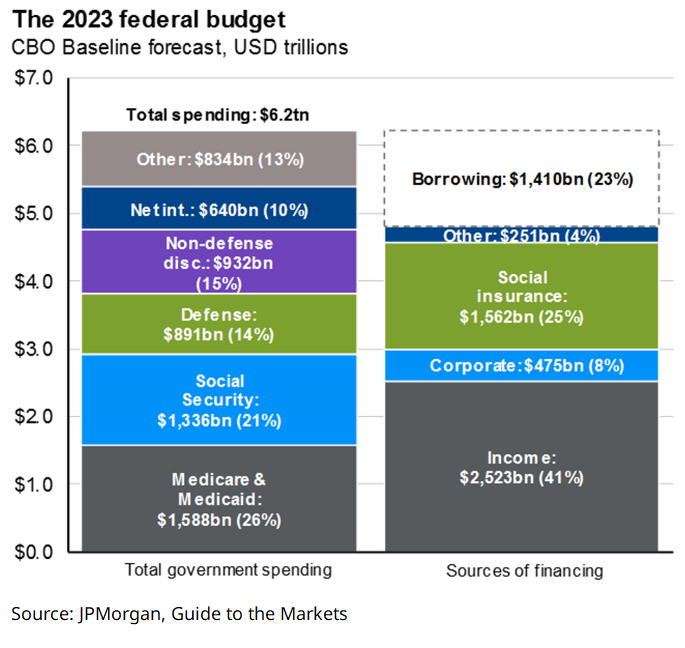
The fiscal impact on the economy will likely be mild based on the level of non-defense discretionary spending freeze/cuts. Non-defense discretionary spending makes up only 15% of the estimated $6.2 trillion federal budget (see below).


Short-term interest rates may move higher because the Treasury will need to issue quite a bit of T-bills to refill their coffers and reverse the “extraordinary measures” that the Treasury had to take to pay bills over the last couple of months.

May 2023 Market Summary


“May was a mixed month for stocks as the NASDAQ surged, the S&P remained about flat, and the Dow Jones Industrial Average took a hit. The NASDAQ advanced 5.9% in May largely thanks to stellar gains in the semiconductor space, notably by NVIDIA (NVDA), Advanced Micro Devices (AMD), and Broadcom (AVGO). The S&P 500 rose 0.4%, while the Dow Jones Industrial Average lost 3.2%. It was a down month around the world–Emerging Markets slipped 1.7%, and Developed Markets sank 4.1%.


Only 3 of the 11 US stock sectors were positive in May as Technology, Communication Services, and Consumer Discretionary led the way. On the flip side, Energy tumbled 10%, followed by Materials (down 6.9%) and Consumer Staples (down 6.2%).


Unemployment increased by 0.3 percentage points to 3.7% in May one month after retreating back to its lowest level since 1969 (3.4%). Inflation remained essentially unchanged MoM, and the Federal Reserve issued its 10th consecutive rate hike at the start of the month, bringing the Fed Funds Rate to 5.25%. Oil was down over 6.5% in May, bringing both WTI and Brent down over 41% from their highs last year.


US Treasury yields spiked sharply in May amid debt ceiling risk. The 1-Month Treasury Bill surged a whopping 93 basis points to 5.28%, followed by the 3-Month at 5.52% (+42 bps) and 6-Month at 5.46% (+40 bps). Long-term bonds, such as the 10-Year, also got a lift, but its yield of 3.64% still puts it as the lowest on the curve.”


May continued a trend reversal that has been playing out all year – growth over value and mega caps over everything else. The largest 50 stocks in the S&P 500 outperformed the over 450 by the widest margin since 2005.


Mega caps outperforming is not a negative sign for the stock market. It’s likely a function of investors chasing mega cap technology and artificial intelligence trends.


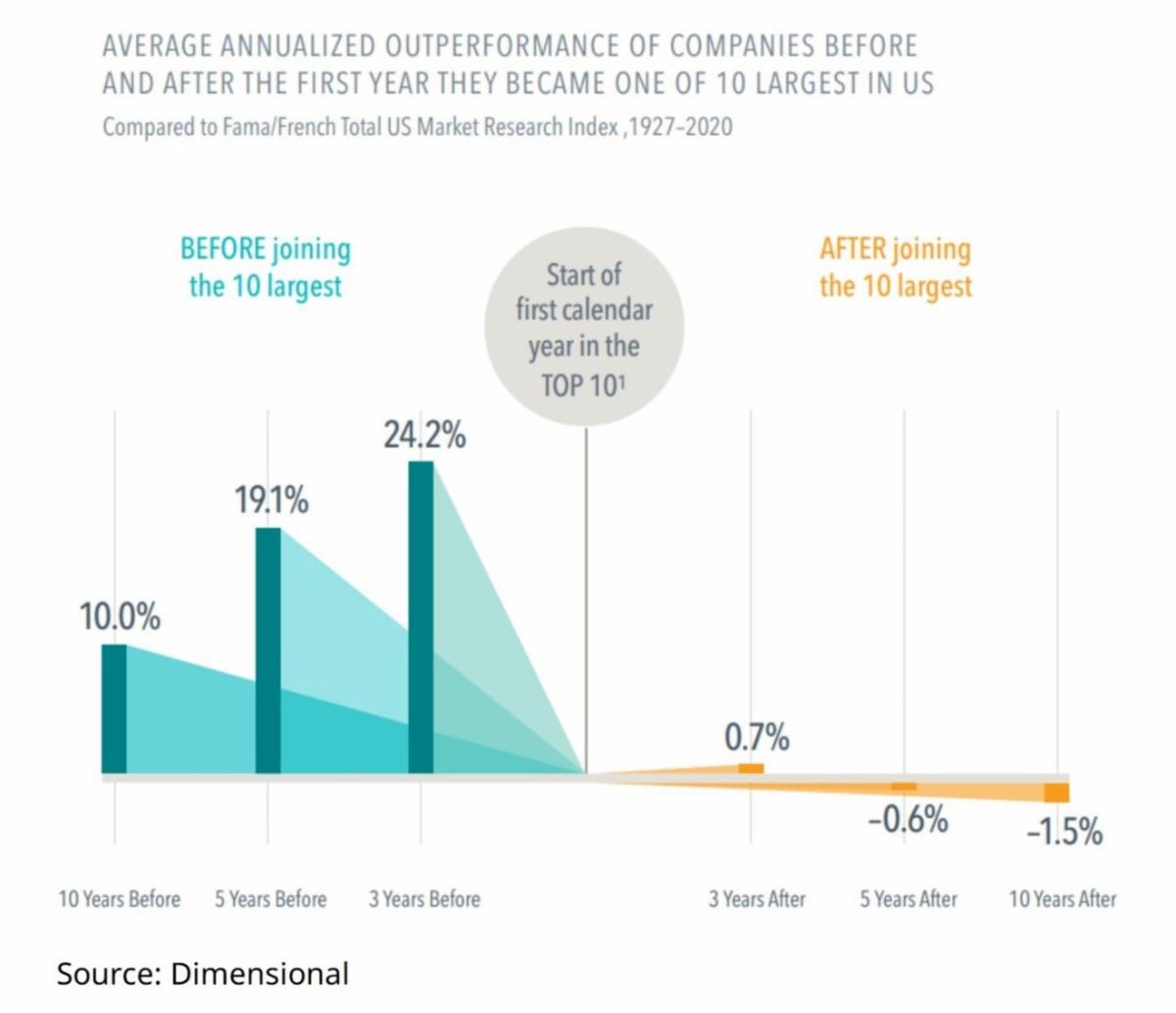
Just beware of chasing individual names like Nvidia, which is up 172% this year to the 4th largest U.S. company at nearly a $1 trillion market cap. Historically, when a company first hits top 10 status, it underperforms the market on average by 1.5% over the next decade.

The FAFSA Gets an Overhaul


“Traditionally, the FAFSA, which millions of families complete each year, is released Oct. 1. The U.S. Department of Education, however, recently announced that the FAFSA for the 2024–2025 school year won’t be available until sometime in December.


The delay is being blamed on the significant overhaul of the FAFSA, which the Department of Education has characterized as the ‘most ambitious and significant redesign of the federal student aid application in decades.’…


Here are some highlights of the new FAFSA, which will generally be favorable for lower-income students and bad news for families with multiple children in college, small businesses and households with divorce.


Change No. 1 The term Expected Family Contribution, which refers to how much the federal aid formula believes a household can pay for college, is being changed to Student Aid Index….


Change No. 2 The FAFSA overhaul will be a financial hardship for families with more than one child in college. Traditionally, parents captured a 50% break on their EFC with two children in college and the discount increased to 66% with three. [Now eliminated]…


Change No. 3 The new FAFSA didn’t do any favors for small-business owners and family farms. In the past, these folks enjoyed the ability to exclude their business and farm assets from the FAFSA as long as they did not employ more than 100 full-time or full-time equivalent workers. That exemption will no longer exist…


Change No. 4 The changes will also represent a hardship for some divorced parents... Traditionally, the custodial parent, who completes the FASFA, has been the one where the student has lived the majority of a 12-month period ending on the day the FAFSA is filed. With the new formula, it’s the parent who has spent the most money on the child who will be the one completing the FAFSA, and that will often be the parent who is better off financially…


Change No. 5 The FAFSA changes represent good news for grandparents and other generous souls who want to help with a child’s college costs. Starting with the 2024–2025 school year, qualified distributions that are made by grandparents, aunts, uncles and others will no longer be taxed as a child’s untaxed income, which traditionally has been assessed at 50%.”


The FAFSA gets a major overhaul (and delay) for the 2024-2025 academic year. A few of the items noted above are likely to have a major impact on how parents and grandparents plan to address college aid and costs.

Read More
 

Graph of the Week

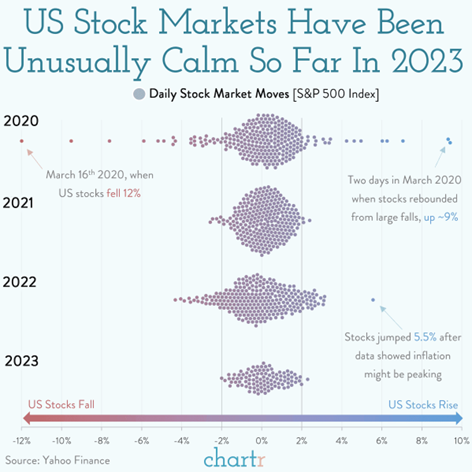
“US stocks have been calm all year, swaying only gently from side-to-side on any given day. The sharpest drop in the flagship S&P 500 Index came on February 21st, when the market fell 2%. Last year, a 2% drop would have only been the 24th worst day, and of course it’s absolutely nothing compared to the ~8%, ~10% and even 12% falls that we saw in 2020, during the early days of the pandemic.”

Tweet of the Week

Thanks for reading. Have a great weekend!


Guidance for today. Growth for tomorrow.


RBGWA - Logo - Full Color.jpg

Tim Ellis, CPA/PFS, CFP®

CIO and Wealth Advisor

RBG Wealth Advisors

O: 901.244.2891 | C: 662.444.1415

E:  tellis@rbgwa.com

A:  5100 Wheelis Dr., Ste. 211, Memphis, TN 38117

W: rbgwa.com

LinkedIn  Twitter  Facebook

RBG Wealth Advisors LLC is a registered investment adviser. Information presented is for educational purposes only and does not intend to make an offer or solicitation for the sale or purchase of any specific securities, investments, or investment strategies. Investments involve risk and, unless otherwise stated, are not guaranteed. Be sure to first consult with a qualified financial adviser and/or tax professional before implementing any strategy discussed herein. Past performance is not indicative of future performance.