RBGWA - Logo - Full Color.png
 

RBG Wealth Weekly

March 3, 2023


Ladies and gentlemen, the weekend! In this space each week, Greg and I share some of our favorite articles, notes, and graphics from the past week along with our commentary. Please feel free to provide feedback and forward along to others if you enjoy. We appreciate you taking the time to read. 


If you are a client, we truly appreciate your business. If you are not a client, please click below to learn more about our firm and contact us.

Visit our Website
 

Articles of the Week

Silicon Valley Bank


“The spectacular blow-up currently taking place at SVB and its primary subsidiary, Silicon Valley Bank, is the biggest story in the markets this week. SVB is systemically important for the technology sector and its Northern California ecosystem. As Jim Cramer put it last night, the Federal Reserve has been firing a machine gun at the economy for the last 12 months but it hasn’t hit anything yet. Until today.


The general story here, without repeating all of the detailed accounts out there, is that this is a bank that grew deposits and assets at a rapid rate between 2015 and 2021 as the technology bull market became a full-blown bubble. They had to stuff all the deposits somewhere and that somewhere was in 10-year Treasurys yielding 1.5% on average. Now that interest rates have gone up almost 500 basis points, those bonds are down in price. At the same time, there have been no IPOs or exits for their clients (founders and VCs) and the cash burn rates at these businesses have necessitated the ongoing withdrawal of funds from their SVB accounts.


Therefore, the bank had money going out faster than it had been coming in and an asset portfolio with big losses. They decided to sell a chunk of their portfolio assets at a loss and do a capital raise to account for the funding gap. This set off a chain reaction that led to a classic run on the bank as many prominent venture capitalists began telling their portfolio companies to move their money away. This sort of thing can feed on itself. SVB went from a $45 billion market cap to sub-$5 billion as of this morning’s open.”


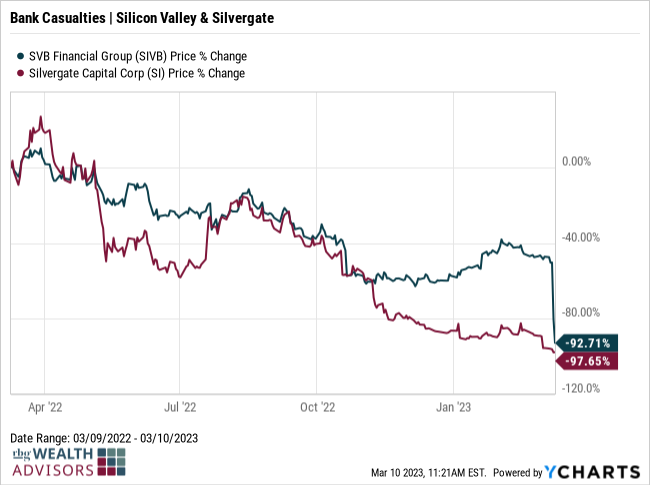
While it’s an outlier due to the specialized nature of business and clients, this week exposed some casualties of the interest rate hiking cycle. SVB took a $1.8 billion loss on a $21 billion Treasury bond portfolio due to rising interest rates and need for capital. For scale, SVB reported net income of $1.6B in 2022.


Carl White from the St. Louis Fed has written about bank portfolios and even unrealized losses having negative effects on liquidity and funding, earnings, and in some cases capital (see above).


Just the day before SVB, Silvergate Bank, who was the primary bank for cryptocurrency companies, announced that it was winding down operations. The FTX scandal and crypto “winter” are a different beast but born out of the same environment.

Powell changed the market’s view of interest rates


“Federal Reserve Chairman Jerome Powell’s prepared speech this week to Congress took just a few minutes, but it changed everything…


Heading into the appearances, markets had been looking for the Fed to raise its benchmark interest rate by 0.25 percentage point at its meeting later this month, then perhaps two more moves before stopping, with the end point around 5.25%.


That changed after Powell’s appearance, during which he cautioned that if inflation data remains strong, he expects rates to go ‘higher than previously anticipated’ and possibly at a faster pace than a quarter point at a time.


Markets now strongly expect a half-point increase in March and the peak, or terminal rate, to hit close to 5.75% before the Fed is finished.


So what changed?


Basically, it was the January inflation data plus signs that the labor market remains remarkably strong despite the Fed’s efforts to slow it down. That made Powell, who only weeks earlier had talked about ‘disinflationary’ forces at play, switch gears and start talking tough again on monetary policy.”


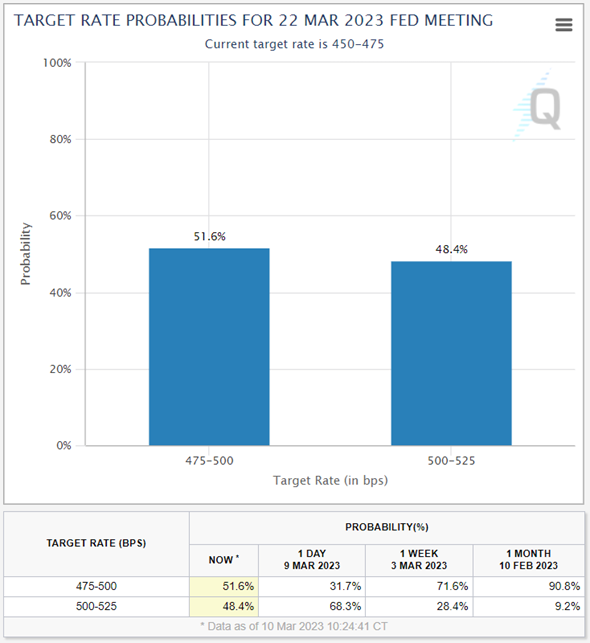
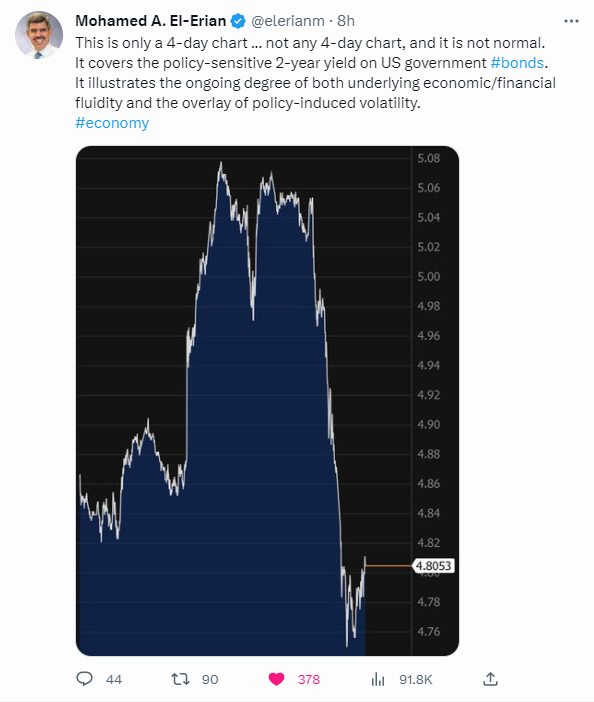
It’s been a crazy week trying to project how much the Fed will raise interest rates at their next meeting on March 22nd. One month ago today, there was a 90.8% probability of a 0.25% rate hike per fed futures markets. After Fed Chair Jerome Powell’s hawkish testimony to Congress on Tuesday and Wednesday, it flipped to a 68.3% probability of a 0.50% rate hike. Today, after the stress in the banking sector, it’s back to almost a coin flip. We still have a couple of data points left in these 12 days after the February jobs report including Consumer Price Index data. 

Market Timing & Interest Rates


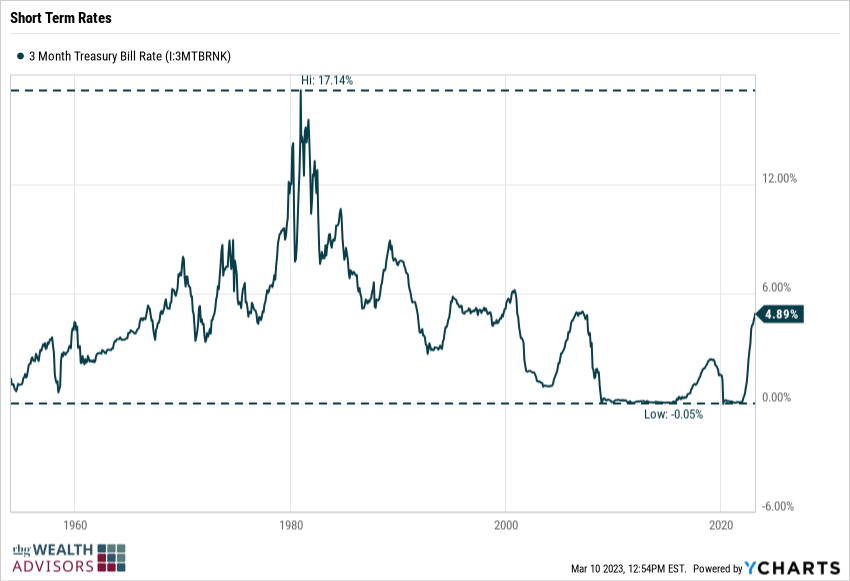
“We’re looking at 5% yields across the board for short-term government bonds.


Some people will still scoff at these yields by reminding you that inflation is still 6% but let’s be honest — right or wrong, most investors think in nominal terms, not real.


Short-term yields have been on the floor for so long that 5% interest rates are bound to grab the attention of investors…


But there is an important distinction between an asset allocation decision based on risk vs. reward trade-offs and market timing.


The biggest problem with making a huge shift in your portfolio from stocks to cash is that short-term interest rates are fickle…

In the short-run cash can offer stability. At the moment it also offers pretty, pretty good nominal yields. Over the long-run you’ll barely keep up with inflation.


In the short-run stocks can rip your heart out. I don’t know if the bear market is over or if we are in for more carnage. But over the long-run the stock market remains the best bet for beating inflation and compounding your wealth.


Market timing requires you to be right twice.


Getting out is easy. Getting back is not."


This was a good straightforward article from Ben Carlson on taking advantage of higher short-term bond yields with existing cash, but not trying to time markets or make wholesale changes in asset allocations. Higher nominal yields are often a result of higher inflation (see currently), and the real returns (net of inflation) often reflect flat to mildly negative returns. Meanwhile, equities, commodities, real assets, and certain bond classes can produce positive real returns during these same periods.

Read More
 

Graph of the Week

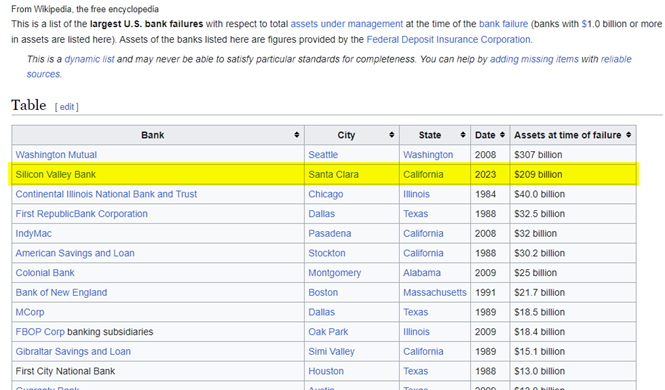
On Friday, California regulators closed Silicon Valley Bank and named the FDIC as receiver, marking the 2nd largest U.S. bank failure by assets at the time of closure. The bank had $209 billion in assets and $175.4 billion in deposits as the time of failure, per the FDIC.

Tweet of the Week

Thanks for reading. Have a great weekend!


Guidance for today. Growth for tomorrow.


RBGWA - Logo - Full Color.jpg

Tim Ellis, CPA/PFS, CFP®

CIO and Wealth Advisor

RBG Wealth Advisors

M: 901.682.2431 | C: 662.444.1415

E:  tellis@rbgwa.com

A:  5100 Wheelis Dr., Ste. 300, Memphis, TN 38117

W: rbgwa.com

LinkedIn  Twitter  Facebook

RBG Wealth Advisors LLC is a registered investment adviser. Information presented is for educational purposes only and does not intend to make an offer or solicitation for the sale or purchase of any specific securities, investments, or investment strategies. Investments involve risk and, unless otherwise stated, are not guaranteed. Be sure to first consult with a qualified financial adviser and/or tax professional before implementing any strategy discussed herein. Past performance is not indicative of future performance.