|
RBG Wealth Weekly
March 17, 2023
| | |
|
Ladies and gentlemen, the weekend! In this space each week, Greg and I share some of our favorite articles, notes, and graphics from the past week along with our commentary. Please feel free to provide feedback and forward along to others if you enjoy. We appreciate you taking the time to read.
If you are a client, we truly appreciate your business. If you are not a client, please click below to learn more about our firm and contact us.
| | |
|
“The liability issue: extreme reliance on institutional / [venture capital] funding rather than traditional retail deposits
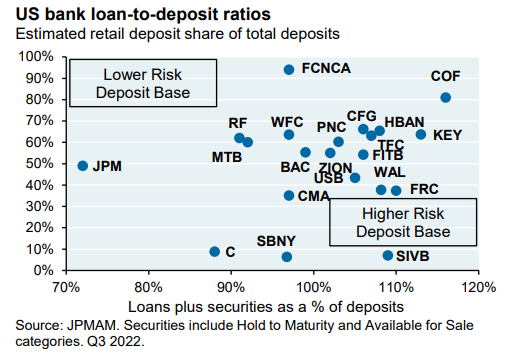
While capital, wholesale funding and loan to deposit ratios improved for many US banks since 2008, there are exceptions. As shown in the first chart, SIVB was in a league of its own: a high level of loans plus securities as a percentage of deposits, and very low reliance on stickier retail deposits as a share of total deposits. Bottom line: SIVB carved out a distinct and riskier niche than other banks, setting itself up for large potential capital shortfalls in case of rising interest rates, deposit outflows and forced asset sales.
| | |
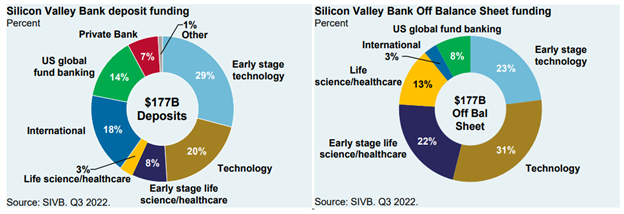
A further look at SIVB funding (pie charts) shows unusually high reliance on corporate / [venture capital] funding; only the small red private bank slice looks like traditional retail deposits to us. Out of SIVB’s $173 billion of customer deposits at the end of 2022, $152 billion were reportedly uninsured (i.e., over the $250,000 FDIC insurance threshold) and only $4.8 billion were fully insured. It’s fair to ask about the underwriting discipline of VC firms that put most of their liquidity in a single bank with this kind of risk profile. At the end of 2022, SIVB only offered 0.60% more on deposits than its peers as compensation for the risks illustrated below; in 2021 this premium was 0.04%.” | | |
|
We included an article last week and remarked on Silicon Valley Bank being an outlier in the banking world. Here are some stats and charts that put it into context. Their unusual reliance on an industry (venture capital tech startups) that is volatile and under stress due to higher interest rates was a problem. That client base is also tight-knit and very online (see article below). It made for a house of cards that fell very quickly.
U.S. Treasury/Federal Reserve/FDIC officials stepped in last weekend to fully guarantee depositors (almost 88% of SIVB total deposits were above the FDIC guarantee threshold). Obviously, SIVB stockholders and bondholders are left out in the cold. For that reason, in my opinion, it’s misguided to call it a bailout. It’s a backstop for depositors to preserve faith in the banking system and ensure that deposits don’t funnel to the largest 3 – 4 U.S. banks. More may be needed as First Republic Bank (note FRC is closest to SIVB on the first chart) was under constant pressure this week before receiving $30 billion in deposit commitments from 11 other banks.
| | |
|
“Silicon Valley Bank failed in spectacular fashion on Friday after investors and depositors tried to pull a staggering $42 billion in one day on Thursday…
But how did the bank run become so big so fast in the first place? According to one theory, it can be traced back to one email newsletter and an accompanying tweet, and the Twitter reaction that followed…
He elaborated on Saturday, writing that the 'entire debacle was potentially caused' by Byrne Hobart’s newsletter, and he outlined the steps behind his thinking. Hobart writes The Diff newsletter, which Armstrong stated “pretty much every VC I know reads.'
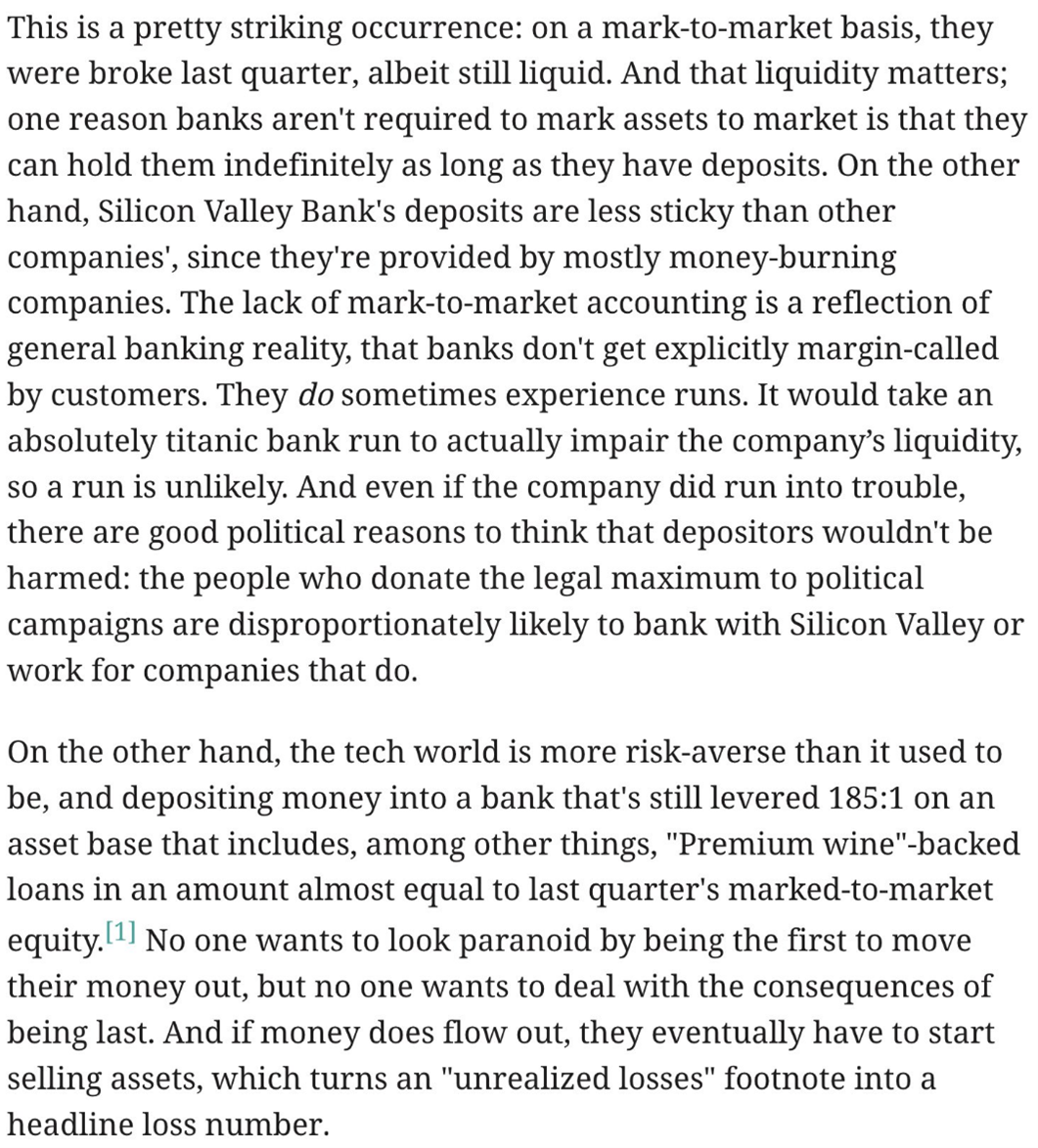
Hobart’s tweet on Feb. 23 read: 'Also in today's newsletter: Silicon Valley Bank was, based on the market value of their assets, technically insolvent last quarter and is now levered 185:1.' He included in the tweet a few paragraphs from the newsletter…
| | |
|
1) Byrne posts this article/Tweet calling out SVB's risk.
2) Pretty much every VC I know reads this newsletter
3) They all start to pay very, very close attention to SVB earnings
4) Absolutely massive earnings miss by SVB
5) Peter Thiel, USV, and Coatue are first to send out messages/mass emails to portfolio co's to pull out funds
6) Tech Twitter catches word of this
7) Bank Run
8) Collapse”
Twitter and private Slack channels essentially acted as an accelerant to fuel the run on the bank. Wild stories of companies scrambling to wire cash to outside business accounts and even executives’ accounts culminated in $42 billion of deposit outflows on Thursday, March 9th, just one day after their SEC 8-K filing that reported the liquidation of their Treasury portfolio and attempted capital raise.
| | |
|
“In addition to its dual mandate to keep inflation in check and to promote full employment, the Fed has a third unwritten mandate: to maintain financial stability. In times of stress, financial stability concerns often trump the other two mandates. Consequently, we believe the Fed may pause its rate-hiking cycle, or make smaller rate increases, until the outlook is clear.
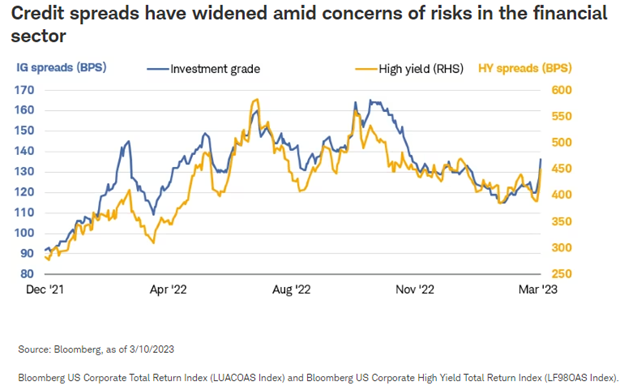
Financial conditions had already begun to tighten in recent months and the recent volatility will only make that worse. Banks already have been tightening lending standards and raising interest rates on loans, making credit for businesses and households less available and more costly. As you can see in the chart below, both investment-grade and high-yield corporate bonds' yield difference, or "spread," versus a comparable Treasury security has widened sharply as investors demand a higher premium to compensate for perceived higher risks in the credit market.
| | |
|
Moreover, there are signs that inflation pressures are easing and wage pressures are slowing. These indicators suggest that the effects of Fed rate hikes of the past year are beginning to work by causing growth and inflation to slow.
The fixed income markets have shifted dramatically. After discounting the potential for a federal funds target rate rising to as high as 5.5% or more in the next few months, expectations are now for a peak rate of 4.75% to 5%, suggesting just one more rate hike of 25 basis points and then rate cuts in the second half of the year. Long-term Treasury bond yields have also fallen sharply.”
A market positive to come out of the banking turmoil - it's likely to stop the Federal Reserve's rate hiking / tightening cycle and may even result in upcoming cuts.
| | |
|
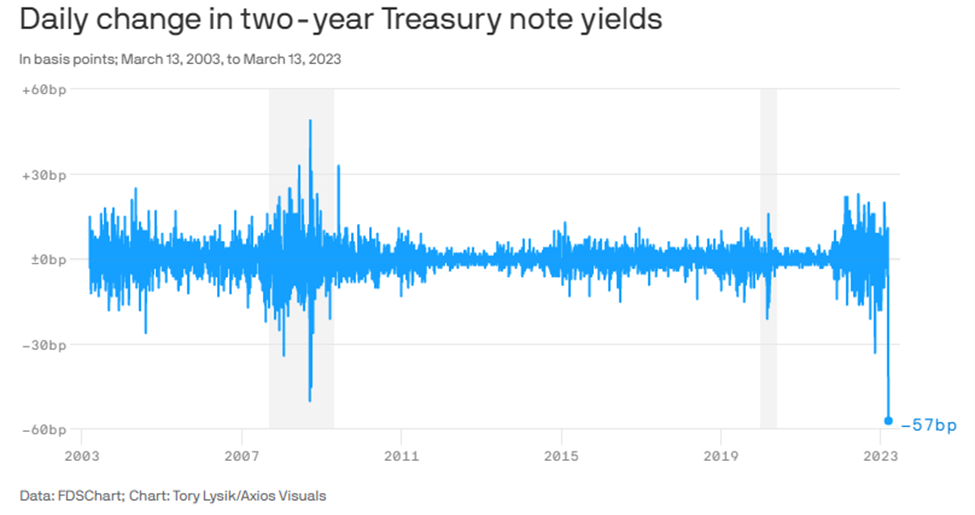
“The yield on the two-year U.S. Treasury note plunged by more than half a percentage point (bond yields go down as prices go up).
- That may not sound like much — but in the world of government bonds, moves of this magnitude are incredibly rare.
- The last time we saw a one-day move this large was on Sept. 17, 2001, when markets first reopened — and then tumbled — after the Sept. 11 terrorist attacks.
- Besides that, the only day that comes close is Oct. 21, 1987, in the aftermath of the stock market crash.”
| | |
Thanks for reading. Have a great weekend! | | | |
Guidance for today. Growth for tomorrow. |
|
|
Tim Ellis, CPA/PFS, CFP®
CIO and Wealth Advisor
RBG Wealth Advisors
| | |
RBG Wealth Advisors LLC is a registered investment adviser. Information presented is for educational purposes only and does not intend to make an offer or solicitation for the sale or purchase of any specific securities, investments, or investment strategies. Investments involve risk and, unless otherwise stated, are not guaranteed. Be sure to first consult with a qualified financial adviser and/or tax professional before implementing any strategy discussed herein. Past performance is not indicative of future performance. | | | | | |