|
“The patent that’s given Vanguard Group an edge over competitors for the past 20 years — and helped its clients pull in more than $100 billion worth of additional investment gains — expired today.
Rival fund managers are now free to replicate a unique but controversial fund structure created by the Jack Bogle-founded firm in 2001 that allows mutual funds to act like exchange-traded funds by generating returns for investors while minimizing taxes…
‘The SEC is the clear lynchpin here,’ said Nate Geraci, president of The ETF Store, an advisory firm. ‘If they green-light this structure, I expect a number of traditional mutual fund companies to seriously explore using it.’
The regulator needs to grant companies exemptive relief from current rules that would let them use the fund structure that effectively gives a mutual fund access to the famous tax efficiency of ETFs.
‘If the SEC doesn’t allow this structure for additional asset management firms, there will be real questions raised as to whether the SEC is perpetuating an unlevel playing field by only allowing the already dominant Vanguard sole use of this expired patent,’ said Geraci.”
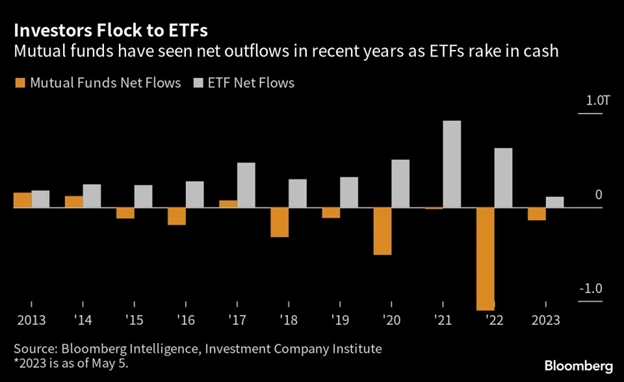
A Vanguard (formerly) patented process allowed them to launch exchange-traded funds (ETFs) as a share class of their popular mutual funds, rather than a standalone ETF. That structure was beneficial in a couple of ways.
First, it allowed them to offer ETFs, which have some inherent benefits compared to mutual funds.
Second, the ETFs (as a share class) allowed the mutual funds to be more tax efficient. The ETF share class can trade stocks and bonds capital gains through an in-kind redemption process. That benefit extended to the stocks and bonds held by mutual fund share classes. This hybrid nature provided a tax efficiency advantage. When comparing the Vanguard mutual funds to their competitors, they had less capital gains distributions.
The patent expiration means that mutual fund competitors may likely use the same process if the SEC approves.
|