October 28, 2026 • י״ז מרחשון תשפ״ז

Dear Chaverim,


First, with hakaras hatov to Yaakov Eisenberger of Toronto and his company, Fieldgate, our Halacha Hotline is up and running both by email and WhatsApp. This has allowed many more chaverim to access the Roshei Yeshiva at YU. If you haven't utilized it yet, I encourage you to do so!


Next, over the past two years, one of my top priorities has been to grow our rabbinic family. The RCA is strongest when it brings together the full range of rabbis serving our community: pulpit rabbis, educators, chaplains, and rabbis working in outreach and communal life. Baruch Hashem, the results have been remarkable. In that time, 54 new chaverim have joined the RCA.


Now I’d like to ask for your help, as you are our best ambassadors. If you know a rabbi you think belongs in the RCA, such as a colleague, a former talmid, or a new rabbi in your community, please let me know first so I can check eligibility. Next, I’ll ask you to reach out. A personal recommendation from a chaver is the best recruitment tool. Together we can keep building a strong, connected, and supportive rabbinic community.

With warm wishes for a wonderful Shabbos

R. Menachem Penner

Chomer Lidrush

A spark to start your drasha heading into Parshas Vayeira

1) Ten Is a Whole World


A guest contribution from our chaver R. Avi Kilimnick


1) Ten Is a Whole World


A guest contribution from our chaver R. Avi Kilimnick


When Avraham pleads for Sedom, he begins at fifty tzaddikim and works his way down to ten, and at every step Hashem agrees. R' Ari Kilimnick asks a simple question: no count ever takes place, and Sedom is destroyed anyway, so what did the tefillah accomplish? He answers that it was never only about Sedom. Avraham showed that tefillah makes the one who davens, and the world around him, better, whatever the outcome. He also lowered the bar for how much righteousness it takes to protect a place, so that ten became the permanent measure of kedusha. By counting down from fifty rather than up from one, he taught that ten is not a bare minimum but a group carrying the weight of fifty and an entire city. We stand in shul waiting for the olam to begin; Avraham reminds us that when the tenth man walks in, a whole olam has arrived. Read R' Kilimnick's full piece here..

2) The Voice That Sounds Like Mind


On the road to the Akeidah, the Midrash Tanchuma (Vayera 22) tells us that the Satan did not come at Avraham as an obvious adversary. He appeared as an old man, a zakein, and argued that a man his age would not destroy a son given to him at a hundred. When Avraham refused to listen, the Satan went to Yitzchak as a young man, a bochur, and told him that the old man had lost his mind and was going to slaughter him. Each one was approached by someone who looked and sounded just like himself.


Click Here to Read More

3) An Angel is Enough to Save


In Mesoras Menachem, a volume in honor of our chaver, R. Menachem Genack, Rav Chaim Leib Ilson relates in the name of the Rav that when the Beis HaLevi taught the Akeidah to his son Rav Chaim, then three or four years old, the child asked why "kach na es bincha" came from Hashem Himself while "al tishlach yadcha el hana'ar" came through a malach. The Rav paired it with a second story.


Read the article here


Click Here to Read More

4) The Prophet in the Room


Sometimes the haftarah's story, simply told, is the derasha, and Vayeira's is a fine example. The hospitality of the Isha HaShunamis, Elisha's unexpected promise of a son, the child's sudden death, and his mother's determined ride to the prophet need little embellishment. Tell the story, let its drama unfold, and then stop at one puzzling detail: Elisha sends Gechazi ahead with his staff to revive the boy, and nothing happens. Why does it fail, and what changes when Elisha comes himself?


Click Here to Read More

Manning the Media


"To make AI morally good, tech companies are turning to religion. But some say it isn't that simple," Krysta Fauria, Associated Press (May 2026)


The AP reports on the first "Faith-AI Covenant" roundtable in New York, where AI companies including Anthropic and OpenAI met with leaders of many faiths, among them Rabbi Diana Gerson of the New York Board of Rabbis, in hopes of arriving at shared moral principles for the technology. Supporters argue that regulation cannot keep up and that religious leaders bring long experience guiding people's moral lives, while skeptics see some public relations in it and ask whether some of this technology should be built at all. Avraham's cry over Sedom, "hashofeit kol ha'aretz lo ya'aseh mishpat," insists that even ultimate power answers to justice, and the two commands of the Akeidah (entry 3) ask how much authority we should grant a voice that claims to speak for Heaven. The harder question for our own people is not whether machines can be taught morality, but whether those of us asked to teach it are clear enough about our own.


RCA Nachas


Our chaver Shlomo Appel helped posthumously publish his father’s book, The Concise Code of Jewish Law: A Guide to Daily Prayer and Religious Observance, by Rabbi Dr. Gersion Appel, z"l. The book was edited by our chaver Daniel Goldstein. Recently published by OU Press in conjunction with RIETS Press and Maggid Books, it is available from OUPress.org.


Do you have some nachas to share about yourself or another RCA member? Let us know!

A-Guide-To-Daily-Prayer-Cover-416x631 image


Partnered Content


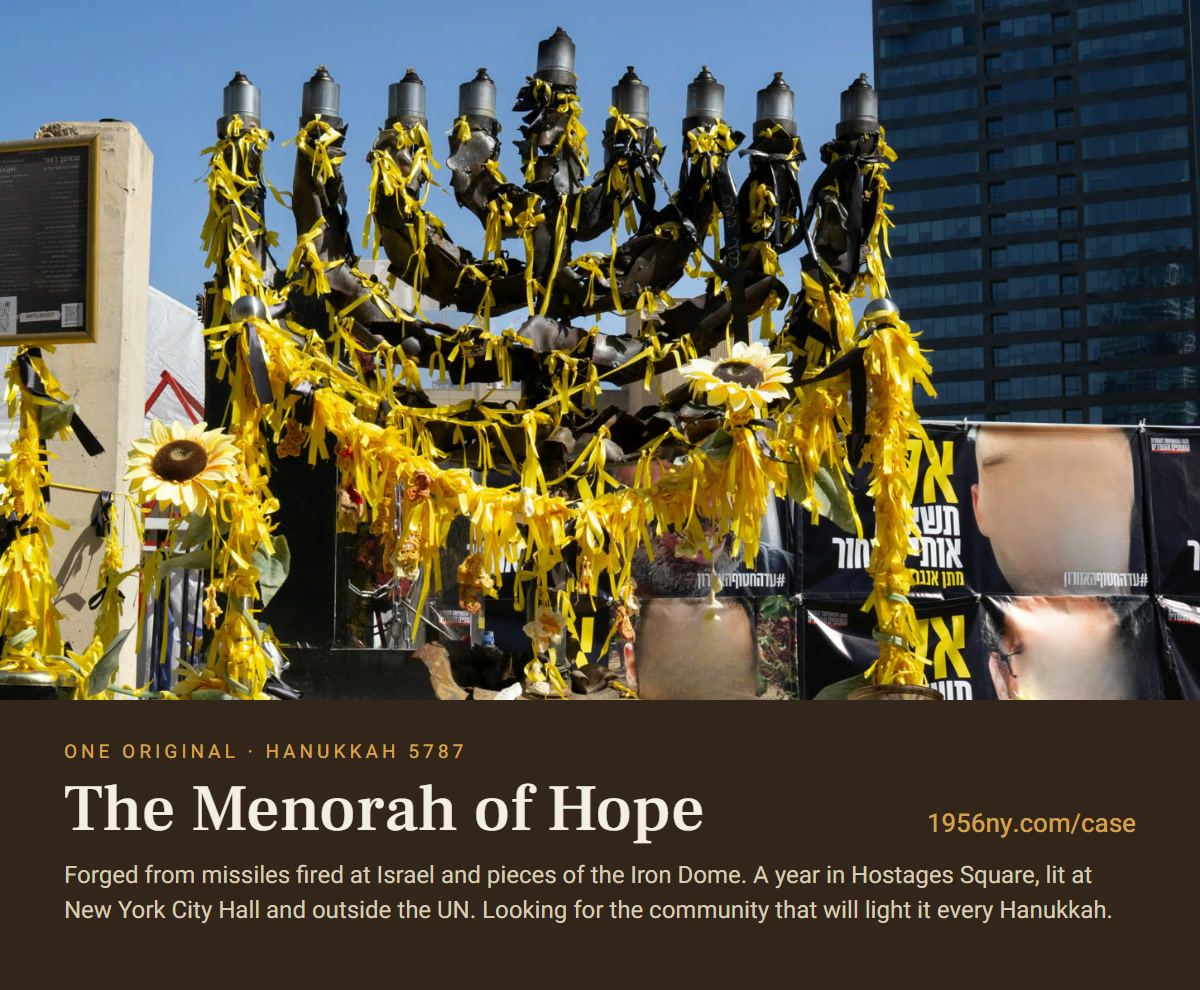
The Menorah of Hope is looking for its home this Hanukkah


Israeli artist and Air Force reservist Eli Gross forged the Menorah of Hope from fragments of missiles fired at Israel from Iran, Gaza and Lebanon, and pieces of the Iron Dome that stopped them. None of those missiles took a life.


For a year it stood in Hostages Square in Tel Aviv, where thousands tied yellow ribbons to its branches. Last Hanukkah, it was lit at New York City Hall and outside the United Nations.


Now the single original is offered for acquisition to one community, to be lit every Hanukkah, for generations. It stays with that community permanently. A family can dedicate it, in their name or in memory of someone dear, or a circle of families can share it as a Minyan of Hope, with every name on the plaque.


To have it in place for the first night of Hanukkah, communities decide by mid-November.


Watch the 94-second film and see the full case: 1956ny.com/case


Eli Gross · grossjewishart@gmail.com


L'maan Tzion: Advocacy for Israel

Mourning two Chayalim who were murdered last Friday.


The IDF identified the two soldiers killed as Staff Sgt. Ron Yonatan Roytman (23, from Ashkelon) and Sgt. Yuval Shai Svilem (20, from Hod Hasharon), both serving in the Ari Battalion (775) of the Search and Rescue Brigade. Hashem Yikom Damam. 

e100b45a98f523182bad2a57ef4c796d image

RCA Halacha Line

Sponsored by Jack Eisenberg of Toronto, and his company, Fieldgate


Rabbis can submit questions via a dedicated email at halachaline@rabbis.org or through WhatsApp at (347) 659-4595. For more information see here.

OU Daf HaKashrus

Included in this issue:


  • The Ingredient Panel: Propylene Glycol
  • Lo Basi: Factory Cooking