June 24, 2026 • ט׳ תמוז תשפ״ו


From the Desk of the Executive Vice President


IN THIS WEEK'S EMAIL

RCA Updates

In Our RCA Family

Chomer Lidrush

Manning the Media

RCA Updates

Please consider joining me in signing this urgent letter to Mayor Mamdani, which is being organized by the Jewish Majority.

1) Tradition Subscriptions - Gift Opportunity


Expand Tradition’s readership while offering a wonderful gift to a collegiate or recent graduate! Every RCA member is invited to give a one-year subscription to a young person in their community. It is our hope that they will enjoy the journal and subscribe after their free issues conclude. Please use this link to access this gift.    


2) Final Details: July Mission to Israel, July 14-16


Thanks to all who have registered already for the RCA Mission to Israel from July 14-16. We still have a few spots left. For more information or to register contact Jay Weinstein.


3) The RCA's Rabbi Steven M. Dworken, z"l Continuting Education Program and the Torat haAretz Program


On Monday, we were fortunate to hear from Rav Baruch Wieder, Rosh Yeshiva of Yeshivat HaKotel as part of the RCA's Torat HaAretz Program. The recording of this inspiring shiur is available here.


4)America at 250


I) RCA America at 250 Chomer Resource Page


Click Here for Special Chomer Lidrush for America's 250th Anniversary. We are also seeking to grow this resource list through RCA chaver contributions to this project! Please email any Chomer Lidrush and/or Shiur Mekorot you wish to share to Rabbi Benjamin J. Samuels at ravbensam@shaarei.org


II) Join 250 for 250, for a year-long educational journey celebrating America's 250th anniversary. Click Here to sign up. Contact Rabbi Andrew Shaw for more information.


In Our RCA Family


  • Mazel Tov to our chaver David and Julie Fine on the birth of a grandson, born to their children Second Lieutenant Amiel and Atara Fine
  • Mazel Tov to our chaver Gershon and Fran Sonnenschein on the birth of a granddaughter , born to their children Yonatan and Estee Sonnenschein

Chomer Lidrush

Some ideas to turn your gears heading into the parsha.

1) Given the Tools to Succeed


Why would Hashem hand Moshe a staff He never meant him to use? קח את המטה", take the staff,” and then speak to the rock. Our chaver Ari Zahtz sharpens this question with a parent's dilemma: you send your son up to study for his bechinah and tell him to take his Nintendo Switch along, then act shocked when you find him playing. Why dangle the temptation in the first place?


The answer may hinge on the definite article. Hashem did not say take a staff, but קח את המטה, the staff, and the Chizkuni identifies it as Aharon's, the very one that had blossomed with almonds a parshah earlier. That staff was never bait. It was a reminder. Aharon's mateh was the symbol of achdus, the shevet that closed the machlokes of Korach and marked Klal Yisrael as one. R. Zahtz suggests Hashem was telling Moshe that, facing the endless complaints of these people, his task was to hold the staff that keeps them whole, not to lash out at the מורים. As we enter Tammuz and the Three Weeks, that blossoming staff is handed to us, too.


2) We Abandoned Moshe When He Needed Us Most


The reason for Moshe's death in the midbar remains a question, despite all the theories our meforshim offer. Rav Soloveitchik zt”l notes that it must, categorically, remain a mystery. Death itself, and Moshe's death above all, belongs to “זאת חקת התורה”, a decree the mind cannot grasp. I.e., we are not meant to understand it.


But one truth, the Rav insists, stands clear: Moshe suffered בעבורם, because of the people. Not, he is careful to say, because they caused his error at the rock. That fault was Moshe's own. They are to blame for something else: When the gezeirah was sealed, Moshe pleaded for it to be torn up, and the Rav says that had the people loved him as he loved them, had they joined their tefillos to his, HaKadosh Baruch Hu would have been forced to relent. But, he explains, they did not join.


R' Soloveitchik hears the whole tragedy in one word. Moshe says ואתחנן, I prayed, in the singular, not ונתחנן, we prayed. I prayed alone; no one stood with me. ויתעבר ה' בי למענכם, Hashem grew angry with me because of you. The leader who had given his life for them was left, at the very end, to daven by himself.


3) Down but Not Out


The Gemara in Berachos asks why Bilam's nevuah was omitted from kerias Shema. After all, Bilam invokes Yetzias Mitzrayim twice, while the section we do recite mentions it only once. R. Moshe Taragin uses the question to open the real drama of Bilam's curse.


Bilam, says R. Taragin, conceded that we had once been chosen. He knew of Har Sinai and the wonders of the midbar. His wager was that after the Eigel and the meraglim, we lost our chosen status. Now, he figured, Hashem had moved on to a younger nation and left the original covenant void, exposing Klal Yisrael to history like any other people. To his dismay, he was forced to admit לא הביט און ביעקב, הן עם לבדד ישכון. The covenant held! We were still Hashem’s choice.


This, R. Taragin notes, is precisely the claim other religions would inherit and weaponize: once chosen, now forsaken. Through centuries of churban and exile, it seemed to hold, and after the Holocaust, it seemed truer than ever. Then, 1948 wiped the smirk from Bilam's face.


4) For a Parshah Shiur: How Does G-d Punish Through the Snakes?


Nechama Leibowitz hangs the question on a single word: the Torah writes וישלח ה' בעם את הנחשים in the sense of releasing something, not sending it on a mission, and from that she argues Hashem never dispatched the נחשים השרפים as agents sent to strike. The snakes were always there, native to that midbar of נחש שרף ועקרב, and it was simply their nature to bite. All along, Hashem had restrained them as one quiet layer of His protection. When the people sinned, He withdrew that layer and let the snakes be snakes. Punishment, on this reading, was not an agent sent but a shield lifted, and the shiur builds itself toward the Amidah's daily thanks for all the harm we never feel. See this beautiful piece cataloged by our chaver Benjamin Yasgur.

Manning the Media


Here’s something you should read: Notes from Grief Camp (The Walrus)

This parshah buries Aharon and seals Moshe's own death in the Midbar, and the people who complained at the rock never grasped what it would mean to lose him. Mitchell Consky, writing in The Walrus, spent a weekend as a counselor at Camp Erin, a bereavement camp where every child has lost a parent or sibling, and where he had buried his own father. What he found cuts against everything we assume about mourning: children grieve in a puddle, jumping in and out, devastated one moment and shrieking with joy on a canoe the next, while adults drown in the ocean of it. One boy, at a camp for grieving children, called it the best day of his life.

As we head into the Three Weeks, with our own children heading off to camp, the piece is a study in how sorrow and simchah are not rivals, and how togetherness makes a loss lighter to carry. Worth the read before Tammuz sets in. (PDF)

• • •


Read something that made you think? We’d love to read it, too – and then feature it! Drop us a line. 


Did our chomer help you over Shabbos? Want to see more or less of an idea? Let us know!

TRADITIONONLINE

Drop the Adjective 

by Hillel Goldberg, Click Here


Commitment in a Fragmented Community 

by Malka Z. Simkovich, Click Here


REVIEW: Expressivist Religious Zionism

by Yoel Finkelman, Click Here

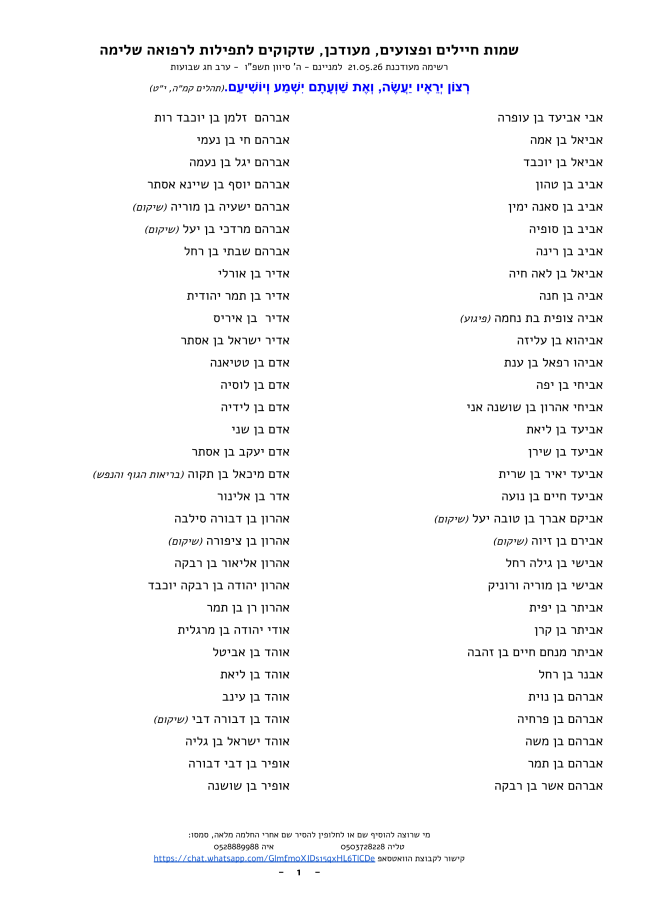
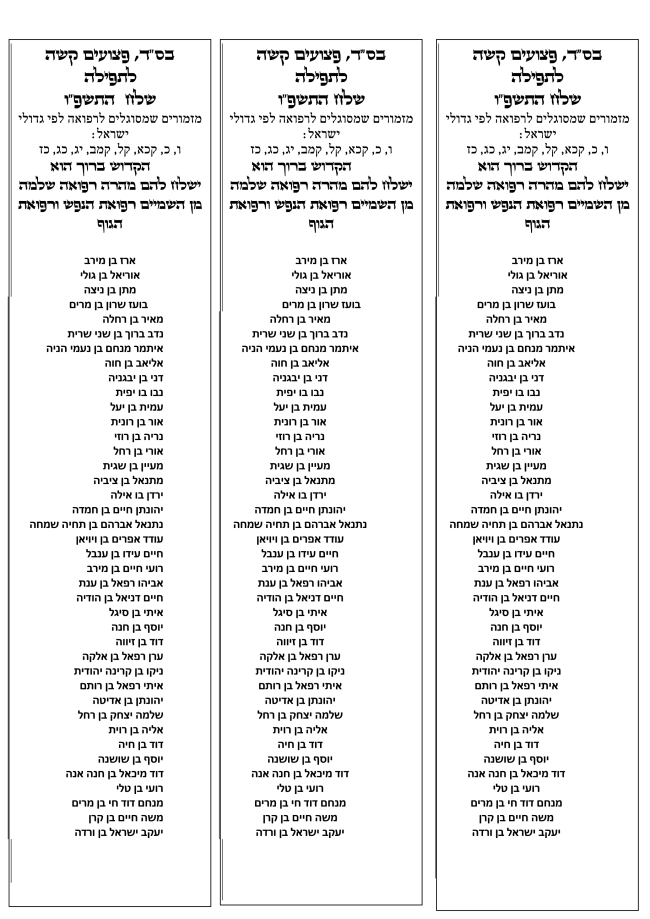
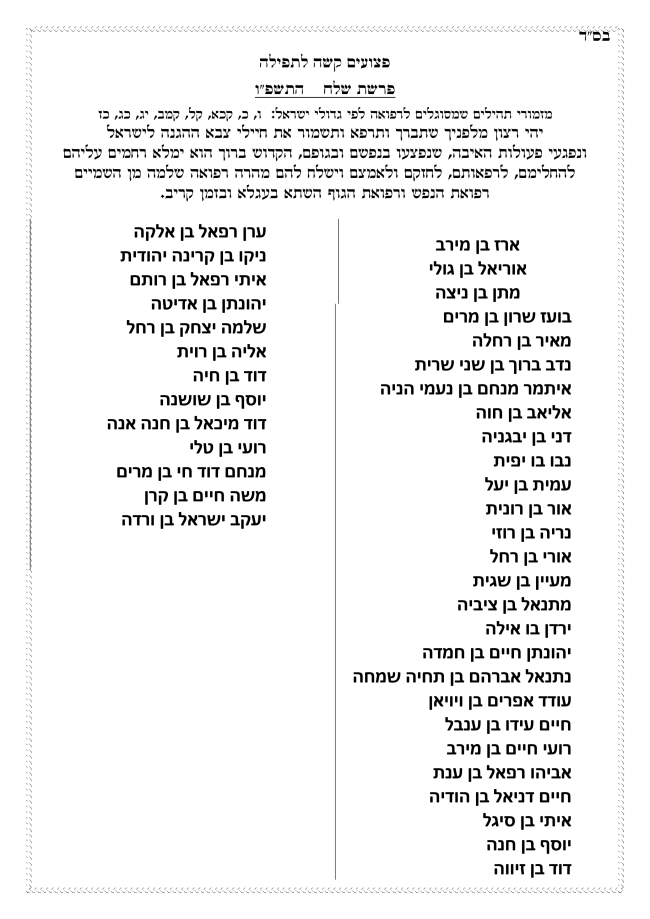
SERIOUSLY INJURED SOLDIERS AND CIVILIANS

With thanks to Rav Dovid Fine


••••••••••••••••••••••••••••••••••••••••

  • Who We Are
  • Click here to order the RCA Madrikh
  • RCA - Assistance in Contract Negotiations, Apply Here
  • Exclusive 20% Kodesh Press Discount Code for RCA Members (certain exclusions apply): RCA20
  • Exclusive 15% Koren Publishers Discount Code for RCA Members (certain exclusions apply): RabbiRCA
  • The RCA Siddur Avodat Halev is available from Koren Publications at a discount by contacting shlomop@korenpub.com
  • Interest free loans of up to $5000 are available to RCA chaverim through the Rabbi Myron and Sarah Rakowitz Fund. Please contact Menachem Penner for more information.
  • Burial plots are available in the RCA section of Eretz haChaim Cemetery in Bet Shemesh. Contact Dovy Grunbaum, 1-866-437-2210, for details.
  • RCA Guidelines and Protocols on Child Safety and Sexual Abuse in a Congregational Setting
  • To sign up for the RCA Health Insurance Plan contact Jay Wildstein at the Grober-Imbey Insurance Agency, 516-872-9500 x3027
  • RCA Retirement Plan Resources Click Here.
  • For information about the RCA Retirement Plan contact Dov Levine by e-mail or at the Retirement Plan Help Desk at 845-533-2633.