|
Rethinking How We Measure Community College Success
As the year winds down, a national conversation has been gaining steam around how we define quality and student success in higher education. The Carnegie Classification group recently introduced a new “Student Access and Earnings Classification,” designed to measure institutional value through two lenses: the enrollment of low-income students and graduates’ median earnings. While the intentions are good, many community-college leaders across the country are raising red flags about what’s missing from this equation.
Several examples in recent reporting illustrate why earnings alone tell an incomplete story. In Inside Higher Ed’s coverage, leaders from institutions in rural and economically distressed regions pointed out that their graduates often step directly into critical but modest-paying roles, teachers’ aides, nursing assistants, agricultural technicians, early-childhood professionals, and first responders, jobs that may not spike median earnings but are fundamental to the health of their communities. Likewise, colleges serving tribal nations and remote counties argued that the classification doesn’t account for regional wage structures or the impact of local employers. A paramedic in rural Kansas will not earn the same as one in San Francisco, but both are indispensable. These examples underscore the risk of labeling vital institutions as “low value” simply because they serve places where wages reflect local economies.
For rural community colleges, and really, for most two-year institutions, value has always been about more than income. It’s about workforce mobility, regional economic development, access for first-generation learners, wrap-around support, and the civic and cultural vitality that colleges anchor in their communities. Rural colleges, in particular, take on roles far greater than traditional higher-ed metrics acknowledge: they are training hubs, community conveners, small-business engines, and often the single most accessible pathway to opportunity for miles.
As policymakers and the public respond to these new classifications, it’s important that we keep the narrative grounded in what actually matters. Community colleges should absolutely strive for strong outcomes, but those outcomes must be measured through a lens that understands place, mission, and the lived realities of the students we serve. At RCCA, we’ll continue to engage in this conversation and advocate for metrics that reflect the whole value of rural institutions, not just the parts that fit neatly into a spreadsheet.
| |
College Spotlight:
Northwest Mississippi Community College
| | |
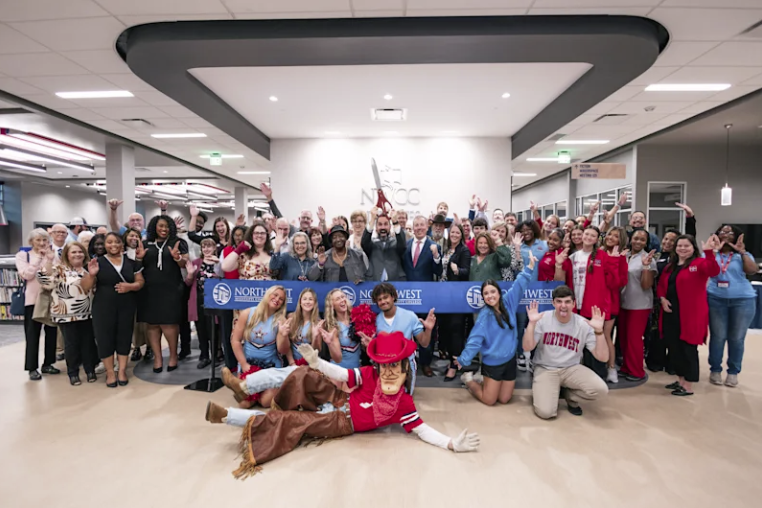
Northwest Mississippi Community College marked the reopening of the R.C. Pugh Library on Nov. 20 following a $4.9 million renovation that reimagined the historic facility as a modern, student-centered learning hub. The 16,857-square-foot space now includes expanded study areas, private rooms, a state-of-the-art maker space, updated technology, and welcoming gathering spaces, all while preserving the building’s original mid-century design elements.
College leadership highlighted the library’s evolution from a traditional book repository into a vibrant academic and community resource designed to support collaboration, creativity, and student success. Faculty and staff emphasized that the renovation enhances both functionality and accessibility, creating an environment where students can study, learn new skills, and connect with campus resources.
Students have already embraced the revitalized library, describing it as a place of opportunity, support, and inspiration. The project reflects Northwest’s ongoing commitment to investing in spaces that enrich learning, strengthen community, and empower students to succeed.
Read the full article here.
| |
New Toolkit Helps Postsecondary Institutions Use Technology to Support Student Learning
The Institute of Education Sciences released the Toolkit of Resources: Using Technology to Support Postsecondary Student Learning. The toolkit is designed to help colleges put into practice the recommendations from the What Works Clearinghouse practice guide Using Technology to Support Postsecondary Student Learning.
The toolkit is intended for use by colleges and includes:
- A four-module professional learning course for college instructors that supports their implementation of the practice guide recommendations. Institutions may offer the course online or in person using customizable materials, including a facilitator guide, slide decks, videos, and course documents.
- Self-assessment for instructors to help them gauge and monitor their use of technology to support student learning.
-
Resources for college administrators, including a concise summary of the Using Technology to Support Postsecondary Student Learning recommendations for leaders; a readiness assessment and feedback report to identify capacity gaps and track progress; a planning guide with templates and examples for implementation; and materials to support department-level adoption when institution-wide rollout is not possible.
Together, these resources provide actionable strategies for administrators and instructors to strengthen digital teaching practices and improve student outcomes.
To access the toolkit, please visit the Regional Educational Laboratories Toolkits.
The Institute of Education Sciences, a part of the U.S. Department of Education, is the nation's leading source for rigorous, independent education research, evaluation, statistics, and assessment.
| | National Education Research and Development Center for Improving Rural Postsecondary Education | | |
The Institute of Education Sciences (IES) has awarded $9,996,676 to launch the National Education Research and Development Center for Improving Rural Postsecondary Education, led by MDRC.
Over the next five years (9/1/2024–8/31/2029), the center will study strategies that can improve college enrollment, persistence, and completion for students from rural communities nationwide.
The work includes research using nationally representative NCES data, as well as projects across 10 states and 25 colleges and universities, with practitioner and researcher advisors representing 21 states.
Topics include strengthening high school-to-college pathways, understanding how rural learners make decisions about college and training, and evaluating promising approaches like dual enrollment expansion and “train in place” rural nursing programs.
Learn more about this new IES-funded rural education initiative here.
| | In Case You Missed It, from our Friends at ACCT | | |
Uncertainty of When Workforce Pell Dollars Would Go Out
Tomorrow will mark the end of the first session of the Accountability in Higher Education and Access through Demand-driven workforce Pell (AHEAD) Committee, where negotiators across the higher education and workforce space hammer out the regulations that will govern Workforce Pell implementation for short-term programs spanning from eight to 15 weeks. Statute dictates that the Department of Education must begin accepting applications for Workforce Pell program eligibility by July 1, 2026; however, it is unclear when these programs would be approved by the Department and when states would need to submit their program list.
Join us and other workforce leaders on December 16 at 2 p.m. ET in our webinar, Preparing for Workforce Pell: Deciphering the Workforce Alignment Requirement, where we discuss and learn how colleges can make sure they are doing what they can to prepare for Workforce Pell eligibility. Register here.
| | |
Help Your Students Lead in Their Hometowns
Learn how Civics Unplugged partners with colleges to grow student civic leaders.
Our next RCCA Alliance Learning Series webinar is coming up, and this one focuses on something at the heart of rural community colleges: helping students see their hometowns as places where they can lead and build meaningful futures.
Join us on Wednesday, January 21, for Cultivating Place-Based Civic Leadership Among Students with Zoë Jenkins, Director of Civic Trust & Recruitment at Civics Unplugged.
Civics Unplugged is shaping young leaders to build the future they want to live in by training them in the principles of civic innovation. The organization provides young leaders with the education, support, and intergenerational community they need to find their civic agency, strengthen their mental well-being, and develop solutions to the challenges they care about most. Since its founding, Civics Unplugged has supported more than 6,000 young leaders and sparked hundreds of youth-led projects that have reached over 10 million people.
In this webinar, we’ll explore
- How Civic Unplugged’s civic innovation curriculum can align with your academic programs and community role
- Ways to support student flourishing and combat “brain drain” in rural regions
- Real examples of young people driving change in their hometowns
- What a partnership between Civics Unplugged and rural community colleges can look like
Details coming soon!
We hope you’ll join us and bring your questions, ideas, and experiences to the conversation.
| | Resources and Opportunities | | |
2026 Community Collaboration Challenge - Now Accepting Applications
The Partnership for Student Success (PSS) at the Johns Hopkins University Everyone Graduates Center is excited to launch our fourth annual Community Collaboration Challenge! With support from the Leon Lowenstein Foundation, the Challenge provides $5,000 - $10,000 awards to communities and is designed to support collaboration that expands and pilots evidence-based K-12 student supports in the form of high-impact tutoring, mentoring, student success coaching, postsecondary transition coaching, and/or wraparound/integrated student supports.
PSS will be hosting an informational webinar during which potential applicants can learn more about the Community Collaboration Challenge and ask questions. These webinars will be hosted on the following dates, and recordings of each webinar will be posted on the PSS website:
January 7, 2026, 12:00 p.m. ET Register Here!
Questions can also be sent to ps_success@jh.edu.
Learn more and apply Community Collaboration Challenge
| |
Important Dates From ACCT
| | Follow the RCCA Facebook Page | | | | |