Monthly News & Updates


May | 2026

Insights From The Alliance

Why Rural Stories Matter

One of the great strengths of rural community colleges is that we are deeply connected to the places we serve. Our institutions are woven into the fabric of our communities in ways that are often difficult for others to fully understand. We know our students personally. We understand local industries, local challenges, and local opportunities. We celebrate the successes of our towns and feel the impacts of economic shifts, workforce shortages, and changing demographics firsthand.


But one of the challenges of rural leadership is that it can sometimes feel isolating. Many rural colleges are separated by significant geographic distances and serve communities with unique local dynamics and priorities. It is easy to become focused on the immediate needs of our own campuses and communities and lose sight of the broader conversations and innovations taking place across rural America.


That is why storytelling and information-sharing matter so much.

Recently, I had the opportunity to meet with Emily Lytle, the new Rural Engagement Reporter at Open Campus and author of the Mile Markers newsletter. Emily is working to create new ways for people engaged in rural higher education and workforce development to share ideas, connect with one another, and elevate stories that too often go untold in national higher education conversations.


What stood out to me most in our conversation was the recognition that rural colleges have important stories to tell, not simply because they are “feel good” stories, but because they represent innovation, resilience, and solutions that much of the country can learn from. Rural institutions are developing creative workforce partnerships, expanding access in geographically challenging areas, supporting students facing complex barriers, and serving as anchor institutions in communities that might otherwise be overlooked.


At the same time, it is important that we remain informed about what is happening in rural communities beyond our own service areas. Challenges facing a college in the Mississippi Delta, rural Montana, Appalachia, or eastern Oregon may look different on the surface, but there are often shared themes underneath: enrollment pressures, workforce transitions, housing shortages, healthcare access, broadband limitations, and questions about how to create opportunities that encourage students to remain in, or return to, rural communities.


I would encourage our members to consider sharing their own stories as well. Often, some of the most innovative work in higher education is happening quietly in rural communities without much national attention. By sharing our successes, challenges, and lessons learned, we strengthen not only our own institutions, but the broader rural higher education ecosystem.

If you are interested in following this work or sharing stories from your institution or community, I encourage you to connect with Emily Lytle and subscribe to the Mile Markers newsletter.


Emily Lytle

Rural Engagement Reporter, Open Campus

Email: lytle@opencampus.org


Rural higher education deserves visibility, collaboration, and a stronger national voice and that begins with telling our stories.

From the RCCA Board: Serving the Hidden Many

Community colleges provide access to higher education for individuals and sectors of society that previously were excluded from historically selective postsecondary opportunities. In our rural areas of the country, our rural community colleges provide educational access that is not only an equalizer for all demographic sectors, but literally offers the ability for anyone to pursue educational opportunities that are locally and conveniently available, and are designed to meet local economic development needs for local jobs.


Rural community colleges are usually at a disadvantage in both policy and funding frameworks, and their leaders are often challenged to maintain visibility in state and national arenas when our communities and students can be easily hidden from view among the crowd of larger stakeholders. Because rural colleges service smaller numbers of students across wider geographic areas, they are also sometimes unfairly compared to our larger urban colleges in terms of efficiency, and they consequently can be measured against a set of operating assumptions that do not align with our rural reality.


Yet, we love our rural reality, despite the headwinds we often experience as rural college leaders.

We choose to live and serve in rural America where we know one another by name.

We are dedicated to the educational work that helps our rural communities be visible and thriving.

We devote uncompromising focus on outcomes that meet local economic development needs while addressing the hopes and ambitions of individual students.

By necessity we craft solutions on a dime, and we embrace partnerships.


We serve the hidden many, one at a time.


And we need each other.

Please let us know how we can continue to make RCCA a resource that supports us in our shared efforts to make our rural communities be more visible and successful.


Ryan Carstens, Ed.D.

System Liaison Officer

BYU-Pathway Worldwide


RCCA/ATEA 2026 National Conference

Call for Proposals

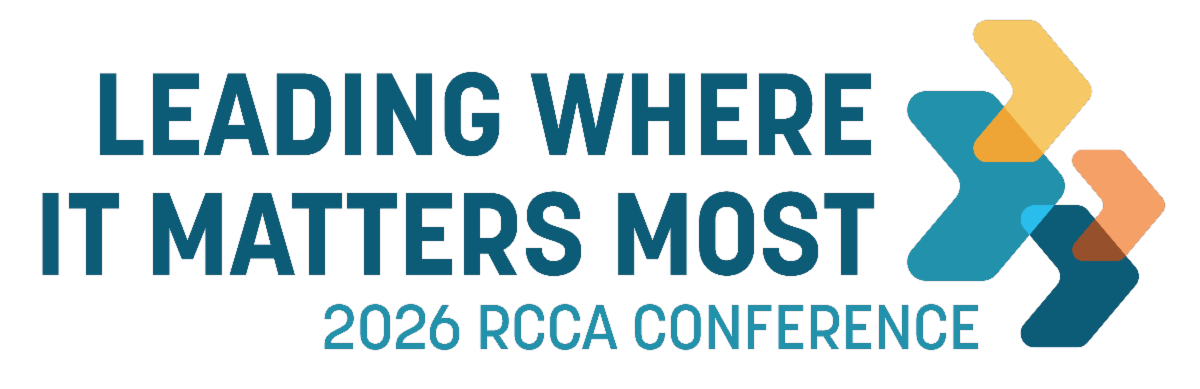
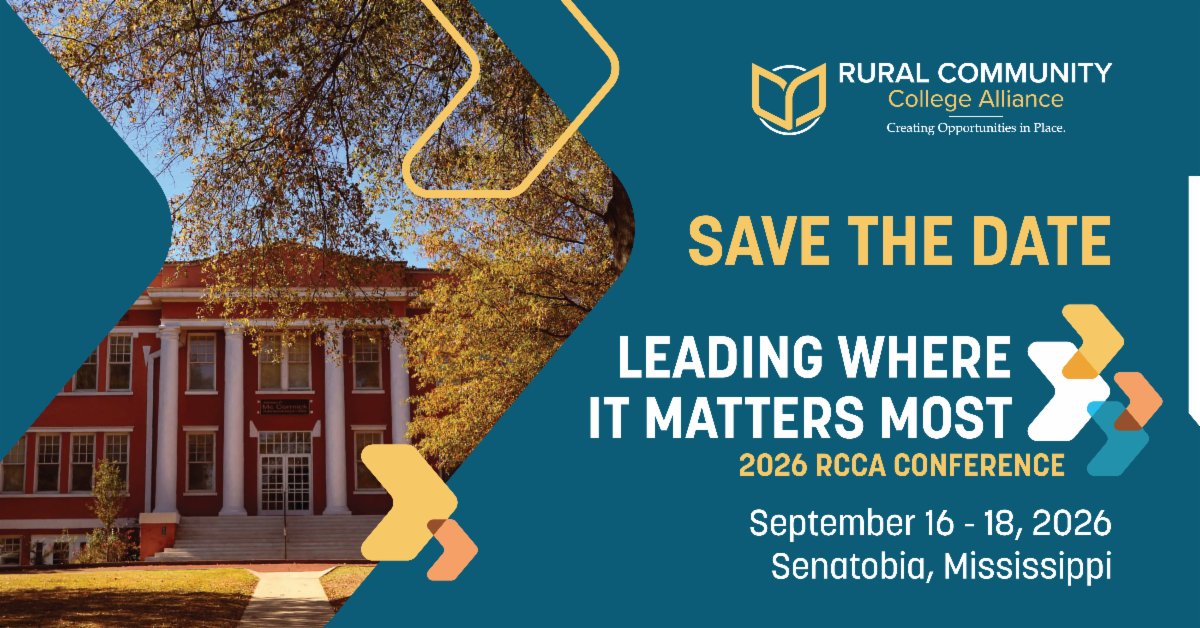
The Rural Community College Alliance is now accepting proposals for the 2026 National Conference: Leading Where it Matters Most.


We’re looking for speakers with real-world strategies, success stories, and fresh ideas that reflect the strength and innovation happening in rural higher education.


  • Proposal Deadline: May 30, 2026
  • Notifications Sent: June 15, 2026


Program tracks include:


  • Community & Economic Impact
  • Leadership in Rural Higher Ed
  • Gateway to Student Success
  • Alliance Members in Action (Wildcard)


Questions? Contact katie@25comm.com.


We’re excited to see what you bring to the table!

RCCA Alliance Learning Series


Rural community colleges are navigating a future shaped by workforce shifts, demographic change, and rapid technological disruption. But most planning processes are still built for the short term.


That's exactly what this month's RCCA Alliance Learning Series webinar aims to change.


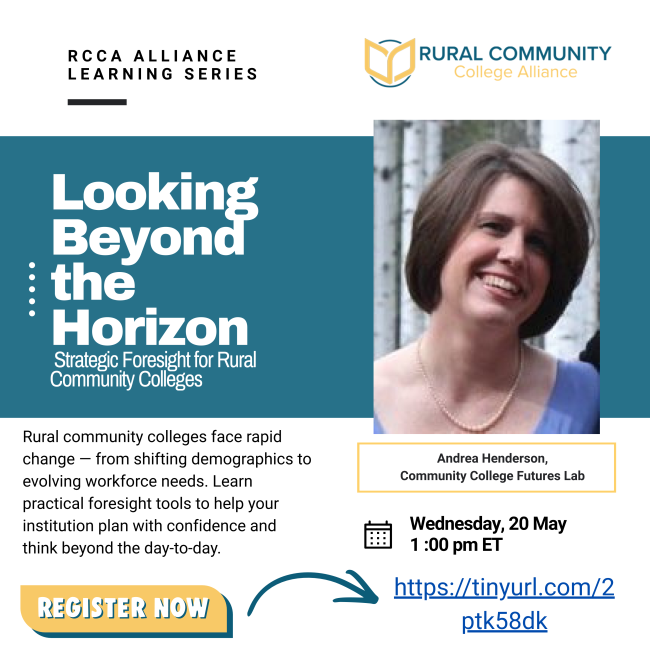
Looking Beyond the Horizon: Strategic Foresight for Rural Community Colleges Wednesday, May 20 | 1:00 p.m. ET


Presenter Andrea Henderson of Community College Futures Lab will walk participants through strategic foresight, what it is, how it differs from traditional strategic planning, and how tools like environmental scanning, drivers of change, and scenario planning can help your institution make more resilient, forward-looking decisions.


This session is built for leaders who want to think more systematically about the future without losing sight of the realities on the ground. You'll leave with a practical understanding of the foresight process and concrete ideas for applying it at your institution.


Resources and Opportunities

Community College Presidents and Trustees Invited to Complete National Survey on Economic Development

New America and the Association of Community College Trustees (ACCT) are conducting a first-of-its-kind national survey on the role community college trustees and presidents play in building institutional capacity for workforce and economic development -- and they want to hear from you.


The survey takes about 10 minutes and is open to community college trustees and presidents through June 12. Respondents may also be considered for spotlights in the final publication, speaking opportunities at New America events and the ACCT Leadership Congress, and conversations with reporters and federal policymakers focused on community colleges.

Your perspective matters.


Take 10 minutes to shape the future of community college governance.

Grant Opportunities

Strengthening Community College Training Grants

In this 6th round, the objective of the Strengthening Community College Training Grant (SCCTG) competition is to fund community colleges aiming to build "program and system capacity for implementing and scaling access to short-term training opportunities through Workforce Pell Grants—i.e., promoting industry-driven strategies, worker mobility, and integration with the larger state workforce system (e.g., Workforce Innovation and Opportunity Act (WIOA) partners) for statewide impact." The closing date for this grant opportunity is May 20, 2026, at 11:59 PM ET.


Child Care Access Means Parents in School (CCAMPIS)

The U.S. Department of Education (ED) released this year’s competition for Child Care Access Means Parents in School (CCAMPIS). This year, ED expects to make 148 awards between $150,000 to $1,000,000 for four-year grants to colleges with at least $250,000 in Pell Grant funding to support child care for parenting low-income students. Here is an FAQ from ED. Urban Institute is offering a free webinar titled Using Data to Strengthen Your CCAMPIS Application on May 14. Register here. The deadline to apply is May 29, 2026.

Important Dates from ACCT


Meet your 2026 RCCA National Conference host!

Watch Northwest Mississippi Community College's welcome video and get excited for the 2026 RCCA National Conference.

Save-the-date graphic for the Rural Community College Alliance 2026 Conference titled “Leading Where It Matters Most,” scheduled for September 16–18, 2026, in Senatobia, Mississippi, featuring a campus building image and RCCA branding.
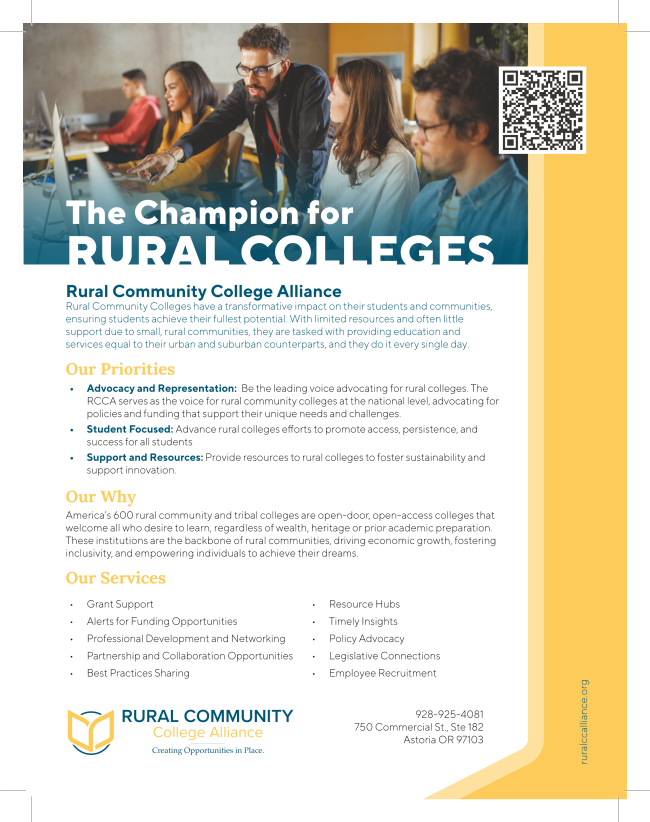
Group of professionals collaborating at computers with overlay text reading “The Champion for Rural Colleges.” Graphic highlights the Rural Community College Alliance mission, priorities, and services supporting rural community and tribal colleges.

Follow the RCCA Facebook Page

Facebook
X Share This Email
LinkedIn Share This Email