April 2026

In the News
The Scholarly Kitchen logo

The Perils of Using Generative AI to Perform Research Tasks: Editors’ and Publishers’ Viewpoints


The Scholarly Kitchen

March 9, 2026

Marco Marabelli, Robert M. Davison, Giovanni Gatti


"Generative AI, Academic Research, and Publishing


The role of Generative AI (GenAI) has lately been a hot topic for The Scholarly Kitchen’s readers, particularly for its transformative power in the publishing industry, with guest posts discussing the balance between leveraging emerging technologies and producing human-centric research, for instance. But let’s step back for a second. It all began in 2017, with Vaswani and colleagues’ seminal article, “Attention is All You Need”, which disrupted the AI space. They introduced new ideas to explain how AI processes language, with a focus on novel AI systems (i.e., GenAI) that were able to receive inputs (prompts) from users that were used to generate seemingly coherent outputs (text, images, music). Individuals, organizations, and society have since been heavily impacted and, as generally happens with disruptive technologies (cf. television, mobile phones, smartphones, the internet), the consequences, both positive and negative, have exceeded the wildest predictions."


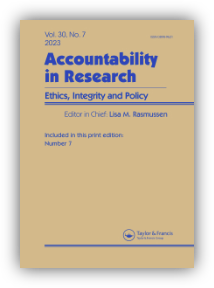
The Accountability in Research: Ethics, Integrity and Policy issue cover.

Hallucinated citations produced by generative artificial intelligence may constitute research misconduct when citations function as data in scholarly papers


Accountability in Research: Ethics, Integrity and Policy

March 15, 2026

David B. Resnik & Mohammad Hosseini


"Abstract

In this article, we discuss the growing problem of hallucinated citations produced by Generative Artificial Intelligence (GenAI) in scholarly research and writing. We argue that GenAI hallucinated citations might qualify as a provable instance of research misconduct under the U.S. federal regulations when a) the researcher uses a GenAI tool to produce hallucinated (i.e., nonexistent) citations for a research document; b) the citations function as data because they directly support research findings, as in, for example, review articles or bibliometric studies; and c) the researcher demonstrates indifference to the risk of fabrication of the data (i.e. citations) because they did not check the GenAI’s output for veracity and accuracy."


Resnik, D. B., & Hosseini, M. (2026). Hallucinated citations produced by generative artificial intelligence may constitute research misconduct when citations function as data in scholarly papers. Accountability in Research. 

 
U.S. Department Health and Human Services (HHS)
The Office of Research Integrity (ORI)
Research Misconduct Case Summaries
 

iThenticate Upgrade 2.0 scheduled for 
April 30, 2026

On April 30, 2026, access to our current version of iThenticate will end. Please plan for 24 hours of downtime while our institution’s accounts, users and user groups, submissions, similarity reports, and folders are being transferred to the new version.


After April 30, 2026, our current version of iThenticate will be disabled, and all users will access past similarity reports and make future submissions via iThenticate 2.0.


Key details of the transition:

  • Look for a “Welcome to iThenticate” email
  • You will receive a welcome email from “noreply@turnitin.com” inviting you to activate your new iThenticate 2.0 account when the migration has completed.
  • Access your new iThenticate 2.0 account from the new URL
  • You will no longer access iThenticate from the current URL.
  • Embedded in the “Welcome to iThenticate” email will be the UK iThenticate's new URL.
  • You will click on this link to set a new password and activate your new 2.0 account. (Make sure your browser allows pop-ups.)
  • Welcome email expiry
  • You will have 7 days to log in using the link in the welcome email, to set a new password, and activate your new 2.0 account. If it expires, please email the UK iThenticate Support Team to resend the Welcome email.

Compliance for the Online RCR Course through CITI by College

As of April 20, 2026, we have 90% compliance with the Online RCR Course through CITI across all colleges.


We greatly appreciate your willingness to perform the vast array of outstanding research and scholarly activity taking place at the University in an ethical and responsible manner.

College

% Compliance

Total Required

Agriculture, Food, and Environment

91%

1,254

Arts and Sciences

91%

1,337

Business and Economics

89%

149

Communication and Information

94%

179

Dentistry

100%

121

Design

70%

86

Education

87%

819

Engineering

91%

717

Fine Arts

91%

288

Health Sciences

94%

590

Law

93%

38

Medicine

94%

2,781

Nursing

94%

334

Pharmacy

94%

155

Public Health

95%

293

Social Work

77%

826

Graduate School

76%

125

Lewis Honors College

94%

16

Libraries

98%

50

Other Units

93%

1,764

OTHER RESEARCH RESOURCES

iThenticate (plagiarism-checking software)

iThenticate (plagiarism-checking software) is now available for RCR-compliant researchers and graduate students.


Click the button below to request your account today!

Electronic Research Notebook

Need a safe and secure place to store your research data? Need to collaborate with your colleagues easily and efficiently?


LabArchives isn't just for labs, and it's free to all UK researchers!   


Click the button below to learn more about Electronic Research Notebooks

 
RCR Team
Watch this short video to learn more about RCR and why it is important!
 
RCR Contacts:
Jen Hill
(859) 257-2978

Jenny Smith
(859) 257-7903

Emily Matuszak
(859) 562-3562