August 2025

In the News

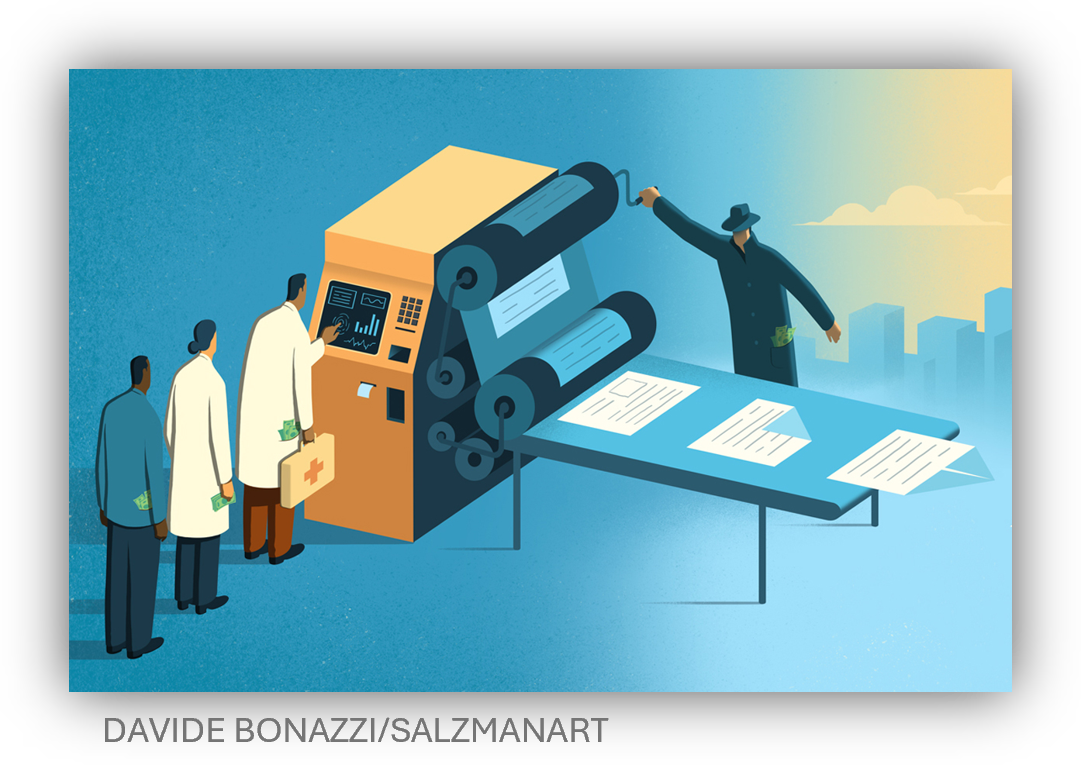
Scientific fraud has become an ‘industry,’ alarming analysis finds


Sophisticated global networks are infiltrating journals to publish fake papers


Science

August 4, 2025

Cathleen O'Grady


"For years, sleuths who study scientific fraud have been sounding the alarm about the sheer size and sophistication of the industry that churns out fake publications. Now, an extensive investigation finds evidence of a range of bad actors profiting from fraud. The study, based on an analysis of thousands of publications and their authors and editors, shows paper mills are just part of a complex, interconnected system that includes publishers, journals, and brokers.


The paper, published today in the Proceedings of the National Academy of Sciences, paints an alarming picture. Northwestern University metascientist Reese Richardson and his colleagues identify networks of editors and authors colluding to publish shoddy or fraudulent papers, report that large organizations are placing batches of fake papers in journals, suggest brokers may serve as intermediaries between paper mills and intercepted journals, and find that the number of fake papers—though still relatively small—seems to be increasing at a rate far greater than the scientific literature generally.


The paper shows that misconduct “has become an industry,” says Anna Abalkina of the Free University of Berlin, who studies corruption in science and was not involved with the research. Richardson and colleagues hope their sweeping case will attract attention and spur change."

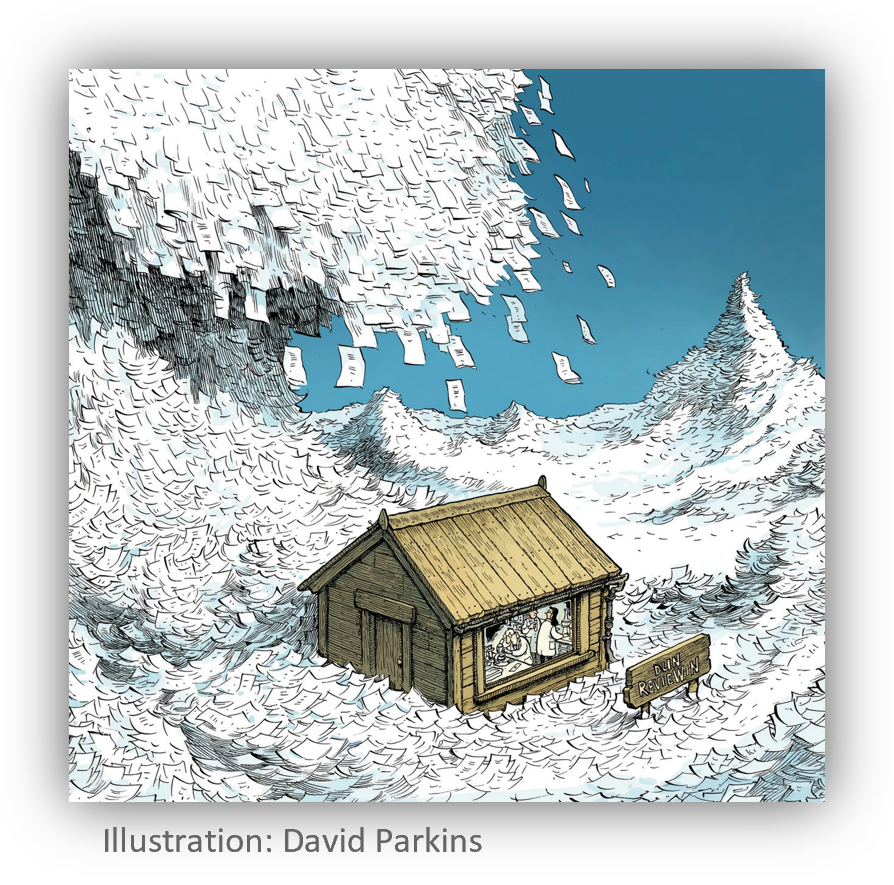
The peer-review crisis: how to fix an overloaded system


Journals and funders are trying to boost the speed and effectiveness of review processes that are under strain.


Nature

August 6, 2025

David Adam


"Attached to the Very Large Telescope in Chile, the Multi Unit Spectroscopic Explorer (MUSE) allows researchers to probe the most distant galaxies. It’s a popular instrument: for its next observing session, from October to April, scientists have applied for more than 3,000 hours of observation time. That’s a problem. Even though it’s dubbed a cosmic time machine, not even MUSE can squeeze 379 nights of work into just seven months.


The European Southern Observatory (ESO), which runs the Chile telescope, usually asks panels of experts to select the worthiest proposals. But as the number of requests has soared, so has the burden on the scientists asked to grade them.


“The load was simply unbearable,” says astronomer Nando Patat at ESO’s Observing Programmes Office in Garching, Germany. So, in 2022, ESO passed the work back to the applicants. Teams that want observing time must also assess related applications from rival groups.


The change is one increasingly popular answer to the labour crisis engulfing peer review — the process by which grant applications and research manuscripts are assessed and filtered by specialists before a final decision is made about funding or publication."


U.S. Department Health and Human Services (HHS)
The Office of Research Integrity (ORI)
Research Misconduct Case Summaries
 

Reminder: August 1, 2025 RCR Policy Change

As of August 1, 2025, the RCR In-Person Training/Discussion Sessions is no longer be required by the University of Kentucky.


On July 17, 2025, the Acting Vice President for Research, Ilhem Messaoudi, Ph.D., and the Associate Vice President for Research Integrity, Bill Stoops, Ph.D., announced that the RCR In-Person Training requirement will be eliminated as of August 1, 2025. The online RCR course through CITI will still be required and will now have an expiration of 4 years rather than biennial.


*For individuals listed on research projects funded by agencies that require face-to-face training, please refer to the PI of that project.

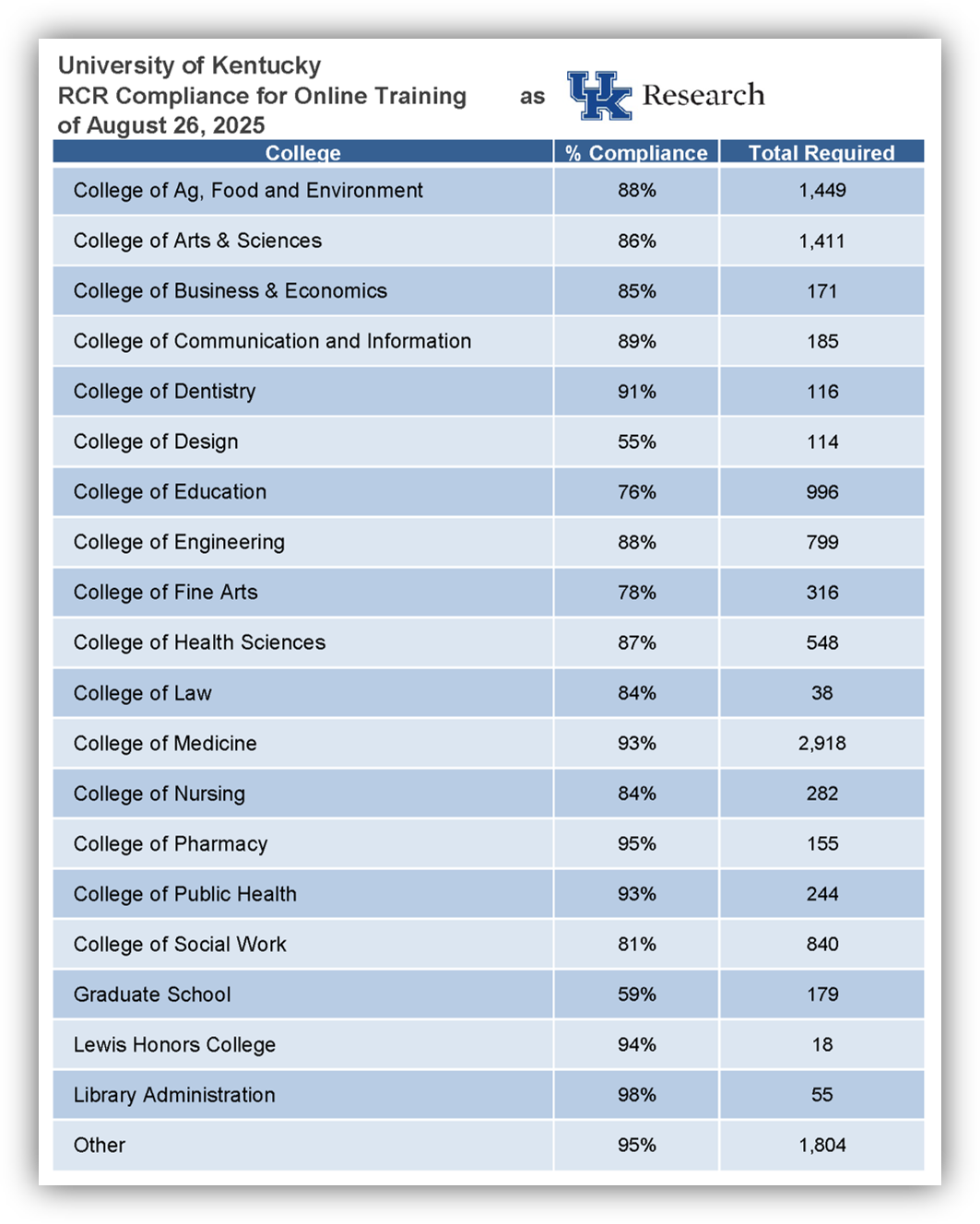
Compliance for the Online RCR Course through CITI by College

As of August 26, 2025, we have 88% compliance with the Online RCR Course through CITI across all colleges.


We greatly appreciate your willingness to perform the vast array of outstanding research and scholarly activity taking place at the University in an ethical and responsible manner.

OTHER RESEARCH RESOURCES

iThenticate (plagiarism-checking software)

iThenticate (plagiarism-checking software) is now available for RCR-compliant researchers and graduate students.


Click the button below to request your account today!

Electronic Research Notebook

Need a safe and secure place to store your research data? Need to collaborate with your colleagues easily and efficiently?


LabArchives isn't just for labs and it's free to all UK researchers!    


Click the button below to learn more about LabArchives today!

 
RCR Team
Watch this short video to learn more about RCR and why it is important!
 
RCR Contacts:
Jen Hill
(859) 257-2978

Jenny Smith
(859) 257-7903

Emily Matuszak
(859) 562-3562