|
Winter 2025
Welcome to RDInsights, a quarterly newsletter from the USF Research Development Institute (RDI). This newsletter will be one channel through which the RDI communicates updates from the Institute, funding opportunities, and other resources to enhance research success.
| |
UPDATES FROM THE
RESEARCH DEVELOPMENT INSTITUTE (RDI)
| | |
Federal Funding Priorities Update
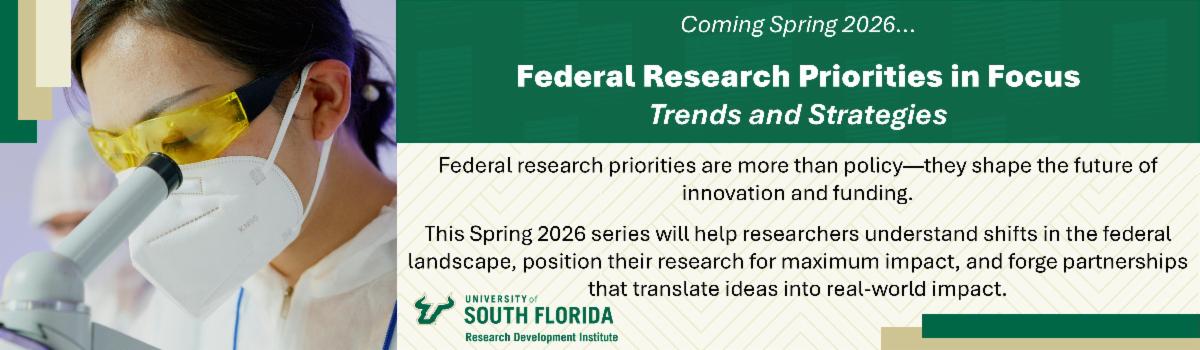
In September, the Office of Management and Budget and the Office of Science and Technology Policy produced a memo which outlines the Trump Administration’s research and development budgetary priorities. These five priority areas have been selected to ensure that America retains global leadership in areas crucial to ensuring national security and the welfare of its citizens. Researchers should review these areas and consider how their research might align with administration priorities.
-
Critical and Emerging Technologies: includes artificial intelligence, quantum information science and technology, advanced communications networks, future computing technology, semiconductors, and advanced manufacturing.
-
Energy: includes fossil fuels, nuclear fission and fusion, geothermal and hydropower, critical minerals, polar regions research, ocean exploration and observation.
-
National Security: includes advanced military capabilities, Golden Dome, preparedness and resilience.
-
Health and Biotechnology: includes chronic diseases, rare diseases, plant and animal health, -Omics and AI, biosafety and biosecurity, biomanufacturing.
-
Space Exploration: includes human space exploration, moon and Mars missions, forecasting and space weather, leveraging commercial capabilities.
| | |
DOD Reduces Research Priorities from 14 to 6
On November 17th, DOD Undersecretary of Defense for Research and Engineering Emil Michael announced that the agency they were trimming down their research priorities from 14 to six. The reduced list focuses on capabilities that can be delivered quickly, in the next 36 months, and will drive “the most decisive advantage on the battlefield.” While research in other areas may still be funded, these six areas will receive the most focus. Researchers should think about how their work could align with these areas.
-
Applied Artificial Intelligence: Embedding AI into Command and Control systems to achieve intelligent workflows and decision superiority.
-
Biomanufacturing: Harnessing living systems to produce critical materials at scale.
-
Contested Logistics Technologies: Technologies to ensure seamless resupply and operational continuity in contested environments.
-
Quantum and Battlefield Information Dominance: Ensure resilient communications, navigation and electromagnetic dominance in conflicts.
-
Scaled Hypersonics: Deliver Mach 5+ hypersonic weapons at scale, providing unmatched speed, precision, and survivability.
-
Scaled Directed Energy: Scaling high-energy lasers and microwave technologies to provide low-cost, high-impact solutions against emerging threats.
| | |
USF RDI & IT Drive Innovation in Research Administration with NSF BUILD Grant
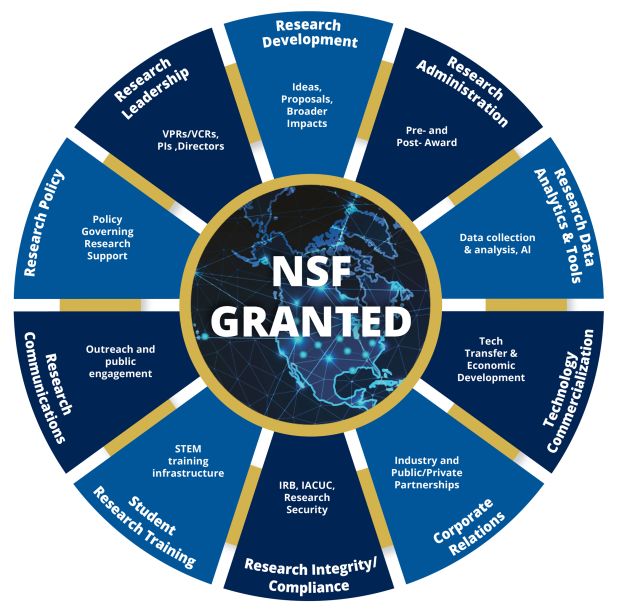
Everyone has a role to play in the research enterprise advancing knowledge to enable change. USF receives $3.4 million NSF grant for BUILD program to train future research administrators. The BUILD (Bridging the Unmet Industry Learning Demands for Research Administrators) training program is designed to establish the next chapter in workforce training and education that will, in turn, create a pipeline of highly qualified talent to address the issue of understaffing in the research administration and research development (RARD) profession.
To address the gap, the BUILD team is developing the textbook for preparing the future of the field. Over the next 5 years, BUILD will recruit 35 mentors for about 100 mentees, design and launch 4 courses which will align with the BUILD textbook and include a repository with open access via the USF Libraries with extensive resources in various accessible formats. The BUILD training program aims to prepare undergraduate researchers to become part of the RARD workforce by building awareness, and creating competency-based training, strengthened by a mentoring network designed to support future of the field.
| | | SPRING SCHEDULE ANNOUNCED | | |
We’re excited to share the spring lineup of the Interdisciplinary Innovators Exchange series on industry-engaged research at USF!
This spring will continue our mission of equipping faculty with practical strategies, resources, and real-world insights to strengthen partnerships with industry and amplify research impact. We’ll dive into everything from safeguarding and commercializing your innovations, to sharpening entrepreneurial skills, launching faculty-led startups, and unlocking SBIR/STTR funding—all with the goal of helping faculty transform discoveries into scalable innovations.
Each session runs 12:00–1:00 PM EST via Microsoft Teams and features expert presenters from USF’s innovation ecosystem.
| | |
Intellectual Property & Commercialization: A Deep Dive
January 28th, 2026, 12:00 – 1:00 PM EST
This session dives into the process of invention disclosures, patenting, and licensing at USF—clarifying rights, responsibilities, and opportunities for faculty inventors. REGISTER
| | |
Developing an Entrepreneurial Mindset
February 3rd, 2026, 12:00 – 1:00 PM EST
This session explores how entrepreneurial thinking supports partnership-building, drives innovation beyond the lab, and aligns academic pursuits with industry needs. REGISTER
| | |
Start-Up 101: From Lab to Launch
March 3rd, 2026, 12:00 – 1:00 PM EST
This session covers the basics of faculty entrepreneurship: forming a university-affiliated startup, understanding ownership and licensing, and navigating investment opportunities. REGISTER
| | |
SBIR/STTR Overview & Matchmaking
April 8th, 2026, 12:00 – 1:00 PM EST
This session helps faculty access SBIR/STTR funding, navigate applications, and build partnerships to turn research into commercial impact. REGISTER
| | REGISTER NOW! The full schedule, related resources, and information on our monthly office hour (third Thursday of the month) can be found online. | | |
From Concept to Commercialization
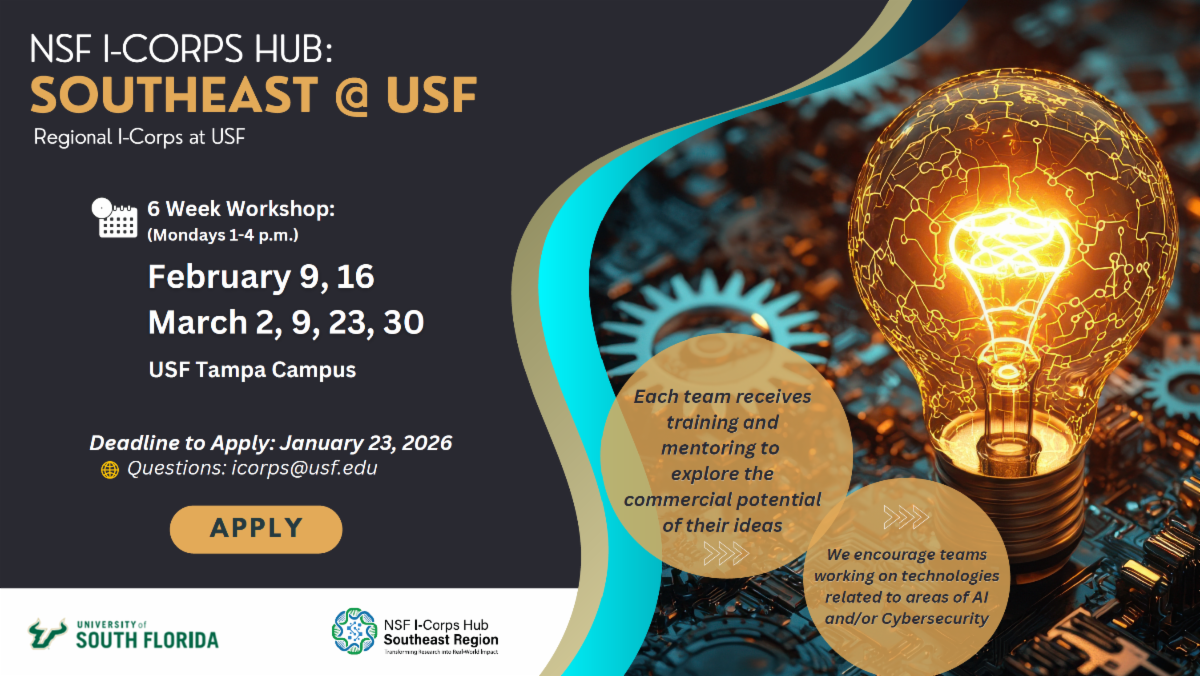
If you’ve got a great idea for a product, technology or service, the Regional I-Corps at USF program can help you take it to the next level.
- Find and talk with potential customers
- Develop a successful business model
- Turn your technology into a commercially viable product
Sign up now for this six-week workshop! Mondays, 1:00 – 4:00 pm on 2/9, 2/16, 3/2, 3/9, 3/23, 3/30 (USF Tampa Campus)
Application Deadline: January 23, 2026
For more information: icorps@usf.edu
| | |
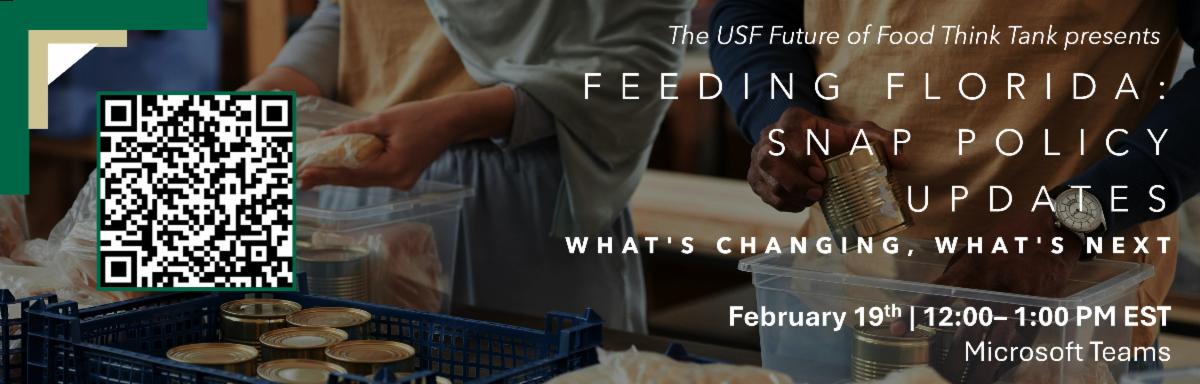
The USF Future of Food Think Tank is proud to present:
Feeding Florida: SNAP Policy Updates
What’s Changing, What’s Next
February 19th, 2026
12:00 – 1:00 PM EST
Sky Beard serves as the Florida Director for No Kid Hungry, a national campaign tackling issues related to child hunger. Sky will share updates about recent changes made to SNAP at the federal level and the current and future impact on Floridians. SNAP is a critical tool in fighting food insecurity—this presentation will provide an overview of how new cost share requirements with states could pose significant challenges to the state budget as well as SNAP participants.
| | |
Upcoming Spring Internal Awards!
There are a few more internal award cycles remaining this spring! These competitive grants are designed to empower faculty across disciplines by supporting innovative research, scholarship, and creative endeavors that elevate USF’s academic excellence.
| |
LIMITED SUBMISSION OPPORTUNITIES
(Apply through InfoReady)
| | |
The National Endowment for the Arts Big Read supports community reading programs designed around a single NEA Big Read book. As our nation moves into its 250th year, the goal of this program is to honor America’s rich artistic and cultural heritage, inspire meaningful conversations, celebrate local creativity, elevate a wide variety of voices and perspectives, and build stronger connections in each community.
Internal Deadline: January 6, 2026; Agency Deadline: January 29, 2026
| |
The Mathers Foundation supports basic research with translational potential in areas such as immunology, microbiome, structural biology, cancer, genetics, stem cells, and neuroscience.
Internal Deadline: January 9, 2026; Foundation Deadline: February 13, 2026
| | |
The main goal of the S-STEM program is to enable academically talented, low-income students to pursue successful careers in promising STEM fields. Ultimately, the S-STEM program seeks to increase the number of academically promising low-income students who graduate with an S-STEM eligible degree and contribute to the American innovation economy with their STEM knowledge. Recognizing that financial aid alone cannot increase retention and graduation in STEM, the program provides awards to institutions of higher education (IHEs) not only to fund scholarships, but also to adapt, implement, and study evidence-based curricular and co-curricular[a] activities that have been shown to be effective in supporting recruitment, retention, transfer (if appropriate), student success, academic/career pathways, and graduation in STEM.
Internal Deadline: January 15, 2026; Agency Deadline: March 3, 2026
| | |
This NIH R25 grant funds hands-on summer research programs for high school students, undergraduates, and science teachers. The goal is to spark interest in biomedical, behavioral, and clinical research, build the future workforce of researchers and educators, and connect participants to the mission of specific NIH Institutes.
Internal Deadline: January 15, 2026; Agency Deadline: February 15, 2026
| | |
NIH To Launch Unified Funding Framework to Strengthen Research Award Decisions
National Institutes of Health (NIH) is rolling out a unified funding framework (effective January 2026) to make award decisions clearer and more consistent across all Institutes, Centers, and Offices. Funding choices will weigh peer review feedback in full, along with health priorities, scientific opportunities, workforce sustainability, and budget realities. The goal is to improve transparency, accountability, and balance in how NIH supports meritorious research, while ensuring broad distribution of funds across disciplines and institutions and responsiveness to evolving biomedical needs.
|
| EXTERNAL FUNDING OPPORTUNITIES | | |
Amazon Web Services Education Equity Initiative: The initiative aims to empower organizations to create digital learning solutions for underserved learners globally. Amazon is committing up to $100 million in AWS credits and technical expertise to support socially-minded organizations develop innovative digital learning solutions that utilize cloud and AI technologies. Deadline: December 31, 2025
Collaboratory to Advance Mathematics Education and Learning for K-12: The Collaboratory to Advance Mathematics Education and Learning (CAMEL) for K-12 initiative aims to advance mathematics learning and education through purposeful collaboration that draws on the interdisciplinary Science of Learning (including neuroscience; cognitive, developmental, and social sciences; computer science; machine learning; engineering; and education research), deep experiences in education practice and teaching, and innovations in the use of data science, AI and technology.
LOI Deadline: January 9, 2026; Full Proposal Deadline: March 11, 2026
NSF - Accelerating Research Translation (ART): The overarching goal for the Accelerating Research Translation (ART) program is to advance the U.S. scientific and economic leadership by building capacity and increasing the number of robust translational research ecosystems in Institutions of Higher Education (IHEs) that span across the full geography of our nation. The ART program seeks proposals that have a blend of: (1) activities that will help build and/or strengthen the institutional infrastructure to sustainably grow the institutional capacity for research translation in the short and long terms; (2) educational/training opportunities, especially in engaged scholarship and experiential opportunities for students, postdoctoral researchers, and faculty, to become entrepreneurial leads (EL) and/or seek use-inspired- and/or technology transfer- and research translation-oriented careers in the public and/or private sectors; and (3) specific, research translation and technology transfer activities that offer immediate opportunities for transition to practice to create sustained economic and collective impacts. Track 2 & 5 Deadline: January 15, 2026; Tracks 1, 3, & 4: March 12, 2026
NSF - Stride Ventures - The Tech Metal Transformation Challenge: The Tech Metal Transformation Challenge is a multi-year national initiative to accelerating technologies that turn domestic waste streams into high-performance materials, strengthening U.S. supply chain resilience for critical metals and advancing innovation-driven manufacturing. Through a multi-year, three-stage program led by STRIDE Ventures, up to eight teams will receive up to $2 million in Stage 1 (10 months) for R&D, up to six teams will advance in Stage 2 (12 months) with up to $2.5 million each for market validation, and up to four finalists will earn up to $3 million in Stage 3 (12 months) to scale and commercialize their technologies. Deadline: January 15, 2026
DOD White Sands Basic Research Opportunity: The Office of Science and Technology Policy (OSTP) requests input from all interested parties on Federal policy updates that aim to accelerate the American scientific enterprise, enable groundbreaking discoveries, and ensure that scientific progress and technological innovation benefit all Americans. This RFI will inform the formulation of Executive branch efforts to advance and maintain U.S. S&T leadership. Deadline: June 22, 2026
| | | |
FEATURED RDinsight
Beginning January 25, 2026, NIH will require biosketches, supplements, and current/pending support to be submitted through the Common Form in SciENcv. Investigators must have an ORCiD ID, link it to eRA Commons, and certify documents in SciENcv. The new format removes text styling, limits citations to ten in the Products section, and allows only the ORCiD public profile link. Applicants should prepare now for these significant changes. Read more.
| | | PRIVATE FOUNDATION FUNDING OPPORTUNITIES | | |
Whitehall Foundation invites LOIs for bioscience research projects: BWF The Whitehall Foundation aims to support scholarly research in the life sciences that is not heavily supported by federal agencies or other foundations with specialized missions. The foundation is interested in basic research in neurobiology, defined as invertebrate and vertebrate (excluding clinical) neurobiology, specifically investigations of neural mechanisms involved in sensory, motor, and other complex functions of the whole organism as these relate to behavior. The overall goal should be to better understand behavioral output or brain mechanisms of behavior. LOI Deadline: January 15, 2026; Full Proposal Deadline: June 1, 2026
Food Allergy Fund Microbiome Collective: Grants will be awarded to research teams that propose innovative approaches to understanding the role that the microbiome plays in the development and persistence of food allergy. Proposals identifying investigations into the interaction between the mucosal surfaces and the immune system that result in the development of allergic responses to food are welcomed.
Deadline: January 31, 2026
National Academies Gulf Research Program Science Policy Fellowship: The Gulf Research Program’s Science Policy Fellowship program helps scientists hone their skills by putting them to practice for the benefit of Gulf Coast communities and ecosystems. Fellows gain first-hand experience as they spend one year on the staff of federal, state, local, or non-governmental agencies in the Gulf region applying scientific knowledge to policy. Fellows who have completed a MA, MS, or MPH/MSPH degree or who are currently enrolled in a doctoral program will receive an annual stipend of $63,800. Fellows who have completed a PhD, ScD, EngD, MD, DrPH, or DVM will receive an annual stipend of $69,300. Deadline: February 26, 2026
| | UPCOMING EVENTS & OPPRTUNITIES | | |
The Office of Science and Technology Policy (OSTP) requests input from all interested parties on Federal policy updates that aim to accelerate the American scientific enterprise, enable groundbreaking discoveries, and ensure that scientific progress and technological innovation benefit all Americans. This RFI will inform the formulation of Executive branch efforts to advance and maintain U.S. S&T leadership. Submissions are due by December 26, 2025
Renaissance Philanthropy opens American cohort for Big if True Science Accelerator
The Big if True Science Accelerator (BiTS) is a 15‑week, part‑time program designed to help scientists, engineers, and entrepreneurs transform bold, high‑risk ideas into concrete, fundable research programs. Led by former DARPA program managers, fellows receive mentorship, training, and hands‑on experience in program design, execution, and tech translation, while building connections with peers and funders. The program culminates in a Demo Day, where participants pitch their refined proposals to agencies, philanthropies, and investors, positioning them to drive breakthrough innovation across disciplines. Applications accepted through January 19, 2026
| | | | |