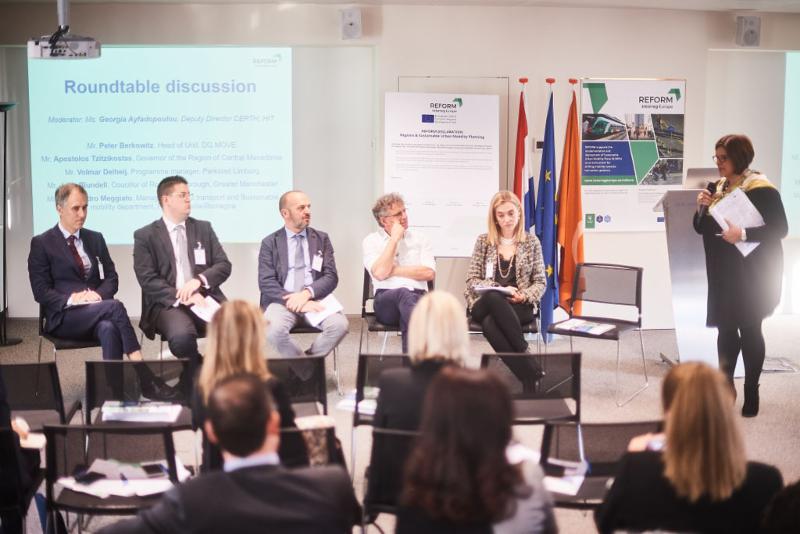
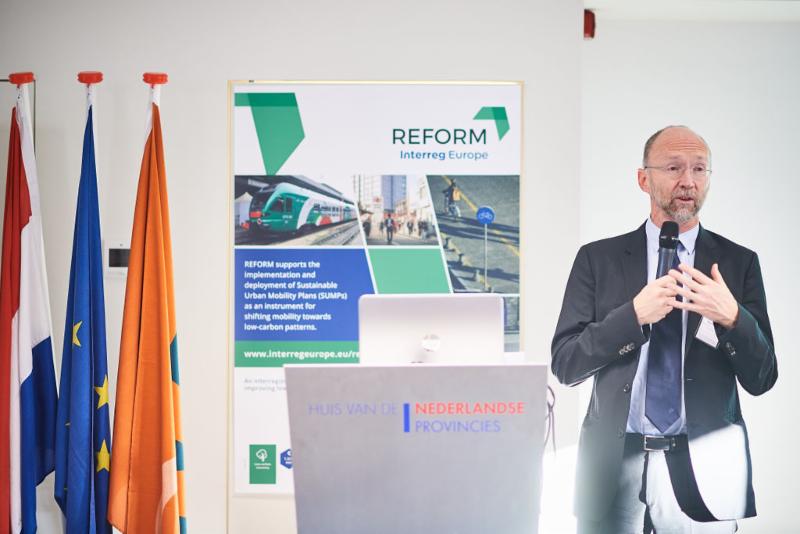
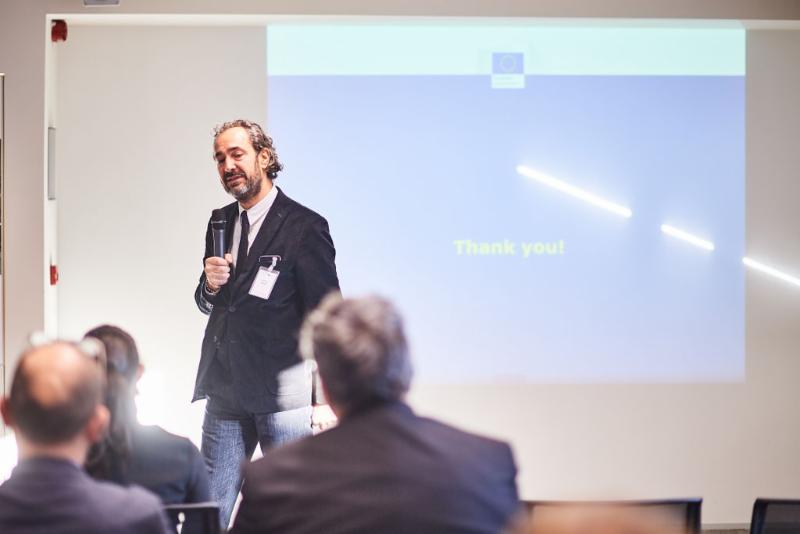
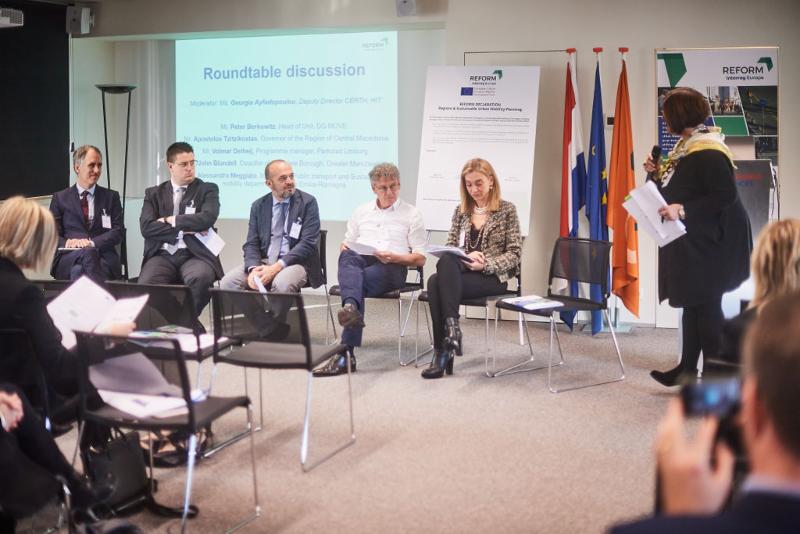
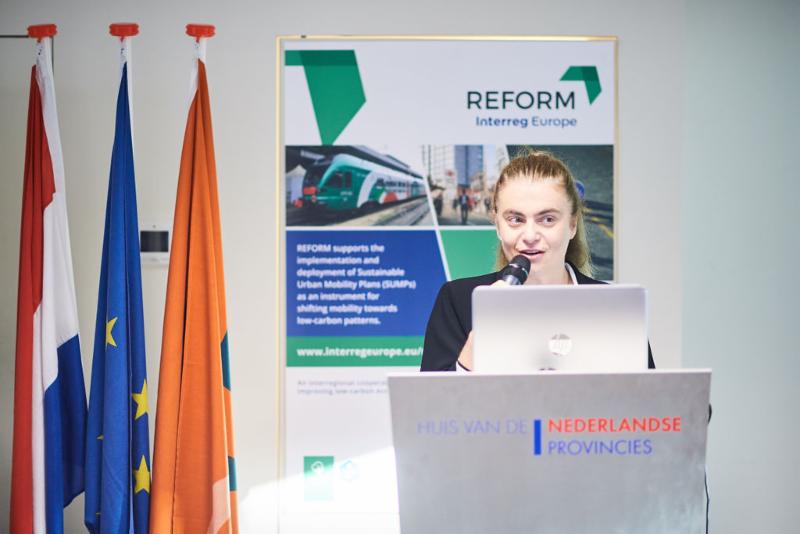
On Tuesday 4th December 2018, in Brussels, the political representatives of four European regions signed with high-level representatives of the European Commission a common declaration on the role of regions in Sustainable Urban Mobility Planning. The conference took place in the heart of the European quarter of Brussels, at the House of Dutch Provinces.
This event gathered a panel of high level speakers coming from European regions.
Mr. John Blundell, Councillor of Rochdale Borough Council,
Ms.
Nadia Bessa, from the Directorate of Innovation and Entrepreneurship Support of the
Region of Central Macedonia,
Mr. Volmar Delheij, Programme Manager at the region of Parkstad Limburg and
Mr. Alessandro Meggiato,
Manager of the Public Transport and Sustainable Mobility department
of the Emilia-Romagna Region represented respectively the regions of Greater Manchester (United Kingdom), Central Macedonia (Greece), Parkstad Limburg (the Netherlands), and Emilia-Romagna (Italy). They exchanged their views with two high-level representatives of the European Commission,
Mr. Matthew Baldwin, deputy Director General at DG MOVE – the entity in charge of mobility and transport – and
Mr. Peter Berkowitz, Head of Unit at DG REGIO – the entity in charge of the regional and urban policy.
The result of strong European interregional cooperation
The four above-mentioned European regions have been cooperating for two years, in the framework of an INTERREG Europe project called REFORM. Within the context of this project, the four regions exchanged on their respective sustainable mobility planning approaches and experiences. As a result of this process, they identified areas in which the regional authorities can play a key role in the development and deployment of Sustainable Urban Mobility Plans (SUMPs) in Europe, such as funding, guidelines or knowledge exchange.
These findings were presented in the form of a declaration to the representatives of the European Commission, who acknowledged the importance of regions in the implementation and adoption of SUMPs.
Mr. Baldwin said “
The European SUMP guidelines are currently under revision. In the new version, a stronger focus will be put on the role of regions”. The importance of interregional cooperation was also highlighted by
Mr. Berkowitz who stated “
There is a big potential to scale innovation in the area of urban mobility, across Europe”.
Towards a more sustainable mobility planning approach in regions
Sustainable Urban Mobility Plans are recognised by regions as strategic planning tools to foster low carbon mobility.
Mr. Meggiato wants to further develop the adoption of SUMPs in his region. “
In Emilia-Romagna, three cities have already adopted a SUMP. The region is providing guidelines and financial incentives to stimulate the other municipalities of the region to adopt a SUMP”.
Mr. Delheij added that "
A common vision and a common behaviour among municipalities of a single region are necessary to implement effectively SUMPs. In Parkstad-Limburg, representatives of all municipalities are meeting every week to share their progresses and experiences."
For
Mr. Blundell, sustainable urban mobility planning is a necessary tool to foster the integration of several urban policy areas. "
The SUMP in Greater Manchester started new conversations between different departments. For instance, our transport, environment, health & safety departments are fully cooperating to achieve the goals of the SUMP."
Given their successful cooperation, the four European regions will continue their interregional cooperation in the upcoming years.
Ms. Bessa said “
Our cooperation with the regions of Emilia-Romagna, Pakrstad Limburg and Greater Manchester has been much beneficial for the Region of Central Macedonia. In particular, Greater Manchester provided inspiration for our SUMP”.
From January 2019, the four European regions will start to implement their respective action plans, drafted in the framework of the REFORM project.
Ms. Maria Morfoulaki, representing CERTH/HIT and coordinator of REFORM is confident that "
the four regions will provide support to local authorities in the areas of coordination, capacities, guidance and monitoring."
<end>