REQUEST FOR PRE-PROPOSALS
American Mosquito Control Association
2022 Research Fund
Deadline: Friday, July 2, 2021
The American Mosquito Control Association (AMCA) Research Fund invites new
pre-proposals for research on mosquito control and related topics for funding for calendar year
2022.

AMCA® is a nonprofit organization that is dedicated to providing leadership, information,
and education leading to the enhancement of public health and quality of life through the
suppression of mosquitoes.

The AMCA Research Fund is devoted to funding research that will lead to new tools and strategies for mosquito surveillance and control and ultimately protecting the
public from mosquito-borne disease and discomfort from mosquito bites.
Priority Areas
In general, AMCARF seeks to support research that:

Enhances public mosquito and vector control agency mosquito control programs
Originates from young/early career researchers building their careers
Originates from and/or includes researchers from Mosquito Control Districts

More specifically, AMCARF priority areas for this funding cycle include but are not limited to
projects investigating:

Spatial repellents – Research topics may include new agents, mixtures, or product
efficacy assessments. Funding priorities include field evaluations; physiological impacts on
mosquitoes; impacts related to vectorial capacity.

Effects of climate change on mosquitoes and pathogens – Potential research topics may
include: tracking the movement of subtropical mosquito species moving into naïve
territories as isotherms change; how climate change may impact other aspects of vector
physiology (vectoral capacitance, biting pressure, insecticide resistance, etc.); risk
determinations of pathogens in new areas.

Arbovirus transmission – new methods to assess arbovirus transmission, surveillance,
risk, and control are needed. Research projects focusing on the development of novel,
cost effective methods for assessing arbovirus prevalence in mosquito populations are of
particular interest.

Impacts of mosquito control on non-target organisms – research on the effects of
mosquito surveillance and control chemistries on non-target organisms is extremely
informative. These projects may focus on either the toxicity to non-target organisms in
laboratory, semi-field, or field-level studies.

Eligibility
The AMCA Research Fund will consider pre-proposals from public and private universities, mosquito abatement districts, qualified private research institutions, independent researchers, and small companies.

Early career researchers including those at the Assistant Professor rank, Post Docs, PhD
candidates, and researchers at local, county, state, and federal government institutions with
fewer than 10 years on the job are especially encouraged to apply.

Graduate students working to obtain a Master’s degree are also eligible to apply.

No more than 2 pre-proposals per researcher per grant cycle will be accepted.

Principal Investigators and pre-proposals must be from or directly affiliated with institutions
based within the United States; i.e., AMCARF funds can only be disbursed to US institutions.
Criteria
Pre-proposals will be evaluated on their scientific merit and relevance to the outlined priority
areas.

Pre-proposals are reviewed by a committee appointed by the AMCA Board of Directors that
will consist of at least three leaders in the mosquito and vector control industry, three district
personnel, three university personnel, and three government (local, state, federal) public health personnel.

All pre-proposals must conform to local, state, and federal regulations including those governing the use of humans and non-human animals in scientific research and all environmental regulations.

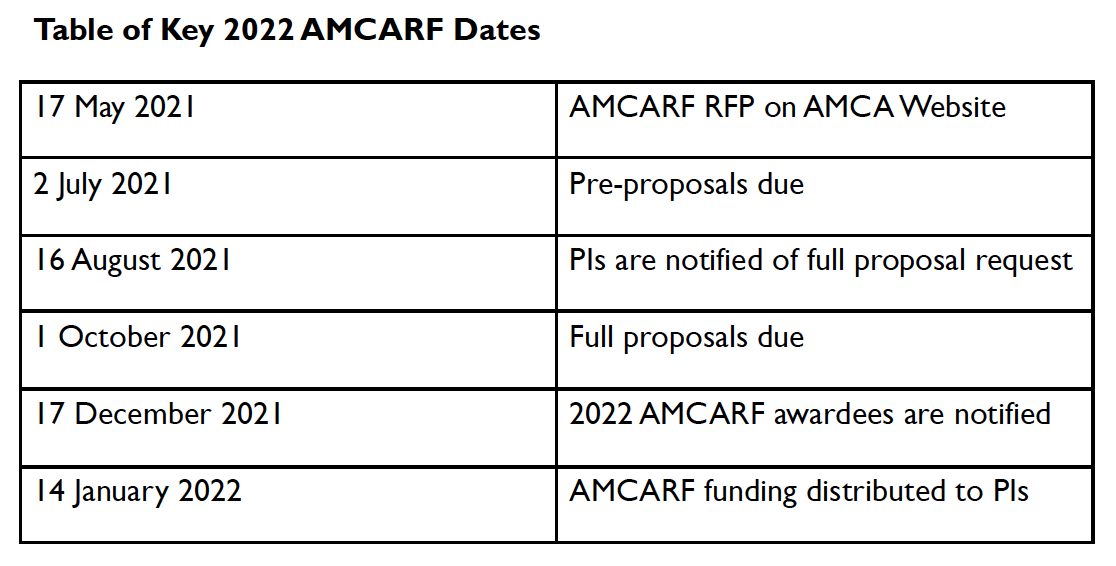
Pre-proposals will be reviewed from 6 July 2021 to 16 August 2021. Principal Investigators of proposals selected for a full proposal will be notified on 16 August 2021. Full proposals from selected pre-proposals will be due by 1 October 2021 with notification of award by 17 December 2021.

Principal Investigators for those projects selected for full proposals will be provided guidance on the requirements of a full proposal.
Funding
Funding will be provided to awardees by 14 January 2022, and awardees will be publicly
announced at the 2022 AMCA Annual Meeting in Jacksonville, Florida and published in the
Annual Meeting Program.

Funding awarded may be up to $55,000 per one year of a project; however, preference will be given to projects that request less than $55,000.

Funds should be spent within 12 months of the award date; unspent funds will be revoked and replaced into the AMCARF pool for the next funding cycle. Requests for extension beyond 12 months must be submitted to the AMCARF no later than 1 month before the expiration date.

AMCARF does not make multi-year funding commitments. However, AMCARF will make a
single-year commitment for a multi-year project. For multi-year projects, the year for which
support is being requested must be indicated (e.g., “Year 2 of a 3-year project”).

AMCARF is committed to funding small projects and cannot fund university or
government overhead costs or administrative fees.
Reporting
AMCARF awardees are expected to attend, actively participate in, and conduct an oral
presentation at the AMCA Annual Meeting to promote the impact of their research and
AMCARF’s role in that research. Depending on the number of AMCARF-funded projects, an
AMCARF Research Symposium may be scheduled. At minimum, oral presentations of
AMCARF-funded research will be slotted in the relevant sessions and specifically marked as
AMCARF research in the AMCA Annual Meeting program.

Specific details on funding for attending the AMCA Annual Meeting must be included in the
budget.

A Progress Report will be required to be submitted by 29 July 2022.

An Annual Report will be required to be submitted by 16 December 2022.
AMCA | Website