Spring 2023 | Volume 2 | Issue 2

Subscribe to stay in touch!

Since our last issue:


Runaway and Homeless Youth Training and Technical Assistance (RHYTTAC)

 2022 National Grantee Training


RHYTTAC hosted a powerful grantee training in November 2022. Participants had access to workshops and breakout sessions and experienced dynamic opening and closing keynote speeches from Dr. Shawn Ginwright (Founder/CEO of Flourish Agenda, Inc. and Professor at San Francisco State University) and Jeremy Anderson (author. coach and entrepreneur) respectively. Get access to the training recordings here.


Did you know that the RHYTTAC 2023 National Grantee Training is being held in person for the first time in three years! Mark your calendars now to attend the training in Seattle, WA, November 29, 2023 - December 1, 2023. Also, be sure to check with RHYTTAC for more information about in person upcoming regional trainings.


New Commissioner for the Administration on Children, Youth and Families Appointed

The Administration on Children, Youth and Families (ACYF) welcomes a new commissioner, Rebecca Jones Gaston, confirmed by the U.S. Senate in December 2022. Located within the U.S. Department of Health and Human Services, ACYF is comprised of the Children’s Bureau and the Family and Youth Services Bureau. ACYF programs provide social services that promote the positive growth and development of children, youth and their families through protective services and shelter for children and youth in at-risk situations and adoption for children with special needs.


Commissioner Gaston has worked in the field of human services and child welfare for nearly 25 years as a social worker, advocate, therapist, consultant and administrator. Before joining the Biden Administration, Gaston was the child welfare director for the state of Oregon’s Department of Human Services that oversees child protection, foster care and adoption services. Gaston also served as a director with Casey Family Programs providing technical assistance to child welfare agencies throughout the United States, served as the national campaign director for AdoptUsKids, a collaboration with the Children’s Bureau and the National Ad Council, and served as the executive director of the Maryland Department of Human Services’ Social Services Administration with oversight of child welfare and adult services.


Gaston holds a degree in psychology from Georgetown University and a master’s degree in social work from the University of Pennsylvania. Learn more about Ms. Gaston here.


!!! New Infographic Available!!!


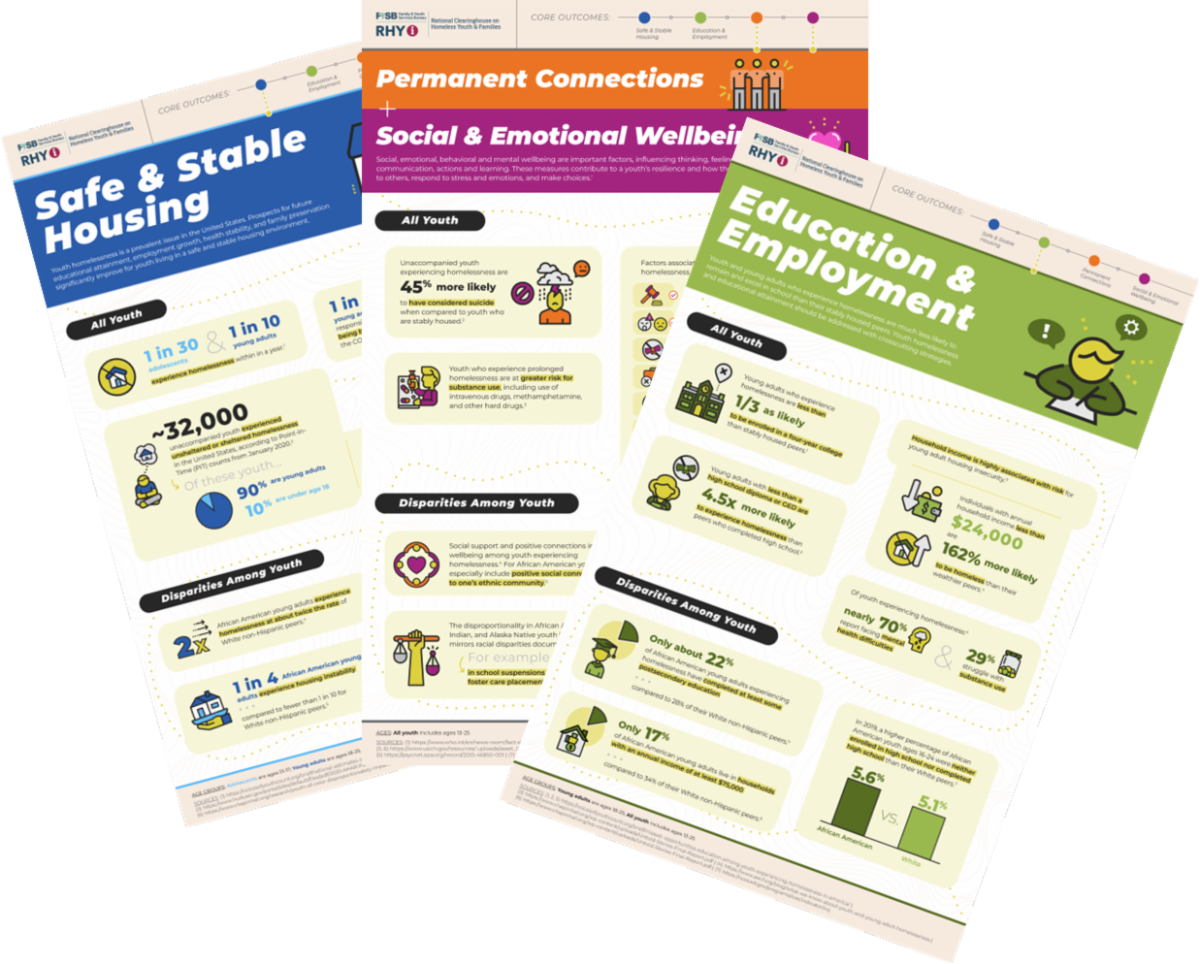
The National Clearinghouse on Homeless Youth and Families has developed an infographic on data related to disparities among youth experiencing homelessness and those contemplating running away. The data are framed by the Runaway and Homeless Youth (RHY) Program’s four core outcomes: safe and stable housing, education and employment, social and emotional well-being, and permanent connections. This infographic provides helpful data to RHY grantees and others in the RHY research and advocacy community that can be used to support program implementation, development of materials, grant development and applied research.


Click here to get the infographic.


Upcoming Observances

Monthly observances allow us to focus on issues that impact youth experiencing homelessness and those contemplating running away. The Clearinghouse has developed materials that are targeted at these observances to provide you with information to improve your program's performance. Check them out below.

May

June


The Director's Corner

Each May, we recognize Mental Health Awareness Month to help raise awareness about the importance and impact of mental health on the well-being of all people across our Nation. Among youth who experience homelessness, rates of mental health disorders are significantly higher than among young people in the general population.1


The Voices of Youth Count report from Chapin Hall at the University of Chicago found that 69 percent of homeless youth reported mental health problems. According to the Substance Abuse and Mental Health Services Administration (SAMHSA), the trauma of homelessness, even short term, can have a significant impact on a youth’s future development. Children who experience homelessness have significantly higher rates of emotional, behavioral, and immediate and long-term health problems. They often struggle with self-esteem, which puts them at risk for substance use, suicide, and other negative outcomes. Four out of five children who are experiencing homelessness have been exposed to at least one serious violent event by age 12.2


Further, the Centers for Disease Control and Prevention named suicide as the leading cause of death among youth experiencing homelessness and also indicated high rates of suicide attempts among these youth. While research suggests that the interpersonal factors of perceived burdensomeness and thwarted belongingness are proximal causes of suicide, more research is needed about factors associated with these risks.3 


The RHY Program funds grantees that support youth experiencing homelessness, those at risk of homelessness and those contemplating running away throughout the U.S. and its territories. Our grantees screen for mental health concerns upon intake and are able to connect youth with community mental health providers when necessary.


I am glad to share a webinar series available from our partner, the Runaway and Homeless Youth Training and Technical Assistance Center (RHYTTAC). These interactive webinars will help you stay informed about the role that SAMHSA plays in addressing homelessness youth behavioral health, benefits of peer-to-peer mental health training for youth and approaches for direct care providers and staff to foster and protect their own mental health. The first webinar, Mental Health Virtual Training: SAMHSA Efforts to Support Youth Experiencing Homelessness (description below), is being conducted on Tuesday, May 16, 2023, from 1:00 PM - 2:30 PM EDT. Click here to learn more and register for this free virtual webinar. There are two additional webinars planned in the coming months. We will announce registration procedures for these webinars as more information becomes available, so be sure to subscribe to our mailing list so you won’t miss out! 


Part 1: SAMHSA Efforts to Support Youth Experiencing Homelessness (February 2023)

In a March 2019 report, the Congressional Research Service identified family conflict and family dynamics, a youth's sexual orientation, sexual activity, school problems, pregnancy and substance use as primary risk factors for youth homelessness. This population accounts for most in need of behavioral health services. This presentation will aim to increase audience awareness and understanding of the role that SAMHSA plays in addressing homelessness youth from the perspective of behavioral health.


Part 2: Youth Mental Health: Peer to Peer Learning Space (Peer to Peer Led Training) (TBD)

Many youth who are experiencing a housing crisis will also experience a mental health challenge at the same time. It is important for those working with youth who have run away or are experiencing homelessness to understand the basics of mental health and how these co-occurring challenges affect each other. This training will give participants the opportunity to learn from the presenters, as well as peers.


Part 3: Supporting Mental Health Needs of Youth (Youth & Young Adult Led Training) (TBD)

Mental well-being is complex and layered. Acknowledging the impact of trauma on the mental welfare for youth is one piece in promoting health outcomes; acknowledging secondary trauma or re-traumatization for providers is another. As we continue to discuss mental health supports for youth, we will also discuss approaches for direct care providers and staff to foster and protect their own mental health. Participants will have the opportunity to engage in youth-led and peer-to-peer learning, facilitated discussion, and interactive coaching. 


Sources

1 https://www.usich.gov/resources/uploads/asset_library/Homelessness_in_America_Youth.pdf

2 https://www.samhsa.gov/homelessness-programs-resources/hpr-resources/youth

3 Slesnick N, Zhang J, Walsh L. Youth Experiencing Homelessness with Suicidal Ideation: Understanding Risk Associated with Peer and Family Social Networks. Community Ment Health J. 2021 Jan;57(1):128-135. doi: 10.1007/s10597-020-00622-7. Epub 2020 Apr 17. PMID: 32303933; PMCID: PMC7572482.


Now Available!

Notice of Funding Opportunity

FY 2022 Housing and Urban Development (HUD)

Youth Homeless Demonstration Project (YHDP)


The U.S. Department of Housing and Urban Development (HUD) released the Notice of Funding Opportunity (NOFO) for the Youth Homeless Demonstration Project (YHDP) on April 13, 2023. HUD will award approximately $60 million in the YHDP to up to 25 communities nationwide through this NOFO.


The YHDP is an initiative designed to reduce the number of youth experiencing homelessness. The goal of the YHDP is to support selected communities, including rural, suburban, and urban areas across the United States, in the development and implementation of a coordinated community approach to preventing and ending youth homelessness.


Applications are submitted through grants.gov. Read more about HUD’s YHDP Notice of Funding Opportunity (NOFO) here. Applications are due June 27, 2023.


NOFO Details

Funding Opportunity Number: FR-6700-N-35

Funding Opportunity Number: Youth Homeless Demonstration Program

Expected Number of Awards: 25

Total Program Funding: $60,000,000

Award Ceiling: $15,000,000

Award Floor: $600,000


NCHYF Research Summaries Database

Computer and pen and coffee cup on desk

The Clearinghouse is a national resource to help you stay up to date on the latest research, screening and assessment tools, communications information and more. We've provided a few resources below to help with enhancing your knowledge of the varied issues impacting youth contemplating running away or experiencing homelessness.


Visit our Research Summaries Database to search for reliable information to support the growth and sustainability of your youth serving organization. Let us know other topics you are interested in learning more about. Email us at GetRHYi@nchyf.org.


RHY Screening and Assessment Tool

Have you had difficulty finding the right screening and assessment tool to help provide a better understanding of how to help your clients? Perhaps you have found one, but are not sure if it's a reliable instrument.


We have done that work for you! The Clearinghouse has reviewed hundreds of tools to create a database containing more than 125 RHY screening and assessment resources that you can trust are valid and credible. You can search for the type of tool you want, stratified by multiple filters such as cost, age range, trauma, etc.


Check out this tool here.


Partner Resources

The goal of The Clearinghouse is to support the end of youth homelessness. We understand that achieving this goal requires collaboration among multiple organizations and systems that support youth. These include local, state and federal partners, youth serving organizations and academia. The Clearinghouse forges partnerships with all of these entities to bring you the most current and credible resources to support your programs.


Two of our primary partners, who are also supported by FYSB, are the National Runaway Safeline (NRS) and the Runaway and Homeless Youth Training and Technical Assistance Center (RHYTTAC). We encourage you to learn more about these organizations for resources and best practices to support your clients.


NRS provides free resources to support your implementation and outreach activities. Check out these resources available below from NRS and visit their website for more resources.


RHYTTAC is the training and technical assistance provider for all federally-funded RHY grantees. Stay in touch with RHYTTAC for assistance in developing and implementing effective approaches to serving young people who have run away and/or are impacted by homelessness, accessing new resources, and establishing linkages with other programs with similar interests and concerns.


Visit the RHYTTAC website for more resources.


Facebook  Twitter