|
|
Summer 2023 (June, July and August) | Volume 3 | Issue 3
| |
Save The Date
Runaway and Homeless Youth Training and Technical Assistance (RHYTTAC) 2023 National Grantee Training is being held in person for the first time in three years! This year’s theme, Together: Equity, Creativity, & Youth Leadership, highlights the importance of creating spaces for young people to be engaged in developing positive and affirming social connections with peers and adults. Mark your calendars now to attend the training in Bellevue, WA, November 29, 2023 - December 1, 2023. Also, be sure to check with RHYTTAC for more information about resources available to enhance program performance.
| |
We’re Excited – Check Out Our New Look! | |
The National Clearinghouse on Homeless Youth and Families (NCHYF) recently received a major facelift! In July 2023, we launched a new look and even more user-friendly functionality. The newly designed site features a carousel slide pointing you to new information on the site, a section highlighting resources, such as infographics, tip sheets, videos, and other information for the use of youth-serving organizations and those involved in research supporting ending youth homelessness. Browse the new site and let us know what you think! Email us at GetRHYI@nchyf.org. | |
Have you seen the latest? | |
|
It’s summertime! For most of us, summer is a time to relax, vacation with family and rejuvenate. However, for youth experiencing homelessness, summer can be a time of increased anxiety - largely because schools are closed, removing an important source for structure, stability and meals upon which these youth often rely. We also know that youth-serving organizations often experience a surge in requests for services during these months, straining their resources and staff.
The good news is that there are a variety of resources to provide support for these youth during the summer. For one, many school districts offer summer programs that provide meals for students. Additionally, under the McKinney-Vento Act (42 U.S.C. §11432(g)(1)(J)(ii)), every local educational agency (LEA) must appoint a local homeless education liaison (local liaison) who serves as the district’s lead homeless education contact. Among other responsibilities, local liaisons ensure that children, youth, and families experiencing homelessness receive referrals for physical, mental and dental health care, substance abuse issues, housing, and are informed of all available transportation services to their school.
NCHYF partner, National Runaway Safeline (NRS), is another resource to help support youth experiencing homelessness during the summer and all year. NRS maintains a comprehensive database of agencies and services that offer support to youth ages 12-21 across the United States and its territories. They refer youth and families in crisis to appropriate community-based organizations and collaborate to support prevention and educational programming.
Understanding that youth who are experiencing homelessness require additional support and resources during the summer months to help them feel stable and secure is an important aspect to supporting these youth. Check out the RHY Program grantee map to identify a grantee near you and available services for youth, or contact your LEA, the National Runaway Safeline, or dial 211 for information and referrals on summer programming for underserved youth in your area. We are hopeful that these resources provide solid starting points for your youth-serving program.
| |
LGBTQIA2S+ Youth Experiencing Homelessness | |
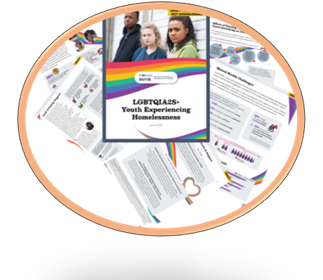
Youth who identify as LGBTQIA2S+[1] disproportionately experience homelessness and are at high risk for family rejection, physical assaults, and sexual exploitation in shelters and on the streets. Research shows that these youth have a 120% higher risk of experiencing some form of homelessness. LGBTQIA2S+ youth had over twice the rate of early death among youth experiencing homelessness.[2] Providing safe, supportive, and welcoming environments for LGBTQIA2S+ youth is essential for helping them find stability in their lives. Learn more about the challenges faced by these youth and resources to help support them. Click here to get the infographic.
| Mental Health Awareness Among Youth Experiencing Homelessness | |
|
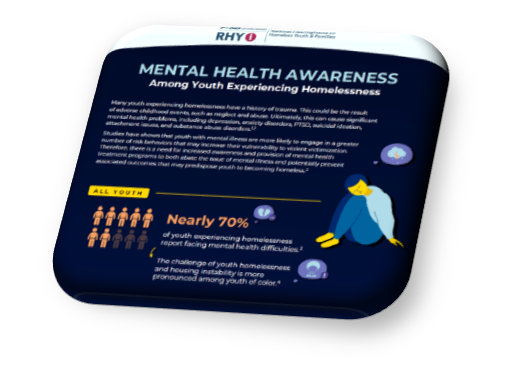
Many youth experiencing homelessness have a history of trauma. This could be the result of adverse childhood events, such as neglect and abuse, and result in significant mental health challenges. FYSB has created an infographic providing an at-a-glance overview of mental health awareness among youth experiencing homelessness. Check it out here.
| |
|
FYSB RHY Program Grantees
Support LGBTQIA2S+Youth Experiencing Homelessness
| |
|
Twenty-eight percent of LGBTQIA2S+ youth report experiencing homelessness or housing instability at some point in their lives had two to four times the odds of reporting depression, anxiety, self-harm, considering suicide, and attempting suicide compared to those with stable housing.[3] The FYSB RHY program funds youth-serving organizations to support these and other vulnerable youth.
RHY grantees offer a safe place for LGBTQIA2S+ youth experiencing homelessness or contemplating running away. Queer Peers, a gender and sexuality support group provided by RHY grantee Jackson Street Youth Services, provides a space for LGBTQIA2S+ youth to talk about things that are important to them, such as physical, social, and emotional health. FYSB funds grantees throughout the U.S. that offer a wide variety of services to LGBTQIA2S+ youth including providing food, shelter, support, enrichment, life skills and other training, coaching, and street outreach.
Check out the video featuring RHY grantees for ideas of how your organization might show its support of LGBTQIA2S+ youth. Subscribe to our mailing list for more videos featuring additional RHY grantees supporting Pride Month.
| |
Youth homelessness in the United States is pervasive, with young people of color disproportionately affected. Negative outcomes for young people who experience housing instability are copious and well-documented— from early pregnancy, to suicidality, to physical and mental health problems. Increasingly, jurisdictions across the country are looking to Direct Cash Transfer (DCT) programs as a possible solution.[4] | |
A DCT program is any intervention that provides money directly to individuals in the form of unrestricted payments.[5] Forms of payment are provided by check, giving cash, making a direct deposit or wire transfer to a bank account, using a prepaid debit card, or electronic mobile payments, and can be made in one lump-sum payment or regularized payments over time, such as biweekly or monthly payments. As such, DCTs differ from many other types of social programs that make payments to landlords, businesses, or organizations on someone’s behalf. These programs support youth to sustainably exit homelessness and get on paths of their choosing that lead to thriving.
| |
In 2019, a collaborative of Chapin Hall at the University of Chicago, Point Source Youth, and young adults with lived experience of homelessness conducted formative research and a process of engaging multiple stakeholders to inform the design and delivery of a DCT program for youth experiencing homelessness in New York City (NYC). This research led to the following key conclusions about how to develop an effective DCT program for young adults experiencing homelessness.[6]
-
Center the program on youth, equity, and trust. Youth of color—especially American Indian and Alaska Native, Black, Multiracial, and Hispanic youth—have significantly higher homelessness prevalence compared to their white non-Hispanic peers.
-
Boost housing stability and empowerment. The program will support youth to sustainably exit homelessness and get on paths of their choosing that lead to thriving. This objective should inform the cash transfer amount, duration, and optional supportive programming.
-
Adopt a flexible and simple approach. Youth experiencing homelessness have diverse needs, preferences, and circumstances. The program should allow youth to choose between different payment mechanisms and supportive programming options to facilitate better results for youth in diverse situations.
-
Identify and manage barriers to success. While common concerns about the risks of giving money to people living in poverty do not play out, certain design and support decisions can reduce the risk of rare adverse events and can help mitigate the potential of losing other public benefits or facing costly tax implications.
Whether your organization currently provides a DCT program or is considering developing one, these resources can be of assistance:
| |
NCHYF Research Summaries Database | |
|
The Clearinghouse is a national resource to help you stay up to date on the latest research, screening, and assessment tools, communications information, and more. We've provided a few resources below to help enhance your knowledge of the varied issues impacting youth contemplating running away or experiencing homelessness.
Visit our Research Summaries Database to search for reliable information to support the growth and sustainability of your youth serving organization. Let us know other topics you are interested in learning more about. Email us at GetRHYi@nchyf.org.
| |
|
The goal of NCHYF is to support the end of youth homelessness. We understand that achieving this goal requires collaboration among multiple organizations and systems that support youth. These include local, state and federal partners, youth-serving organizations and academia. We forge partnerships with all these entities to bring you the most current and credible resources to support your programs.
Two of our primary partners who are also supported by
FYSB are the National Runaway Safeline (NRS) and the Runaway and Homeless Youth Training and Technical Assistance Center (RHYTTAC). We encourage you to learn more about these organizations for resources and best practices to support your clients.
| |
|
NRS provides free resources to support your implementation and outreach activities. Check out these resources available below from NRS and visit their website for more resources.
National Runaway Prevention Month
This November is National Runaway Prevention Month (NRPM), a public awareness campaign that shines a light on the experiences of runaway and homeless youth and provides a source of hope and support for these young people. Spearheaded by the National Runaway Safeline (NRS) with support from the Family and Youth Services Bureau, NRPM brings together hundreds of partner organizations and Youth Ambassadors to educate the public about the importance of preventing youth homelessness and spotlight resources available to youth in crisis nationwide.
Youth-serving organizations are encouraged to join the NRPM partner community. All partners are provided with guidance, support, materials and more to help them plan and execute successful local NRPM campaigns. Partner registration is open now! For more information about NRPM and how to participate in the 2023 campaign, visit 1800RUNAWAY.org/nrpm.
Let’s Talk Podcast
This summer, the NRS Youth Advisory Board (YAB) has launched a series of podcast episodes. Planned and hosted by the YAB members, each episode delves into topics related to their own lived experiences, such as health care access for youth experiencing homelessness and the intersection of disability and homelessness." Find podcast episodes on the NRS website.
| |
|
RHYTTAC is the training and technical assistance provider for all federally-funded RHY grantees. Stay in touch with RHYTTAC for assistance in developing and implementing effective approaches to serving young people who have run away and/or are impacted by homelessness, accessing new resources, and establishing linkages with other programs with similar interests and concerns.
Visit the RHYTTAC website for more resources.
| |
|
[1] LGBTQIA2S+ acronym means Lesbian, Gay, Bisexual, Transgender, Queer and/or Questioning, Intersex, Asexual, Two-Spirit, and the countless affirmative ways in which people choose to self-identify.
[2] Morton, M. H., Samuels, G. M., Dworsky, A., & Patel, S. (2018). Missed opportunities: LGBTQ youth homelessness in America. Chicago, IL: Chapin Hall at the University of Chicago. Available at: https://www.chapinhall.org/research/lgbtq-young-adults-experience-homelessness-at-more-than-twice-the-rate-of-peers/
[3] https://www.thetrevorproject.org/research-briefs/homelessness-and-housing-instability-among-lgbtq-youth-feb-2022/
[4] https://www.chapinhall.org/wp-content/uploads/Cash-Transfers-Policy-Toolkit_Introduction.pdf
[5] https://www.chapinhall.org/wp-content/uploads/Cash-Transfers-Policy-Toolkit_Introduction.pdf
[6] https://www.chapinhall.org/wp-content/uploads/Cash-Transfers-Policy-Toolkit_Introduction.pdf
| | | | |