|
Theme:
- Foundations of Quality IEPs for TODHHs
Tech Tool of the Month
Featured Topic:
News from RMTC-DHH:
- What’s New with RMTC-DHH?
- Upcoming Training: See the Sound – Visual Phonics
- TA-Live!
- Coffee with the Contacts
Teacher Toolkit:
- Florida Communication Plan Webpage & FAQs
- Optimizing Outcomes for Students who are Deaf or Hard of Hearing
- Media and Materials Loan Library
- Media and Materials Own Library
Did You Know?
- Florida Educators of Students who are Deaf & Hard of Hearing (FEDHH) Conference
- 8th Annual Scarlett’s Park Conference
- 2026 Interpreting for Deaf Professionals Summit
- Deaf Awareness Day Cookout
Upcoming Events
- TA-Live! Foundations of Quality IEPs for TODHHs
- Visual Phonics (Virtual)
- FEDHH Conference
- TA-Live! Writing Strong Present Levels & Measurable Goals
| |
Foundations of Quality IEPs for TODHHs
| |
In this edition of Tech Notes, we are diving into the core foundations of quality individual educational plans (IEPs) for students who are deaf or hard of hearing (DHH). Designed to support our entire community, including educators, specialists, administrators, interpreters, and families, this issue focuses on practical tools for building data-driven, student-centered plans. You will also find our featured Tech Tool of the Month, Deaf Awareness Month highlights, and the latest updates from RMTC-DHH. | | | |
Padlet
What is it?
Padlet is a visual collaboration platform that acts as a digital multimedia bulletin board. Its latest evolution, Padlet Sandbox, provides a flexible visual canvas for drawing, whiteboarding, and creating interactive learning paths. Coupled with its AI recipe generator, educators can transform lesson ideas into visual choice boards, timeline maps, and interactive discussion boards in seconds.
Why it’s great for educators:
-
Multimodal Submissions: Students can contribute using text, drawings, voice notes, video clips, or uploaded images, giving everyone a choice in how they express understanding.
-
Instant Visual Layouts: Organizes content automatically into clear streams, grids, or spatial maps to keep classroom discussions structured and scannable.
-
Interactive Sandbox Canvas: Allows teachers to design step-by-step interactive whiteboards, games, and clickable visual cards for station learning.
-
Granular Moderation Controls: Includes built-in content filters and teacher approval settings to keep student interactions safe and positive.
-
Generous Free Plan: The free tier includes full access to Padlet Sandbox and core board creation tools for everyday classroom use.
Bonus for students who are deaf or hard of hearing:
Padlet is a standout tool for providing equal visual access and spatial organization in the classroom. For students who are deaf or hard of hearing, fast-paced auditory discussions can present a real barrier. Padlet transforms class dialogue into an open visual gallery where posts, images, and text responses are anchored on screen.
Students who are DHH can process peer contributions at their own pace without needing to look away from an interpreter to track who is speaking. Teachers can use the "Map" or "Canvas" layouts to create visual vocabulary banks, where signed video models, written terms, and contextual pictures sit side-by-side. Additionally, the option for students to post visual drawings or typed responses allows students who are DHH to participate fully in class discussions without relying on oral turn-taking.
| | |
This month is dedicated to recognizing and supporting students who are deaf or hard of hearing. It honors the unique language (such as American Sign Language), traditions, and values of the Deaf community. It also provides an opportunity for educators to reflect on how they meet the communication and learning needs of these students, celebrate their strengths, and ensure they have meaningful opportunities to thrive in all educational environments.
RMTC-DHH offers a variety of resources to help educators and families work effectively with students who are deaf or hard of hearing:
-
Teacher Toolkit – Explore LiveBinders, Padlets, and assistive technology tools.
-
Assessment Tools – Use tools like the Florida Individual Performance Profile (FLIPP) to guide data-based discussions and support individualized planning.
-
Family Resources – Help families stay informed and involved in their child’s education.
-
The National Association of State Directors of Special Education (NASDSE) developed Optimizing Outcomes for Students who are Deaf or Hard of Hearing: Educational Service Guidelines in 2018. This publication discusses components of quality deaf/hard of hearing programs including essential principles, laws and policies, evaluation, personnel, and so much more. The book also contains the Deaf Hard of Hearing Program and Service Review Checklist (Chapter 9), which outlines critical components of educational programs for students who are deaf/hard of hearing. RMTC-DHH developed a series of webinars that can be reviewed as a professional learning community on the Ten Essential Principles from Optimizing Outcomes.
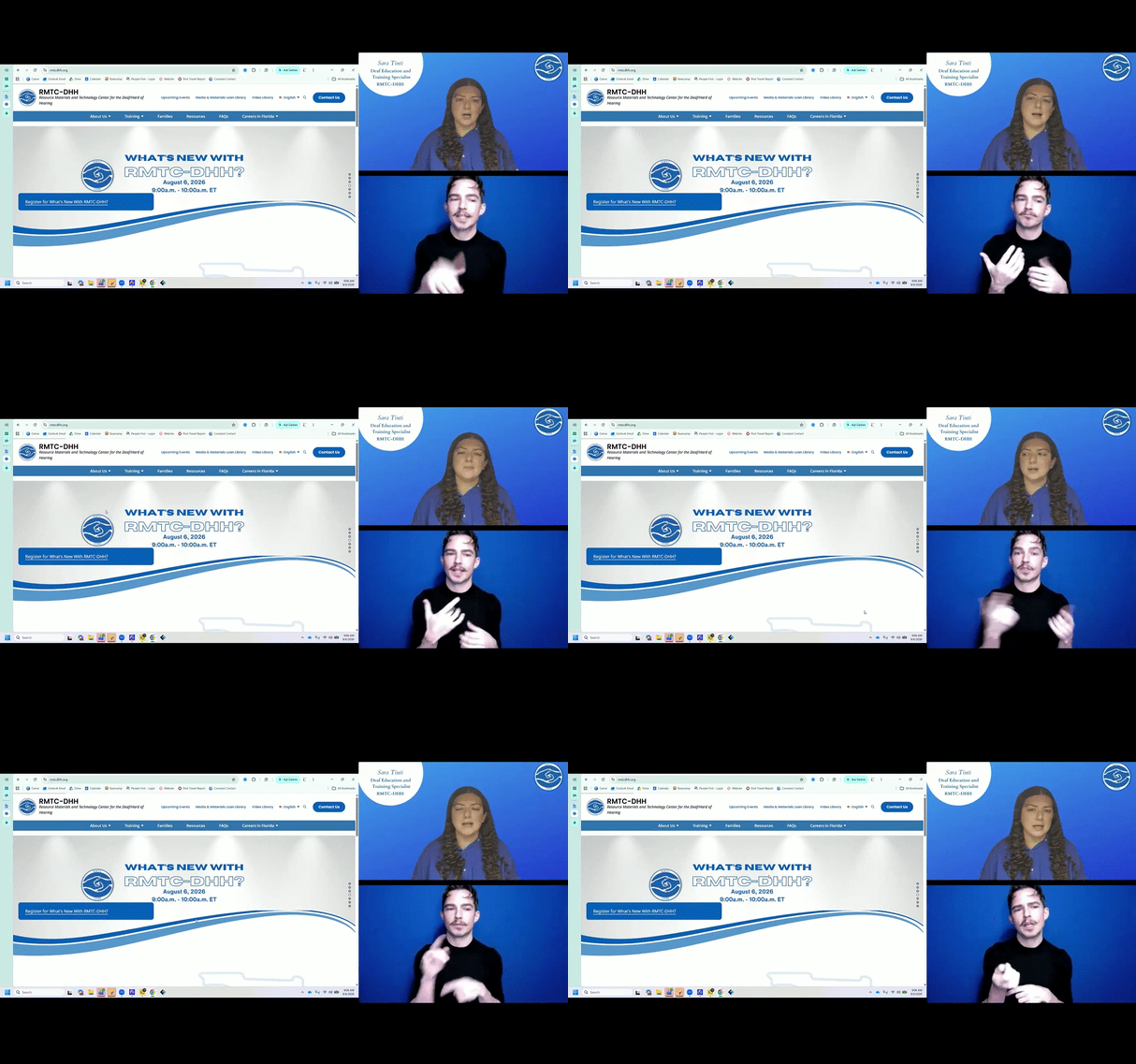
| | What’s New with RMTC-DHH? | Did you miss our welcome back webinar? RMTC-DHH has a plethora of exciting, new things happening this year! Including a new Media and Materials Loan Library and Own Library! Check out the recording to stay in the know. | Upcoming Training:
See the Sound – Visual Phonics | |
Please join RMTC-DHH for See the Sound – Visual Phonics.
See the Sound – Visual Phonics is a multisensory, evidence-based intervention approach to phonics instruction rooted in the Science of Reading. It features a system of unique hand movements and symbols that represent the sounds of English, without the ambiguity of English orthography. This includes sounds commonly referred to as vowels, consonants, diphthongs, and digraphs.
See the Sound – Visual Phonics is not an additional curriculum, but a strategy that can be integrated into existing phonics-based curricula or interventions.
Who should attend:
Professionals in Florida supporting students who are deaf/hard of hearing who have not been previously trained in See the Sound – Visual Phonics.
Training Dates:
-
October 6, 2026 4:00 p.m. – 8:00 p.m. EST (3:00 p.m. – 7:00 p.m. CST)
-
October 8, 2026 4:00 p.m. – 8:00 p.m. EST (3:00 p.m. – 7:00 p.m. CST)
-
Location: Online (Zoom)
Please note:
Participants are required to attend both days and keep their cameras on throughout the training to allow verification of correct handshapes. Completion of these requirements is necessary to be officially trained in the intervention and receive a certificate of completion.
| | | |
Please join RMTC-DHH for TA-Live! The sessions will be recorded for future viewing.
Sessions include:
-
September 23, 2026: Foundations of Quality IEPs for Teachers of the Deaf and Hard of Hearing (TODHH)
-
November 18, 2026: Writing Strong Present Levels & Measurable Goals
-
January 13, 2027: Accommodations, Services, Supports, & SDI
-
April 7, 2027: Progress Monitoring & Data Collection
When?
The next TA-Live! session will be September 23, 2026, from 2:00 p.m. to 3:00 p.m. ET (1:00 p.m. to 2:00 p.m. CT).
| The theme for this month’s discussion is Foundations of Quality IEPs for TODHHs. Please note that participants must register for each event separately to attend. For more information and to register for each event, visit the TA-Live! page. | | | |
Join RMTC-DHH for Coffee with the Contacts, a quarterly virtual collaborative learning community designed for DHH contacts and their designees. In these facilitated conversations, participants have the opportunity to propose and discuss topics related to the educational programs of students who are DHH. Contacts can visit the DHH Contacts webpage to submit discussion topics, access collaborative notes, and join upcoming sessions. These sessions will not be recorded, and automatic speech recognition captions will be available in Zoom.
New for 2026-2027: Participants must register separately for each event. Registrations will be available a month prior to each event.
When?
All session times are from 9:00 a.m. to 11:00 a.m. ET (8:00 a.m. to 10:00 a.m. CT)
- December 16, 2026
- February 24, 2027
- May 5, 2027
| | |
-
Florida Communication Plan Webpage & FAQs: Review key guidelines on completing Florida’s required Communication Plan, ensuring that your student's unique language and communication needs drive every decision made during the IEP process.
-
Optimizing Outcomes for Students who are Deaf or Hard of Hearing: Explore RMTC-DHH’s video series unpacking the national guidelines principle by principle, giving educators actionable strategies to design compliant, high-quality educational programs for DHH learners.
-
Media and Materials Loan Library: Explore our curated selection of professional books and multimedia resources available for checkout. Florida educators can borrow these titles at no cost to support in-depth professional learning:
-
Building Skills for Success in the Fast-Paced Classroom (Catalog #1958): A foundational guide for multidisciplinary IEP teams to understand accessibility considerations, acoustic environments, and team collaboration.
-
Co-Enrollment in Deaf Education (Catalog #1983): Provides research and framework models for collaborative team planning across mainstream and specialized DHH settings.
-
Media and Materials Own Library: Access our collection of print-ready guides, tip sheets, and instructional materials created by RMTC-DHH to support your practice. Florida educators can request physical copies of these resources to be printed and shipped directly to them at no cost to support classroom instruction and team collaboration:
-
Assessment Tools for Students who are Deaf and Hard of Hearing (Catalog #5000): Outlines evaluation rules under Florida regulations (Rule 6A-6.0331, F.A.C.), details minimum required assessments, and outlines mandatory timelines for initial evaluations and the IEP process.
-
TODHHs: Critical Resource Needed for Legal Compliance (Catalog #5024): Emphasizes the critical role of credentialed TODHHs in evaluation, legal compliance under IDEA/504, and active participation in IEP development and service delivery.
-
DHH Eligibility Timeline (Catalog #5008): Outlines the required steps and timelines for evaluation, eligibility determination, Communication Plan development, and IEP meetings in accordance with Florida regulations.
-
Communication Continuum for Individuals who are DHH (Catalog #5005): Visualizes the range of receptive and expressive communication preferences to guide initial team discussions regarding communication access.
| *Florida stakeholders may borrow or request materials for free from RMTC-DHH's Media and Materials Loan and Own Libraries, provided materials are shipped to an address within Florida. Return shipping labels are included with all borrowed Loan Library items, making shipping entirely free to the user. | | | | Florida Educators of Students who are Deaf & Hard of Hearing (FEDHH) Conference | | |
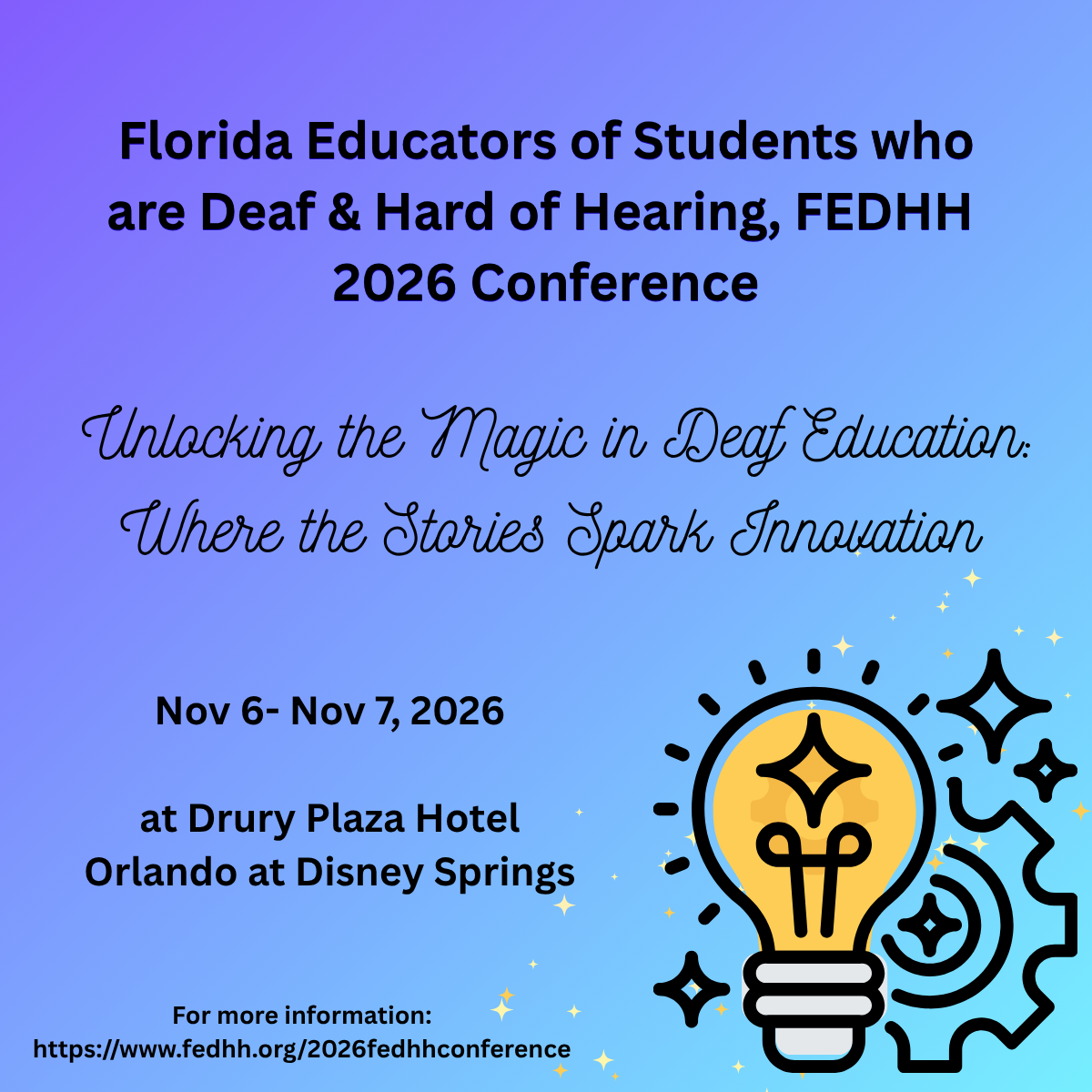
Join FEDHH November 6–7, 2026, at the Drury Inn & Suites near Disney Springs in Orlando for a collaborative conference advancing innovation and excellence in Deaf education.
Explore evidence-based practices, emerging ideas, and practical strategies to strengthen access, language, literacy, technology, inclusion, and academic outcomes for Deaf and hard of hearing learners.
Connect, collaborate, and leave inspired with new ideas and solutions for the future of Deaf education.
November 6–7, 2026
Drury Plaza Hotel Orlando near Disney Springs | Orlando, Florida
| | 8th Annual Scarlett’s Park Conference | | The Silent Garden at Fresno State is holding the 2026 Scarlett's Park Conference virtually on Saturday, September 26, 2026. This free online conference will focus on congenital cytomegalovirus (cCMV) and its impact on children who are DHH. The schedule features keynote speakers, professional presentations, and personal panel discussions covering medical, educational, and family perspectives. Free CEUs (RID and BEI) are available, and both ASL interpreting and live captioning will be provided. | | 2026 Interpreting for Deaf Professionals Summit | | The 2026 Interpreting for Deaf Professionals Summit will take place virtually from September 25–27, 2026. Organized around the theme "Align, Collaborate, and Elevate," this national conference brings together interpreters and professionals who are deaf, hard of hearing, and DeafBlind to optimize communication access across healthcare, technology, higher education, legal, and business environments. Attendees can earn up to 1.6 RID CEUs through a variety of interactive workshops and panel discussions. | | Deaf Awareness Day Cookout | | The Sally J. Pimentel Deaf & Hard of Hearing Center (DHHC) is hosting the Deaf Awareness Day Cookout on Sunday, September 20, 2026, from 10:00 a.m. to 3:00 p.m. at Lakes Park in Fort Myers. This free, all-ages community event celebrates National Deaf Awareness Month with food, drinks, games, crafts, and activities. Interpreters will be available throughout the day to support full access for all attendees. | | RMTC-DHH provides Tech Notes as a free resource to teachers, professionals, and families around the state in order to pass along potentially useful information and expand the knowledge and opportunities available to educators and families of children who are deaf/hard of hearing. This email was funded by the Florida Department of Education Bureau of Exceptional Education and Student Services through federal assistance under the Individuals with Disabilities Education Act (IDEA), Part B funds and through an agreement with the Florida School for the Deaf and the Blind. The information included does not reflect any specific endorsement by any parties involved. | | | | |