|
|  |
Barnstable County Regional Substance Addiction Council (RSAC) monthly E-newsletter is a tether of communication across towns, providers, organizations, and individuals on Cape Cod providing information on substance use across the continuum of prevention, harm reduction, treatment, and recovery. | |
BARNSTABLE COUNTY DEPARTMENT OF HUMAN SERVICES CHILDREN'S BEHAVIORAL HEALTH NEEDS ASSESSMENT | |
Barnstable County Department of Human Services conducted an assessment of behavioral health needs in Barnstable County over 14 months (June 2023–August 2024). The overarching goals of this assessment were to:
- Document and better understand the behavioral health issues and needs of children, youth, and young adults in each of the four sub-regions of Barnstable County.
- Document and better understand the availability and accessibility of behavioral health services for children, youth, and young adults in each of the four sub-regions of Barnstable County.
- Inform future efforts towards advocacy, including secure funding and services specifically for and within Barnstable County.
- Inform future efforts towards collaboration and service sharing across Barnstable County.
Throughout the assessment, behavioral health was defined broadly as individual and family experience of life stressors – beginning in early childhood – and stress-related symptoms; mental, emotional, and social well-being; health-related behaviors; and mental health and substance use disorders. Qualitative and quantitative data were collected through community forums, focus groups, surveys, and secondary data reviews.
Key findings reveal a rise in anxiety and depression among children, with symptoms appearing at younger ages. While 90% of parents sought help for their children, a quarter faced challenges accessing services, and half reported limited success. The study points to a lack of school-based mental health support and long waitlists for after-school programs, emphasizing the need for more recreational opportunities.
| |
HARM REDUCTION IN THE COMMONWEALTH: ANALYSIS OF OPPORTUNITIES TO SAVE LIVES | |
|
On December 3rd, the Massachusetts Health Policy Forum and RIZE Massachusetts hosted an event looking at the state's harm reduction services, trends in opioid overdose death data, and a report suggesting new steps to decrease those mortality rates.
The report, completed by researchers from the Opioid Policy Research Collaborative at Brandeis University, lays out 10 recommendations for the state to minimize harm based on overdose death data gathered between 2022 and 2023. While Massachusetts saw overdose deaths fall by about 10 percent in that period, decreases weren't uniform along racial, ethnic and geographic lines. Recent changes also continue to influence overdose deaths, including shifts in drug supply, the concentration and presence of fentanyl in drugs, and communities deploying harm reduction resources.
| |
HARM REDUCTION IN THE COMMONWEALTH: ANALYSIS OF OPPORTUNITIES TO SAVE LIVES | |
|
Drug overdose is a nationwide epidemic. Opioids, both prescription painkillers such as Oxycontin and non-prescribed drugs such as heroin and fentanyl, are responsible for most of these deaths – nearly 48,000 in 2018 alone. Provisional data show that overdose-related deaths have accelerated since then, with more deaths recorded in the twelve-month period ending May 2020 than in any other twelve-month period on record.
Opioid overdoses are typically reversible through the timely administration of the drug naloxone and the provision of emergency care. Access to naloxone and emergency treatment, however, is often limited by laws that pre-date the overdose epidemic and were developed for other purposes. In an attempt to reverse this increase in preventable overdose deaths, many states have recently amended those laws to increase access to emergency care for opiate overdose.
This resource summarizes characteristics of naloxone access in 50 states and the District of Columbia.
| |
PREVENTION SUSTAINABILITY SINCE 2009 | OVERVIEW OF THE LAS PALMERAS COMMUNITY COALITION | |
|
It was late 2009 when the CRESER NGO team found a group of people interested in forming a community coalition under the CADCA model in the Las Palmeras community in the Yarinacocha district, Coronel Portillo Province, Ucayali Department, Peru.
Since 2010, CADCA’s Community Change Model processes have been implemented, bringing together various sectors to conduct diagnostics, develop logical frameworks, and create a strategic plan, similar to many other coalitions around the world. However, this coalition has faced a history of challenges, gained valuable insights, and achieved significant milestones. Today, it is recognized at both the district and provincial levels, occupying a seat on the Multisectoral Committee for the Prevention of Drug Use in Ucayali.
The coalition has managed to develop an outstanding ability to obtain and manage material and human resources from local governments, health centers, the regional government, police, private companies, and professionals, as well as through fundraising activities. As a result, the coalition is recognized as a key organization in drug use prevention in the region and is actively included in regional prevention policies and intervention plans by the regional government and DEVIDA, the national governing body responsible for drug policy.
The Las Palmeras Coalition is a symbol of resilience and innovation in drug prevention efforts and stands as a testament to the power and effectiveness of CADCA’s coalition model. By bringing together different sectors and fostering community-led solutions, the coalition has overcome challenges and brought lasting positive change in the Ucayali region.
Join the CADCA Community to connect with other champions in the prevention field through their online directory!
| |
RESULTS FROM THE 2023 NATIONAL SURVEY ON DRUG USE AND HEALTH (NSDUH): KEY SUBSTANCE USE AND MENTAL HEALTH INDICATORS IN THE UNITED STATES | |
This report provides key findings from the 2023 National Survey on Drug Use and Health (NSDUH) on substance use, mental health, and treatment among the noninstitutionalized U.S. population aged 12 or older. Estimates are presented by age group and by race/ethnicity for selected measures. | |
HOLIDAY DRINKING: HELPING OLDER ADULTS BE HAPPIER AND SAFER | |
Using alcohol to cope places many older adults at heightened risk for negative consequences, especially for those who are social isolated and lonely. This recorded webinar will highlight the special risks of drinking among older individuals and how these risks are heightened over the holidays. Strategies that promote wellness that do not depend on alcohol consumption will be discussed. | |
TEN ESSENTIAL TIPS TO MAINTAIN YOUR RECOVERY DURING THE HOLIDAY SEASON | |
|
The holiday season can be a challenging time for those in recovery from addiction. The presence of alcohol (and sometimes other substances) at gatherings can pose a heightened risk of relapse. In addition, while this time is often filled with happiness and family connections for many, it can evoke a much more complex mix of emotions for people in recovery. The holiday atmosphere often brings past emotions to the surface, along with memories of family disputes and previous relapses, creating stress, fear and anxiety.
Regardless of whether it’s your first or thirtieth holiday season in recovery, the risk of relapse is an inherent part of long-term recovery. This makes crafting a holiday relapse prevention plan crucial. Such a plan helps identify potential triggers and strategize responses to them. Having a well-thought-out plan empowers you to enjoy the festive season while protecting your progress in your recovery.
This comprehensive list of tips can support your recovery during the holiday. Plan NOW so that you can navigate the festivities with confidence, maintaining your recovery while embracing the joy of the season.
| |
SAMHSA RECOVERME: EMPOWERING YOUNG ADULTS FACING SUBSTANCE USE AND MENTAL HEALTH CHALLENGES | |
|
SAMHSA is kicking off RecoverMe, a campaign that connects young adults (ages 18–25) to practical and affirming resources to help them navigate their unique challenges with substance use and mental health.
RecoverMe provides tools, resources, and a supportive recovery community to help young adults on their personal recovery journey and highlights that recovery is not one-size-fits-all. It is shaped by each person’s individual experiences.
| |
SAMHSA inicia la campaña Voy a Recuperarme. La campaña ofrece a los jóvenes adultos, entre 18 y 25 años, recursos prácticos que los empoderan y ayudan mientras ellos enfrentan retos únicos relacionados con el consumo de sustancias y con la salud mental.
Voy a Recuperarme les ofrece a los jóvenes adultos herramientas, recursos y una comunidad de apoyo para ayudarlos en su proceso de recuperación. La campaña también destaca que la recuperación no es igual para todos. Cada proceso de recuperación está formado por experiencias únicas de cada persona.
| |
SAMHSA ISSUE BRIEF: CO-OCCURRING MENTAL HEALTH AND SUBSTANCE USE | |
|
This Issue Brief is one in a series of briefs created by SAMHSA to provide guidance to State Mental Health Agencies to support improvement of the mental health systems within their states.
This document highlights the commonality of CODs and negative outcomes in the absence of evidence-based integrated care. It also provides an overview of treatment barriers and potential solutions, and the effectiveness of integrated care.
| |
PREPARING FOR A SOBER HOLIDAY SEASON | |
The holiday season is a time of joy, connection, and celebration. However, for individuals in recovery from addiction, this festive period can also bring about unique challenges. The temptations, social pressures, and emotional triggers that often accompany holiday gatherings can pose a threat to your sobriety. In this article, we aim to provide you with a comprehensive guide on how to not only survive but thrive during the holidays as a recovering addict. | |
PEOPLE WITH LIVED/LIVING EXPERIENCE OF SUBSTANCE USE WORKGROUP | |
|
Are you passionate about making sure the perspectives of people who use or have used drugs are incorporated into research? Do you want to help shape expectations for meaningfully engaging people with lived and living experience of substance use in research?
The National Institute on Drug Abuse (NIDA) is launching a working group to the National Advisory Council on Drug Abuse (NACDA) made up of people with lived or living experience (PWLLE) with drug use. The primary purpose of the group will be to advise on ways to enhance and increase meaningful engagement of PWLLE with drug use in NIDA-funded research. Workgroup members will provide input and feedback to help NIDA co-create standards for engagement of PWLLE in research that will serve as a resource for researchers and PWLLE about NIDA’s expectations regarding engagement in research.
| |
SMALL GRANT OPPORTUNITY: FALMOUTH COMMISSION ON SUBSTANCE USE | |
|
The Town of Falmouth Commission on Substance Use (FCSU) is pleased to announce the availability of Opioid Abatement funds to support local initiatives that aim to make a positive impact on the community.
Falmouth based projects will be considered for grants awards up to $1,000. Projects must serve residents of Falmouth and deliver services in the areas of substance use prevention/education, harm reduction, treatment services, or recovery supports. Rolling applications for these small grants will be reviewed at monthly FCSU meetings.
Applicants may be required to attend a FCSU meeting to discuss their proposal before or after an award is given. Notifications will be made by the next monthly FCSU meeting.
| |
TOWN OF BARNSTABLE 2024/2025 OPIOID ABATEMENT FUNDING APPLICATION INFORMATION | |
The Town of Barnstable is requesting applications for Opioid Abatement funding from public or private, state and federally recognized nonprofit organizations, agencies, partnerships, or other interested parties to provide services, programs, or initiatives that will mitigate the impacts of the Opioid epidemic.
Please mail or drop off completed applications to:
Town of Barnstable
Town Manager’s Office
367 Main Street, 2nd floor
Hyannis, MA 02601
Completed applications may also be emailed (please put Opioid Abatement Funding Application in subject line) to: email@town.barnstable.ma.us.
| |
OPIOID RECOVERY & REDMEDIATION FUNDS COMMUNITY ENGAGEMENT MODEL PROCESS | |
|
This report (linked below) was created to capture and share a pilot process of authentic community engagement in the decision-making process about Opioid Recovery and Remediation Fund settlement spending. The following describes efforts undertaken in collaboration by the Town of Falmouth, the Falmouth Commission on Substance Use, consultant & facilitator Sky Freyss-Cole and Barnstable County Department of Human Services (BCDHS).
For more information about the contents of the report, please contact Deputy Director of Barnstable County Department of Human Services Mandi Speakman | mandi.speakman@capecod.gov, (508) 470-4936.
| |
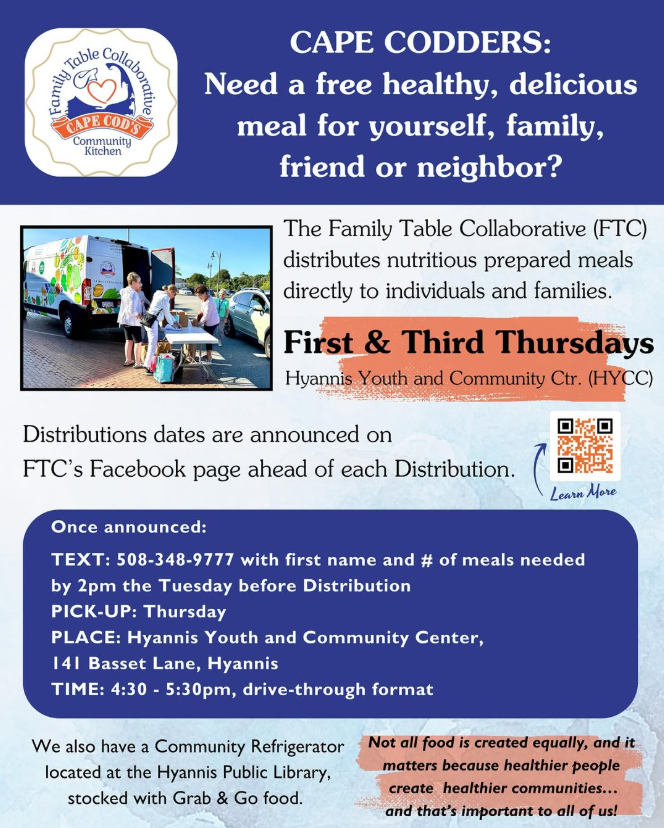
FAMILY TABLE COLLABORATIVE | |
EASTHAM COMMUNITY REFRIGERATOR | |
|
The Eastham Department of Health is excited to announce the Eastham Community Refrigerator! We have healthy food available to anyone who needs it.
Hours of operation are Monday – Friday, 8 AM to 4 PM. We are located in the Health & Conservation Department next to Town Hall at 2500 State Highway, Eastham. Call to see what's in stock! (508) 240-5900 Ext. 3230
| |
FOOD ACCESS CAPE COD
Be sure to download our Cape & Islands Food Access Resource Guide! This publication is updated regularly by the Barnstable County Cape Cod Cooperative Extension and contains all the information you need for food accessibility.
| |
|
ARE YOU REPRESENTED ON OUR NETWORK OF CARE SERVICE DIRECTORY WEBSITE? | |
The Barnstable County Department of Human Services’ Network of Care (NOC) SERVICE DIRECTORY website, is a robust local health and human services directory with resources for individuals, families, and agencies on Cape Cod with public health questions and concerns.
| |
|
newsletter sign-up & submit | |
|
Yes! I'd like to received the Human Services e-newsletter. When you click 'sign me up!' you will have a choice to receive both the Human Services and/or RSAC e-news delivered directly to your inbox.
| |
|
|
* Submissions will only be accepted using our online submission form.
* Attachments must be in .PDF FORMAT ONLY please.
* Posting of articles submitted for this publication is at the discretion of the Department.
| |
| | | |