Consider This...Things to Consider in June 2021
|
|
In this Month:
- June Articles
- Useful Tips and Resources
- Upcoming Federation Events
Click titles for full articles
|
|
News and information about education, research, and support for SESPs; adoptive, foster, and kinship caregivers; and child welfare and education professionals helping children with trauma and other special needs get the most from their education. |
|
|
|
Greetings!
Pathways for Parents (Pathways) is a project at the Federation for Children with Special Needs (FCSN) that supports several programs funded by the Department of Children and Families (DCF) around special education related issues. Pathways offers technical assistance and guidance to these programs, and trainings for a wide range of audiences. The Pathways Coordinator works to make a connection between the Federation and DCF to provide access to trainings and information that support children involved with DCF and other DCF-supported community programs. Pathways works closely with the Recruitment, Training and Support Center (RTSC) to support eligible DCF students in congregate care settings.
The largest group that Pathways serves is the Family Resource Centers (FRCs). There are now 27 FRCs around the state, with at least one in every county. FRCs are an amazing resource for their communities and offer services for free to any family regardless of income. Each FRC has a partner agency in the community. Read More
|
|
|
|
How often have you already heard the phrase "I'm Bored!" They haven't even been out of school for a second yet, and they are already complaining. But what if I told you that boredom may not be a bad thing, especially for the child. Children's boredom can actually be a positive motivator of multiple skills acquisition. "Boredom fosters creativity, self-esteem and original thinking. “The key is to help kids learn how to manage their boredom so they can develop independence and feel agency over their own happiness and well-being,” Dr. Lee advises."
|
|
Would you be surprised if I told you that statistically, 1 out of every 3 black children in America has from two to eight adverse childhood experiences (ACEs) before the age of 18? I'm not surprised given people of color have been historically marginalized resulting in more vulnerable socioeconomic situations that can lead to ACEs. The problem is complicated even further by the fact that the stigma of racism and that of mental health cause an intersection that is devastating to the community as well as the individuals who are struggling.
|
|
|
|
|
"As the world continuously evolves, it is a professional, moral, and ethical obligation for educators to revisit and rethink approaches to teaching and learning." says Lauren Kaufman and Lainie Rowell. If this past year has taught us anything, it is that we need to be adaptable to the needs of our students. We have all been through a lot, especially the children, and now is the time to stop and examine the way that we teach and address those needs.
|
|
I know as a parent as well as a professional, that the phrase "I'm so proud of you" gets used in an attempt to validate another person's feelings and accomplishments. But does it though? I believe that it can be a tricky statement to make to a child, especially one that has little or no self-esteem. If they don't believe that it is something that they can be proud about, then it often falls flat. And often it takes the focus off of the child and places it back on yourself, as if your opinion is more important than how they feel.
|
|
|
|
|
This article from NESCA's Kelley Challen, Director of Transition Services, speaks about the benefits of teens working either during the school year or over the summer. Although the teen workforce has declined over the years, the skills acquired, both "soft" interpersonal skills or vocational skills have a long lasting impact as a predictor of future success. Teens who work are more likely to be successful in post-secondary areas. So for students with challenges this acquisition of skills is very much a necessity.
|
|
As the restrictions of COVID-19 are being lifted in the state the opportunities for working on transition skills are broadening as well. This article is guide and a resource of activities that transition age youth can now be working on in order to accelerate their skill development. Check out the listings!
|
|
|
Useful Tools, Media and Resources |
|
If you have children in child care or work with an EEC licensed program, you will be interested in this recent update by EEC Commissioner Samantha Aigner-Treworgy.
LINKS to Other Useful Resources
|
|
|
Upcoming Federation Events |
|
|
|
Monday, June 28th at 6:30pm
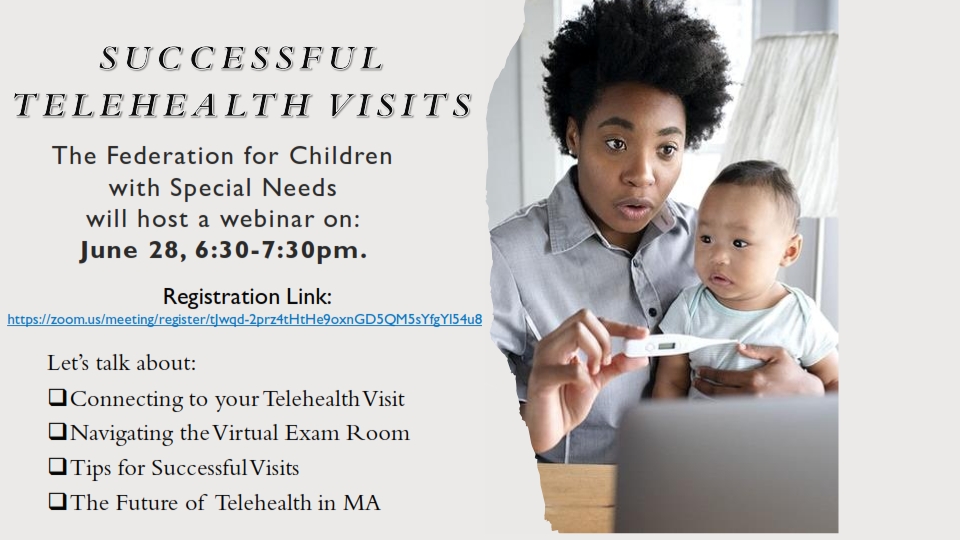
Join the Federation for a presentation on Successful Telehealth Visits on Monday 6/28 at 6:30pm. We will talk about connecting to your Telehealth visit, navigating the virtual exam room, tips for a successful visit, and the future of Telehealth in Massachusetts. Register Here
|
|
June 29th, 10:00am - 12:00pm
July 16th, 10:00am - 12:00pm
|
|
This training will offer a systematic approach to looking at Developmental Childhood Trauma as it impacts our students in the child welfare system. This interactive training will study trauma’s effects on the academic and social/emotional learning of a student and the impact on their IEP.
|
|
|
|
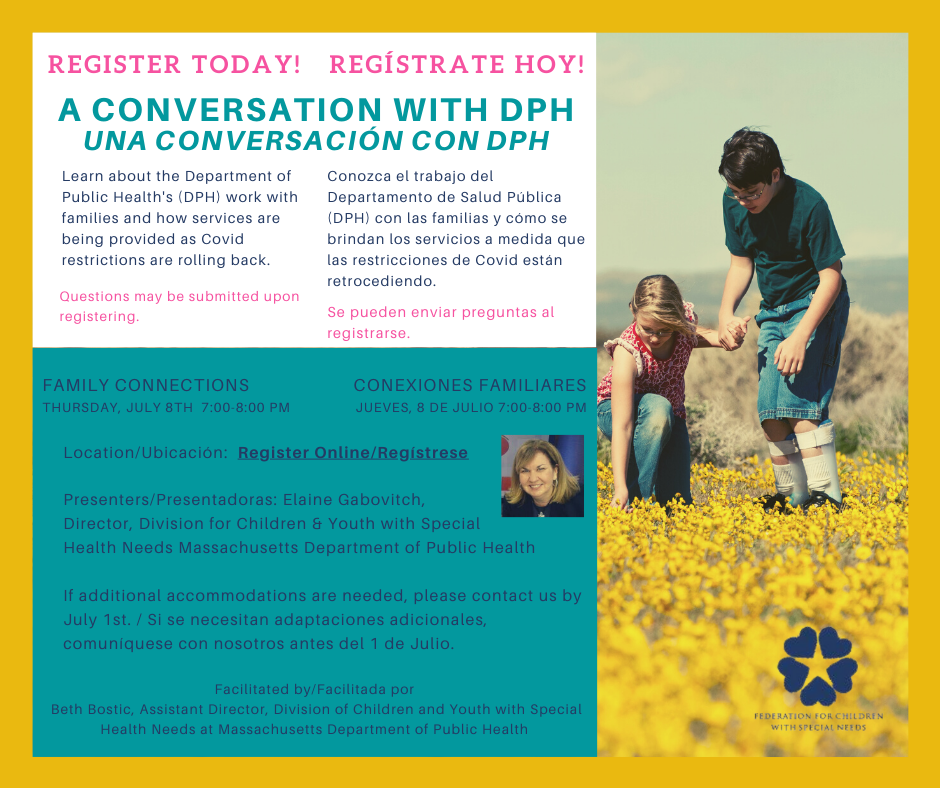
Join us for an opportunity to talk with other families about your questions and concerns, strategies and successes. Our guest is Elaine Gabovitch, Director, Division for Children & Youth with Special Health Needs. Discussion facilitated by FCSN Board Member Beth Bostic.
Únase a nosotros para tener la oportunidad de hablar con otras familias sobre sus preguntas e inquietudes, estrategias y éxitos. Nuestra invitada es Elaine Gabovitch, directora de la División para Niños y Jóvenes con Necesidades Especiales de Salud. Discusión facilitada por Beth Bostic, miembro de la junta de FCSN.
|
|
July 22nd, 2:00pm - 3:30pm |
|
This presentation provides an understanding of the transition planning process, including why transition planning is important, services that could be included, who is eligible, student and parent/SESP roles in transition planning, and the role of student’s vision. We will discuss how to prepare for a transition planning meeting, using the transition planning form, the age of majority, the anticipated graduation date, and the options when the Team does not agree, including procedural due process rights.
|
|
August 4th, 3:00pm - 4:30pm |
|
Discipline and Suspension Discipline and Suspension Describes different types of disciplinary offenses, the school responsibilities for discipline, range of consequences for rule violations, the difference between suspensions, expulsions, and emergency removals, different categories of suspensions, procedures for out of school suspensions and expulsions, and legal protections for students on IEPs including the Manifestation Determination Review.
|
|
|
|
SESP Weekly Zoom Special Education Surrogate Parents Weekly Zoom Meeting All SESPs are welcome. This will be an open zoom meeting format with RTSC support staff facilitating conversations around general questions that are common among SESPs. Hosting this month's groups is Bridget Koetsch at bkoetsch@fcsn.org or (617) 399-8369. Register
Thursday, July 1st, 6:00-7:00 pm
Tuesday, July 13th, 12:00-1:00 pm
Saturday, July 24th, 9:00-10:00 am
Wednesday, July 28th, 6:00-7:00 pm
|
|
Free Upcoming Online Orientations
Wednesday, June 30, 2021 at 5:00-7:30 pm
Wednesday, July 14, 2021 at 6:30-9:00 pm
Saturday, July 24, 2021 at 12:00-2:30 pm
Tuesday, July 27, 2021 at 9:00-11:30 am
|
|
For more information on becoming a Special Education Surrogate Parent
|
|
Federation for Children with Special Needs
|
|
|
|
|
|
|