RUN - RESEARCH UNIVERSITIES' NEWSLETTER
VOL 20 | OCT 8, 2021
|
|
Universities and the Provincial Economy – Part 1 |
|
“Governments have a critical role to play in shaping markets, not just fixing market failures…[r]esponding after a failure has occurred is, by definition, too late – and often carries a high financial and human cost, as we have seen with COVID-19 and the 2008 financial crisis. As the Province of B.C. advances its economic recovery agenda, it has the opportunity to shape a different kind of economy – one that is sustainable, inclusive, resilient, and oriented around solving problems that matter to people and planet.”
– Marianna Mazzucato, world leading economist specializing in relationships between technological, economic, and social change.
|
|
For many generations British Columbians in all corners of the province have benefited from our abundant natural resources; we have been extraordinarily lucky by global standards to enjoy such a rich natural endowment. BC is also well-positioned to thrive in a new global environment where knowledge and ideas are increasingly critical to generate economic and social benefit for all the people of our province. We can do this because we have an outstanding K-PhD education system, vibrant technology and life sciences sectors, and a remarkably attractive environment in which to live, work, and play.
And while our natural resources remain a great strength, businesses in these sectors have been shifting rapidly to apply advanced technologies to create ever-greater economic and social value. Resource companies have become high-tech companies, increasingly reliant on highly educated and skilled workers. This shift is in response to global pressures and opportunities, and it mirrors the rise in technology-driven solutions in all parts of the economy.
While the nature of employment in the resource sectors has shifted increasingly to knowledge intensity from previous decades, at the same time there has been very rapid growth in many kinds of jobs that require ever-higher levels of education. We have seen companies like Boeing, Microsoft, and Amazon attracted to BC by our location, a stable and inclusive society, and by the availability of high-quality talent. Over the past year we have also seen ten BC startup companies— AbCellera, BlockStream, Clio, Dapper Labs, Galvanize, GeoComply, Nexii, Thinkific, Trulioo and Visier— become “unicorns”, reaching valuations of $1 billion and employing thousands of people. These companies, and many others like them, have an insatiable demand for highly talented employees.
For BC to continue to attract foreign investment, and for our BC startups to remain local while scaling up to become global anchor companies, they will increasingly need ever more skilled, high-level talent as well as investment capital and exceptional leaders. In the new economy, people don’t just go to where companies are—companies go to where talent is.
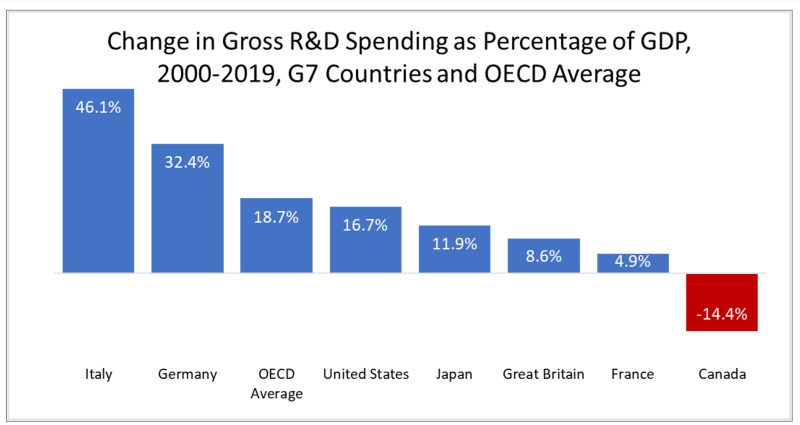
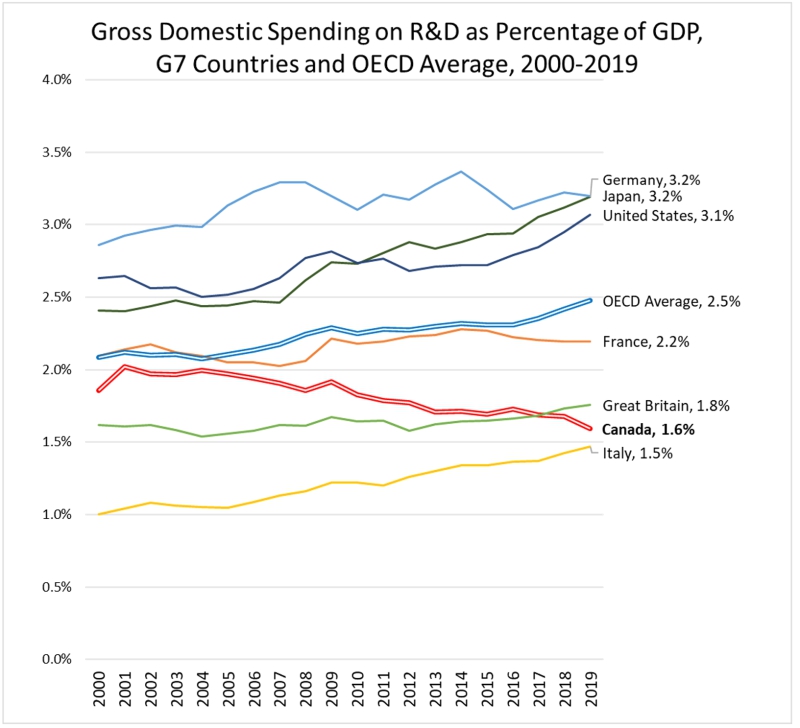
BC’s innovation ecosystem has made substantial progress but much more needs to be done. Innovation, and the economic gains it creates, result directly from investment in research and development. This link between innovation and economic growth is well understood across the globe, as demonstrated by other countries’ R&D investments over the last 20 years:
|
|
Unfortunately, Canada is the only G7 country where R&D investment as a percentage of GDP is declining, driven by both shrinking business investment in R&D and decreasing public investment. This will hurt the country over the long term.
|
|
Other jurisdictions are investing heavily in innovation because they are convinced that attracting business capital and advanced talent will drive their economies. And some of them (USA, Germany, Britain) have recently announced yet further acceleration of investments which will place increasing pressure on talent attraction for those who are investing, and on talent retention for those who are not.
In BC we have an opportunity to similarly drive our innovation ecosystem and economy if all of us—industry, academia, and government—work together to leverage ideas, talent, and capital to drive solutions to some of our most pressing challenges. We should set our own priorities and capitalize on the innovation assets that are already established: green solutions, biomanufacturing, digital and advanced computational technologies, and resource-related innovations.
With rapid changes in the global economy, BC cannot afford to be complacent. We cannot continue to rely solely on our rich natural endowment as a source of wealth and an attractor of talent. It is increasingly urgent for us to modernize our economy to retain the standard of living we currently enjoy.
Our universities contribute strongly to the talent and ideas that drive national and provincial success, and therefore they should be seen as a key part of the economic plan of the province. This will require investments in advanced talent, particularly in graduate programs. It will require coordination and incentives by government for increased investment by business in R&D and innovation. And it will require ambitious goals to be set that involve cooperation and mutual benefits among business, government, and post-secondary institutions.
BC’s research universities are heartened that mission-oriented innovation priorities are being contemplated by the province and are eager to partner with government, industry, and Indigenous peoples to secure a prosperous future for all British Columbians.
|
|
The Research Universities’ Council of British Columbia (RUCBC) represents the interests of BC's research universities. RUCBC's mandate is to identify issues facing the universities, provide system-wide leadership in the development of relevant public policy and communicate on behalf of the university system.
|
|
|
|
|
|
|