|
Since 1930, Radnor Hunt Races have been the measure of the spring sporting season in the region
Meet new race director James Slater and the race team working overtime to breathe life into this Brandywine Conservancy benefit event
| |
|
The grand dame of Main Line Philly, the Radnor Hunt Races celebrate 92 years of horseracing history this Saturday, May 20, just south of Malvern, 10 miles west of Philadelphia.
Proceeds benefit open space and clean water programs of the Brandywine Conservancy — sole beneficiary of the races for more than 40 years.
In addition to the National Steeplechase Association card – five races on the right-handed W.Burling Cocks racecourse including the $20,000 Radnor Hunt Cup timber stake headliner, there will be pony races, the third annual Katherine W. Illoway invitational side-saddle race, an antique carriage parade and a parade of the Radnor hounds.
Since 1967, the Brandywine Conservancy has worked to preserve and protect water resources, the open landscape, history and active farmland in the region. The conservancy has protected more than 70,000 acres of open space — including the Radnor course itself and more than 30 percent of Chester County and much of the farmland in southeast Pennsylvania and northern Delaware.
| |
In the early 1980s, the largest privately owned contiguous tract of land in Chester County, totaling 5,367 acres, was at risk of being developed. Owned at the time by Buck & Doe Run Valley Farms, a subsidiary of the King Ranch cattle operation of Texas, this land was vitally important to the region’s environment, most notably for the estimated six million gallons of water that flow daily from springs and streams that begin on the property. The Brandywine Conservancy worked to save it. | |
|
|
While the connection between open space preservation, foxhunting and steeplechasing has always been part of Radnor’s heritage, it wasn’t until the fundraising partnership with the Brandywine Conservancy began that the event became associated with “Racing for Open Space.” The two joined forces in 1983 in a partnership spearheaded by the late Betty Moran and the conservancy’s co-founder, the late Frolic Weymouth.
The meet has generated more than $5.5 million for the organization’s clean water and open space efforts since becoming race beneficiary.
More history and photos, and links to the Brandywine website, are online at radnorhunt.org.
| |
Meet ‘the accidental race director’ – James Slater | |
|
When longtime Radnor race chairman Skip Achuff died last August, NSA horseman James Slater stepped up to the plate, his first time at the reins of a major sporting event.
Given his life's experience and education, though, it comes as no surprise he's jumped right in.
Slater, 44, grew up in Lincolnshire, England, in the small market town of Horncastle 20 miles from the North Sea coast. (Douglas Lees photo, left)
For what it was worth, the nearest racecourse was Market Rasen. Though that had no impact on Slater's upbringing since his family wasn't in the thoroughbred world.
“There was no racing, at all, in my family before me,” Slater explains. His mother was “the typical horse girl. She used to go off to the local riding school, foxhunting and everything.”
Both Slater’s parents were English teachers at a secondary school – British high school.
Slater and his younger sister were shuttled to riding lessons as kids, with a bit of pony club eventing and show jumping. But, still no racing.
At his parents insistence, Slater went to university, earning his BA in French from the University of Hull in Yorkshire. It was that very course of study that led him into steeplechasing and, eventually, to his longtime U.S. base in southeastern Pennsylvania.
“Your third year, you’re to study aboard,” Slater explains, “so of course I went and found a jumps racing yard in France to ‘work on my French.' "
| |
|
He got on with Italian-born Jean-Paul Gallorini, what Slater recalls as a “larger-than-life figure based near the Maisson Laffitte racecourse northwest of Paris.
It was an immersive course in the French language – “I was the only English-speaking person in the barn. You know you’ve (mastered) a language when you start thinking in French, dreaming in French.
Gallorini’s was a classic European-style outfit, with huge sets of 20-25 horses going out at a time, and Slater “did his three” each day. Every horse would school once a week, he recalls, and his first week on the job he found himself galloping down over a set of French hurdles – boxes with brush in the top.
His riding experience from back home didn’t hurt, but Slater says he had to “learn a whole new way of riding a fence” at speed.
| |
|
It was a magical year, Slater recalls, but at the end of it he had to go back to finish his degree. “I wrote my senior dissertation in French on the difference between English and French horse racing.
“I’m sure it wasn’t very good, (but) in the end it did the trick.”
When it came time to get a post-grad job, Slater leaned into the experience and got a pupil assistant job with Charlie Egerton’s Chaddleworth near Lambourn.
His mum was anxious for Slater to spread his wings. His heart was still in racing, of course, and the possibility of becoming licensed to ride races, so he looked west. From dozens of query letters Slater sent out, Jonathan Sheppard was the first to respond.
“He told me, come on over, you’ve got a job and a place to stay. Bring your riding gear and a padlock.
“I was so naïve. I figured the champion trainer must have lockers for us in the barn or something.
“Nope. The lock was for the door to my room in the (shared) house. There wasn’t a doorknob so you had to have a lock if you wanted your door to shut.”
Slater remembers first walking into the infamous “704 house” near Sheppard’s outfit in West Grove, Pennsylvania. “There was a mattress on the floor. A bare lightbulb. That’s about all.”
| |
|
A far cry from the bare furnishings, Slater discovered gold when he went to the farm, rows of talented horses and people in the barn that would become lifelong friends. Tom Foley was riding out at Sheppard’s then, as was Danielle Hodsdon (Tod Marks photo of Hodson and Sheppard). He found his tribe in the Lofting barn under longtime Sheppard assistant Jim Bergen. There were some very, very good horses there at the time – champion Mixed Up, Breeders Cup and Eclipse winner Forever Together, George Strawbridge homebreds Rimrod and Broad Hopes.
“Jonathan, in his style, would give everyone a chance,” Slater recalls. “I rode work, was schooling, and in the spring (of 2004), he put me on a horse in a training flat race at Glenwood (Park in Middleburg at the Virginia Fall meet.) I got run off with. It was awful.
“But it was a start.”
| |
Slater won his first race the next spring at the old Farmington-Keswick Point-to-Point at Montpelier and the winners started coming. He was Virginia circuit novice champion and NSA champion apprentice and timber rider in 2006. Slater got on some good ones: Riding for Hall of Fame trainers Sheppard and Tom Voss and others, he won the cross-country steeplethon and the timber stake at Camden with Foiled Again, the Genesee and Pennsylvania timber stakes with Askim, the hurdle stake at Montpelier with Slip Away and the Shawan stake with Tax Ruling. He was second on Coal Dust in the 2008 Maryland Hunt Cup, third with Bon Caddo in 2014. | |
|
2008 Maryland Hunt Cup finish: Charlie Fenwick, III wins on Irv Naylor's Askim, trained by his mother Ann Stewart. James Slater on Coal Dust (right) was narrowly second.
©Douglas Lees
| |
|
|
At a "natural" 165, Slater says he was mostly limited to timber racing and amateur races, though he did ride a season as a pro. In the end, however, he says he chose food, and better health, over reducing to make weight.
All told, Slater rode 53 winners from some 500 mounts. He still rides a few on the flat, as recently as April tuning up timber division standouts Andi’amu and Tomgarrow for Leslie Young. “It gives me an excuse to get a little fitter and stay a little lighter,” Slater says.
In 2005, Slater married Brianne Grumbling, longtime assistant for trainer Sanna Neilson, one-time private trainer for Irv Naylor and current assistant for Young. They live in Unionville, and Slater works at Greg Bentley’s Runnymede (they race under the name Runnymoore Racing LLC) in Coatesville. They do some breeding, layups and pre-training before the horses go to the racetrack. One of their best, Hardest Core, won the 2014 Arlington Million.
“It’s about as grown-up of a job you can get and still get paid to look after horses.”
| |
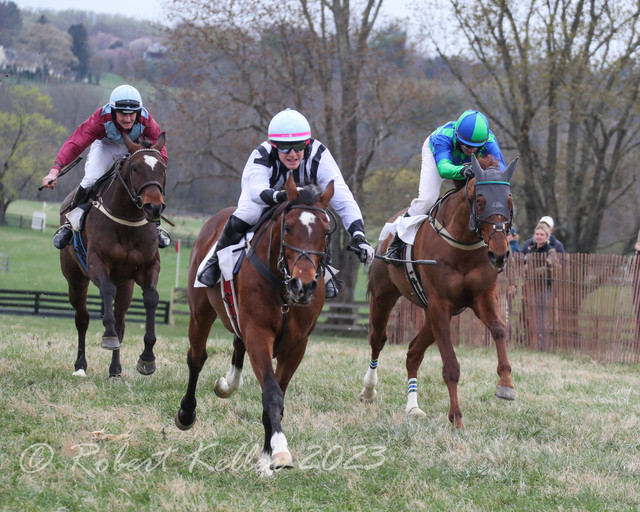
Slater (far right) finished second on Leipers Fork Steeplechasers' Tomgarrow in the 2023 Amateur Flat race at the Elkridge-Harford Point to Point (©Bob Keller) | |
|
|
At age 11, their son William is already an accomplished jockey – winning multiple field masters ‘chases and pony races with small pony phenom Chewy and others, and he does show jumping. Slater says he’ll try to steer William on the same track he took, education first, horses when he wants/how he wants.
(Douglas Lees photo of Will Slater on Chewy, with dad James, at the 2022 Rappahannock Point to Point)
| |
|
Though James Slater never won a race at Radnor, he’s long lived nearby and recognizes the importance of the meet, to horsemen, to the Chester County community and to the race beneficiary, the Brandywine Conservancy.
He calls the late Betty Moran, lifelong racing horsewoman who helped link the meet to the conservancy, the “heart and soul of the Radnor races.” (For more about Betty Moran and her ties to Radnor, reach TGSF's 2019 "Legends of Steeplechase" story, by Betsy Burke Parker)
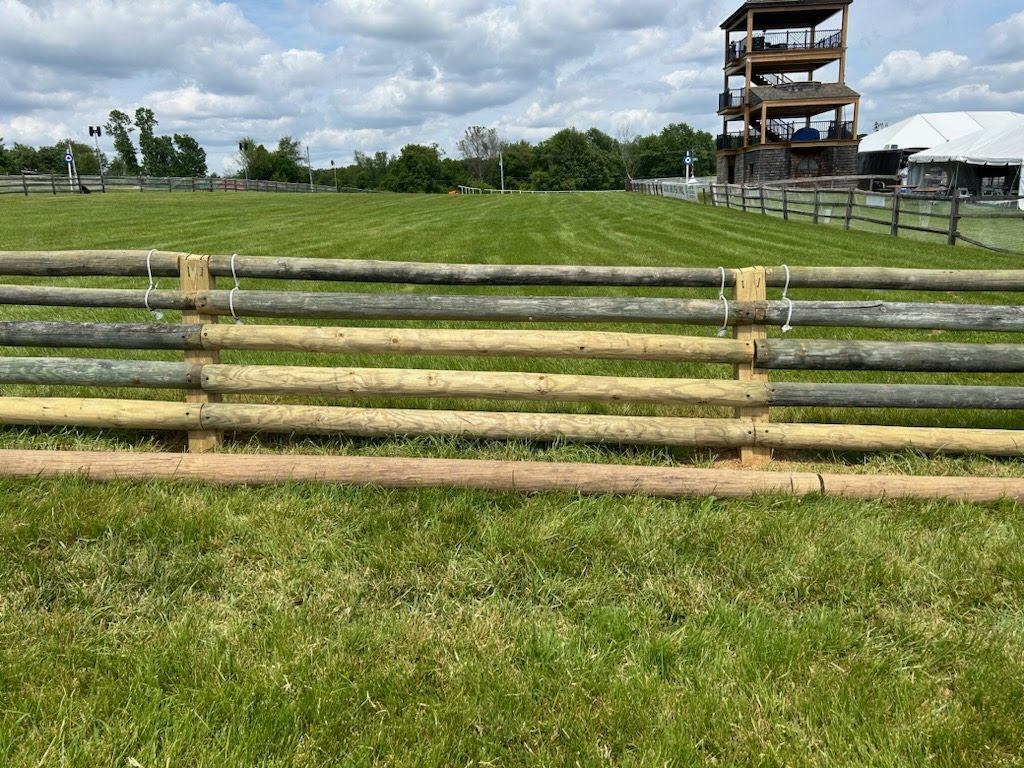
The course is lovely, he says, a right-handed rolling oval, more than a mile around. The timber jumps are on the inner rail, the hurdles on outer, with a rising two-furlong run-in to the wire from the top bend.
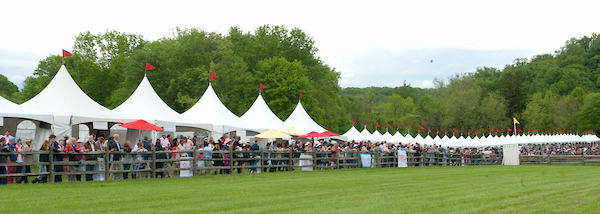
The natural bowl configuration allows spectator parking and tailgate spaces on the outer rail and on the infield.
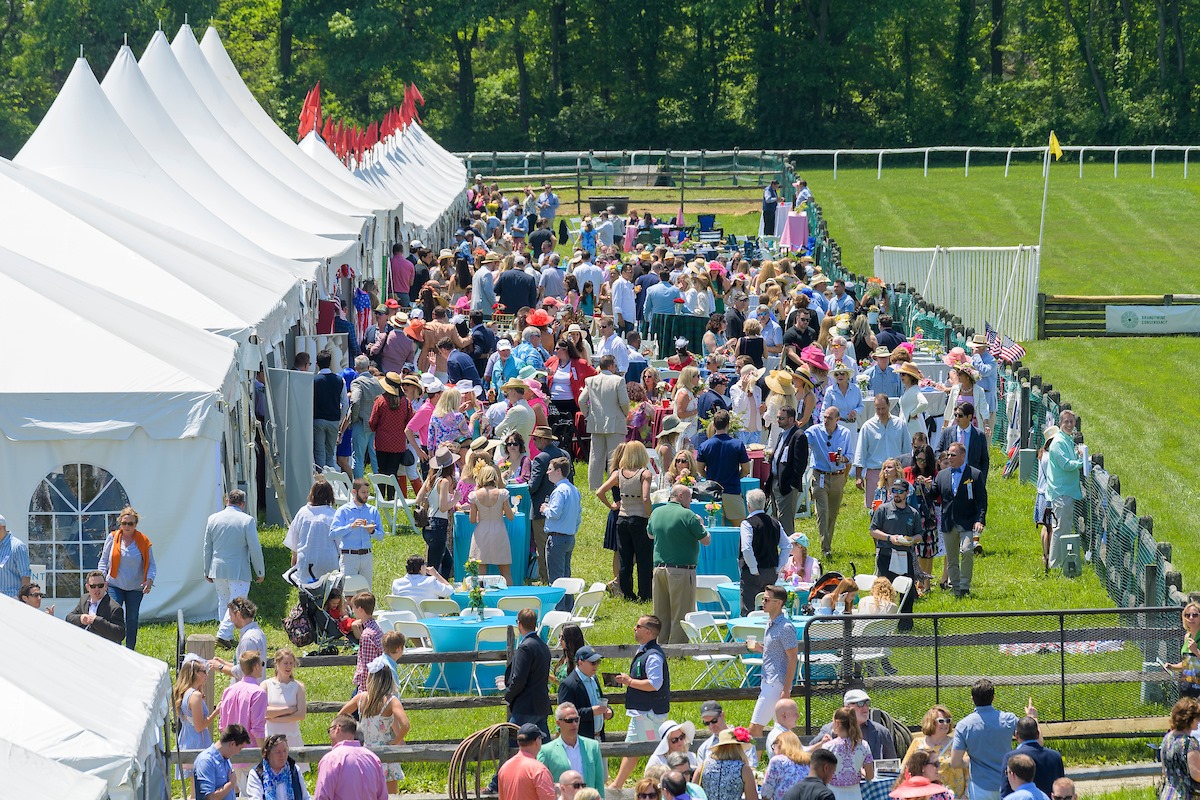
In a good year, Slater says, they get 25,000 or more, all pre-paid reserved tents and tailgates.
| |
|
The Radnor course. Saturday's five-race card, worth $110,000, has drawn 38 runners whose connections are looking for a final opportunity to pick up purse money before the summer season begins. Read more HERE.
©Tod Marks
| |
|
|
History of the Radnor Hunt
Established west of Philadelphia, Pennsylvania in 1883, the Radnor Hunt is the oldest continuously active foxhunt in the U.S.
Founding subscribers included Pennsylvania Railroad titan Alexander Cassatt and James Rawle of the Brill Streetcar manufacturing firm. Rawle was elected first hunt president with Horace Montgomery the first master of hounds.
| |
|
The evolution from race rider to race manager was pretty natural, he says. “A few years ago, Kathy Neilson got me involved with the Cheshire hunt races. It started snowballing, and last year I was clerk of the course at Willowdale” as well as serving as a steward at the Wicomico point-to-point.
“I didn’t know at the time, but Skip obviously did know – he called me last year after the Radnor races and wondered if I’d be interested in taking over the race chairman job for him.”
| | | | |