Weekly Digest Number 13 - March 28th, 2023 |
|
Welcome to the RWU Rail & Labor News! This news bulletin is produced and emailed out each Tuesday morning. We hope you find each week's news and information useful. If so, please share with co-workers, friends, and colleagues. If you like, you can sign them up to get all the news from RWU HERE. Or forward them the link. Note: If you read over this news bulletin each week, you will be sure to never miss the important news of what is going on in the railroad world from a worker's perspective!
|
|
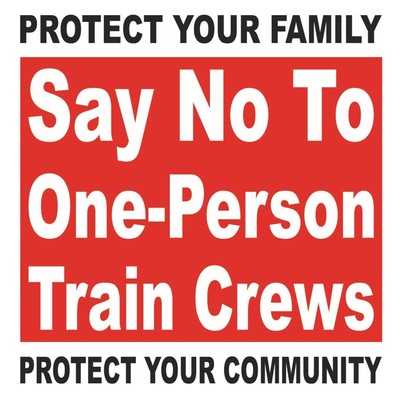
(Editor's Note: Comically, NS has worked itself into a corner from which the only escape was to withdraw their Section 6 notice of intent to eliminate the road conductor. CEO Shaw on the hot seat before Congress was asked directly if he would support the fed legislation mandating a minimum of 2 person crews on all trains. He could nor answer, but ... as long as his company was pushing at the bargaining table to eliminate the position, we know what his answer could only be. And that is not the answer the people of East Palestine, nor the American people, want to hear at this point. Within 24 hours, UP likewise is backing away. See below.) |
|
Norfolk Southern, SMART-TD End Ground-Based Conductor Talks |
|
Norfolk Southern Railway is discontinuing negotiations with the nation’s largest rail union over a "conductor redeployment" plan that could have reduced the Class I's train crews to one person.
"Over the next year, SMART-TD and Norfolk Southern have the opportunity to work together to implement important predictability improvements for our conductor workforce," said SMART-TD President Jeremy Ferguson in the press release. "These scheduling enhancements, which were part of last year's national agreements, have the potential to make an immediate positive impact for our conductors by giving them fixed days off and greater certainty about their weekly assignments."
The willingness of NS to drop plans for a ground-based conductor model "is a welcome show of good faith in the negotiation process," Ferguson said. A description of the ground-based model is available here.
Under terms of the national labor agreements, NS and SMART-TD have until mid-June to negotiate the details of the scheduling enhancements. Given the short time frame, NS withdrew its bargaining notice on conductor redeployment to focus on quality-of-life priorities, company officials said.
"While redeployment of conductors to ground-based shift-work will provide more predictable jobs and minimize time away from home, there are a number of other priorities that our labor partners would like to address, and we are committed to working together to make immediate progress,” said NS Vice President of Labor Relations Wai Wong.
Withdrawing the bargaining notice removes the mandatory requirement for the parties to bargain over the issue, though voluntary discussions remain an option.
Yesterday’s announcement follows NS President and CEO Alan Shaw’s appearance Wednesday before the Senate Committee on Commerce, Science and Transportation, where he declined to say whether he supported the mandatory two-person crew provision in the proposed Railway Safety Act of 2023.
|
|
(Editor's Note: Justin Mikulka has been blowing the whistle for many years now on the Class One railroads BS. Here he lays out the case that the cost-cutting and profiteering of the neo-liberal capitalist system lies behind these systemic failures that lead to tragic calamities.) |
|
Corporate Greed Is a Root Cause of Rail Disasters Around the World
Greece’s worst rail disaster ever is the result of the same corporate cost-cutting and deregulation that led to East Palestine and Lac-Mégantic disasters.
|
|
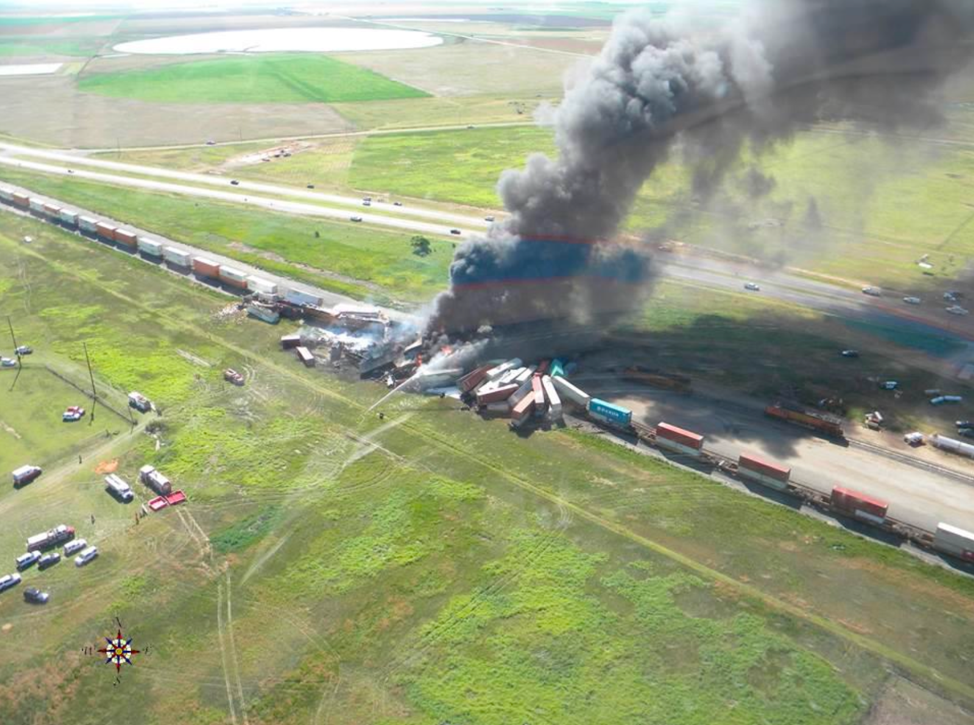
On February 25, Greece experienced its deadliest rail disaster ever when a freight train ran headlong into a passenger train coming towards it on the same track, killing 57 people. This tragic accident, near the city of Larissa, occurred just weeks after the East Palestine, Ohio rail disaster, and while the outcomes are different, the root cause is the same: corporate greed and deregulation.
While two trains colliding on the same tracks might seem unfathomable to Americans, it shouldn’t be. A similar accident occurred in Texas in 2016, a year after the U.S. rail industry refused to meet a Congressionally mandated deadline for installing a safety system called positive train control, which would have prevented the accident.
Threatened with a rail shutdown, Congress buckled and gave the industry an extra three years to install the safety system, with the option for an extension until the end of 2020. On December 29, 2020, the Federal Railroad Administration announced that positive train control was finally installed on all of the required rail lines.
As DeSmog has reported, the U.S. rail industry has lobbied against the requirement to install positive train control since 1970. In fact, one rail lobbyist received an award for being “part of a successful push for a congressional agreement to extend a deadline for automated trains on most of the nation’s railways.” The National Transportation Safety Board first recommended positive train control in 1970 after two Penn Central commuter trains collided head-on near Darien, Connecticut, the previous year. Four people were killed and 43 were injured.
|
|
(Editor's Note: Here we go. With a few weeks until merger date, KCS in Mexico appears poised for full scale "melt-down." The lunacy never ends. On another note, this moment in history would be a great time for Mexican, U.S. and Canadian railroad workers to come together and make common cause.) |
|
KCS Working to Ease Congestion in Mexico as CP Merger Date Looms
Surge in traffic and shortage of crews contributed to operational headaches in Mexico
|
|
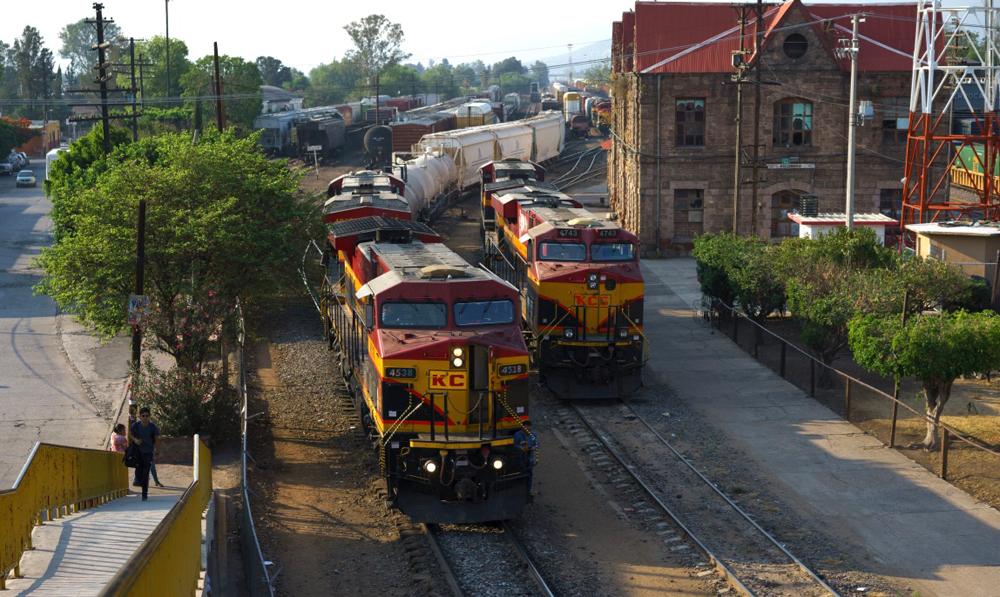
KANSAS CITY — Kansas City Southern de Mexico is battling congestion in key terminals thanks to a combination of stronger than expected traffic growth and a shortage of train crews.
The congestion, which began in December, now threatens to gum up Kansas City Southern’s U.S. network less than four weeks before Canadian Pacific gains control of the railroad and creates Canadian Pacific Kansas City. But KCS says the railroad is on the mend. “KCSM’s service metrics are steadily improving and are expected to be at normal fluidity within two to three weeks,” KCS spokeswoman Doniele Carlson says.
Rick Paterson, a Loop Capital Markets analyst who closely tracks railroad performance measures, says the most recent KCS data shows a decline in velocity for the week ending March 18. Although systemwide dwell was down, it was up at Laredo, Texas.
“It’s pretty indisputable at this point that KCS de Mexico has melted down, with all the headaches that entails: unhappy customers, defections to truck, strained relations with all stakeholders, including government, and the typical one-year timeframe for a full service recovery,” Paterson wrote in a note to clients on Friday. “This is what Canadian Pacific is going to face on April 14 when the deal closes and the two systems are legally combined. We’re sure CP has thousands of pages of integration plans for KCS, but restoring and stabilizing service at KCSM has no doubt jumped to the top of page one.”
Traffic on KCS de Mexico is up 8.8% so far this year, compared with a 2% decline in KCS volume in the U.S. Systemwide, train velocity is down 22% compared to a year ago, while terminal dwell is up 35% through March 10, Paterson notes.
|
|
SIGN NOW: Protect Communities from Corporate Railroad Greed! |
|
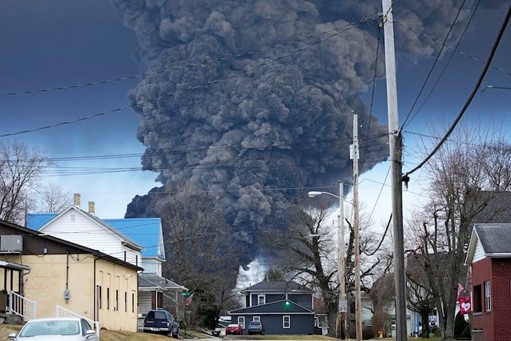
A train carrying poisonous chemicals derailed in Ohio, causing a massive explosion and mass evacuations. The Lever’s reporting found that in the decades leading up to the disaster, corporate lobbyists successfully weakened safety rules for these kinds of trains carrying hazardous materials.
Get this: Those rules were so gutted, the train that released a toxic fireball wasn’t even classified as a train carrying hazardous flammable materials, and wasn’t required to use new braking systems designed to prevent derailments.
Chemical lobbyists got Obama officials to exempt trains like the one in Ohio from hazmat safety rules.
Rail lobbyists got Trump officials to repeal rules requiring better brakes on trains.
The Railroad workers union warned that these safety issues were a “ticking time bomb”--and now the people of East Palestine, OH are paying the price.
The Biden administration can do something — RIGHT NOW. Transportation Secretary Pete Buttigieg can stand up to rail lobbyists and enact the safety rules that corporate lobbyists previously blocked to better protect us from trains carrying toxic chemicals through our towns and cities.
Up until now, Secretary Buttigieg hasn’t moved to expand train safety rules. In fact, his department is right now considering a rule promoted by railroad corporations to actually weaken train safety rules.
This is totally unacceptable, especially as an environmental and public health disaster unfolds in Ohio. Trains carrying toxic, flammable material are passing through communities every day — and lobbyists have succeeded in exempting them from tough safety laws. The opposite must happen. We must demand that Secretary Buttigieg immediately use his existing power to make safety rules much stronger, so that rail workers and communities across America are protected.
|
|
(Editor's Note: Just another freelance writer here, coming out with yet another insightful piece of why the railroads should be publicly owned.) |
|
What If WE Owned The Tracks?
By Jason Clifford March 22
|
|
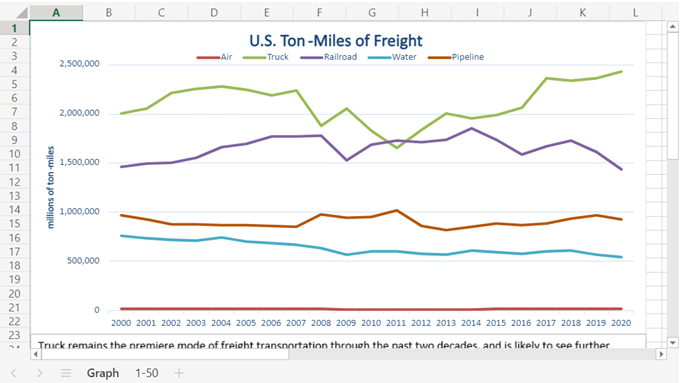
When it comes to energy efficient transportation in America, no transportation option is better than the railroads. They have been the freight transportation backbone of America for nearly 200 years, which is why all the recent news about train derailments and union strikes deserves our attention. While more profitable then they have ever been for investors, the railroads are moving less freight and employing fewer workers now then they did in 2006. After underinvesting in their labor force, rolling stock, and tracks for decades, are America’s railroads entering a state of decline, and if so, should we start discussing the pitfalls and possibilities of public rail ownership?
For some context, it will be good to have a brief history lesson. Starting with the birth of America in the late 1700s and early 1800s, bulk goods were moved by waterways, as the only other option was horse-drawn carriage. In the early days of the country, cities were built around the navigable waterways to transfer goods and services. However, as the nation grew westward, it was harder and took longer to ship goods and services by waterway. Baltimore, wanting to retain its importance as a major shipping port, looked to Europe’s emerging train technology as an opportunity to more quickly deliver goods and people to inland areas of the country. Hence, starting in 1828, the Baltimore and Ohio railroad was built as the first major railroad in the US. The Baltimore and Ohio Railroad company was founded to build the tracks and run the trains, with significant investments from the State of Maryland and other private investors.
|
|
(Editor's Note: The term, "You have been railroaded" is never more applicable than when a state attempts to take action in defense of its citizens - whether that be regulating limits on train length, setting minimum crew size or preventing blocked crossings - and the courts jump to the defense of the rail carriers. The railroad is literally above the law. It is time for the feds to act and stop this dangerous practice by limiting train length and levying substantial fines.) |
|
Supreme Court Asks Federal Government for Opinion on Blocked-Crossing Laws
March 21, 2023
Move could indicate court’s willingness to consider Ohio appeal
|
|
WASHINGTON — The U.S. Supreme Court has asked the federal government to offer its view on an effort by states to regulate how long railroads can block grade crossings.
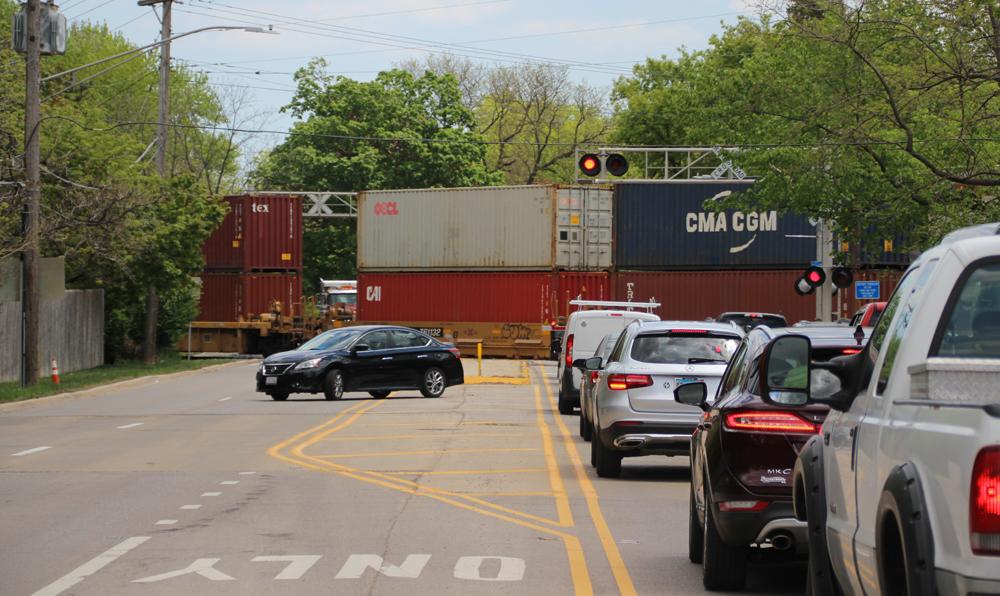
Lower courts have long ruled that state and local laws regarding blocked crossings are preempted by the federal laws regulating interstate commerce, but the states argue that Congress has failed to act regarding blocked crossings, and Ohio argues that courts have misinterpreted the act which dissolved the Interstate Commerce Commission and created the Surface Transportation Board. The states argue the blocked crossings constitute a safety risk because they can prevent or delay first responders’ reactions to emergency situations.
|
|
(Editor's Note: This scathing indictment of the how the rail industry is beholden to Wall Street hedge fund investors is not to be missed! ) |
|
Derailments, Wall Street, and the Future of the Rail Industry |
|
Have you noticed a new train derailment story every day this year?
It’s not just you. There are 1700 train derailments every year and the rate of train accidents has risen 27% over the last 10 years.
This is a safety crisis. We investigated what’s behind it ...
|
|
(Editor's Note: The year 2022 was not a good one for the Class Ones in terms of freight moved, with 3/4 million less loads moved than in 2021. This year's figures to date show an accelerated downward trend in freight moved. The number of containers/trailers moved is down 15% year-over-year. Is that freight just non-existent ... or is it going by truck. And if so, why is it not on the rail) |
|
U.S. Freight-Rail Volumes Plunge 9.4% in Week 11 |
|
U.S. rail traffic in the week ending March 18 totaled 453,500 carloads and intermodal units, down 9.4% compared with the same period in 2022, according to Association of American Railroads data.
The railroads logged 227,454 carloads, down 2.7%, and 226,046 containers and trailers, down 15.2%.
Three of the 10 carload commodity groups that AAR tracks weekly posted increases for the week. They were: coal, up 2,886 carloads to 67,912; motor vehicles and parts, up 1,150 carloads to 15,091; and metallic ores and metals, up 378 carloads to 20,534.
Commodities that posted decreases included grain, down 4,439 carloads to 18,743; chemicals, down 1,993 carloads to 32,175; and nonmetallic minerals, down 1,890 carloads to 29,265.
For the first 11 weeks of 2023, U.S. railroads reported cumulative volume of 2,523,553 carloads, down 0.3%, and 2,556,114 intermodal units, down 9.6% compared with volumes in the same period a year ago.
|
|
(Editor's Note: At this point, most of the Class Ones have reached agreement with most of their unions, providing roughly the same deal. Conspicuously absent from any deals are the unions of the operating crafts. One might assume they will ultimately settle for the same or similar deal as the others. Notice that the deal is NOT the 7 sick days that was originally demanded and drafted into (failed) legislation. The carriers - after their intransigence to providing even ONE day of sick time in national handling last Fall, are now forking over 4 "voluntarily." Why? They know that otherwise it could be nationally legislated, and could entail more paid time off and with no contractual loopholes and restrictions ) |
|
UP Joins Other Railroads in Providing Paid Sick Days for Some Workers
Union Pacific employees get 4 new days and can divert 3 paid personal days to sick days
|
|
On the heels of deals at other Class I railroads, Union Pacific has reached agreements with eight unions to provide workers up to seven paid sick days. The agreement goes into effect April 1.
According to a prepared statement from UP (NYSE: UNP), the employees in the unions that agreed to the deal will receive four sick days, prorated for this year. Additionally, they will be able to convert three of their currently allotted personal days to sick days.
That structure — four days outright plus the ability to convert three — is the same as the deal that granted additional sick days to workers at Norfolk Southern (NYSE: NSC).
The unions that reached agreement with Union Pacific were the National Conference of Firemen and Oilers; the Brotherhood of Railway Carmen; the International Association of Machinists and Aerospace Workers; the International Brotherhood of Electrical Workers; the International Brotherhood of Boilermakers; the International Association of Sheet Metal, Air, Rail and Transportation Workers – Mechanical Division; the International Association of Bridge, Structural and Ornamental Iron Workers; and the Brotherhood of Maintenance of Way Employees Division.
Union Pacific said one union, the Transportation Communications International Union, already had a sick-day agreement with the company. That leaves four unions that do not yet have a deal in place, and UP said the railroad was negotiating with them.
|
|
CN Reaches Labor Agreement with UNIFOR
BNSF and Canadian Pacific also reach deals with unions
|
|
Canadian railway CN has reached tentative agreements with two labor groups affiliated with Unifor, a union representing mechanical, intermodal, facility management and clerical workers that are part of CN’s Canadian operations.
CN (NYSE: CNI) said it would not provide details on the tentative agreements until after ratification.
“We are very pleased to have reached these tentative agreements,” said CN President and CEO Tracy Robinson in a news release. “CN has always been committed to achieving negotiated settlements to improve the conditions of this important group of employees as we continue our essential work moving the North American economy. We look forward to future collaboration with Unifor.”
|
|
Positioning of Dead-in-Tow Locomotives in Alabama Derailment was Against NS Rules, NTSB Says in Preliminary Report
March 21, 2023
Lack of proper couplers meant units transported in revenue move should not have been coupled together
|
|
With Norfolk Southern under close scrutiny in the wake of February’s derailment in East Palestine, Ohio, the Alabama incident received additional attention because it came shortly before NS CEO Alan Shaw testified before a Senate hearing [see “Norfolk Southern train derails …,” Trains News Wire, March 9, 2023].
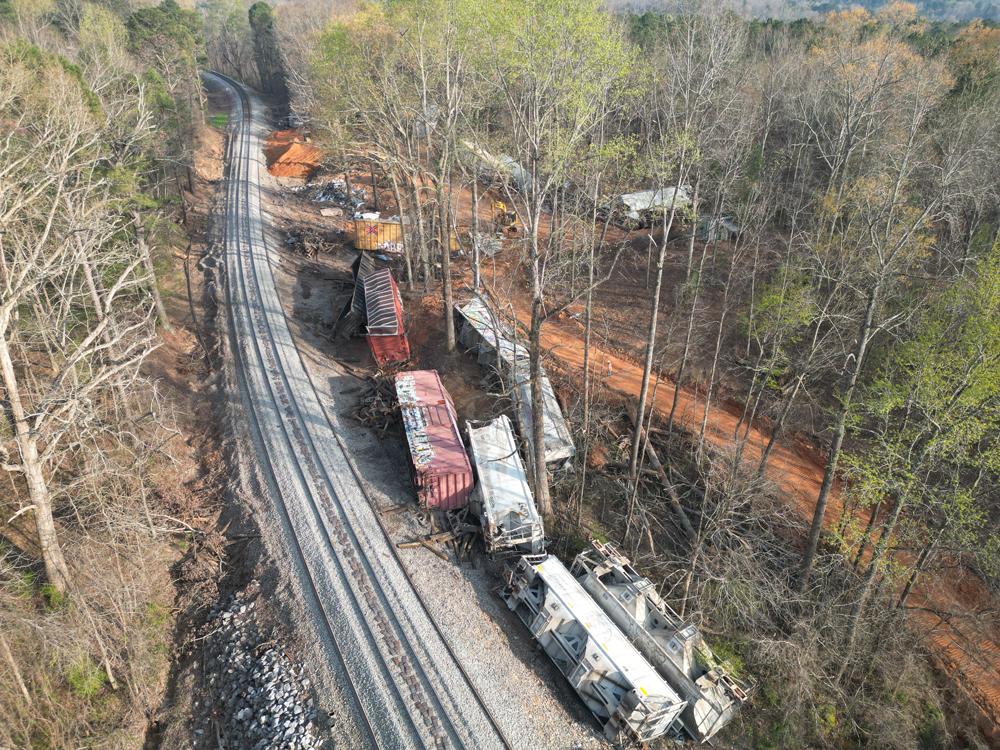
The derailment involved two locomotives and 37 cars of a six-locomotive, 108-car train at about 6:19 a.m. EST. Two portions of the train derailed: two locomotives and 29 cars near the head end, and eight cars near the rear. There were no injuries and no release of hazardous materials — although three cars in the consist contained hazardous-material residue. NS has estimated total damage at $2.9 million.
The dead-in-tow locomotive — waybill locomotives being transported for revenue —should not have been coupled together, according to NS rules, because they were not equipped with alignment control couplers. Those couplers resist lateral coupler movement under compressive in-train forces, according to the report. Initial accident reports provide basic information on an incident and do not attempt to determine a probable cause, so this report does not necessarily indicate the locomotive issue led to the derailment.
The report indicates the NTSB’s ongoing investigation will focus on NS communication, maintenance, and inspection practices; locomotive and railcar positioning; and train handling.
|
|
(Editor's Note: Well, hallelujah! I am sure the hedge funds are not exactly happy about this, but know that is simply had to happen. How many of these new hires will stay remains to be seen. Also check the numbers. The industry hired a boatload of "executives, officials and staff assistants." Not known for their ability to move trains, nor to inspect or maintain track, locomotives or rail cars.) |
|
Class I Employment Rose in February |
|
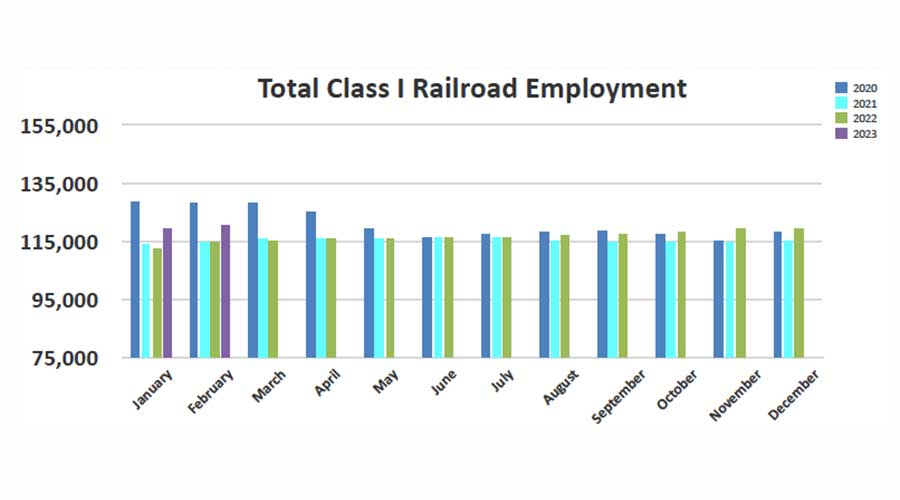
Class Is operating in the United States employed 120,210 people in February, a 0.81% increase over January's employment levels and a 5.19% increase year over year, according to Surface Transportation Board data.
Five of six employment categories logged more workers last month than in January. They were: executives, officials and staff assistants, up 1.45% to 8,114 employees; transportation (train and engine), up 1.08% to 50,858; maintenance of way and structures, up 0.88% to 28,454; maintenance of equipment and stores, up 0.32% to 17,851; and professional and administrative, up 0.05% to 10,086.
The transportation (other than train and engine) category dropped 0.14% to 4,847 employees last month compared with January's level.
Year over year, all categories logged increases: transportation (train and engine), up 7.99%; executives, officials and staff assistants, up 6.65%; maintenance of equipment and stores, up 3.87%; professional and administrative, up 2.58%; maintenance of way and structures, up 2.31%; and transportation (other than train and engine), up 2.19%.
|
|
(Editor's Note: While countries the world over forge ahead with electrification, the North American privately held infrastructure does NOTHING. In fact, the Class One corporations have NO plans for ANY electrification. See the recent article about how and why we lag so far behind and what needs to be done HERE.)
|
|
India’s Central Railway Completes Electrification of its Entire Network
Central Railway is the seventh zonal network to complete full electrification.
|
|
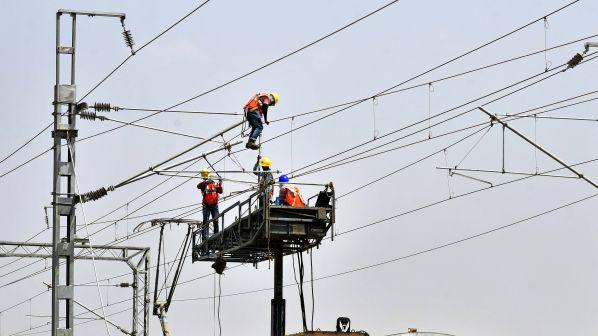
With the completion of electrification of the 52km line connecting Ausa Road to Latur Road on February 23, Indian Railways’ (IR) Central Railway (CR) became IR's seventh zone to have achieved 100% electrification on its entire broad-gauge network of 3825km.
With complete electrification, CR’s general manager, Mr Naresh Lalwani, expects to reduce CR’s carbon footprint by 500,000 tonnes of CO2 and save Rs 16.7bn ($US 202m) annually. CR is located in the centre of India and includes the cities of Mumbai, Nagpur, Pune, Nasik, Solapur and Kolhapur. It operates the busy Mumbai suburban rail network, which was already electrified.
Rail electrification has gathered pace in India since the National Democratic Alliance government headed by prime minister Mr Narendra Modi came to power in 2014. During the last eight years, 30,446km has been electrified compared with the 3874km achieved between 2007 and 2014. Up to March 2022, IR had electrified 52,247km, which was approximately 80% of IR's total broad-gauge network of 65,141km.
IR plans to complete electrification of its entire broad-gauge network by the end of this year in pursuit of its goal to become a net zero carbon emitter and the world's largest green railway network.
|
|
|
|
|
|
|