Rail & Labor News from RWU
| |
Weekly Digest Number 23 - June 4, 2024 | |
Welcome to the RWU Rail & Labor News! This news bulletin is produced and emailed out each Tuesday morning. We hope you find each week's news and information useful. If so, please share with co-workers, friends, and colleagues. If you like, you can sign them up to get all the news from RWU HERE. Or forward them the link. Got a hot tip? Please forward the article and a link to raillabornews@gmail.com. Note: If you read over this news bulletin each week, you will be sure to never miss the important news of what is going on in the railroad world from a worker's perspective! | |
Editor's Note: The current State Legislative director of the BLET for the state of Nevada and the former State legislative director of SMART-TD from the state of Nevada - both RWU members - collaborate to tell it like it is. Despite the recent war of words at the national level between top officer of the unions of the operating crats, it is imperative that rank & file members of the two unions continue to work closely together and understand that unity and solidarity - not falling for the carriers' game of divide-and-conquer - is essential if we hope to win! | |
Matt Parker, Jason Doering / May 29
As ambitious rail projects like Brightline West push forward, Nevada stands at a critical crossroads in terms of infrastructure growth and rail safety. It’s been a year since Gov. Joe Lombardo vetoed Assembly Bill 456—a bill that aimed to strengthen rail safety protocols—and the risks that haunt our tracks are not just lingering; they are intensifying. In a state known for its high stakes, gambling with rail safety seems a perilous bet we continue to make. In addition to Amtrak trains already operating through our state, the Brightline West project will transport the most precious cargo carried by rail: people. With this fact in mind, we simply cannot continue to gamble with rail safety—the stakes are too high.
| |
Editor's Note: This is an important step forward not just for Amtrak and the travelling public but for all railroad workers. Every expansion, every new route and every new frequency should be supported and touted by rails and our unions. Amtrak expansion is the way forward for rail labor! | |
High Speed Rail Alliance
On May 21, Amtrak launched a new train called Borealis, serving the corridor between the Twin Cities and Chicago. The train has broader significance than its once-a-day frequency and 79 mph speed limit might suggest. Its enthusiastic launch shows that the communities it serves, their elected leaders, and other decision-makers recognize the importance of this corridor, and its future potential. It also shows the importance of convenient scheduling, multi-state cooperation, and service to communities large and small, for building the public and political support that future expansion will depend on.
| |
Editor's Note: Our allies and friends with Truckers Movement for Justice (TMJ) are on the move in Texas and deserve the support of railroad workers. These brothers and sisters are fellow workers in the supply chain who are being shafted by the same damn Wall Street system that is screwing rail workers. | |
July 1 Permian Basin Protest - Demurrage Must Be Paid | |
West Texas Truckers / May 30
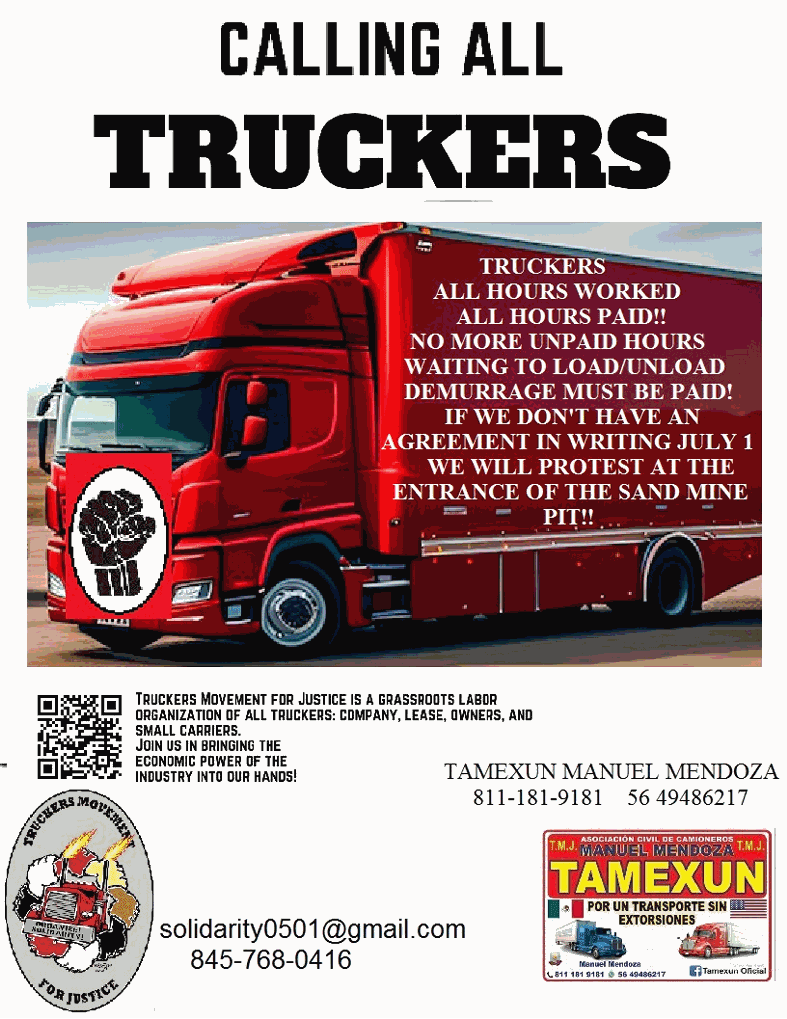
"Greetings and Solidarity. TMJ/Tamexun truckers in West Texas are preparing an organizing campaign in the Persian Basin that is multi pronged to target both economic and environmental demands on behalf of drivers and their communities. The Convoy plans will center around Monahans and Kermit, Texas and are targeting the Frac sand operations of several of the largest mines in the Permian Basin. The staging area for the Convoy is in front of the Halliburton office/yard in Midland, I believe, and efforts will be made to block or shut down the sand mines so as to stop oil/gas production. A 2nd Convoy that week is also planned, to keep pressure on and disrupt production. The flyer here is the 1st hit we plan. Please share widely we are actively trying to build a labor/environmental Coalition around this struggle!!!"
|
|
Editor's Note: This is huge news if in fact it is true that EPA knowingly sided with NS and did what it could to downplay the severity of the catastrophe. | |
Union of Concerned Scientists / May 28
According to a whistleblower report issued in May 2024, following the East Palestine, Ohio train derailment, an Environmental Protection Agency (EPA) program manager directed an EPA contractor to falsify records related to the detection of vinyl chloride. Vinyl chloride is a colorless gas primarily used to make PVC plastic; exposure to it can cause cancer and other health problems. Why it matters: By failing to follow ethical research protocols, the EPA endangered the health and safety of East Palestine’s residents. The EPA’s mission is to protect human health and the environment and to reduce environmental risks “based on the best available scientific information.”
| |
Editor's Note: Well, the carriers can say what they want, but this appears to be a conclusive study that shows that long trains mean more derailments. Period. | |
Jim Mathews, Rail Passenger Assoc / May 31
Apart from the on-time performance problems posed by co-existence with passenger trains, as of this week we know with mathematical confidence that extra-long freight trains also pose a higher risk of derailment – and that the risk continues to grow as the length of the train grows. Moreover, the risks are even worse for trains operated by short lines than for those operated by the big Class I railroads, roughly 1.2 times higher for Class II and III railroads, a new study out this week shows. “Even when accounting for the reduction in the number of freight trains operated when the average train is longer, longer freight trains are associated with an increase in the aggregate odds of freight train derailment,” the study’s authors concluded. “The results presented suggest a clear, monotonic, and positive relationship between freight train length and derailment risk.”
| |
Editor's Note: We need to shout this from the rooftops! If you want to reduce carbon emissions, then move freight and passengers off the highways and out of the skies, and put them on the rails. Every environmental activist out there needs to jump on board this train. Not only will we gain safer, less congested and beat up highways, not only will be gain far less carbon emissions, we will gain thousands of new good union railroad jobs! Rail workers and enviros unite! | |
High Speed Rail Alliance / May 23
Trains are the true EV powerhouse for cutting carbon emissions and fighting climate change. Here’s why. Lawmakers and business leaders alike are touting electric cars as a game-changer for climate change. And it’s true that cutting carbon pollution from vehicles is critical. The transportation sector accounts for about 29 percent of greenhouse-gas pollution in the US. The on-road emissions in Texas alone account for nearly ½ of 1 percent of all carbon-dioxide pollution globally. But the hype around electric cars is misplaced. Electric trains are the true powerhouse EV in the fight against climate change. And it’s not even close.
| |
Editor's Note: More and more the rail industry is under the microscope for its diesel emissions and their effect on workers and trackside communities. Here is another case where RR workers and environmental activists, plus trackside communities, and locomotive builders can all come together and make common cause. | |
Labor Today International / June 2
UE Local 1177 President Larry Hopkins was one of the panelists at a community roundtable about rail pollution held in Chicago on Wednesday. “I live on the southwest side of Chicago,” Hopkins said, “and I’m bounded by four rail yards within a two to four mile radius.” He charged that the old, polluting diesel locomotives used in Chicago’s rail yards are “harming railroad workers and drivers like myself, and people that live in these communities.” According to the Chicago Metropolitan Agency for Planning (CMAP), Chicago has more rail infrastructure than any other American city. Currently, 25 percent of all freight trains and 50 percent of all intermodal trains pass through the metropolitan area.
| |
|
John Gallagher / May 22
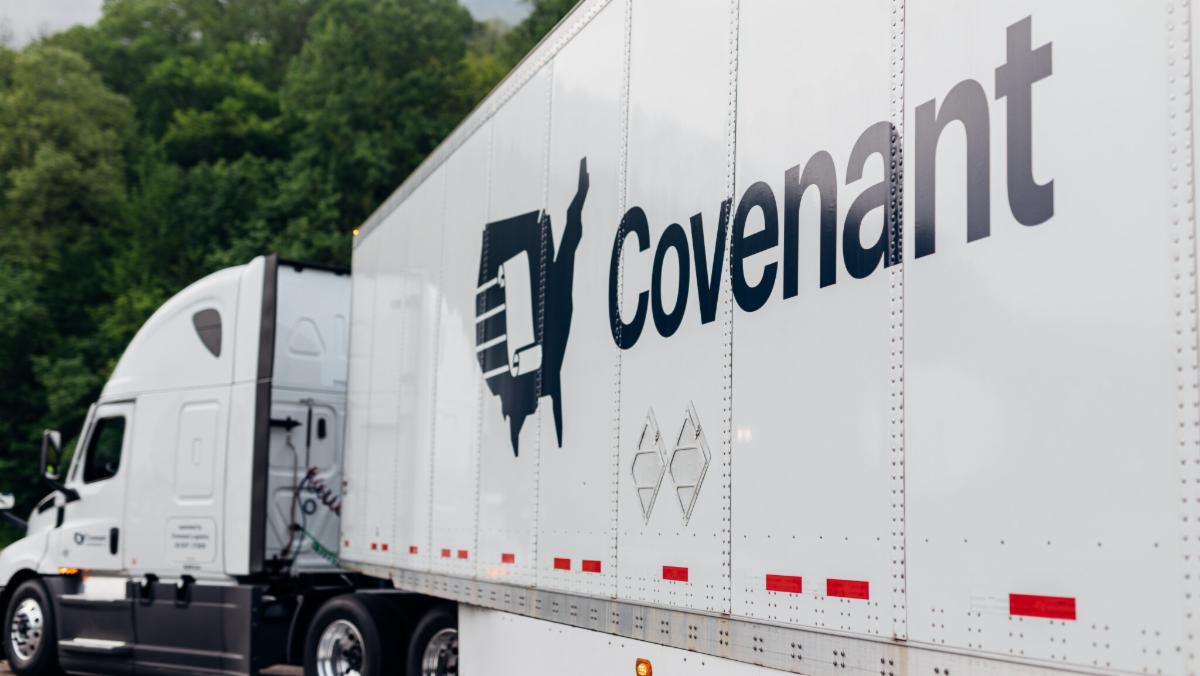
Truckload carrier Covenant Logistics is seeking a two-year federal exemption to streamline the process for employing 2,000 new drivers, the company told regulators. Chattanooga, Tennessee-based Covenant, along with its logistics affiliate Landair Transport Inc., has petitioned the Federal Motor Carrier Safety Administration to allow commercial learner’s permit (CLP) holders who have passed a CDL skills test to drive a truck without an on-duty CDL holder present in the front passenger seat, as is currently required. The changes are opposed, however, by some owner-operators and by truck safety advocates who warn that rolling back driver testing regulations will lead to more crashes.
| |
NEWS FROM AROUND THE LABOR MOVEMENT | |
Editor's Note: Vermont is blazing the trail for what other states - and the nation - needs to do to facilitate union organizing and a robust labor movement. We would point out that in addition to winning this important victory, the state of Vermont AFL-CIO is one of the few state labor federations to have dramatically increased its numbers in recent years. The body has also endorsed RWU's call for public ownership of the railroads. | |
VT AFL-CIO / May 28
On Tuesday, May 28th, the Vermont Protect the Right to Organize "PRO" Act passed without the Governor’s signature! The Act's effective date is July 1st of this year. Workers will now have a fairer, more democratic process should they decide to form a union. The Act will do the following:
- Prevent employers from disciplining workers who choose not to attend meetings whose primary purpose is communicating an employer’s political or religious opinion – also known as captive audience meetings.
- Grant domestic workers the right to form a union.
- Allow majority sign-up or card check elections for workers covered by Vermont's labor statutes, including domestic workers.
- Create a study to examine the application of Vermont’s labor relations and employment laws to agricultural workers in Vermont and to identify potential legislative action to provide additional coverage to agricultural workers under those laws.
| |
Weekly Derailment Department | | | | |