Rail & Labor News from RWU
| | Weekly Digest Number 28 - July 8th, 2025 | | Welcome to the RWU Rail & Labor News! This news bulletin is produced and emailed out each Tuesday morning. We hope you find each week's news and information useful. If so, please share with co-workers, friends, and colleagues. If you like, you can sign them up to get all the news from RWU HERE. Or forward them the link. Got a hot tip? Please forward the article and a link to raillabornews@gmail.com. Note: If you read over this news bulletin each week, you will be sure to never miss the important news of what is going on in the railroad world from a worker's perspective! | | THIS WEEK'S RAIL AND LABOR NEWS | |
RT&S / July 1st
U.S. Representatives Salud Carbajal and Mike Lawler reintroduced the Railroad Yardmaster Protection Act.
The Railroad Yardmaster Protection Act seeks to “strengthen workplace protections” for yardmasters by affording them the same protections as other workers in the railroad yard. The legislation, which was first introduced in 2019, includes railroad yardmasters under federal hours of service requirements. This would cover “locomotive engineers, conductors, switchmen, dispatchers, and signal employees.” Endorsed by SMART, the legislation says yardmasters would not be required to be on duty for more than 12 hours. Additionally, they must receive a minimum of 10 hours off duty afterward.
SMART-TD commented on the introduction of the legislation, “SMART-TD applauds Congressman Salud Carbajal and Congressman Mike Lawler for their steadfast leadership in introducing the Railroad Yardmaster Protection Act. For far too long, our Yardmaster members have been left without the basic protections afforded to other safety-sensitive rail employees.
| |
GoFundMe
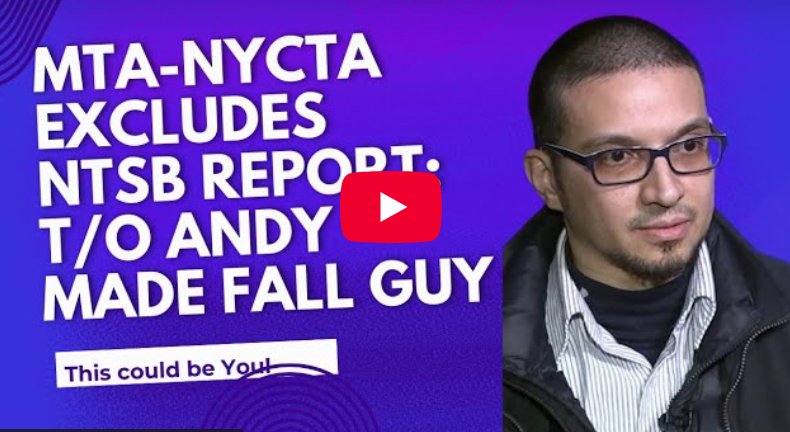
Andy Valentine has been wrongfully terminated—and we need your help to fight back.
On January 4, 2024, a devastating subway crash at 96th Street left dozens injured. The MTA rushed to blame “employee error,” but the National Transportation Safety Board (NTSB) proved otherwise.
Andy, was the flagger riding in the head car of a disabled train, AND he acted heroically. He:
- Saw the red signal
- Radioed the supervisor
- The communication failed
- Stayed behind to ensure passengers’ safety
But the MTA’s faulty communication system caused the transmission to fail. The NTSB investigation clearly shows the crash was due to a system failure—not employee error.
Train Operator Andy Valentine has been scapegoated, terminated by an arbitrator who refused to look at the NTSB Report — and we need your help to fight back.
| |
Trains Magazine / July 2nd
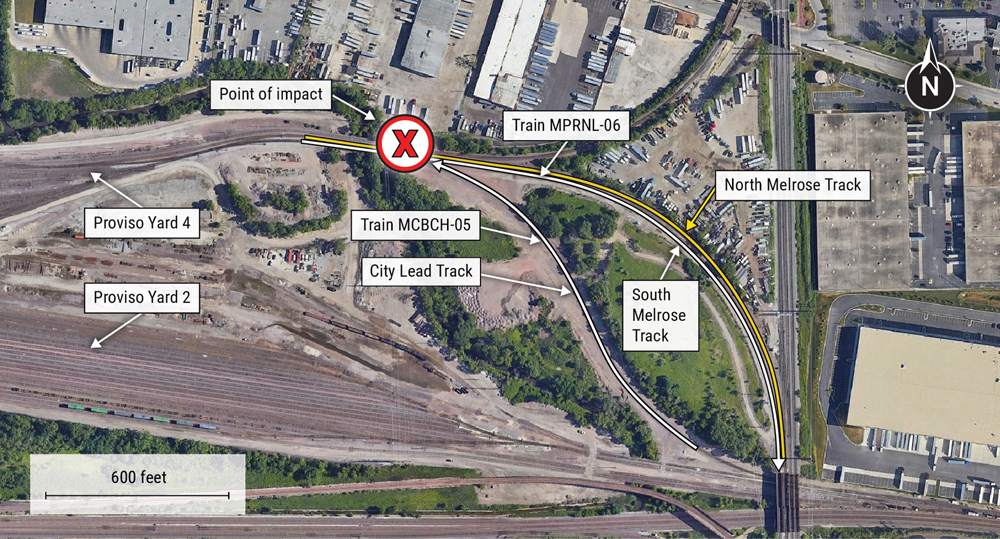
The probable cause of a July 2024 fatal collision at Union Pacific’s Proviso Yard was an inexperienced conductor’s failure to alert the engineer to stop the train at a designated point during a shove move in unfamiliar territory, the National Transportation Safety Board said today (July 2, 2025).
The conductor — who was certified 12 days before the July 6 accident and had never led a shove movement at Proviso — was killed when the tank car he was riding collided with a departing train [see “Union Pacific worker killed …,” Trains News Wire, July 8, 2024]. The NTSB said that UP sent the conductor “into the field without performance-based verification that he could safely navigate the territory.”
|
| Editor's Note: Amtrak finally will resume service to this route after a 20 year hiatus due to Hurricane Katrina. The Class One carriers have stonewalled at every step, attempting to thwart resuming passenger train service. At one point CSX asked for more than $1 billion in infrastructure improvement to make it happen! If it takes 20 years to reinstate just 150 miles of passenger train territory, one cannot help but wonder how long it might take to regain a robust passenger train network in the U.S. The Class One privately held carriers are stonewalling us at every turn. Time for Public Ownership and worker control! | |
Progressive Railroading / July 1st
Starting Aug. 18, Amtrak trains will operate along the Gulf Coast between Mobile, Alabama, and New Orleans for the first time in 20 years.
Amtrak is now accepting bookings for the Mardi Gras, its new twice-daily intercity train service, with morning and evening departures from both Mobile and New Orleans. Amtrak trains haven't operated along the Gulf Coast since Hurricane Katrina knocked out service in 2005.
“We encourage customers to get their tickets now to experience this new, comfortable and scenic service, and have the first opportunity to travel by train on the Mississippi Gulf Coast in nearly 20 years,” said Amtrak President Roger Harris in a press release.
| |
Orlando Weekly / July 1st
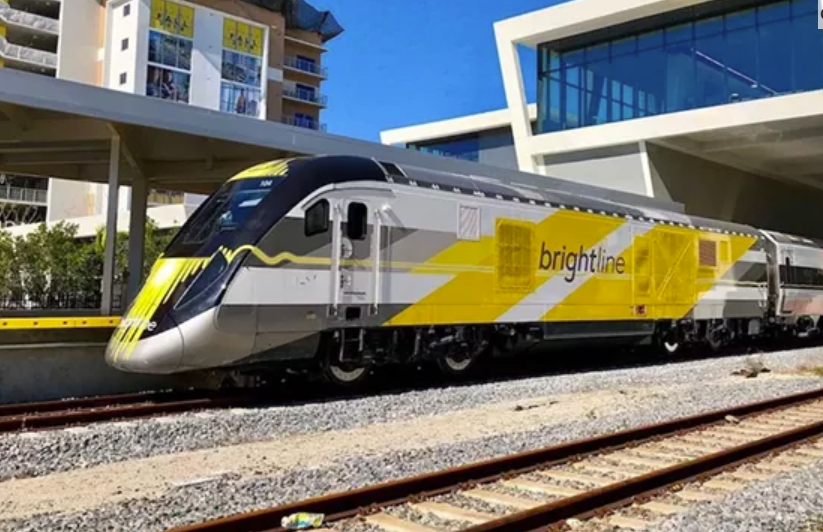
The Federal Railroad Administration, an agency of the U.S. Department of Transportation, is warning Brightline Florida that in order to continue to receive federal transit dollars, the high-speed rail company will need to ensure it is in compliance with federal grant requirements.
This includes acknowledging that they are, in fact, a rail carrier eligible for rail-specific federal grants — an acknowledgement that is relevant to a recent unionization effort among some of their employees.
The private, for-profit company Brightline — which operates several rail routes from as far south as Miami up to Orlando — had been accused by the Transport Workers Union of union-busting, in part by trying to pretend it doesn't actually qualify as a rail carrier.
| |
Railway Age / June 30th
Railroad recoveries are almost always uneven (CSX the recent exception), and we’re seeing that with a mixed bag of data this week regarding CPKC’s efforts to rebound from the operational disruptions from the May 3 cutover of the old KCS Management Control System (MCS) to CP’s TYES system within the U.S. On balance, progress is being made, but we’re not out of the woods yet.
We’ll start as usual with full system terminal dwell (Canada, U.S. and Mexico), with a peak of 11.4 hours in the week ending June 6, followed by an improvement to 11.1 hours through June 13, and then a small backstep to 11.2 last week. An uptick of 0.1 hours (six minutes) is insignificant, but regardless maintains dwell above CPKC’s historically poor benchmark of 11 hours.
| | Editor's Note: How tragic that Amtrak cannot meet the consumer demand that now exists. Amtrak has survived and grown in spite of a half century of being threatened with extinction and starved of capital, hence the lack of infrastructure, maintenance facilities and adequate, modern rolling stock. Now that huge demand exists for passenger train services, the carrier is not up to the task. We are reaching a critical time when new equipment must be ordered immediately. | |
Trains Magazine / July 3rd
Two planned and two unplanned bus bridges are occurring over the Fourth of July holiday weekend to keep passengers moving on Amtrak’s long-distance network.
Coast Starlight equipment will spend the night of July 4-July 5 at Sacramento, Calif., and Klamath Falls, Ore., while Seattle-Los Angeles passengers are bused overnight between the two stops as a result of Union Pacific trackwork that evening.
In the east, work continues at least through the end of July between Albany-Rensselaer, N.Y. and Pittsfield, Mass., to repair damage from a sinkhole that opened up under the tracks. This has affected the seasonal weekend Berkshire Flyer and the daily Boston section of the Lake Shore Limited; buses are substituting for the duration. Trains News Wire is attempting to get more information on the extent of the track outage.
| | Editor's Note: As we have stated before, a coast-to-coast rail system in the U.S. would stand to gain enormous efficiencies and should have happened a century ago, benefitting workers, shippers, passengers and the nation. However, if the benefits accrue to just the Class One stockholders, a "final" round of mega-mergers is a very bad idea. Class One mega-mergers will not result in curing what ails the rail freight system in the U.S. - poor customer service and flat car loadings. As evidence, did the UP-SP;CNW merger make customers happy? Did the Conrail carve-up work, especially for NS shippers? How are things going at CPKC? The answer is a publicly run rail infrastructure like the rest of our transport infrastructure. See the RWU Resolution HERE. | |
Trains Magazine / July 4th
With only six Class I freight railroads remaining and stringent merger rules set by the Surface Transportation Board’s 2001 framework, the consensus largely held that the window for large-scale transactions was closed. Any potential merger, under these rules, must not only demonstrably enhance competition but also clearly articulate public benefits — typically improved service or gains for shippers. This high bar has historically kept serious engagement with the concept of consolidation at bay, but this is beginning to change.
A recent surge of interest from a diverse array of investors, ranging from long-only funds to event-driven specialists, has prompted a fresh examination of the U.S. rail sector, London-based analyst MKP Advisors said in a research note. This signals a potential shift in how market participants perceive the viability of rail mergers. Current analysis is focused on identifying combinations that could take place within the prevailing political and regulatory environment. While logic for consolidation may exist, the thinking goes, its realization hinges on navigating a complex web of governmental oversight and stakeholder interests.
| | NEWS FROM AROUND THE LABOR MOVEMENT | | Each week, RWU includes a few articles about advances and developments in the larger labor movement that are of interest to railroad workers. Got an artcile to submit for possible inclusion next week? Email it along to raillabornews@gmail.com. Thank you! | |
In These Times / July 2nd
Ninety years ago this summer, Congress passed legislation hailed at the time and for many years after as “labor’s Magna Carta.”
The Wagner Act — or, more formally, the National Labor Relations Act — was the product of Depression-era concern about the social and economic effects of industrial unrest manifest in citywide general strikes, factory takeovers, and many violent confrontations between workers trying to form unions and the police or private security forces defending the interests of anti-union employers.
The architects of the Wagner Act were New Deal Democrats. They knew that a new national labor policy was needed to promote collective bargaining as a peaceful alternative to such unregulated labor-management conflict. Its other intended benefit, as labor historian Jefferson Cowie points out, was “boosting worker purchasing power and consumption in order to stimulate the economy” amid the Great Depression.
| |
Portside / July 1st
Workers across the United States are getting a raise this week after minimum wage increases took effect across several states and localities Tuesday.
The wage increases are expected to affect more than 880,000 workers this summer as minimum wage laws take effect in areas including Alaska, Oregon, Washington, D.C. and certain cities in California and Washington state, according to a report by The Economic Policy Institute.
In Everett, Washington, a city just north of Seattle, companies with more than 500 employees are now required to pay a minimum of $20.24 an hour. In Alaska, the statewide minimum wage is now $13.00 an hour, up from $11.91 — meaning a full-time, year-round worker in Alaska will receive an average annual wage increase of $925, according to the report.
| | |
Labor Notes / July 16th
What kind of power does your organization have currently? What power do those in opposition to you have? What would you need to build in order to accomplish your goals?
This workshop will teach skills to analyze power in the present moment to strategically build the workers movement we need. We’ll be joined by labor educator Stephanie Luce.
This is an advanced workshop for those organizers who are already part of a union or other worker organizations. Join us for this workshop if you already:
-Regularly do one-on-one conversations with members
-And have engaged in building an escalating campaign to win on a workplace or community issue.
| | WEEKLY DERAILMENT DEPARTMENT | | Each Tuesday in this news bulletin, RWU does our best to present a picture of what has been happening over the course of the previous week in terms of derailments in North America, and investigation determinations of previous accidents. NOTE: This list is by no means comprehensive. Smaller and less consequential mishaps are generally not reported here. If the wreck results in injury or fatality, or is especially damaging/extreme, a full article will appear as a feature in the dozen or so rail articles above. Know of a train wreck? Please feel free to forward a link to raillabornews@gmail.com for possible inclusion next week. Thanks! |
| | | |