Rail & Labor News from RWU
| | Weekly Digest Number 50 - December 09, 2025 | | Welcome to the RWU Rail & Labor News! This news bulletin is produced and emailed out each Tuesday morning. We hope you find each week's news and information useful. If so, please share with co-workers, friends, and colleagues. If you like, you can sign them up to get all the news from RWU HERE. Or forward them the link. Got a hot tip? Please forward the article and a link to raillabornews@gmail.com. Note: If you read over this news bulletin each week, you will be sure to never miss the important news of what is going on in the railroad world from a worker's perspective! | | THIS WEEK'S RAIL AND LABOR NEWS | | Editor's Note: The delay in filing this merger application is spoken of as an inconvenience to investors, yet no one pauses to consider the workers whose lives will be rearranged long before the ink dries. The corporations assure regulators that their submission will be “exceptional,” but labor has learned through bitter experience that exceptional filings do not guarantee exceptional treatment on the ground. Every postponed deadline is a reminder that these titanic deals proceed at the tempo of capital, while the rank and file are expected to bear the consequences without question. Rail labor must not confuse procedural thoroughness with genuine accountability; the former is performed for regulators, the latter is owed to the men and women who move the nation’s freight. If this merger is to be judged fairly, it must be measured not by the polish of its paperwork but by the protections it extends to those who will live under it. And until those guarantees are explicit, labor’s vigilance.. not corporate optimism, must set the timetable. | |
|
Railway Supply / December 3rd
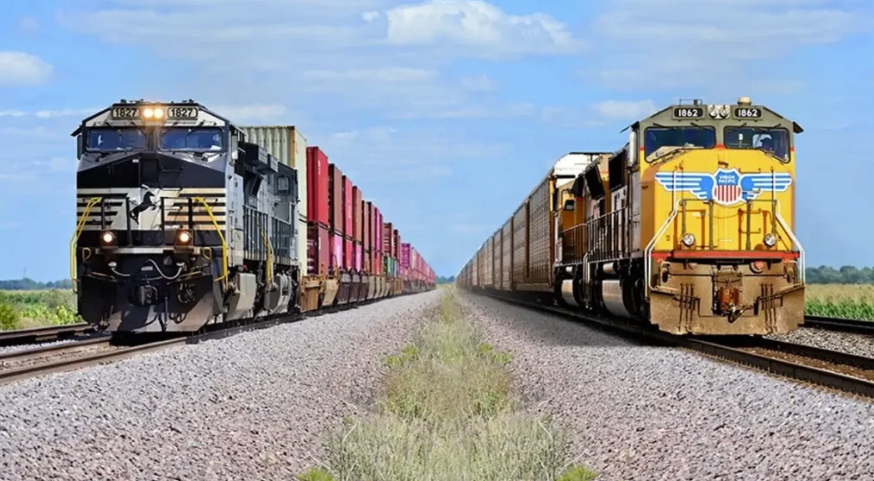
UP NS merger application is now slated to reach federal regulators around Dec. 16, roughly two weeks later than Union Pacific and Norfolk Southern had hoped to file it this week, according to Trains.
At an investor appearance on Tuesday, UP Chief Executive Jim Vena said the schedule slipped because one of the outside firms responsible for a portion of the filing needed extra time to finish its work before the massive package could go in for Surface Transportation Board (STB) merger review.
This is reported by the railway transport news portal Railway Supply.
Vena stressed that the carriers want the final product to be “exceptional” so that, when they hand it to the STB, regulators are comfortable that the railroads have answered all questions and provided the information the board is looking for.
| |
| Editor's Note: The loss of a conductor in Ontario is a reminder that railroading remains a profession where a day’s work can still exact the ultimate price. Behind every headline is a family forever changed and a craft that feels the absence of one of its own. No investigation, however thorough, can restore what was taken, but it can honor the fallen by confronting the conditions under which they labored. Rail labor stands with the family, the crew, and every worker who steps onto the ballast knowing the risks far too well. May this tragedy strengthen our resolve to demand a safer, more humane industry for all who keep the rails alive. | |
|
Trains Magazine / December 4th
A Union Pacific conductor was fatally injured on Wednesday in a grade-crossing accident near Ontario, Calif., the National Transportation Safety Board said today.
“NTSB is sending a team to investigate Wednesday’s accident involving a Union Pacific Railroad conductor fatally injured while conducting a reverse movement when the train collided with a combination vehicle at a highway-railroad grade crossing near Ontario, Calif.,” the safety board said in a post on X on Thursday morning.
“We are saddened by the loss of a Union Pacific employee who died on the job Wednesday in Ontario, California, and extend our deepest sympathies to his family and the employees who worked alongside him,” a railroad spokeswoman said in an email.
| |
| Editor's Note: When railroads quarrel over the remnants of old mergers, they speak the language of competition, but the workers know it is power.. not service, that lies at the heart of these disputes. The conditions imposed in 1996 were meant to shield the public and the industry from monopoly, yet the burden of enforcing them has fallen not on the corporations but on those who labor under their shadow. If BNSF’s charges are true, it is another chapter in the long record of promises made to regulators and broken on the ground. Rail labor has seen too often how mergers erode accountability while leaving the rank and file to endure the consequences. Whatever judgment the Board renders, it must reckon first with the lived reality of the workers who keep these railroads moving. | |
|
Trains Magazine / December 1
BNSF Railway has asked the Surface Transportation Board to review Union Pacific’s compliance with conditions that the board imposed to preserve competition after UP’s 1996 acquisition of Southern Pacific.
Due to considerable overlap between the UP and SP systems, the STB granted BNSF the ability to serve customers at so-called 2-to-1 locations, where shippers served by both UP and SP would be served by just UP after the merger.
“In the nearly 30 years since the UP/SP merger, however, UP has engaged in a pattern of obstructive conduct that has diminished those competitive options and has harmed customers by delaying or preventing BNSF from fully replacing the competition that was lost through the UP/SP merger as the Board originally intended,” BNSF said in a Nov. 28 regulatory filing. “Although BNSF has diligently worked to enforce the rights the Board entrusted to it through constant vigilance, extensive negotiations with UP, and numerous petitions to the Board, its efforts have faced repeated resistance and obstruction from UP."
| |
| Editor's Note: RWU has been reaching out to establish ties with Mexican and Canadian railroad workers. (Here is the Resolution in Spanish). This struggle of the workers on the CPKC in Mexico is emblematic of the need for trans-border solidarity among the rail workers of Mexico, Canada, and the United States. The rail corporations transcend all national boundaries, we need to as well! | |
Global Media / December 1st
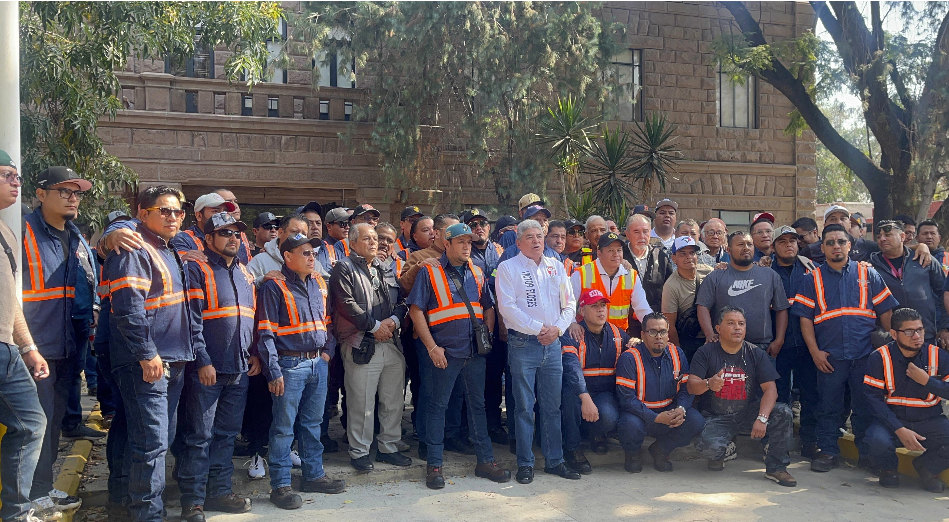
The Mexican Railway Workers Union (STFRM) Section 24 in San Luis Potosí denounced that the Kansas City Canadian Pacific (CPKC) company is seeking to eliminate yard positions, a measure they consider unjustified and a violation of the right to strike, reported their representative, Víctor Zapata Jiménez.
Zapata explained that the company recently announced its intention to eliminate operational positions, which prompted the workers' meeting held this Monday: " What the company intends to do is wrong; the company is currently scheduled to strike next January, and with this action, it is violating the workers' right to strike," he stated.
The union leader explained that there were conflicting instructions from management at the local terminal . On Sunday, an operations manager informed them that workers would continue to be paid, but would not be allowed to operate machinery. However, on Monday, a higher-ranking official stated that operations would continue as normal.
[Translated from Spanish]
| | Editor's Note: When workers who lived through the Conrail meltdown warn that another corporate consolidation will grind crews into exhaustion and chaos, their testimony should outweigh every polished promise in a merger brief. Yet some in rail labor have rushed to endorse this deal, offering their signatures as if memory were an inconvenience rather than a safeguard. It is a betrayal to pretend that “redundancies” don’t mean jobs, terminals, and whole crafts placed on the chopping block. The rank and file deserve leaders who remember who bears the weight when the network seizes and the public is left demanding answers. If labor cannot speak with one voice against repeating a disaster it already survived, then at least let the workers’ warnings stand as the truth our institutions were too timid to defend. | |
|
In These Times / December 3rd
Maximillian Alvarez: What’s going on with this merger? Why should people care about it? And from a worker perspective, what is this going to mean for you guys and for all of us?
Ron Kaminkow: Having lived through what they call a “meltdown,” a massive service failure in 1999 that actually continued into the year 2000. I think they didn’t get this mess cleaned up for probably about 18 months. Our main line looked like a parking lot and the Norfolk Southern takeover of our portion of Conrail was an unmitigated disaster.
This is not good for railroad workers. We worked endlessly, largely 12 hours every time we went to work. It’s a complete chaotic environment. This is not a safe environment. Workers are demoralized. It’s a state of confusion, and we are all constantly fatigued. And we’re pretty upset that we’ve seen our railroad turned upside down and largely destroyed by a corporate takeover. So I would postulate that this kind of meltdown is certainly not in our interest, and there’s very good reason to believe that a UP and NS merger would result in this.
Mergers take place in industries, and the rail industry is no exception, because they want to gain economies and eliminate what they call redundancies. So these two railroads meet at least five major terminals, and these terminals are already congested and complicated.
| |
| Editor's Note: Once again the nation is asked to trust that technology can replace the judgment of the men and women who walk the rails, though it is their vigilance.. not corporate assurances, that has carried this industry through every era of danger. The railroads celebrate a waiver that trims human inspections, yet nowhere in their triumph is there mention of the workers whose hands and eyes have long been the last defense against catastrophe. Safety cannot be delegated to machines while the people who know the track best are pushed further from it. Labor must ask, loudly and without apology: who benefits from fewer inspections, and who pays when the gamble fails? Until the voices of the rank and file are placed at the center of these decisions, no waiver can claim the mantle of progress. | |
|
The Seattle Times / December 5th
The nation’s freight railroads are going to be able to try relying more on technology and inspect their tracks in person less often after the federal government approved their waiver request on Friday.
The Association of American Railroads trade group asked for the relief from inspection requirements that were written back in 1971 because railroads believe the automated track inspection technology they use today is so good at spotting problems early that human inspections aren’t needed as frequently. They say that extended tests that BNSF and Norfolk Southern ran show that safety actually improved even when human inspections were reduced from twice a week to twice a month.
The Federal Railroad Administration didn’t go quite that far in its decision, but the agency said railroads will be able to cut inspections down to only once a week under the approved waiver.
| |
|
Trains Magazine / December 6th
A strike by the union representing Southeastern Pennsylvania Transportation Authority rail transit and bus operators is imminent, the leader of that union said on Friday.
The Transport Workers Union of America said in a press release that SEPTA has refused to negotiate on quality-of-life issues for members of TWU Local 234, and that the union is prepared to strike “at any time.”
TWU International President John Samuelsen says the transit agency “is attacking our health benefits; they’re attacking our retirement security. They’re not taking this contract negotiation seriously.”
Members of the union have been working without a contract since Nov. 7. WPVI-TV reports that Local 234 President Will Vera said his “patience has run out” at a Friday press conference. “I’m tired of talking and we’re about to start walking,” Vera said.
| | Editor's Note: The idea that this proposed merger itself will unclog Chicago - though a single line service through the city could be an improvement - is ludicrous. The CREATE Program on the other hand actually speaks to the issue of Chicago congestion, as it pinpoints infrastructure projects that eliminate congestion and allow for freer movement of trains across the city. The Class One carriers have embraced CREATE because it is largely publicly funded. But funds are scarce, it moves at a snail's pace, and so many of the key projects are far from implemented after more than two decades. | |
Chicago Tribune / December 1st
By merging with Norfolk Southern, Union Pacific wants to create a coast-to-coast railroad to carry nearly half of all U.S. rail freight.
Union Pacific says the $85 billion merger would serve the public interest and win federal approval by unclogging Chicago, the cradle of American railroading and still its biggest and most notorious bottleneck.
But the “increased monopolistic power” of the combined railroad will drive up shipping costs and could kneecap America’s global competitiveness, according to nine Republican attorneys general in a letter last month.
Shipping costs are already a pocketbook issue for everyday Chicagoans. Americans received 66 packages on average in 2024, a 78% increase over seven years, according to Capital One retail data. During this time, the average price per package dropped by just 4%.
| | Editor's Note: When ports and shippers sound the alarm over a merger’s reach, labor should hear it as a warning meant for us as well. Consolidation has never delivered prosperity to the rank and file; it has delivered fewer choices, thinner accountability, and a heavier burden on those who keep the freight moving. The promise of a transcontinental carrier may dazzle investors, but workers know that when competitors disappear, so do the safeguards that protect their livelihoods. Rail labor must insist that the public interest is not defined by corporate convenience but by the conditions under which people labor and communities survive. If this merger cannot withstand that measure, it deserves no easy passage. | |
|
Freight Waves December 2nd
Major U.S. ports and their stakeholders warned federal regulators that the proposed rail merger of Union Pacific and Norfolk Southern could hurt their competitive standing and the larger economy absent careful evaluation of the historic deal.
In a letter to the Surface Transportation Board, the National Association of Waterfront Employers (NAWE) expressed “strong concerns” with the merger, which would create the first freight-only transcontinental railroad.
“We are greatly concerned as to whether a reduction of two of the four major remaining competitors offering intermodal rail service will serve to benefit our industry,” said NAWE President Carl Bentzel, in the letter.
| |
|
Railway Age / December 1st
Amtrak issued a press release Nov. 18 touting the railroad’s performance in Fiscal Year 2025 entitled “Amtrak: A Year of Records.” With record ridership, record passenger miles, record capital investments and new trains, it would seem that Everything’s Coming Up Roses at today’s Amtrak. But as the late Paul Harvey might have said, there is “The Rest of the Story,” especially with Amtrak’s Long-Distance services.
Considering that they are the face of Amtrak for much of America, the meager amount of reference to Long-Distance trains in the document suggests different reality than what is intended to convey. It touts an 87% completion rate for the Superliner Refresh Program, without mentioning that “refreshing” is superficial, and far from the needed mechanical refurbishment, especially for cars 30 to nearly 50 years old, and that even with funding available since November 2021, Amtrak has yet to specifically determine a design for replacement equipment for the Superliners, much less select a manufacturer. Amtrak applauds its role in the complaint filed by the Justice Department in 2024 against Norfolk Southern for its chronic delay of the Crescent, but neglects to mention that Norfolk Southern gets to keep operating the northbound Crescent on a schedule more than three hours longer than in 2021 and includes an unsavory 11:29 PM departure from Atlanta.
| |
Trains Magazine / December 4th
Former Surface Transportation Board member Robert E. Primus and former National Transportation Safety Board Vice Chair Alvin Brown on Thursday added racial discrimination claims to their federal lawsuits challenging their dismissals by the Trump administration.
President Donald Trump fired Brown in May and Primus in August without giving a reason for their dismissals. Both men, who are Black, say that the Trump administration has engaged in a broader pattern of disproportionately removing Black members from independent, multimember agencies.
The president has sought to exert greater control over independent agencies like the STB and NTSB. He has ousted Democratic members of the Federal Trade Commission, the Equal Opportunity Employment Commission, the Bureau of Labor Statistics, and the Federal Reserve.
| | NEWS FROM AROUND THE LABOR MOVEMENT | | Each week, RWU includes a few articles about advances and developments in the larger labor movement that are of interest to railroad workers. Got an artcile to submit for possible inclusion next week? Email it along to raillabornews@gmail.com. Thank you! | |
AP News / December 2nd
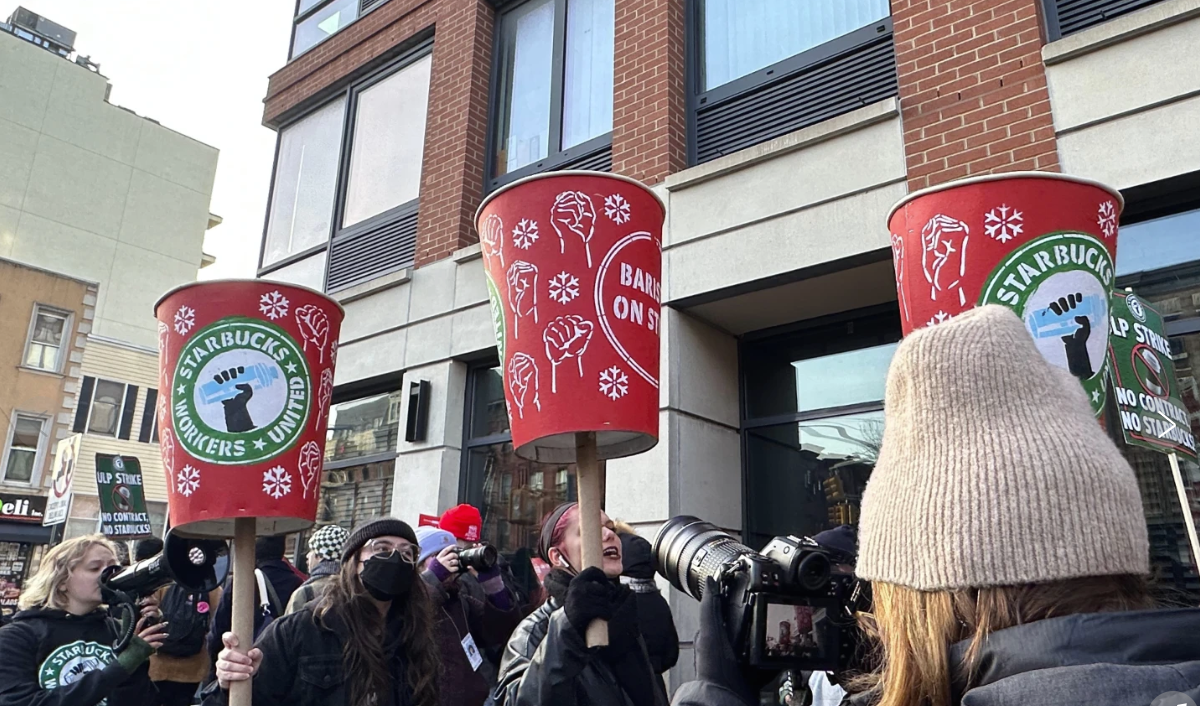
Starbucks will pay about $35 million to more than 15,000 New York City workers to settle claims it denied them stable schedules and arbitrarily cut their hours, city officials announced Monday, hours before Mayor-elect Zohran Mamdani and U.S. Sen. Bernie Sanders visited striking baristas on a picket line.
The development came amid a continuing strike by Starbucks’ union that began last month at dozens of locations around the country.
The workers want better hours and increased staffing, and they are angry that Starbucks hasn’t agreed on a contract nearly four years after workers voted to unionize at a Buffalo store. Union votes at other locations followed, and about 550 of Starbucks’ 10,000 company-owned stores are now unionized. The coffee giant also has around 7,000 licensed locations at airports, grocery stores and other locales.
| | Editor's Note: Not only is this a good thing for these low paid workers, but it is good new for rail workers too. When we reduce the number of workers in society who are being underpaid, that benefits the entire working class in terms of our buying power, union and political power. | |
Stateline / December 3rd
The minimum wage for workers will increase in 19 states and 49 cities and counties next month, with the wage floor reaching $15 per hour in dozens of localities, a new report found.
Though the federal minimum wage of $7.25 per hour has not increased since 2009, many state and local governments continue to increase minimums through legislation or scheduled increases tied to inflation.
An annual report from the National Employment Law Project, a nonprofit advocating for workers’ rights, found that 88 jurisdictions will raise their minimum wages by the end of 2026. In January, Nebraska’s minimum wage will increase from $13.50 to $15 per hour, while Rhode Island will see an increase from $15 to $16 per hour.
| | Editor's Note: In American history, railroad workers have played pivotal roles in key strikes that often spread and involved many more workers than just us, including the Great Railroad Strike of 1877, the Pullman Strike in 1894, and the Great Strike wave - the biggest in U.S. history - in 1946 that included among other, miners and steelworkers. In the years ahead, we may find ourselves in the forefront of the labor movement once again, playing a similar key role in a mass labor uprising. to improve not just our own working conditions, but those of our fellow workers across industry. | | |
Labor Notes / December 4th
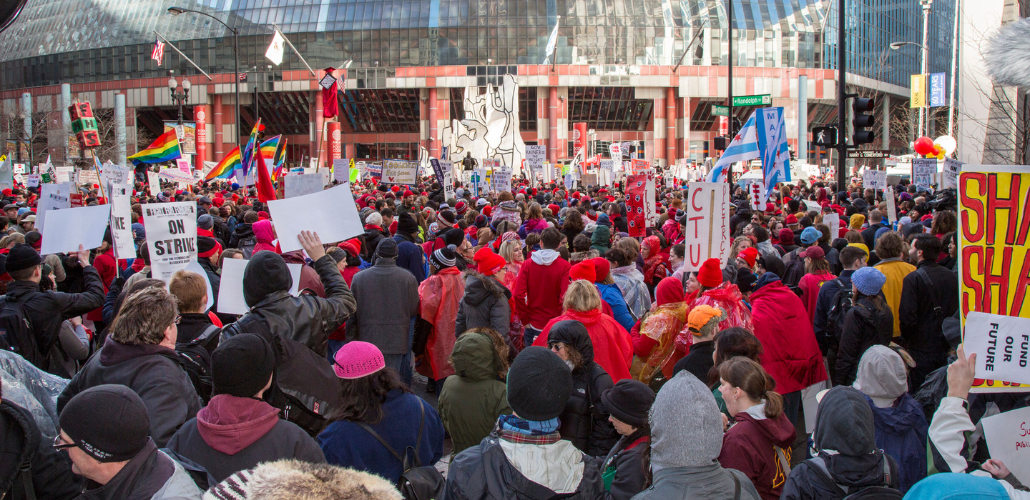
Trump’s attacks on working people—threats to send troops into major U.S. cities, ripping collective bargaining rights from a million federal workers, an immigration enforcement terror campaign that borders on unconstitutional—have been so extreme that many people are talking about a general strike. These calls are coming not just from the usual suspects, but even from my own mayor, former Chicago Teachers Union leader and organizer Brandon Johnson.
We’ve all heard calls for a general strike before—usually not as a serious proposal or strategy, but as a reaction to the attacks that working people face on a regular basis from existing political and economic power. Such calls are easy to dismiss, because they tend to come from well-meaning people without the knowledge of how difficult a strike is to launch and win in a single shop, let alone across a country of 330 million people that hasn’t seen anything approaching a national general strike in almost 150 years.
Those of us who have done the hard work of organizing our co-workers, winning union recognition, and negotiating with recalcitrant employers have frequently dismissed the idea out of hand. But two years ago, in the wake of the “Stand-Up Strike” at the Big 3 U.S. automakers, United Auto Workers President Shawn Fain put the idea on the table when he called on the labor movement to prepare to strike together on May 1, 2028.
| | WEEKLY DERAILMENT DEPARTMENT | | Each Tuesday in this news bulletin, RWU does our best to present a picture of what has been happening over the course of the previous week in terms of derailments in North America, and investigation determinations of previous accidents. NOTE: This list is by no means comprehensive. Smaller and less consequential mishaps are generally not reported here. If the wreck results in injury or fatality, or is especially damaging/extreme, a full article will appear as a feature in the dozen or so rail articles above. Know of a train wreck? Please feel free to forward a link to raillabornews@gmail.com for possible inclusion next week. Thanks! |
| | | |