Rail & Labor News from RWU
| | Weekly Digest Number 28 - July 14, 2026 | | Welcome to the RWU Rail & Labor News! This news bulletin is produced and emailed out each Tuesday morning. We hope you find each week's news and information useful. If so, please share with co-workers, friends, and colleagues. If you like, you can sign them up to get all the news from RWU HERE. Or forward them the link. Got a hot tip? Please forward the article and a link to raillabornews@gmail.com. Note: If you read over this news bulletin each week, you will be sure to never miss the important news of what is going on in the railroad world from a worker's perspective! | | THIS WEEK'S RAIL AND LABOR NEWS | | Editor's Note: The Canadian Transportation Safety Board - analogous to the National Transportation Safety Board (NTSB) in the U.S., - has been recommending for years that Canadian rails be equipped with some form of Positive Train Control (PTC). Likewise, the NTSB had insisted for well over a decade that PTC be employed by railroads in the States. With the 2008 Chatsworth train collision and resulting loss of 25 lives, PTC was finally mandated by law. Will it take a similar disaster in Canada before action is taken? | |
Progressive Railroading / July 10th
The Transportation Safety Board (TSB) of Canada has released its annual review of safety recommendations across the marine, pipeline, aviation and rail sectors that have yet to be implemented.
While 84% of the TSB's safety recommendations since 1990 have been assessed as fully satisfactory, 78 recommendations remain outstanding, eight of which relate to the rail sector, TSB officials said. Notably, the TSB highlighted persistent risks related to delays in implementing enhanced train control (ETC) systems, known as positive train control in the United States, that could help prevent derailments and collisions.
"Some of the recommendations highlighted in this year's assessment stem from investigations that occurred nearly a decade ago," said TSB Chair Yoan Marier. "While we recognize that in some areas progress has been made, meaningful action is still needed to address longstanding safety deficiencies and reduce the risk of future accidents."
| | Editor's Note: Whether you voted YES or NO on the tentative agreement that was before you in the last 18 months or so, this was the biggest yawn of a contract bargaining process in recent decades. Many contracts were actually settled nearly two years ago in the fall of 2024, before even the November 1st date which is generally set to swap "bargaining demands" known as "Section 6 notices." If you are wondering why, just look at what happened in 2022. Rail workers - with the assistance of Railroad Workers United - rose up and demanded more, threatening a nationwide freight rail shutdown, much to the chagrin of Class One rail management and rail union officials alike. This time around, apparently neither wanted that sort of open rebellion again, as did neither political party. | |
Progressive Railroading / July 6th
The National Railway Labor Conference (NRLC) today announced the close of the 2025 round of bargaining as all 12 unions representing freight-rail employees in the national handling process are now covered under agreements through 2029. The Brotherhood of Railroad Signalmen was the final union to ratify its contract.
The NRLC's National Carriers' Conference Committee (NCCC) represents U.S. Class Is and a number of short lines and passenger railroads in labor negotiations with the unions. The 2025 round of bargaining was the shortest round in decades, closing in only 18 months, according to the NCCC.
The prior four rounds averaged more than three years, NCCC officials said in a press release. The 2025 round is also notable as all 12 unions reached and ratified agreements without resort to a Presidential Emergency Board, interest arbitration or emergency legislation for the first time since the 2005 round, they added.
| | Editor's Note: The author makes a brilliant and compelling case for nationalization of the CN. Just like the big Class One carriers south of the border, CN has been able to achieve such "economic success" due to its monopolistic position, driving up prices for shippers, diverting loads to the highways and failing to invest in infrastructure and manpower. | |
Canadian Centre for Policy Alternatives / July 8th
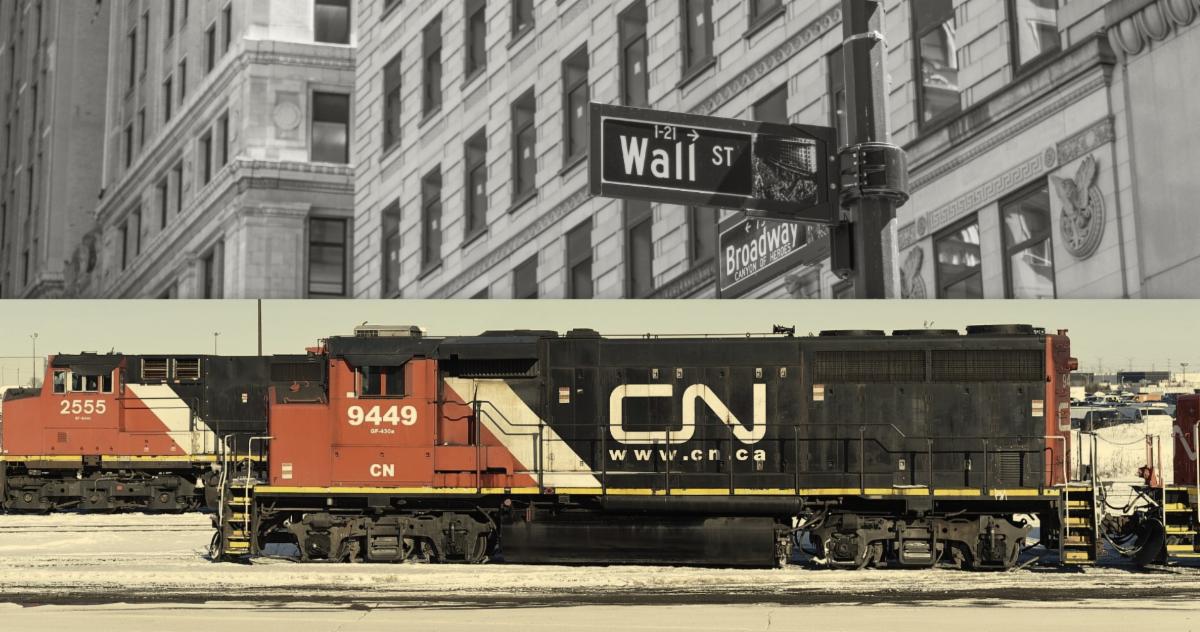
For nearly a century, Canadian National (CN) was a publicly owned crown corporation, providing all corners of Canada with rail service. That changed in 1995, when the federal government privatized CN via an initial public offering (IPO) of its stock. In 2025, CN commemorated 30 years as a private corporation. Along with Canadian Pacific (CP), CN is one of Canada’s two Class I railroads (defined by earning more than $1 billion in annual revenue, as of 2026). As the larger of the two, owning an outright majority of the nation’s rail network, CN has an outsized impact on the Canadian economy. Yet despite its stranglehold on the nation’s critical transportation infrastructure, CN’s private ownership has gone largely unquestioned since privatization.
CN management has largely framed the supposed “success” of privatization around two key metrics: the operating ratio (OR) and free cash flow (FCF). The operating ratio is a metric developed by the rail industry in the 19th century to measure railroads’ profitability by dividing operating revenues by operating expenses. For nearly two centuries, railroads have sought to lower their operating ratios, but with Wall Street’s heightened interest in railroad stocks in the past 20 years, that focus has turned into an obsession. Whereas an 80 per cent OR, or 80 cents spent per dollar of revenue, was standard for a long time, in recent years, railroads have sought to push the OR below 60 per cent. Free cash flow is a related metric, which is composed of operating cash flow (money that the railroad brings in from normal operations) minus capital expenditures.
|
| Editor's Note: It is great to see some previously non-union train dispatchers get organized into the union. It is curious that instead of organizing into the American Train Dispatchers Association (ATDA), they chose the BLET. | |
Progressive Railroading / July 9th
Employees working at the Watco Dispatch Center in Wichita, Kansas, ratified their first union contract with the Brotherhood of Locomotive Engineers and Trainmen (BLET) on June 30.
The dispatchers selected BLET as their designated collective bargaining representative in February 2025. The contract is the first union agreement ratified by Watco employees, BLET officials said in a press release.
The contract covers seniority, job bidding, discipline procedures, grievances, compensation, benefits and layoffs. Current employees will receive a $2,500 signing bonus, with new hires in training receiving the bonus upon qualification. The agreement also establishes, among other things, overtime pay at time-and-one-half for hours worked over 40 hours per week, holiday overtime pay, bereavement leave protections and continued participation in Watco health and welfare, 401(k) retirement and vacation programs.
| | Editor's Note: While UP states that it remains "firm in their commitment" that they will continue to operate these properties jointly and refrain from attempting to control them, without firm rules in place, that could easily change. While on the subject speaking of control, a post merger joint UP-NS would appear to have the numbers to totally control the National Railway Labor Conference and its bargaining arm the National Carriers Conference Committee. If this is in fact the case, the rail unions should be up in arms since in effect, UP-NS would have monopoly control when it comes to bargaining the master freight agreement with the 12 rail unions. The STB needs to look into this matter as well as UP-NS control of the joint properties listed in the article below. | |
Progressive Railroading / July 7th
Union Pacific Corp. and Norfolk Southern Corp. today submitted the first portion of responses to the Surface Transportation Board's (STB) request for supplemental information to support the companies' merger application.
The STB accepted UP-NS' revised merger application on May 28, with a caveat that the railroads submit more information to the board by July 27. The railroads' first application was rejected on Jan. 16 because it did not contain enough information for the board to evaluate if the proposed $85 billion transaction is in the public's interest.
Today's filing with the STB addresses the board's questions regarding the Terminal Railroad Association of St. Louis, Kansas City Terminal Railway and TTX Co., UP officials said in a press release. These entities are jointly owned with other Class Is, operated by independent management teams and governed by non-discrimination policies. UP and NS do not control those companies today and "remain firm in their commitment that they will not control them post-merger," they added.
| | Editor's Note: The accusations are flying between the various Class One carriers over the proposed UP-NS merger. One cannot help but smile to watch these Wall Street titans fire fierce and malicious accusations against one another. Much to the detriment of rail labor, the rail unions have fought viciously with one another over the years. Great to see the big carriers at each other's throats for a change! | |
Trains Magazine / July 10th
A Union Pacific executive said this week in a message to shippers that customers have felt a “real backlash” from BNSF Railway and CPKC after indicating support for the UP-Norfolk Southern merger.
BNSF and CPKC issued strong responses today (July 10).
Kenny Rocker, UP executive vice president, marketing and sales, said in the message on the railroad’s website that customers “are remaining silent on the merger due to concerns about retaliation elsewhere,” then mentioned BNSF and CPKC. “This type of pressure is crossing the line,” he said, urging any shipper with similar experiences to contact UP and the Surface Transportation Board.
CPKC responded by saying of Rocker’s claim in a statement to Trains, “It’s another UP falsehood and any suggestion we are threatening our customers or any stakeholder is categorically untrue.
| | Editor's Note: Lest we forget, the horrendous wreck at Lac-Megantic, Quebec in Canada that took the lives of 47 people was the result of a single person crew operation. When the government charged the engineer and train director with a high crime, Railroad Workers United moved into action. While these workers were ultimately acquitted of the charges that would have incarcerated them for life, justice was never served. CEO of the carrier at fault - the Montreal, Maine and Atlantic (MM&A) - Ed Burkhart never served a day behind bars, nor did any other manager responsible for the reckless, unsafe practices at the MM&A. A minimum two-person crew is the norm on both sides of the border. But its status as standard practice is constantly under attack by the carriers both large and small. RWU has been at the head of the fight to oppose single person train operations since the days of our predecessor organization Railroad Operating Crafts United (ROCU) beginning in 2005. See the Campaign Page to Oppose Single Person Crews. | |
Confined Space / July 6th
July 6 has a rather dubious place in the history of workplace and community safety, corporate responsibility and government oversight.
Lac Mégantic, July 6, 2013
Five years ago today, an unmanned train carrying 72 tank-cars of highly combustible crude oil barreled down a hill at 65 mph, three times the normal speed, and careened off the track in the small town of Lac-Mégantic, Quebec, disgorging six million liters of highly combustible petroleum crude. Within moments the oil exploded. The resulting inferno obliterated most of the downtown and incinerated 47 persons.
The Canadian government prosecuted the train’s engineer and sole crew member for not setting enough hand brakes, as well as two other rail employees, on 47 counts of criminal negligence causing death — crimes that carried a life sentence. Happily, the jury found the workers innocent after a government report and trial testimony that revealed serious weaknesses in the railroad’s safety culture, single operator procedures, safety procedures, maintenance, worker training as well as problems with government oversight. One attorney called it a “perfect storm” of substandard company practices.
| | Editor's Note: Just like that, the Korea rail system orders $4 billion of new equipment (nearly a thousand rail cars) for its next generation of fast trains. Yet, here in the good old US of A, it seems to take an act of God to obtain new up-to-date rail equipment for our passenger trains. | |
Rail Journal / July 8th
KOREA’s national operator, Korail, plans to order a fleet of 49 EMU-320 high-speed trains worth Won 5 trillion ($US 3.3bn) and a prototype EMU-370 train with a maximum speed of 370km/h. Korail will order the first batch of 28 EMU-320 trains next year with delivery starting in 2032.
The decision follows approval by Korea’s Ministry of Finance and Economy of a preliminary feasibility study of Korail’s next-generation high-speed train project. Korail says the objective of the study was to replace the 46 KTX-1 trains, which will reach the end of their life in 2033, in a timely manner and to establish a stable high-speed rail operating environment.
Hyundai-Rotem supplied two pre-series production eight-car EMU 320 trains, called Blue Dragon, which entered service in 2024. Hyundai Rotem released the first of its second-generation EMU-320 high-speed trains in January following initial test runs conducted at the end of 2025.
| | Editor's Note: Bill Moyer of Solutionary Rail interviews Jim Matthews, head of the Rail Passengers Association (RPA) about the state of passenger rail and the "Build America 250 Act." During Trump's first term in office, he attempted to kill Amtrak, but the nation's passenger rail system survived with the national network intact. While this bill is not an Amtrak killer, it has many shortcomings that - if passed in its current form - does not bode well for passenger rail in the USA. | |
Solutionary Rail / July 11th
Time flies when you’re having fun—and also, it seems, when Congress actually does something that materially benefits the country.
It’s already been five years since the landmark Bipartisan Infrastructure Law (BIL)—also known as the Infrastructure Investment and Jobs Act (IIJA)—was passed. This legislation made historic investments in the nation’s passenger rail network. It allowed Amtrak to upgrade its fleets, as well as repair and replace its crumbling bridges and tunnels; and it gave states an invaluable pathway to expanding existing service and restoring discontinued routes.
Though it feels like many of the projects that the BIL authorized are just beginning to see the light of day, we are now on the brink of having to kiss much of that progress goodbye—that is, unless we can do something about it. See, Congress gets together twice a decade to formulate a new policy roadmap for railroads, roads, pipelines, and some aspects of inland waterways. This is known as a Surface Transportation Reauthorization. That, in part, is what the BIL was.
| | Editor's Note: The Real News Network speaks with a panel of survivors of the 2013 Lac-Mégantic rail disaster in Canada - one of the deadliest in North American history - and the 2023 East Palestine, OH train derailment and chemical disaster in the USA. RWU is building a new campaign committee of rail workers and community activists to create a lasting and effective alliance around rail safety. This webinar is PART 2. For PART 1, click HERE. | |
The Real News Network / July 6th
10 years before the catastrophic train derailment and chemical disaster in East Palestine, Ohio, one of the deadliest rail disasters in North American history took place in the Canadian town of Lac-Mégantic, Quebec.
On July 6, 2013, an unattended freight train that had been parked on the tracks overnight began to roll downhill and gather alarming speed as it careened towards the city center of Lac-Mégantic. The train, which was operated by Montreal, Maine, and Atlantic Railway and carrying over 2 million gallons of crude oil, derailed around 1:15 AM. The resulting explosions and fire killed 47 people and destroyed over 40 buildings, obliterating a large portion of the downtown area and prompting mass evacuations.
In this special episode of Working People, we speak with a panel of survivors of the Lac-Mégantic rail disaster in Canada and the East Palestine rail disaster in the USA.
| | Editor's Note: Earlier on this national Big Boy tour, a reporter in tennis shoes fell from the ladder of the steam locomotive and was injured. Now this. For a pair of railroads - UP and NS - that love to talk about "safety first" it appears that adequate preparations are not always being made to ensure the safety of the civilians. | |
Fox 29 / July 2nd
More than 100 people required medical evaluation and care after a mass casualty event at the Reading Railroad Outer Station in Muhlenberg Township earlier Thursday afternoon, according to Blandon Fire Company QRS. Initial reports say the incident stemmed from heat-related emergencies.
What we know:
Blandon Fire Company QRS responded as part of the regional mutual aid system to a declared mass casualty event in Muhlenberg Township, assisting Muhlenberg Township Fire & Rescue 66 and Muhlenberg Ambulance with treatment and support operations at the Reading Railroad Outer Station.
Upon arrival, EMTs from Blandon Fire Company integrated into the incident’s unified command structure and were assigned as QRS Team 2, according to Blandon Fire Company QRS. QRS Team 2 assisted with patient triage, treatment, transport, support and logistics operations.
More than 100 patients required medical evaluation and care throughout the event, according to Blandon Fire Company QRS.
| | NEWS FROM AROUND THE LABOR MOVEMENT | | Each week, RWU includes a few articles about advances and developments in the larger labor movement that are of interest to railroad workers. Got an artcile to submit for possible inclusion next week? Email it along to raillabornews@gmail.com. Thank you! | | Editor's Note: Our friends at the United Electrical union (UE) - which represents locomotive builders (Wabtec) in Erie, PA and crew van drivers around the country - sees Artificial Intelligence (AI) in a historic context of workers vs. profits. The fight is well over 200 years old. AI is just the latest and meanest chapter in this struggle of workers vs. "automation." | |
United Electrical / July 10th
Over two centuries ago, Britain faced high inflation during the Napoleonic Wars. The emerging industrialist class reached a novel solution to cut costs and raise profits: implement new machinery within textile mills, converting skilled labor into unskilled work that could be performed by anyone, even “apprenticed” orphans provided only room and board.
As a response to this degradation of working conditions, the “Luddites” formed. They engaged in nighttime raids against physical capital, only targeting those machines that most threatened skilled work, and those employers who most drove down living standards. Luddites were labor agitators, working through direct action to halt the erosion of living standards in their industry during an era when collective bargaining was outlawed and the strike was not yet perfected. They were only defeated following ruthless suppression by the British government, including new laws making the destruction of machines punishable by death.
Looking back from the perch of the present, the Luddites may seem, at best, to be a noble lost cause fighting against the tide of history. But they understood that history is contingent, and the technology the boss implements is but one of those contingencies.
| | WEEKLY DERAILMENT DEPARTMENT | | Each Tuesday in this news bulletin, RWU does our best to present a picture of what has been happening over the course of the previous week in terms of derailments in North America, and investigation determinations of previous accidents. NOTE: This list is by no means comprehensive. Smaller and less consequential mishaps are generally not reported here. If the wreck results in injury or fatality, or is especially damaging/extreme, a full article will appear as a feature in the dozen or so rail articles above. Know of a train wreck? Please feel free to forward a link to raillabornews@gmail.com for possible inclusion next week. Thanks! |
| | | |