Rail & Labor News from RWU
| | Weekly Digest Number 26 - June 30, 2026 | | Welcome to the RWU Rail & Labor News! This news bulletin is produced and emailed out each Tuesday morning. We hope you find each week's news and information useful. If so, please share with co-workers, friends, and colleagues. If you like, you can sign them up to get all the news from RWU HERE. Or forward them the link. Got a hot tip? Please forward the article and a link to raillabornews@gmail.com. Note: If you read over this news bulletin each week, you will be sure to never miss the important news of what is going on in the railroad world from a worker's perspective! | | THIS WEEK'S RAIL AND LABOR NEWS | | Editor's Note: In recent months, the rail industry has witnessed a steady increase in freight traffic. This of course is in spite of itself, as it has literally done nothing to account for this development. It's all about the trials and tribulations of the deregulated mess called the trucking industry. The irony is that if this trend continues, we just might begin to see service failures the likes of which have haunted the NS in recent weeks, and even full scale "melt-downs" like those in the post pandemic era if the trend continues. Hold onto your hats fellow railroad workers! | |
The Wall Street Journal via MSN / June 22nd
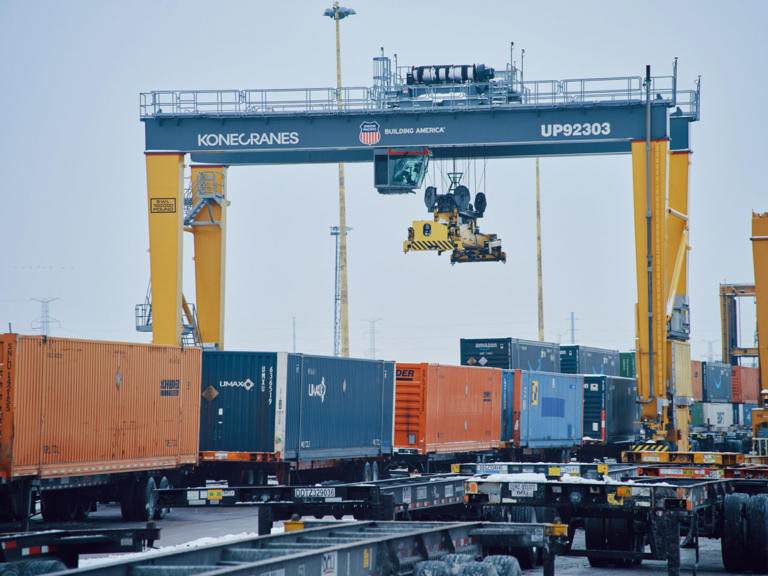
American retailers and manufacturers are learning to love trains again.
Companies abandoned the rails in recent years because trucking was a faster, more secure way of moving furniture, food and electronics across the country.
Now that trucking rates are climbing toward their highest levels in four years, some businesses are deciding a slower, cheaper route across the country suits them fine.
“Everybody’s exploring intermodal,” said Milton Magos, vice president of Mexico operations at freight brokerage Traffix. “They want to know how they can make their supply chain more reliable.”
North American intermodal transports, in which railroads carry containers and truck trailers, rose about 6% in May from a year earlier to an average of around 369,000 containers and trailers a week, according to the Association of American Railroads.
| | Editor's Note: The East Palestine saga continues to haunt Norfolk Southern, as well it should. A simple wheel bearing failure - that could have and should have been easily detected and dealt with prior to the derailment and resulting disaster - has led to the ongoing debacle. PSR - the "operating plan" that is predicated upon endless cuts to maintenance, inspection, staffing, and service designed to save money - is ultimately the culprit here. | |
WSBTV Atlanta News / June 25th
A Florida-based software company is suing Atlanta-based Norfolk Southern Co., alleging the rail giant stole their AI program in the wake of the East Palestine train derailment.
Duos Technologies is demanding damages from Norfolk Southern, according to court records, for the rail company’s use of their AI algorithm without proper licensing, despite the patent held and owned by Duos.
Duos is claiming their stolen tech was used in the wake of the East Palestine derailment to make Norfolk Southern’s portals, which was used for inspections and capturing high-speed images of trains.
| | Editor's Note: The author makes some excellent points, debunking a number of rationales for the proposed UP-NS merger. We all know that there are countless ways for the rail industry to build infrastructural improvements, improve service, successfully market the product, and thereby move more freight. Oh but wait, all that costs money. Better to merge, shut down "redundant" infrastructure, spin off branch lines to non-union shortlines, gain even more monopoly power over pricing, and make Wall Street hedge fund investors happy. (Be sure to read the article's final paragraph.) | |
Trains Magazine / June 22nd
Professor Danielle Zanzalari recently argued in Trains that rail’s loss of market share* results from poor coordination among railroads [see “Rail’s next phase is about coordination, not cost…,” Trains.com, May 23, 2026].
She writes, “each handoff (interchange) introduces friction — scheduling mismatches, terminal delays, service variability” and her solution to the problem is more end-to-end mergers. I agree that moving freight across North America is complicated. But, in my view, the real “friction” is not the handoff between carriers. Rather, it results from the longstanding and ever-present operations research task of routing railcars from thousands of origins to thousands of destinations while minimizing train handling and keeping costs under control. This task is not mitigated or eliminated in end-to-end mergers.
When I began my railroad career in the early 1980s at the Chicago & North Western, the railroad operated dozens of daily trains (intermodal, manifest, and unit auto, coal, and grain) through a seamless interchange with Union Pacific at Fremont, Neb.
|
| Editor's Note: This plan - while not nearly as ambitious as the one 15 years earlier crushed by then Governor Scott Walker - deserves the support of everyone in the state including rail workers. The success of the Hiawatha Service between Chicago and Milwaukee along with the recent success of the new Borealis service between Chicgao, Milwaukee and St. Paul/Minneapolis will surely be duplicated with the plan to extend the Hiawatha service to the state's capital, Madison. Hopefully this can jump start a full revitalization of passenger ril service to all parts of the state. | |
Trains Magazine / June 26th
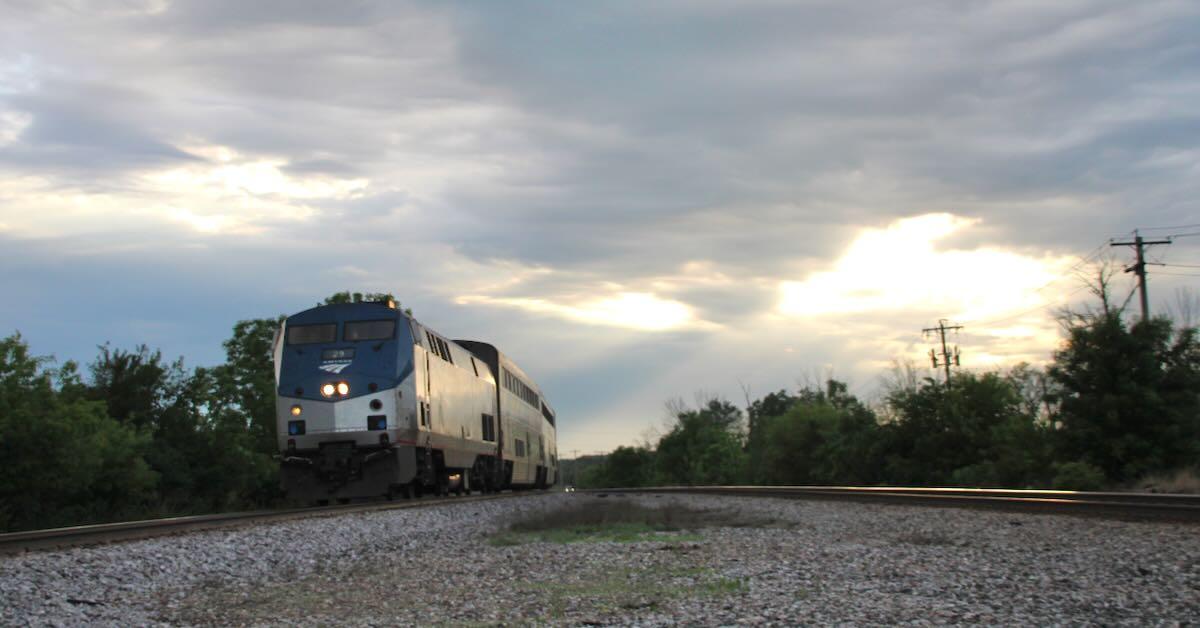
Wisconsin’s Department of Transportation has applied for a $218.2 million federal grant to extend Hiawatha passenger service to Madison, Gov. Tony Evers announced on Thursday, June 25.
The funding would be used to improve existing infrastructure to make it possible for Hiawatha trains to service Pewaukee, Watertown, and Madison. An earlier effort to extend the service received an $810 million federal grant for higher-speed service, but the project was canceled in 2010 by newly elected Gov. Scott Walker.
“The opportunity to expand passenger rail has haunted Wisconsin for a generation because of a short-sighted political stunt — that decision cost our state dearly, and we want to right that wrong,” Evers said in a press release. “… This is an important effort that should have happened a long time ago, and I’m hopeful the Trump Administration will approve our request so we can get this done.”
| | Editor's Note: We reported on this NS derailment a few issues ago. Now two weeks later, negative environmental effects are becoming more apparent. Let's see how Norfolk Southern - the railroad culprit of the East Palestine derailment a few hundred miles southeast of this one handles this - handles this calamity. Citizens of the community, know your enemy! | |
WATE News / June 26th
The fallout from a train derailment in the Lancing area of Morgan County continues to impact the environment.
A Norfolk Southern train derailed on June 11, causing 29 box cars to go off the tracks. Per the Environmental Protection Agency, 19 of them were carrying ethanol, three were breached and caught fire. Now, fish have been seen floating in the Emory River.
“As soon as we put in from the ramp, we started noticing that fish,” said David Newport. “And then the further downriver we went; it was just more and more and more it was. Easily 100 or more.”
| | Editor's Note: STB member Karen Hedlund's recent statement to a Senate Committee hearing that “how we maintain competition in a concentrated industry is going to be a matter of significant concern," might just be the understatement of the year. Monopolization of the rail industry well over 100 years ago - and associated concerns of maintaining competition at that time - was not nearly as far along as it is today. So the STB better damn well be concerned when their decision regarding the proposed UP-NS merger could result in just FOUR Class One railroads left, controlling 90% of the freight rail movements in all of North America! | |
Trains Magazine / June 25th
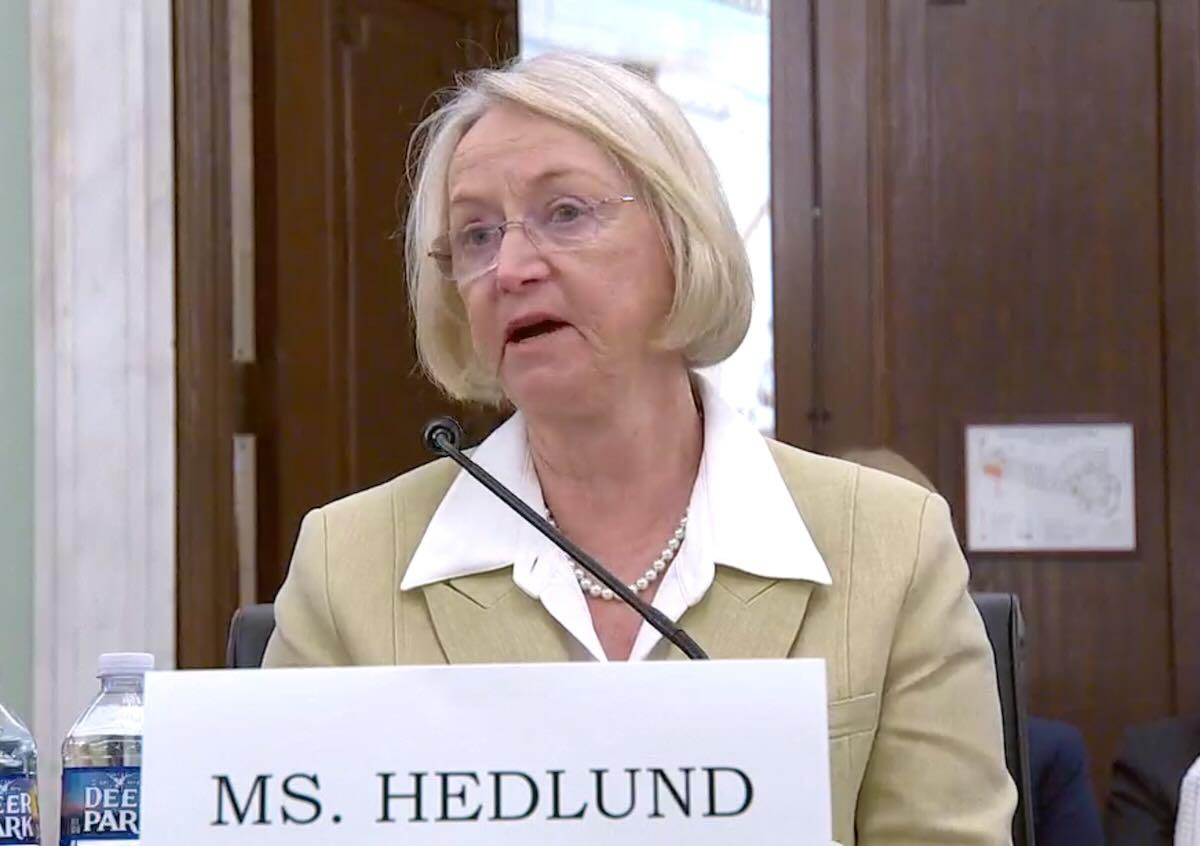
Surface Transportation Board member Karen Hedlund told a Senate committee hearing on Wednesday, June 24, that “how we maintain competition in a concentrated industry is going to be a matter of significant concern” as the board considers the Union Pacific-Norfolk Southern merger.
Hedlund, who has been nominated for a second term on the STB, was one of five nominees for various posts taking part in a confirmation hearing by the Committee on Commerce, Science, and Transportation. With the UP-NS merger before the board, her ability to answer questions regarding the merger was limited. Her comment regarding “significant concern” came as part of a response to queries from Chairman Ted Cruz (R-Texas) asking what factors she would consider relevant to determining whether a merger enhances competition.
“It is a key provision in the regulations that were adopted in 2001,” Hedlund said. “… We have recently asked the applicants to give us more information on their view of how they would enhance competition. I’m sure we’ll receive comments from other parties, but I really hesitate to comment further on an issue that I think will be subject to some discussion in the proceeding."
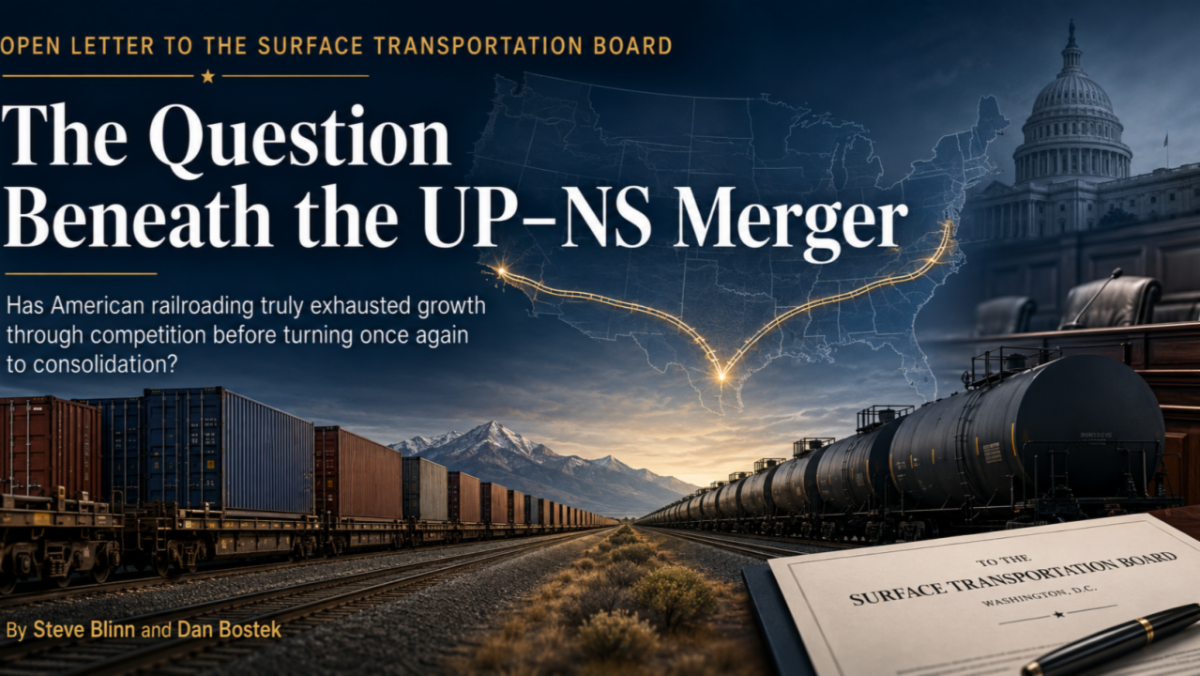
| | Editor's Note: This is a very long involved letter to the Surface Transportation Board (STB) from these two "railroad insider" types. Interestingly, they state, "The question is why growth remains the promise rather than the result," over the course of the last generation of railroading, noting that the rail industry has consistently promised that mergers, new operating plans (e.g. PSR), etc would deliver "growth" when in fact the industry is moving 20% fewer freight carloads than 20 years ago. | |
Published on Linkedin / June 22nd
Before deciding whether Union Pacific and Norfolk Southern should become one railroad, it may be worth asking a simpler question.
What problem is America trying to solve?
At first glance, the answer appears obvious. The applicants have spent months explaining it. Rail needs growth. Rail needs reach. Rail needs scale. Rail needs a network capable of competing more effectively against trucking. Rail needs more single-line service, fewer interchanges, faster routes, better corridors, stronger connectivity, and a transportation product capable of convincing shippers that freight currently moving by highway should move by rail. The amended application filed April 30, 2026 frames the prize directly: the first true coast-to-coast single-line railroad in the United States, roughly 50,000 route miles reaching 43 states, supported for the first time by 100 percent actual waybill data from all six Class I carriers.
| | Editor's Note: The irony here is that the CEO broaches the question that the proposed merger could potentially deter NS from pursuing the running of an efficient railroad TODAY. Even broaching the subject is some kind of admittance that the merger could potentially be an obstacle to providing decent service between now and then. | |
Trains Magazine / June 24th
Norfolk Southern Chief Executive Mark George says the railroad remains focused on improving its service while continuing to advance the proposed merger with Union Pacific, and that it can and must do both simultaneously.
“From the outset of our announcement to merge strengths with Union Pacific Railroad (NYSE: UNP), we have been clear: Norfolk Southern (NYSE: NSC) is not singularly focused on closing a transaction,” George wrote in a LinkedIn post on Monday.
“There is no trade-off between evaluating long-term opportunities to strengthen the freight rail network and executing at a high level for customers today. Responsible leadership requires both,” George wrote. “We operate NS as a standalone railroad that competes and wins in today’s market, because that’s what our customers and employees expect and deserve. We also have to think about what will unlock their ability to tap a more competitive rail ecosystem.”
| | Editor's Note: This article making the rounds among rails is sheer propaganda. The BMWED's - like many unions' - historic support of "Democratic causes" is nothing new. And the reasoning behind this support is because in general, Republicans are opposed to rail industry regulation, strong workplace safety enforcement, unions, strikes, etc. Most unions painstakingly interview candidates for office with a series of questions that have been determined by the union and its membership as to what is in its best interests. Based on answers to these questions - together with the previous record of the candidate - they may or may not obtain the endorsement and financial support of the union. It just so turns out that working class issues tend to be supported to a greater degree by Democrats than Republicans. It's as simple as that. And while any union is composed of a broad demographic that may include all stripes of political views including Republican/MAGA supporters, that tends to be a minority. Democracy does not mean the minority gets its way. All this said in defense of BMWED and other unions, RWU does not necessarily support either party, and questions if monies spent on supposedly "pro-labor" candidates from either could not be better spent organizing workers and/or building a new political party based on strict support of labor and working class issues; i.e. a Labor Party. | |
Fox News / June 20th
A major railroad union is under fire after a watchdog report alleged its leadership funneled money to support Democratic causes that opposed the Trump administration, undermining many of its own MAGA members while also spending millions on questionable expenses.
Leaders of the Brotherhood of Maintenance of Way Employees Division (BMWED-IBT), one of the nation's largest rail unions representing 37,000 members, are accused of using union resources to support Democratic priorities through their spending, according to a report released by the American Accountability Foundation (AAF).
"The leadership's progressive alignment is a stunning betrayal of the large proportion of its working-class members who support the MAGA agenda and President Trump's leadership," the report said.
| |
The Guardian / June 26th
In the weeks after the East Palestine train wreck culminated in a towering fireball and chemical release in the small Ohio town, Jessica Boersma was seriously exposed to the stew of compounds emitted from the derailment site.
Boersma lives less than a quarter mile away, and, as a city council member, she had to spend significant time at the site coordinating with first responders.
Now the first long-term research carried out on East Palestine residents exposed to the disaster suggests how it may have affected her – blood drawn six months after the accident showed signs of chronic inflammation and altered cell counts suggesting the chemical exposure had damaged her body.
| | NEWS FROM AROUND THE LABOR MOVEMENT | | Each week, RWU includes a few articles about advances and developments in the larger labor movement that are of interest to railroad workers. Got an artcile to submit for possible inclusion next week? Email it along to raillabornews@gmail.com. Thank you! | | Editor's Note: More evidence that it is high time that the labor movement get its shit together ad stop supporting irrelevant Democratic party machine candidates, and start supporting progressive working class candidates that challenge the status quo. | |
Labor Politics / June 24th
Tuesday’s election made clear the limitations — strategically and organizationally — of New York City’s labor leaders.
In the city’s two marquee congressional primaries, candidates backed by labor’s biggest names — 32BJ, 1199SEIU, DC37, the Hotel and Gaming Trades Council, the United Federation of Teachers, and others — went down to defeat. In the first, Congressional Hispanic Caucus chair Adriano Espaillat, a corporate Democrat who racked up some fourteen union endorsements, lost his Upper Manhattan and Bronx seat to Darializa Avila Chevalier, a thirty-two-year-old democratic socialist insurgent backed by Zohran Mamdani, the New York City Democratic Socialists of America (NYC-DSA), and Justice Democrats.
Delivering Avila Chevalier the biggest Congressional upset since Alexandria Ocasio-Cortez’s win in 2018, a majority of District 13 primary voters showed that they no longer trust a Democratic establishment unable or unwilling to seriously challenge Trump and an oligarchic status quo.
| | Editor's Note: Maritime workers are a vital part of the international supply chain, and as such are close allies of railroad workers. The same forces mentioned in this article who want to see the Jones Act shredded would love nothing more than to decimate rail unions and obliterate rail regulations. Maritime workers need our support. An injury to one is an injury to all! | |
Stansbury Forum / June 21st
Relatively low on the scale of Presidential abominations, but of potentially great impact, is a development that threatens the existence of one of America’s oldest and, in centuries gone by, most celebrated industries. America’s prosperity as far back as colonial days grew in no small measure due to the creation and rapid expansion of a vibrant colonial and, later, national merchant marine. Merchant ships built in the thirteen colonies and crewed by Americans were essential to the economic growth of the colonies, their prosperity and the establishment of the United States as a great trading nation.
In fact, one of the first actions taken in the first United States Congress of 1789 was the enactment of cabotage laws reserving U.S. waterborne domestic trade to U.S.-flag vessels and other provisions promoting the use of U.S.-flag vessels in America’s foreign trade. This was a principle recognized by the celebrated free trader Adam Smith. He understood that exceptions to his theory of international free trade were necessary in the case of a national merchant marine and supportive navigation laws as a nation’s military and economic security relies on its ability to engage in and protect its seaborne trade.
| | Editor's Note: It is ridiculous that we have this "blue-red" divide in society. It is meaningless and shallow, with wealthy billionaires controlling the entire process and laughing all the way to the bank. Labor has the potential to re-align society and our politics. It is all of us working people - the vast majority - versus the privileged few. If we can re-align society along class lines, we can win election after election and move the political spectrum in a direction that we can have better wages, benefits and working conditions, housing and health care, education and everything else that the average working American wants and needs. Then labor can rule! | | |
Truthout / June 24th
The left in western democracies has been pretty much in free fall since the onset of neoliberal globalization. This is quite ironic since resistance to capitalism from civil society has actually grown during the same period. This resistance is also reflected in the U.S. political landscape, where the Democratic Socialists of America are surging in support through grassroots efforts in major urban areas. Voters are clearly signaling that they are fed up with the establishment wing of the Democratic Party, whose leaders continue serving, above all else, corporate and financial interests and have displayed immense hypocrisy on foreign policy issues. The stunning results on June 23 in New York’s primaries — which came on the back of advances already made by Democratic Socialists in Washington, D.C., Los Angeles, and in Pennsylvania’s 3rd Congressional District, to mention just a few — speak volumes of the ideological bankruptcy of the Democratic Party in the U.S.
But on the rare occasion that left parties have managed to score national electoral victories, as in the case of Greece in 2015, public disappointment and discontent have soon set in as leaders failed to mount a coordinated attack on neoliberal policies and structures, let alone turn class relations on their head.
| | WEEKLY DERAILMENT DEPARTMENT | | Each Tuesday in this news bulletin, RWU does our best to present a picture of what has been happening over the course of the previous week in terms of derailments in North America, and investigation determinations of previous accidents. NOTE: This list is by no means comprehensive. Smaller and less consequential mishaps are generally not reported here. If the wreck results in injury or fatality, or is especially damaging/extreme, a full article will appear as a feature in the dozen or so rail articles above. Know of a train wreck? Please feel free to forward a link to raillabornews@gmail.com for possible inclusion next week. Thanks! |
| | | |