Rail & Labor News from RWU
| | Weekly Digest Number 15 - April 14, 2026 | | Welcome to the RWU Rail & Labor News! This news bulletin is produced and emailed out each Tuesday morning. We hope you find each week's news and information useful. If so, please share with co-workers, friends, and colleagues. If you like, you can sign them up to get all the news from RWU HERE. Or forward them the link. Got a hot tip? Please forward the article and a link to raillabornews@gmail.com. Note: If you read over this news bulletin each week, you will be sure to never miss the important news of what is going on in the railroad world from a worker's perspective! | | THIS WEEK'S RAIL AND LABOR NEWS | | Editor's Note: They went to Wall Street because that is where the merger will be valued, but the burden is already being placed on the workforce that created that value. The demand to preserve positions speaks to a decade where attrition has quietly done what no agreement would openly allow. A deal that leans on shrinking the ranks over time is not building a stronger railroad, it is thinning the people who keep it running. It is a shame rail labor is not standing together on this, because division is the only condition under which this kind of arithmetic ever succeeds. | |
| |
Railway Age / April 10th
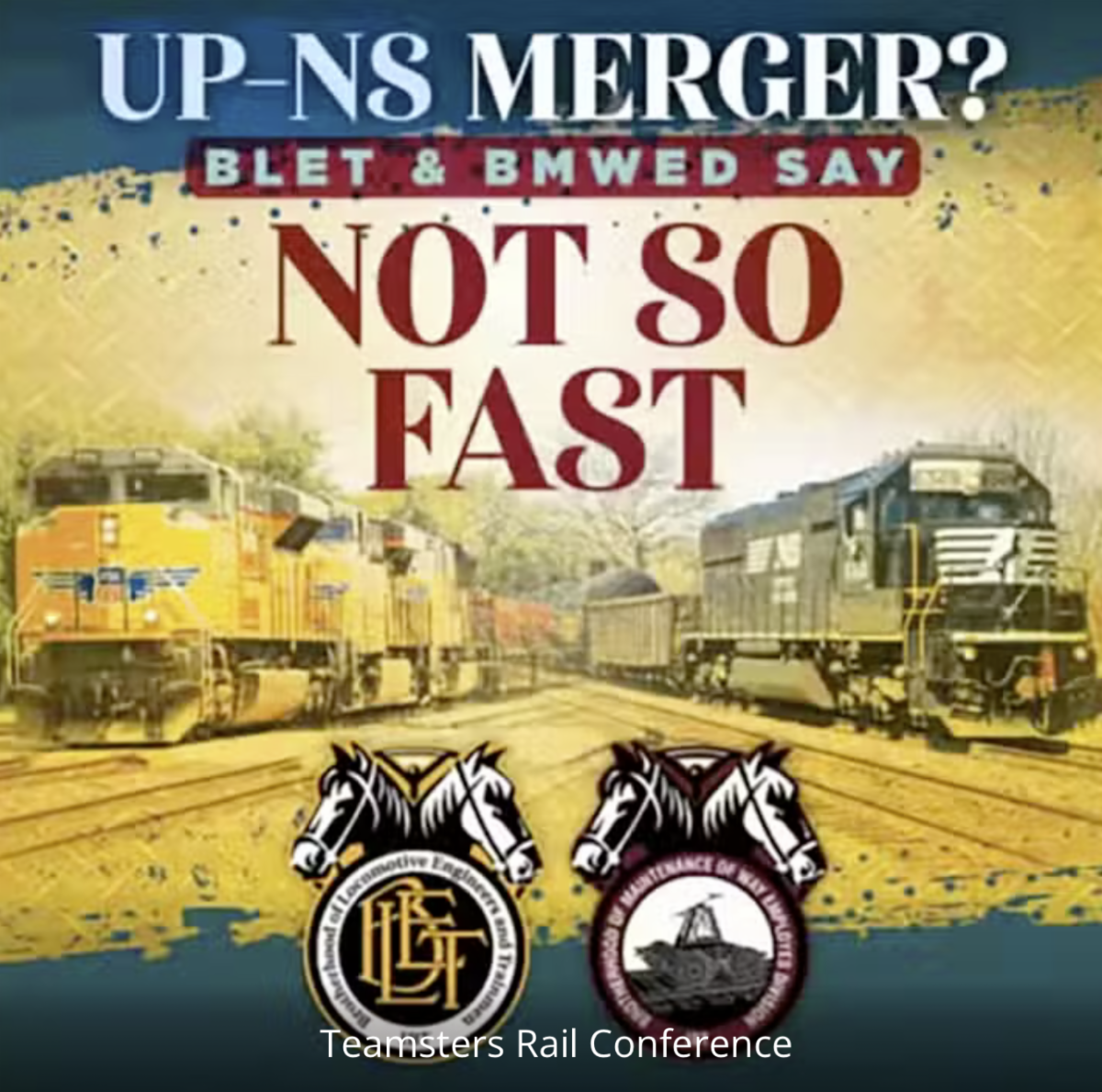
On April 7, Teamsters Rail Conference representatives—BLET National President Mark Wallace, First Vice President Gary Best and National Division staff; and BMWED President Tony Cardwell and Secretary-Treasurer Dale Bogart—met in New York City with Wall Street analysts and investors “to discuss potential ramifications of the proposed Union Pacific-Norfolk Southern merger and the Teamsters Rail Conference’s opposition to the merger,” the two unions said in an April 9 joint release.
“[We] met with more than three dozen investors throughout the day, including a morning session organized by multinational investment bank and financial services company UBS, and separate meetings with representatives from Bank of America, Wells Fargo, Susquehanna International Group and Goldman Sachs,” BLET and BMWED said. “In a post-meeting report to clients, UBS noted that [we] have outlined a clear set of concerns that Union Pacific must address in order to secure their support for the merger. The foremost priority is the preservation of positions, not individuals, as they existed on the date the merger was announced, ensuring that the total number of jobs cannot be reduced over time through attrition or restructuring.
| | Editor's Note: A filing of this scale does not happen over minor disagreements. It points to a merger case being built on assumptions that cannot withstand direct comparison to real traffic. When a model misses what already exists, its projections are not insight, they are optimism dressed as analysis. Railroaders know how that gap gets closed. It is absorbed in the field, where fewer people are asked to carry more across a system that has no room for error.. That is the risk when the numbers lead and the reality follows behind. | |
|
Railway Age / April 7th
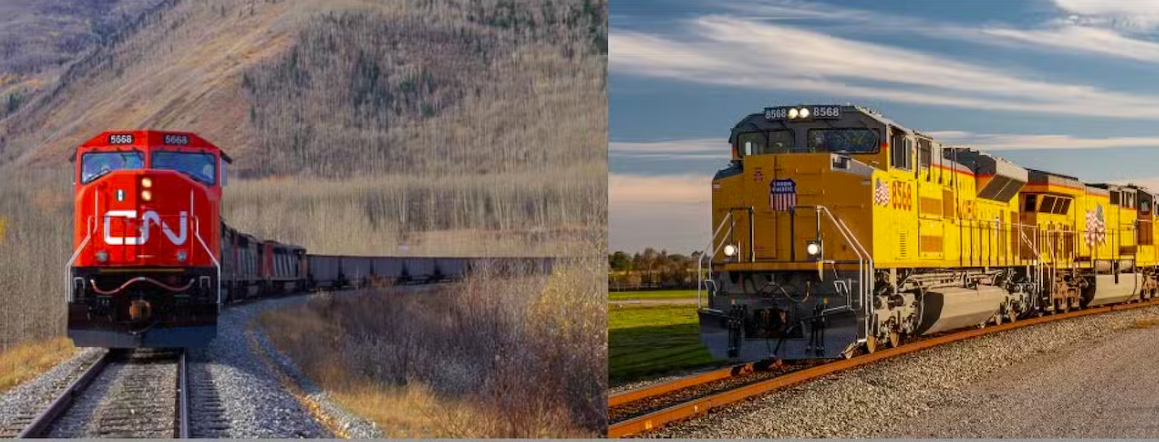
CN on March 23 submitted a 129-page correspondence to the Surface Transportation Board (STB) addressing “major flaws and inconsistencies” stemming from a rail-to-rail diversion analysis submitted by Union Pacific (UP) and Norfolk Southern (NS) (Applicants) in their proposed merger application filed on Dec. 19, 2025.
In the correspondence (download below), CN says that it “raises these issues now to give Applicants an opportunity to correct them before submitting their revised application.” This, CN says, “is particularly important in light of Applicants’ comments indicating they will not take the Board up on its suggestion to ‘improve’ the application and instead will make only limited revisions to the Initial Application to specifically remedy the deficiencies identified by the Board. These issues are so fundamental to the Board’s and parties’ review of the proposed merger that unless they are fixed, a valid assessment of the proposed merger’s impacts on competition, operations, and the environment is not possible.”
According to CN, the Applicants’ Diversion Analysis is “fundamentally flawed and unreliable to assess the proposed merger’s impacts.” The UP/NS Diversion Analysis, CN says, “relies on a statistical model which does not accurately predict actual 2023 market shares, especially for the more than 15,000 Zero Traffic Routes for which Applicants anticipate growth due to the merger.
| |
| Editor's Note: Moments like East Palestine do not just expose failures in equipment. They expose failures in trust. When information fractures and decisions outrun explanation, the public is left to carry the uncertainty the system created. That is where voices like hers emerge, not from ambition, but from absence. Railroaders recognize the pattern. When the system does not speak clearly, someone on the ground eventually will. What follows is not just advocacy, it is a demand that the truth arrive before the consequences do. | |
|
Net Centric Campaigns
The 2023 train derailment in East Palestine, Ohio changed everything.
Like many residents, Jess spent the immediate aftermath searching for answers. Information was inconsistent, guidance unclear, and decisions affecting her community were made quickly and often without transparency.
Her focus at first was personal and local: protecting her family, understanding risks, and making sense of uncertainty.
But as days turned into weeks, something shifted. Jess began speaking publicly, asking questions others hesitated to raise, and connecting with agencies, advocates, and journalists. She gradually became one of the most visible voices for her community.
That period became a turning point, not only in her own life but in how she understood the power of showing up and speaking out.
| |
|
Trains Magazine / April 9th
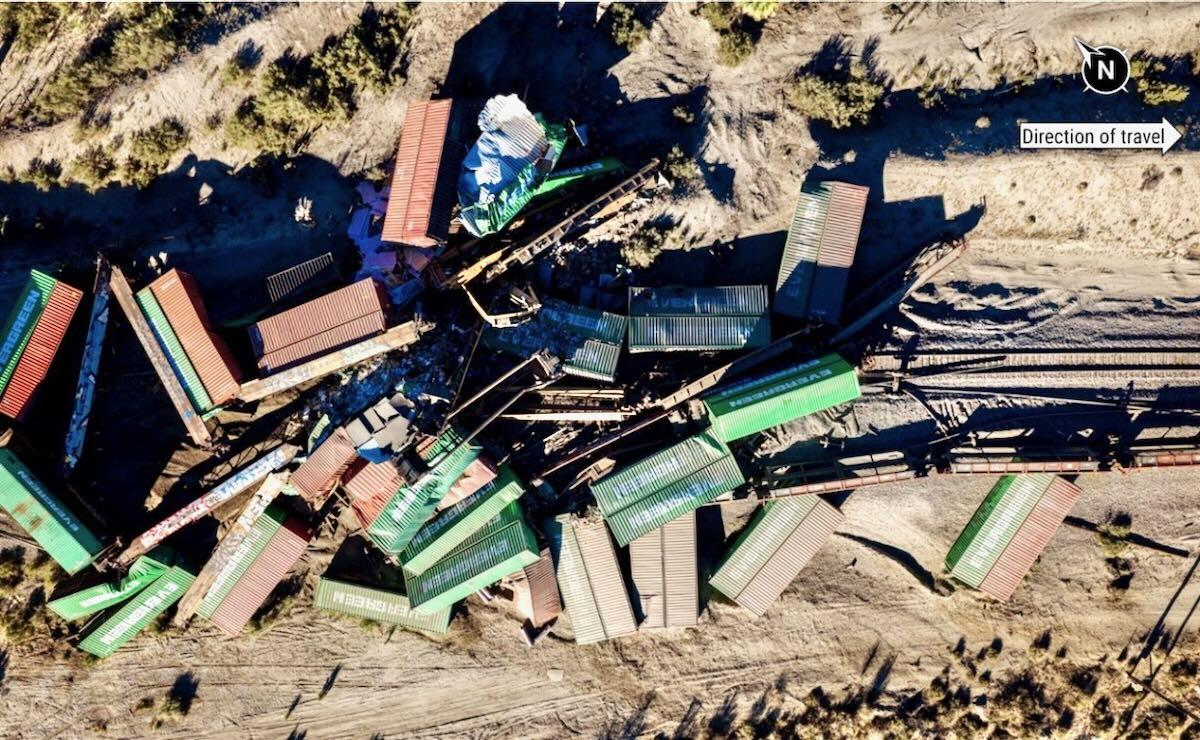
The Union Pacific intermodal train that derailed near the Salton Sea in March was traveling about 40 mph at the time of the derailment, the National Transportation Safety Board said in its preliminary report on the accident released today (April 9, 2026).
The incident occurred about 4:57 p.m. on March 19 near Mecca, Calif., and involved train ILBG4-18, en route from Long Beach, Calif., to UP’s Global 4 intermodal terminal, which is in Joliet, Ill. [see “Union Pacific intermodal train derails …,” Trains.com, March 19, 2026]. The train’s engineer and conductor were uninjured.
The train had four locomotives — two at the head end and two mid-train distributed power units — and 188 intermodal platforms. Twelve articulated railcars derailed totaling 40 platforms — platforms 89 through 128 in the consist. None of the derailed platforms involved hazardous materials. The temperature at the time of the incident was 102.2 degrees; the train was traveling in an area with a 60-mph speed limit for freight trains.
| |
|
Trains Magazine / April 7th
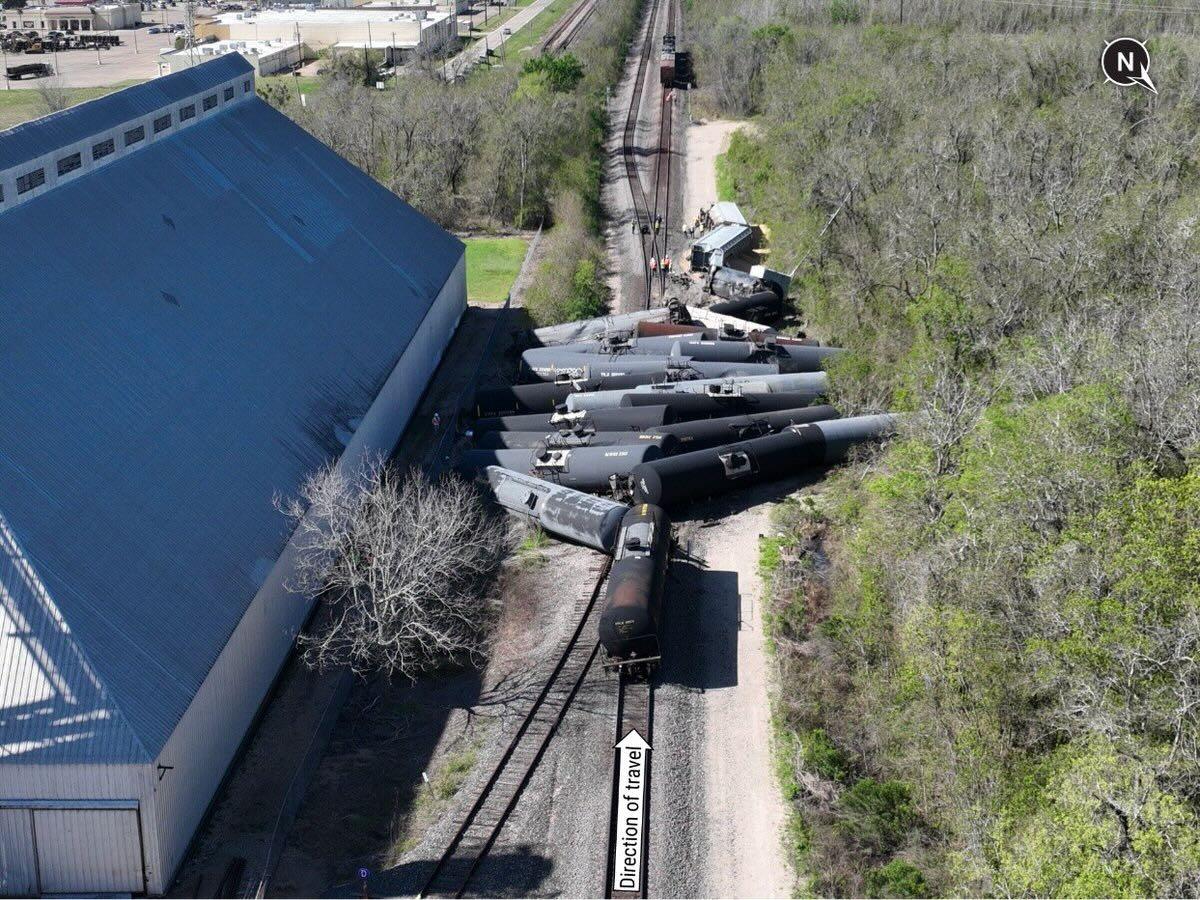
Seven tank cars were breached, releasing about 120,000 gallons of ethanol, in the derailment of a Union Pacific train near Richmond, Texas, the National Transportation Safety Board said in its preliminary investigation report on the March 18, 2026, incident.
The train involved, en route from Houston to Eagle Pass, Texas, consisted of four locomotives, including one mid-train distributed power unit, along with 97 loaded railcars and 50 empty cars. It was 10,295 feet long and weighed 14,470 tons and was traveling about 35 mph in an area with a 60-mph speed limit when it experienced an undesired emergency brake application. In all, 24 cars — the third through 26th in the consist — derailed in the incident at about 4:50 a.m., with materials released from 10 of those cars. The breached ethanol tank cars included two DOT-117J cars and five DOT-117R cars.
UP estimated damage from the incident to be about $3.6 million.
All aspects of the derailment remain under investigation, according to the report.
| | Editor's Note: Enthusiasm is not a contract. When leadership offers support ahead of enforceable protections, it shifts risk onto the very people it is meant to defend. Railroaders do not work in abstractions. Without clear terms on seniority, assignments, technology, and displacement, a “no job losses” pledge is language, not protection. We have seen how this plays out. The details arrive later, and they rarely favor the rank and file once the leverage is gone. If labor is going to speak in this moment, it should speak in terms that bind, not in assurances that can be revised after the ink dries. | |
|
Railway Age / April 7th
Members of the Transportation Division of the International Association of Sheet Metal, Air, Rail and Transportation Workers (SMART-TD) allege their union bucked those rules in voicing support for a Union Pacific (UP)-Norfolk Southern (NS) merger.
Asked by UP and NS to back the marriage proposal in exchange for a “no job losses” pledge, SMART-TD President Jeremy Ferguson figuratively borrowed as his response Molly Bloom’s declaration in the final lines of James Joyce’s novel, Ulysses: “Yes I said yes I will yes.”
Now asked of Ferguson is, “Where’s the beef?” Members cite the absence so far of explicit and enforceable job protection provisions relating to new technology, seniority retention, relocation, assignments outside their craft, and unforeseen, extraordinary disruptions in traffic volume.
| |
| NEWS FROM AROUND THE LABOR MOVEMENT | | Each week, RWU includes a few articles about advances and developments in the larger labor movement that are of interest to railroad workers. Got an artcile to submit for possible inclusion next week? Email it along to raillabornews@gmail.com. Thank you! | |
Freight Waves / April 6th
A nationwide strike by Mexican truckers and farmers blocked major highways and freight corridors across Mexico on Monday, disrupting access to Mexico City, industrial zones and several U.S.-Mexico border crossings.
The protest, organized by the National Association of Transporters (ANTAC) and the National Front for the Rescue of the Mexican Countryside (FNRCM), included road blockades in at least 20 states and began around 7 a.m. CST, with disruptions expected to last several hours or longer in some areas.
The groups say the strike is in response to rising cargo crime, high diesel and operating costs, deteriorating road infrastructure and a lack of progress on agreements with the federal government related to highway security and extortion.
| |
In These Times / April 8th
The 2024 election made one thing unmistakably clear: organized labor is no longer the unshakable pillar of the Democratic Party coalition that it once was. According to a new report from the Center for Working-Class Politics, Arizona State University’s Center for Work and Democracy, and Jacobin, titled “Can Unions Make a Difference?,” more than 40% of union members voted for Trump in 2024. The Democratic coalition has been fracturing across class lines for the last decade — a process known as class dealignment — and that divide is only growing.
The issue isn’t that workers don’t trust unions — 70% of Americans approve of them, the highest approval rating in over 50 years. It’s that they don’t trust politicians. Rather than rebranding, the solution for Democrats is clear: embrace the party’s roots in a concrete way by putting union leaders on the ballot.
At a time when trust in all kinds of institutions — political, business, economic — is collapsing, labor unions stand out with a singular kind of public approval that could be leveraged into real electoral influence. To the American people, unions are a counteragent to the political machine — an institution, yes, but one of the few that people can actually get behind.
| | |
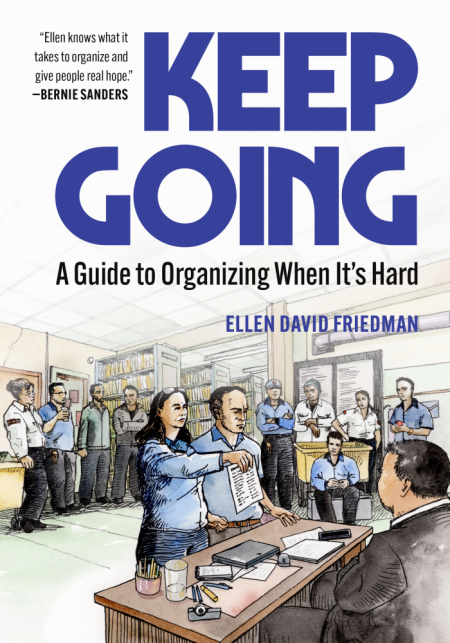
Labor Notes
Organizing can be tough. Co-workers get scared, meetings flop, committees crack, leaders disappoint, and momentum stalls. But when everything feels like it’s falling apart, this book will be your lifeline—helping you get back up, dust yourself off, and figure out your next step.
Drawing on 50 years of experience advising thousands of workers, Ellen David Friedman has created a starter kit and field guide for workplace organizers—offering core principles, examples, and a framework for making sense of the chaos. Begin with the idea that your co-workers have dignity and deserve a say in their own lives, and you’ll start to see the path to building collective power.
You’ll learn how to assess power dynamics, avoid common traps, and keep going when everything feels hopeless. The more you practice democratic methods, the stronger your group becomes. With patience and courage you can navigate obstacles, recover from discouragement, and even turn defeats into lessons for future victories.
| | WEEKLY DERAILMENT DEPARTMENT | | Each Tuesday in this news bulletin, RWU does our best to present a picture of what has been happening over the course of the previous week in terms of derailments in North America, and investigation determinations of previous accidents. NOTE: This list is by no means comprehensive. Smaller and less consequential mishaps are generally not reported here. If the wreck results in injury or fatality, or is especially damaging/extreme, a full article will appear as a feature in the dozen or so rail articles above. Know of a train wreck? Please feel free to forward a link to raillabornews@gmail.com for possible inclusion next week. Thanks! |
| | | |