Rail & Labor News from RWU
| | Weekly Digest Number 2 - January 13th, 2026 | | Welcome to the RWU Rail & Labor News! This news bulletin is produced and emailed out each Tuesday morning. We hope you find each week's news and information useful. If so, please share with co-workers, friends, and colleagues. If you like, you can sign them up to get all the news from RWU HERE. Or forward them the link. Got a hot tip? Please forward the article and a link to raillabornews@gmail.com. Note: If you read over this news bulletin each week, you will be sure to never miss the important news of what is going on in the railroad world from a worker's perspective! | | THIS WEEK'S RAIL AND LABOR NEWS | | Editor's Note: $15.4 million in penalties sounds like progress, until you remember it reflects dangers that were allowed to exist in the first place. Safety cannot begin at the negotiating table after inspectors arrive; it must be the daily obligation of the carriers. When penalties are reduced for fixing what should never have been broken, accountability thins. The railroad workforce has always known how to prevent these failures. The problem has never been knowledge.. it has been power. | |
|
Progressive Railroading / January 6th
The Federal Railroad Administration today announced its new streamlined settlement negotiation process collected $15.4 million in civil penalties issued to Class Is for rail safety issues.
Under the new framework, BNSF Railway, CN, CPKC, CSX, Norfolk Southern Railway and Union Pacific Railroad plus Amtrak can receive civil penalties when inspectors identify safety issues such as defective wheels, with potential reductions when repairs are made and discussed with mechanical craft employees to prevent recurrence.
Overall, the streamlined process reinforces safety as the top priority by driving timely corrections, improved practices and stronger risk mitigation, FRA officials said in a press release. “Our new civil penalty process is already delivering results — forcing Class I railroads to step up, improve safety and address immediately noncompliance. I am grateful to our dedicated safety inspectors who are right there with the railroad workforce in the field," said FRA Administrator David Fink.
| |
| Editor's Note: The Supreme Court’s clarity in Murray, now reinforced by Ziparo, strips away a long-used fiction, that workers must prove an employer’s state of mind to defend themselves. Rail workers were never wrong for speaking up; the law was simply bent to protect those with power. The contributory-factor standard recognizes a basic truth: retaliation rarely announces itself, but its timing and consequences are unmistakable. This is not a technical correction, it is a rebalancing. When workers are free to report danger without fear, safety becomes real instead of rhetorical. | |
|
Train Law Blog / January 5th
Federal Rail Safety Act whistle blower law continues to benefit from the cleansing effect of the Supreme Court’s unanimous decision in Murray v. UBS. In Ziparo v. CSX Transportation Inc., the Second Circuit’s application of Murray confirms the correct causation standards that must be applied in rail whistle blower cases, and overrules all precedents to the contrary:
"In light of Murray, we now recognize that an employee need not demonstrate an employer’s retaliatory motive, intent, or animus to meet their causation burden. Instead, an employee must only demonstrate, by a preponderance of the evidence, that their protected activity “contributed” to the employer’s adverse employment action. And an employee may do that with circumstantial evidence, including sufficiently close temporal proximity alone."
Murray and now Ziparo confirm that the Third Circuit’s landmark decision in Araujo v. New Jersey Transit Rail Operations had it right from the get-go.
To put the FRSA’s contributory factor standard in context, Ziparo delineates the hierarchy of employment discrimination causation standards.
| |
| Editor's Note: Public rail succeeds not because of spreadsheets, but because of the relationships built between workers and the communities they serve. Northstar’s story is not just about ridership counts or schedules, it is about trust, continuity, and human connection forged over years of daily work. When service is treated as disposable, those bonds are quietly severed. A rail system stripped of its people is not efficiency; it is abandonment by policy. The measure of public transportation should be the lives it weaves together, not how easily it can be undone. | |
|
Racket / January 5th
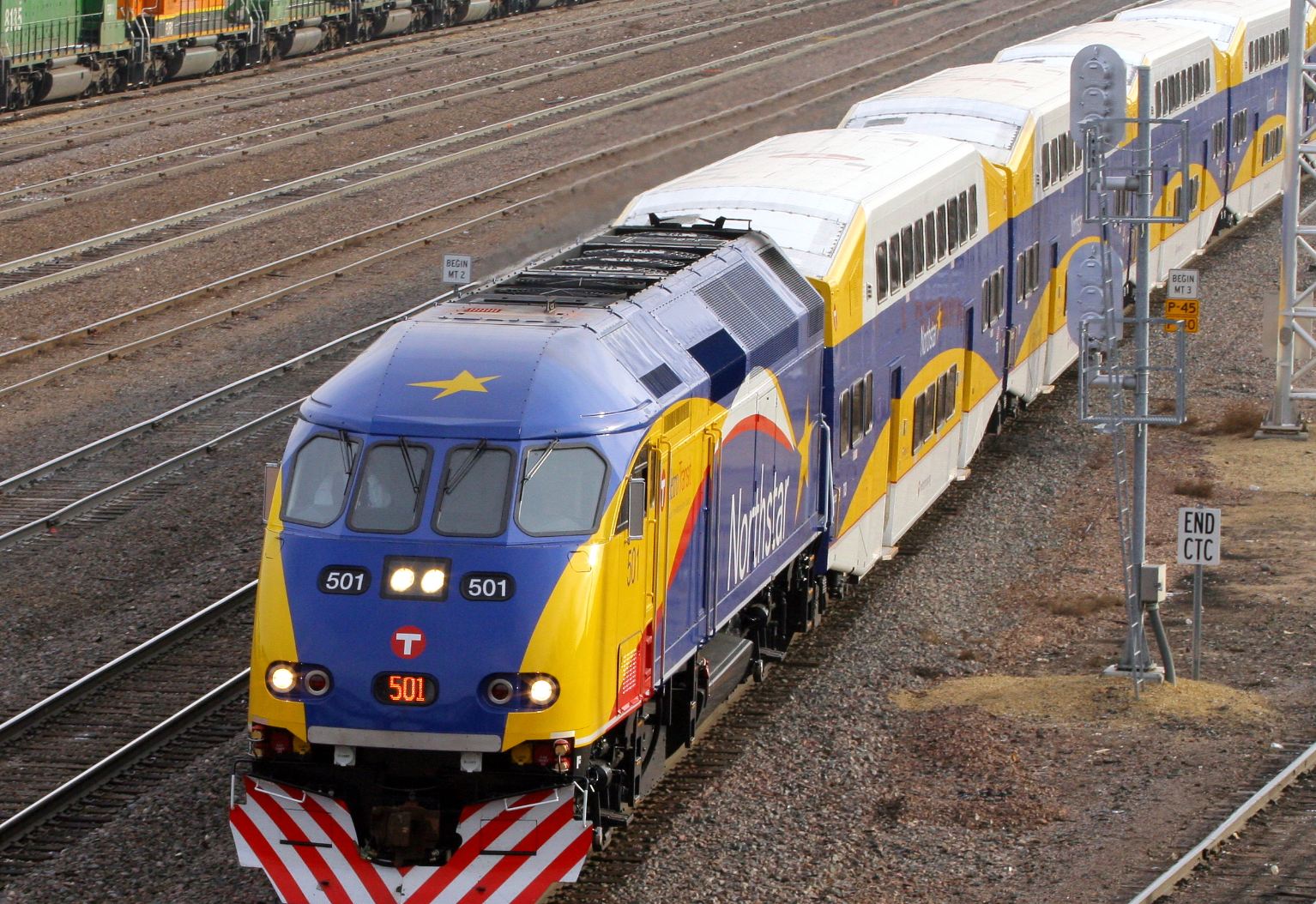
It’s a crisp December morning, and the crowd commuting on the Northstar commuter rail hop down the stairs at Target Station with a more lively energy than you might expect. The time is 8:11 a.m. sharp, and the train car is buzzing with friendly goodbyes to Don, a conductor working the morning flip. During Don’s 11-year tenure with the Northstar, many of these passengers have become close friends.
“We used to have a happy-hour group that would go out once a month,” Don remembers. “We either meet at Cowboy Jack’s or Tootsie’s. Some of the people were close to being family. I've been invited for Christmas and Thanksgivings and graduations.”
The Northstar commuter rail and its accompanying bus service, the Northstar Link, opened on November 16, 2009, and its ridership remained high and steady for a decade, maxing out in 2017 at 793,796 riders. From 2009 to 2020, the Northstar operated 12 trips per weekday from Big Lake to Target Field, six trips each weekend, and special service to Minnesota sports events.
| |
| Editor's Note: For decades, “market forces” have meant captive shippers with no leverage and railroads insulated from consequence. The STB’s proposal acknowledges what workers and customers have long known: competition was not eliminated by accident, but by regulation bent away from the public interest. Repealing barriers that exceed congressional intent is not radical, it is corrective. Choice is meaningless if it exists only on paper while monopolies dictate terms in practice. Railroading was never meant to serve capital alone, but commerce, communities, and the people who move the freight. Restoring access is a step toward restoring balance. | |
|
Trains Magazine / January 7th
The Surface Transportation Board today said it aims to repeal regulations that have effectively prevented sole-served carload and bulk shippers from seeking access to a second railroad.
The regulations cover reciprocal switching, through routes, and through rates. The STB’s Notice of Proposed Rulemaking would jettison Part 1144 of the federal code of regulations, which currently require shippers to demonstrate “anticompetitive conduct” and meet other requirements to obtain relief from the board.
The current regulations go beyond what Congress intended when it passed the Staggers Act of 1980, which partially deregulated the railroad industry, the board said in its unanimous decision.
“This proposal would embrace market forces, enable meaningful choice for American businesses as provided under the statutes, and eliminate regulatory barriers unnecessarily stifling rail competition,” STB Chairman Patrick J. Fuchs said in a statement.
| |
|
Trains Magazine / January 7th
CSX has laid off 166 management employees, about 5% of the non-union workforce, in cuts announced to employees today (Jan. 7).
Other cost-cutting moves, according to Trains sources, include cuts to some management benefits and furloughs to 193 conductors, including 61 covered by the railroad’s Baltimore & Ohion union agreement and 132 on former C&O, Seaboard Coast Line, and Louisville & Nashville lines. An additional 157 conductors were placed in unassigned status, meaning they were not awarded jobs for the week when bids opened. Travel has also been cut back and extra boards have been trimmed.
In a message to employees, CEO Steve Angel said the positions were eliminated “as part of our efforts to streamline the organization given challenging economic conditions.” Those affected had been informed before the message was released.
| | Editor's Note: Great to see passenger trains coming back in Canada. Also on tap is new long distance equipment and high speed rail corridors. The "Northland" train was absent from this route for over a decade. Perhaps the U.S. can take a cue from its neighbor to the north and bring back so many Amtrak routes - among them New York to St. Louis/Kansas City; Chicago - Las Vegas - LA; Chicago - Denver - Portland; Twin Cities - Seattle via Southern Montana; Chicago to Florida; New Orleans to Florida; Norfolk to Chicago; Washington to Montreal - that were short-sightedly discontinued over the course of past decades. | |
Trains Magazine / January 8th
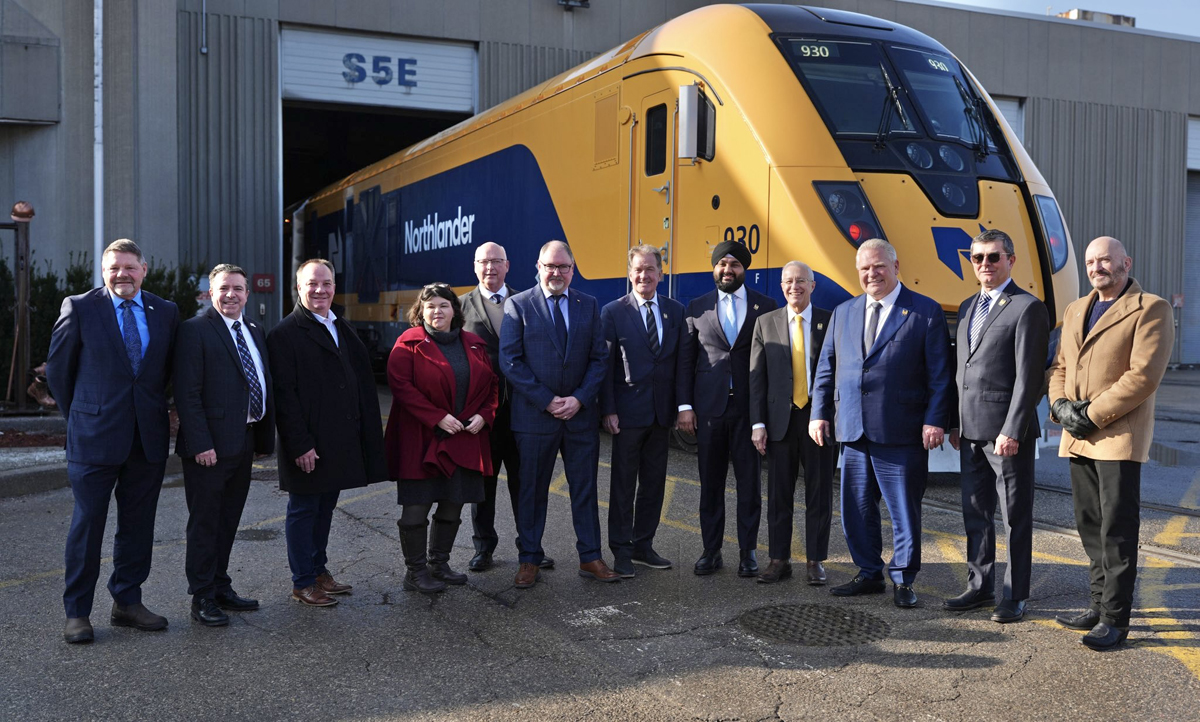
The Government of Ontario today celebrated the arrival of the first of three new Siemens trainsets built for the revival of Northlander passenger service, introducing the equipment at a press conference featuring Premier Doug Ford and Minister of Transportation Prabmeet Sarkaria.
“The Northlander is more than a train,” Ford said during the event at VIA Rail Canada’s Toronto Maintenance Centre. “It’s a lifeline to jobs, education, family and friends, and so much more. … That’s why we are bringing it back into service later this year, and that’s why I am thrilled to welcome the first of three new Northlander trainsets.” Said Sarkaria in a press release, “The Northlander is a key part of our $100 billion plan to build transit and highways so we can protect Ontario and connect families to good jobs, housing, and the services they rely on.”
The first trainset is undergoing testing and commissioning work in Toronto before moving north for extensive Ontario Northland testing along the 740-kilometer (460-mile), 16-station Northlander route. Preparations for the return of the service included completion last year of the North Bay Rail Bypass, a 982-meter connection between Canadian National’s Newmarket Subdivision and Ontarion Northland’s Temagami Subdivision; the government, which provided Ca$5.7 million for that project, says it will cut 15 minutes off the train’s travel time.
| |
High Speed Rail Alliance / Event on Jan. 23
Amtrak’s long-distance routes are in jeopardy.
The national passenger rail provider’s fleet of rolling stock is too small and too old to meet demand, which continues to rise. Trains are often sold out, and frequencies remain dismally low.
This year, it is essential that Amtrak places a large order of new equipment. In order to grow the network and develop the rolling stock supply chain, they need to run more trains. And they shouldn’t be pushing 50.
You can help make this happen. In this webinar, Executive Director Rick Harnish and the High Speed Rail Alliance team will show how advocates throughout the country can get mayors, local governments, universities, nonprofit groups, and other entities to join us in telling Secretary of Transportation Sean Duffy: buy more trains!
| |
Trains Magazine / January 7th
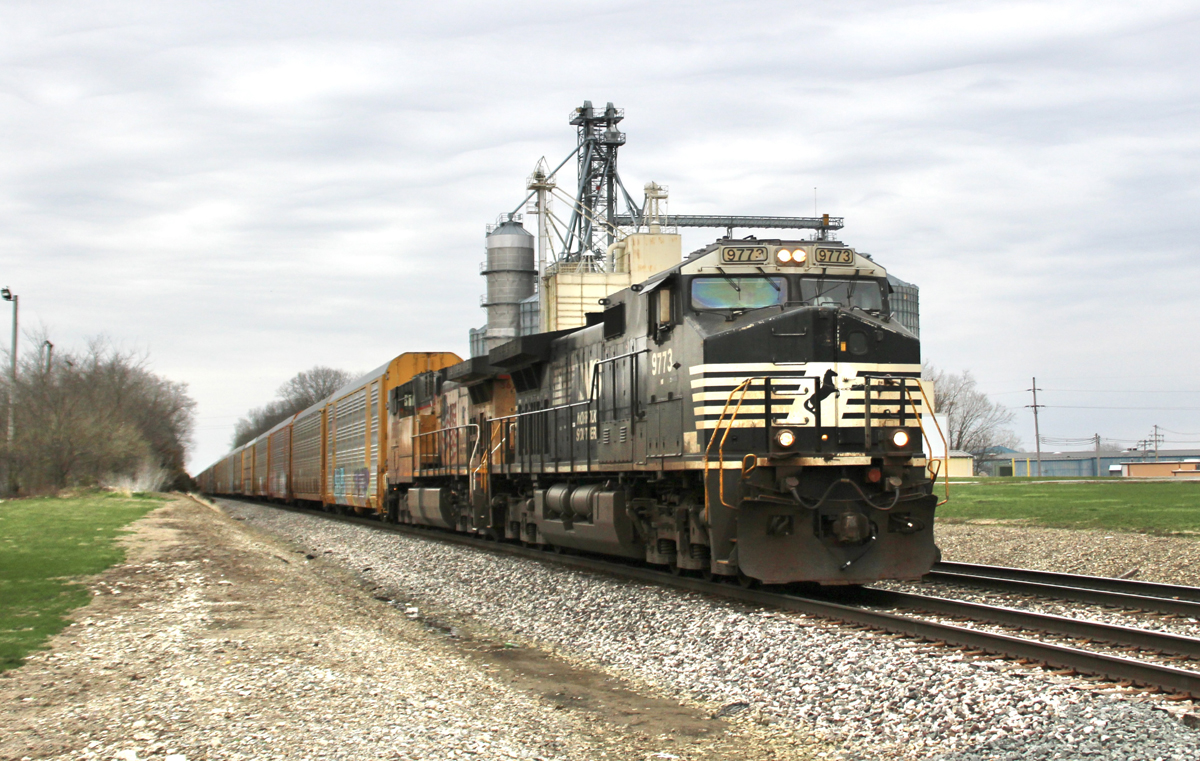
BNSF Railway Chief Marketing Officer Tom Williams warned customers on Tuesday, Jan. 6, that the proposed Union Pacific-Norfolk Southern merger “poses serious risks to competition, service, and your supply chain.”
BNSF has had time to review the 6,692-page UP-NS merger application that was filed with federal regulators on Dec. 19, Williams wrote in a letter to customers, and has concluded that the railroads’ growth projections are unrealistic, that gateway commitments won’t work, and that the combination is likely to produce integration-related service problems.
UP and NS say their merger will take 2 million trucks off the road annually, and that 75% of the merger-related growth will be freight diverted from the highway.
| | NEWS FROM AROUND THE LABOR MOVEMENT | | Each week, RWU includes a few articles about advances and developments in the larger labor movement that are of interest to railroad workers. Got an artcile to submit for possible inclusion next week? Email it along to raillabornews@gmail.com. Thank you! | |
Trade Unions for Democracy / January 7th
Unions around the world have expressed their solidarity with the people of Venezuela and joined the Latin American and internationalist trade union movement in its absolute and unequivocal rejection of the US military operation in Venezuela in flagrant violation of international law and Venezuelan sovereignty.
The Trade Union Confederation of the Americas, along with the International Trade Union Confederation issued the following response:
- Condemnation of military intervention
- Defence of sovereignty and self-determination
- Demand for Human Guarantees
- Call for Peace and Dialogue
Similar statements were issued by the AFL-CIO, the Africa Region of the ITUC, and the European Trade Union Confederation.
| |
Reuters / December 31st
A second U.S. judge has blocked President Donald Trump's administration from effectively shutting down a federal agency that acts as a mediator for workplace strikes and other labor disputes.
U.S. District Judge Arun Subramanian in Manhattan late on Tuesday agreed with 17 labor unions that the administration had failed to explain why it had moved to limit the reach of the Federal Mediation and Conciliation Service and that doing so violated federal law.
Trump in a March executive order, opens new tab
directed that the mediation service and six other agencies be reduced "to the minimum presence and function required by law."
The mediation service subsequently said that it would only assign mediators in disputes in the healthcare industry that involve units of at least 250 employees, and in other sectors when at least 1,000 employees were involved.
| |
Labor Notes / Event on January 22nd
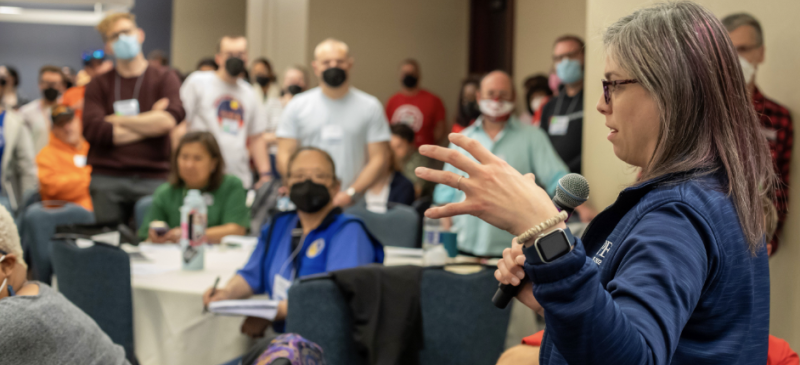
This workshop is intended for stewards and elected officers who work closely with stewards. Please register only if this applies to you.
Chances are that we've all been to a bad meeting. One person talked the whole time, the meeting ran way too long, people left with no clearer sense of what to do about their workplace problems, and so on.
But meetings don't have to be this way. Meetings can be a way for shop stewards to bring their co-workers together to build strength in their fight against the boss—when they're run effectively.
Join Labor Notes for an online workshop for shop stewards on how to hold effective meetings that bring workers into the union (instead of potentially driving them away).
Details: Thursday, January 22, 7 p.m. to 8.30 p.m. Eastern (4 p.m. to 5.30 p.m. Pacific); Online via Zoom
Cost: $10. No one will be turned away due to lack of funds.
| | |
The Labor Guild / Event on February 12th
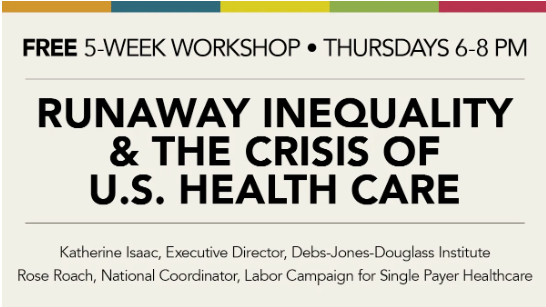
Our healthcare system isn’t working. It costs too much and covers too few people. And at the bargaining table, year after year, unions and employers face off over who will pay for the ever-escalating costs. This course offers and in-depth examination of the U.S. healthcare system, how we compare to other countries, and who really benefits from it. We’ll consider how healthcare impacts collective bargaining, how insurance companies behave, and how the Canadian healthcare system works. And we’ll look at the possibility of a solution that can deliver high-quality, affordable healthcare for everyone.
Components:
- Introduction
- Healthcare Benefits and Collective Bargaining
- Can We Afford Better Healthcare?
- How Do Insurance Companies Make Money?
- What’s the Alternative to Employer-Based, For-Profit Health Insurance?
- How Would Medicare for All Affect Workers?
- Objections and Responses to Medicare for All
| | WEEKLY DERAILMENT DEPARTMENT | | Each Tuesday in this news bulletin, RWU does our best to present a picture of what has been happening over the course of the previous week in terms of derailments in North America, and investigation determinations of previous accidents. NOTE: This list is by no means comprehensive. Smaller and less consequential mishaps are generally not reported here. If the wreck results in injury or fatality, or is especially damaging/extreme, a full article will appear as a feature in the dozen or so rail articles above. Know of a train wreck? Please feel free to forward a link to raillabornews@gmail.com for possible inclusion next week. Thanks! |
| | | |