Rail & Labor News from RWU
| | Weekly Digest Number 22 - June 2nd, 2026 | | Welcome to the RWU Rail & Labor News! This news bulletin is produced and emailed out each Tuesday morning. We hope you find each week's news and information useful. If so, please share with co-workers, friends, and colleagues. If you like, you can sign them up to get all the news from RWU HERE. Or forward them the link. Got a hot tip? Please forward the article and a link to raillabornews@gmail.com. Note: If you read over this news bulletin each week, you will be sure to never miss the important news of what is going on in the railroad world from a worker's perspective! | | THIS WEEK'S RAIL AND LABOR NEWS | | Editor's Note: When the top law enforcement officers of six states feel compelled to stand before a federal regulator and demand answers, the railroads have a problem they cannot lobby their way out of. Union Pacific and Norfolk Southern filed seven amendments to a merger application already deemed incomplete, and the attorneys general of Montana, Florida, Iowa, Kansas, North Dakota, and South Dakota are not satisfied. These are not union halls raising the alarm.. these are red state conservatives telling Wall Street that consolidation has gone far enough. The workers have always known what the suits are just beginning to admit.. fewer railroads means less competition, higher costs, and a workforce held hostage to the balance sheet of a monopoly. | |
| |
Stuart Chirls / May 26
The top law enforcement officers from six states today urged the Surface Transportation Board to reject Union Pacific and Norfolk Southern’s revised merger application.
In a letter to the regulator, including new member Richard Kloster who was approved by the Senate last week, Montana Attorney General Austin Knudsen wrote that his group is “concerned that the application for the proposed merger between Union Pacific (NYSE: UNP) and Norfolk Southern (NYSE: NSC) remains incomplete,” and cited “underdeveloped proposals that run contrary” to the STB’s rules for major mergers.
The letter, which was also signed by attorneys general from Florida, Iowa, Kansas, North Dakota and South Dakota, added that the railroads’ filing of seven amendments to the revised application are complicating their efforts to review the transaction.
The letter noted a previous warning from red state AGs that the merger could reduce competitive options for shippers, increase costs for businesses, and raise prices for consumers.
| | Editor's Note: Nearly thirty years after Union Pacific swallowed Southern Pacific, the STB is being asked whether UP ever honored the conditions it accepted to make that merger possible in the first place. BNSF alleges a deliberate, systematic pattern of blocking competitor access to customers that were supposed to remain contested.. and the board itself acknowledged that if true, the consequences for shippers and competition would be severe. UP’s answer is to hide behind private arbitration, a venue conveniently stripped of the authority to fix what BNSF says is broken. The regulators who blessed consolidation generation after generation are now confronting the bill that working railroaders and captive shippers have been paying all along. | |
| |
The Surface Transportation Board today stopped short of rejecting BNSF Railway’s request that regulators review Union Pacific’s compliance with conditions that the board imposed to preserve competition after UP’s 1996 acquisition of Southern Pacific.
In a November petition, BNSF claimed UP had engaged in a pattern of obstructing BNSF access to customers once served by both SP and UP. Under merger conditions, BNSF is allowed to serve customers at these so-called 2-to-1 locations.
The board acknowledged BNSF’s allegations — if proven — could have serious consequences for shippers and rail competition. The decision also noted that private arbitration, which UP argues is the appropriate venue, can’t address the kind of systemic, pattern-of-conduct questions BNSF is raising, and that arbitrators lack authority to modify the railroads’ settlement conditions.
| |
| Editor's Note: The STB has frozen the UP-NS merger review and demanded answers by July 27... and the chorus of opposition that greeted that decision tells you everything about who this deal actually serves. Shippers, labor, and regulators alike are pressing the same question.. how does combining two of the last four Class I railroads meet the public good rather than simply the quarterly earnings targets of Wall Street shareholders? The application has been deemed technically complete while remaining, in the words of freight advocates, dangerously lacking in transparency. Railroaders have watched this industry consolidate from dozens of carriers down to a handful, and they know that every merger promises competition it never delivers and accountability it never keeps. | |
| |
Opponents and critics of Union Pacific’s proposed acquisition of Norfolk Southern today welcomed the Surface Transportation Board’s skeptical look at the railroads’ revised merger application.
Regulators accepted the application while freezing the review of the merger and requiring UP and NS to submit additional information by July 27.
“This Board action demonstrates that even though the second submitted application is deemed ‘complete’ it is still lacking in transparency that is essential for the Board and stakeholders to conduct a thorough review of the impacts of this unprecedented transaction,” said Nancy O’Liddy, executive director of the National Industrial Transportation League. “More information is needed regarding how the combined UP-NS will: 1) meet the public good; 2) enhance rail-to-rail competition; 3) mitigate anti-competitive practices involving gateway access and pricing, and joint asset ownership; and 4) be held accountable for service failures and increased fees.”
| |
| Editor's Note: When the CEO of Canadian National stands before an investor conference and tells the world that the UP-NS merger cannot meet the public interest standard as written, the railroads’ own peer class has rendered its verdict. Tracy Robinson is not speaking out of altruism.. CN sees an opening to extract trackage rights, line sales, and gateway access from a deal desperate enough for approval to give them away. But buried in the competitive maneuvering of executives is an admission that has echoed through every merger proceeding for thirty years.. consolidation destroys competition, and the only way to paper over that destruction is to carve the network back up and hand pieces to whoever is watching. Railroaders built every mile of that infrastructure, and they will be the last to benefit from whatever remedies the STB extracts from this transaction. | |
| |
Various remedies — including trackage rights, haulage rights, and line sales — will be required for the proposed Union Pacific-Norfolk Southern merger to clear competition-related regulatory hurdles, Canadian National CEO Tracy Robinson says.
The railroads’ merger application, as currently written, cannot meet the Surface Transportation Board requirements that the $85 billion deal is in the public interest and enhances competition, Robinson told an investor conference today.
“We believe that our network could be very useful in introducing competition, and driving our network further down into the U.S. markets for example, and introducing another competitive option in some of the markets that we don’t currently serve,” Robinson says.
Options to enhance competition, she says, include trackage rights, haulage rights, interline agreements, line divestitures, and interchange commitments at various gateways.
| |
| Editor's Note: The STB has accepted the UP-NS merger application for consideration.. and then immediately put the entire proceeding on ice, demanding nine categories of supplemental information by July 27 because key elements remain, in the board’s own words, unclear and underdeveloped. Two rejected or stalled applications, months of delay, and still the railroads cannot tell regulators with a straight face how an $85 billion consolidation of the last four Class I carriers serves the public interest. Shares of both companies fell roughly five percent on the news. Wall Street reading the same tea leaves that rail labor has been reading for years. The workers who will be furloughed, the shippers who will be captive, and the communities that will lose service are not waiting on a July 27 deadline to know what this merger is really about. | |
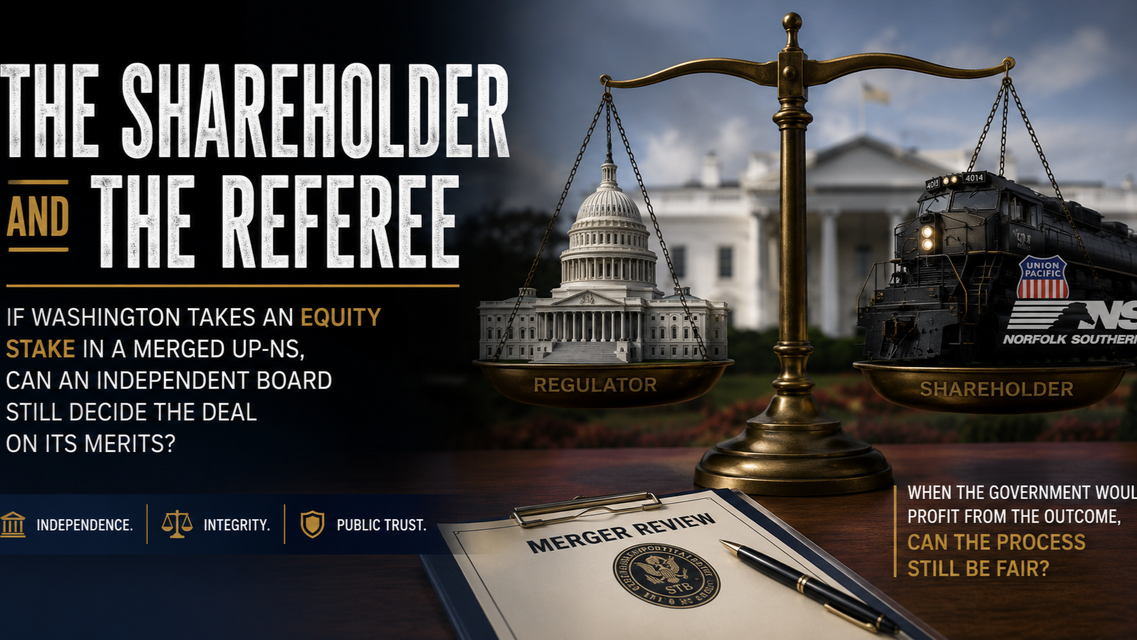
| Editor's Note: The President of the United States has floated the idea of a government equity stake in Union Pacific’s merger with Norfolk Southern, and whatever his motives, the admission buried inside that suggestion is one rail labor has made for decades.. this infrastructure is too essential to be left entirely in the hands of men whose only obligation is to a quarterly earnings report. Rail workers did not build this network so that Wall Street could consolidate it down to a handful of carriers and call it progress. The government that spent generations handing land grants and tax breaks to these railroads is only now beginning to ask what the public gets in return. We have been asking that question from the shop floor and the cab since long before it became a talking point for presidents. | |
| |
President Donald Trump suggested in an interview with Fortune Magazine that he may want the federal government to take a stake in Union Pacific as part of its proposed merger with Norfolk Southern.
The railroad merger comment came as Trump was explaining his broader views on having the government take equity stakes in companies that are deemed essential to the nation, such as computer chip maker Intel or U.S. Steel, and as a way to reduce the national debt.
Fortune quotes the president as saying, “I make one of those deals every day that no normal person would make,” while telling Editor-in-Chief Alyson Shontell about a possible railroad merger that he would want the government to have equity in.
The Fortune story was published online on Monday and did not quote the president mentioning UP or NS by name.
Independent analyst Anthony B. Hatch called the president’s comments “insanity.”
| |
|
Dan Bostek, Steve Blinn, and J. Vann Cunningham / May 26
On May 18, 2026, Fortune published an hour-long interview with President Trump from the Oval Office. Most of the coverage went to tariffs, to artificial intelligence, and to the president’s remark that he should have asked for a bigger stake in Intel. One passage drew less notice at first. Asked about his administration’s recent practice of taking equity in private companies, the president described a possible railroad merger in which he would want the federal government to hold an ownership stake. He did not name the railroads. He did not need to. We all know which merger he was talking about.
He also did something unusual. He named the objection himself. “Some people actually think it’s un-American, what I do,” he told Fortune. “They say, ‘You’re taking their company away.’” His stated justification was the federal balance sheet. “We have $38tn in debt.”
Within days, industry observers and current and former regulators had connected the remark to the only transcontinental combination now in front of the Surface Transportation Board: Union Pacific’s proposed acquisition of Norfolk Southern, Docket FD 36873. CTFN, which first reported the reaction on May 22, asked Union Pacific for a statement. The company’s answer was two words. “No comment.”
| |
High Speed Rail Alliance / May 27
On Tuesday, May 26, U.S. Representatives Seth Moulton (D-MA) and Suzan DelBene (D-WA) introduced the American High-Speed Rail Act of 2026. This bill would provide $205 billion over five years for the planning and construction of a national high-speed rail network.
We applaud Representatives Moulton and DelBene, along with all of the co-sponsors, for introducing this bill and putting high-speed rail investments in front of Congress. The Alliance has long advocated for a federal-level, big-picture vision for a high-speed rail network, and the plans and priorities laid out in the American High-Speed Rail Act would go a long way towards making this a reality.
Take action today and ask Congress to support funding for high-speed rail. This is the level of commitment needed to truly begin developing a national high-speed rail network.
| | Editor's Note: The Railway Safety Act has been attached to the Build America 250 Act, and the Association of American Railroads has responded the way it always responds... by declaring that any safety mandate Congress has the audacity to pass is an unproven burden on the supply chain, an affront to data-driven governance, and a threat to American farmers and consumers. Ian Jefferies would have you believe that 2025’s safety record proves the industry needs no legislative guardrails, which is a remarkable argument to make on behalf of the same industry whose tank cars torched East Palestine while its lobbyists were busy blocking the very regulations that might have prevented it. The AAR has called every safety advance in the history of this industry an overreach right up until the moment it became standard practice, and then claimed credit for it. RWU knows what “targeted and justified by data” means when it comes from a carrier lobby.. it means no. | |
| |
The Railway Safety Act, which has been bouncing around in Congress since 2023 in response to the Norfolk Southern East Palestine, Ohio, derailment in the same year, was reintroduced in 2026. The Act received a boost this week as the House Transportation and Infrastructure Committee decided to attach it to a more extensive piece of transportation legislation, the Build America 250 Act, which focuses on funding for rail and highway transportation development projects.
Ian Jefferies, AAR President and CEO, released the following statement in response to this Congressional action:
“Freight railroads have been clear from the beginning of the surface transportation reauthorization process: rail policy provisions should be targeted, justified by data, and tied to clearly demonstrated operational or safety needs. Unfortunately, some provisions advanced today fail that test. Rather than focusing narrowly on evidence-based reforms connected to the actual causes of incidents like East Palestine, the package includes a wide range of extraneous mandates under the veil of safety that will only increase costs throughout the freight network and broader supply chain with no proven safety benefit – ultimately harming rail customers, manufacturers, energy producers, farmers and American consumers already facing significant affordability pressures. That’s precisely why so many rail customer groups expressed concern about these very provisions.
This approach is particularly misguided given that 2025 marked the safest year in freight rail industry history across several key safety measures, including historic lows in derailments, equipment-caused accidents, track-caused accidents, and employee injury rates. These gains were achieved through sustained private investment, technological innovation, and data-driven safety practices – not static federal mandates. The Railway Safety Act, as written, violates the President’s pledge to lower costs, and is an unfortunate example that politics and special-interest pressure can sometimes usurp sound, data-driven policymaking during today’s proceedings.
Today’s markup is the first step in what will be a long legislative process, and freight railroads will continue working constructively with lawmakers to support policies that strengthen safety, promote innovation, and preserve an efficient and competitive freight transportation system. At a time when Congress is simultaneously greenlighting autonomous transportation technologies in other sectors, efforts to include rail policies that lock yesterday’s operating models into federal law are nothing more than hypocrisy.”
| |
|
BMWED / May 21
During the House Transportation and Infrastructure Committee markup of the BUILD America 250 Act, U.S. Representative Dina Titus (D-NV) introduced an amendment (Amendment 294) that includes language from her Secure Tracks Act protecting visual track inspection frequencies by codifying the twice per week visual track inspection requirement while also requiring railroads to use Track Geometry Measurement Systems (TGMS) as a supplement, not a replacement to human visual inspections. Representative Jeff Van Drew (R-NJ) co-led the amendment.
In a bipartisan 35-31 vote, members of the Transportation and Infrastructure Committee adopted the Titus and Van Drew amendment that includes important language from our Secure Tracks Act.
The BMWED would like to thank the 35 members, including 4 Republicans and 31 Democrats, who value the safety of their communities and rail workers and voted to ensure that our rail infrastructure continues to be inspected and monitored by knowledgeable experts.
| |
|
Ryan Erik King / May 25
Since President Donald Trump decided to launch a war against Iran alongside Israel, Americans have collectively lost an extra $40 billion at the pump due to higher gas prices caused by said war. The squeeze at the pump has become too much for some to bear. A rise in monthly ridership figures for public transportation systems across the country is fueling the notion that commuters are ditching their cars for buses, subways and trains. However, the systems in many major cities aren't adequately funded to handle a surge in usage.
Unsurprisingly, the most significant shift has come in the state with the highest gas prices. While the national average is over $4.50 per gallon, California's average is around $6.14 per gallon. According to climate website Grist, Los Angeles, the San Francisco Bay Area and San Diego have all seen jumps in public transit ridership. The San Diego Metropolitan Transit System had a 6.5% increase. Metrolink, an LA-focused commuter rail system, saw a 4% jump. The San Francisco Municipal Transportation Agency had its highest monthly ridership total since 2020. Outside the Golden State, the D.C. Metro and Amtrak have also reported increases.
| | NEWS FROM AROUND THE LABOR MOVEMENT | | Each week, RWU includes a few articles about advances and developments in the larger labor movement that are of interest to railroad workers. Got an artcile to submit for possible inclusion next week? Email it along to raillabornews@gmail.com. Thank you! | | |
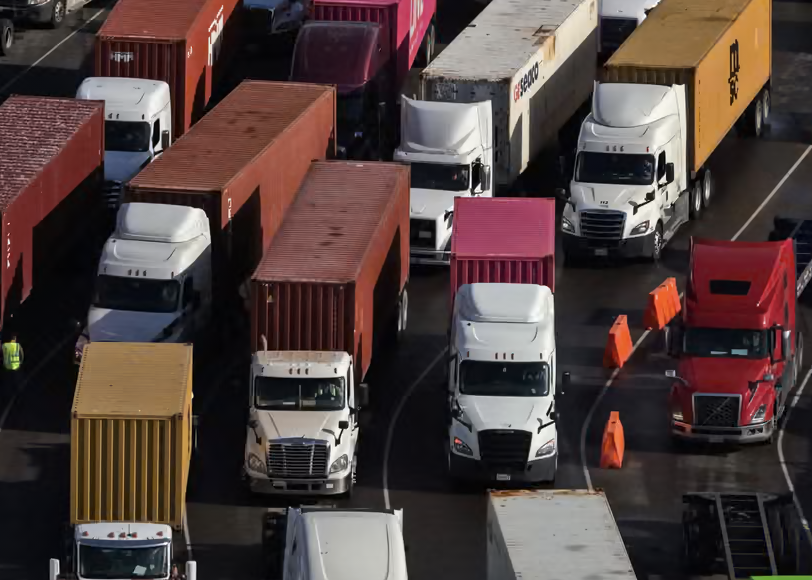
Nearly 200,000 US truck drivers are at risk of losing their commercial driver’s licenses after the US Department of Transportation (DOT) issued a new rule that disqualifies many foreign-born truck drivers from getting or renewing their licenses.
Tens of thousands of immigrant drivers are stuck in a limbo after the rule took effect in March, and lawsuits challenging the rule are still being reviewed by federal courts. The rule restricts licenses to immigrants who have specific employment authorization statuses, disqualifying those with other authorizations, including asylum seekers, refugees and those with Deferred Action for Childhood Arrivals (Daca) status. The rule has shaken immigrant drivers who have spent years dedicated to the industry.
| | |
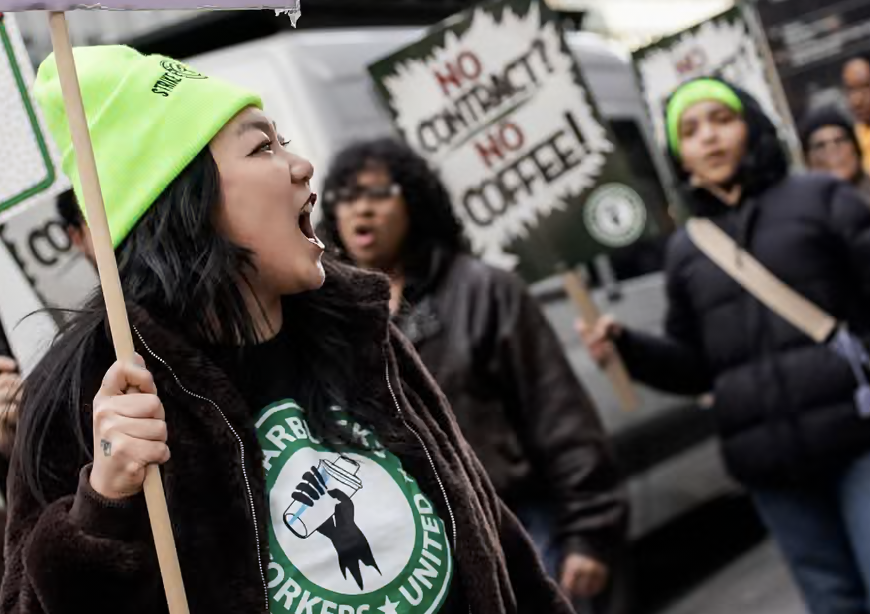
US employers spend more than $1.5bn a year on labor union opposition efforts, according to a report published on Wednesday by the Economic Policy Institute (EPI).
Employers spent company money hiring consultants and law firms specializing in union avoidance and on legal counsel, representation, and litigation services during union elections and organizing campaigns.
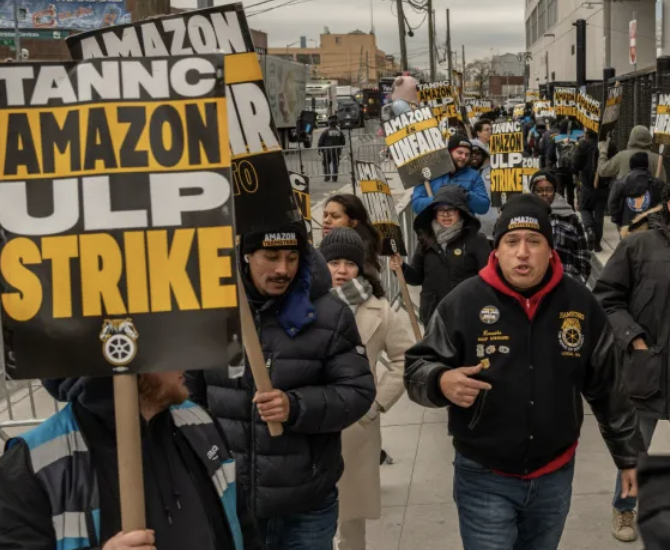
US employers spend $442m on union-avoidance consultants annually, according to an estimate by the EPI. Amazon alone spent $26.6m in 2025 on union-avoidance consultants, based on filings with the US Department of Labor.
An Amazon spokesperson blamed external groups for hiring union-avoidance consultants. “It’s important that our teammates and partners understand the truth, so we’ve continued to work with experts in the field who are able to share objective facts about what it actually means to have an external party take their voice,” they said in an email.
| | |
Jacqueline Munis / May 28
On Tuesday, members of the newly formed App Drivers Union rallied victoriously outside the Massachusetts State House, celebrating the certification of the first statewide rideshare union, representing nearly 70,000 workers.
The organized group of Uber and Lyft drivers is a rare—though increasingly less so—example of new unions forming in the U.S. In 2025, just 16.5 million U.S. workers, or one-tenth of the workforce, belonged to a labor union. That’s the highest number of unionized workers in 16 years, an increase of 463,000 since 2024. Still, unionization is far from its peak in 1954, when one in three Americans belonged to a union.
“In a lot of cases, employers could take the money that they choose to spend on these consultants and attorneys, and rather than spend it on their workers in the form of a decent raise and a first contract,” Teke Wiggin, one of the study’s authors and the strategic coordinator at LaborLab, told Fortune. “Instead of doing what they’re doing, they could recognize the union and negotiate a decent first contract, and they would often be spending the same amount of money.”
“It’s just a shame that that doesn’t happen more often,” Wiggin continued.
| | WEEKLY DERAILMENT DEPARTMENT | | Each Tuesday in this news bulletin, RWU does our best to present a picture of what has been happening over the course of the previous week in terms of derailments in North America, and investigation determinations of previous accidents. NOTE: This list is by no means comprehensive. Smaller and less consequential mishaps are generally not reported here. If the wreck results in injury or fatality, or is especially damaging/extreme, a full article will appear as a feature in the dozen or so rail articles above. Know of a train wreck? Please feel free to forward a link to raillabornews@gmail.com for possible inclusion next week. Thanks! |
| | | |