CBBS Spring E-Newsletter

Digging into this Issue:


It’s been a mad dash through the winter, with an amazing mammoth tusk find, contributions to an international research project on maize, incredible support from Sul Ross and so much more. 


  • A hunter discovered a rare mammoth tusk on the privately-owned O2 Ranch. We put together a team to excavate it and now eagerly await the results of carbon dating. 


  • Dr. Bryon Schroeder played an integral part in an international study on maize that helps us all better understand the lives and movements of people from that time period. 


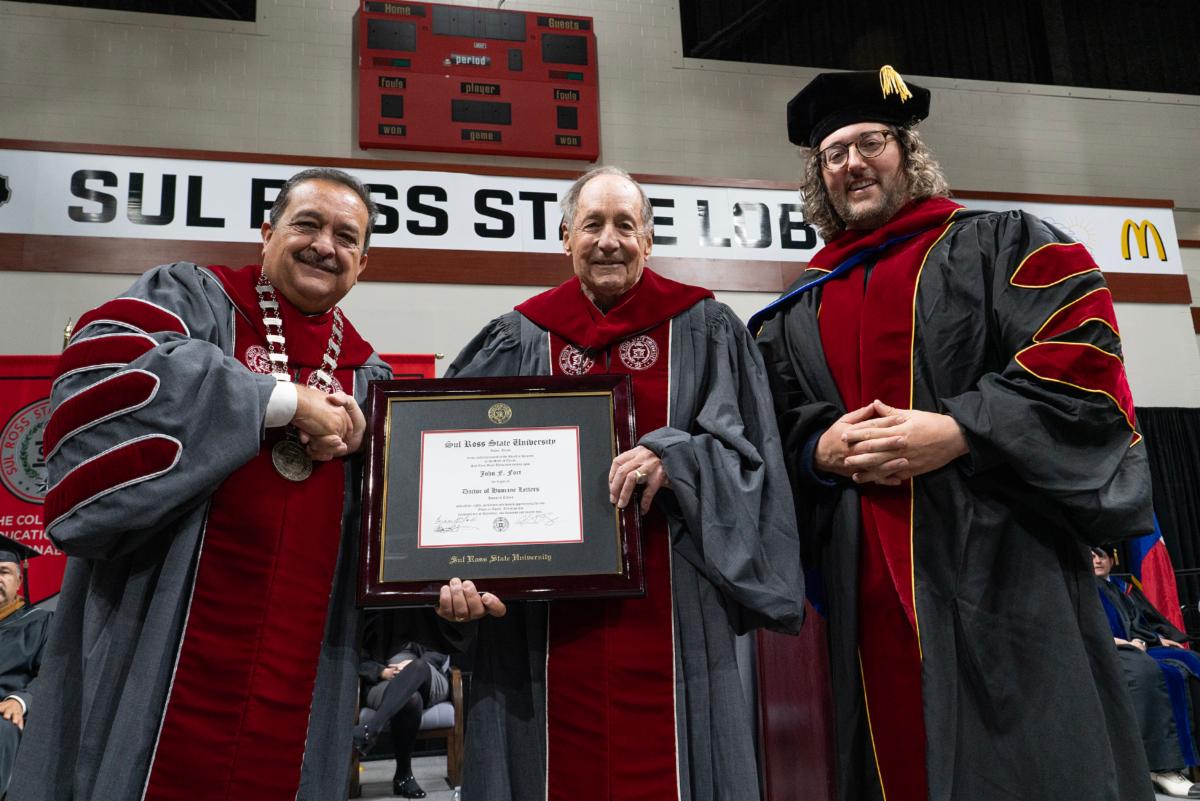
  • John “Jeff” F. Fort III, a long-time CBBS supporter, received an honorary doctorate degree in Humane Letters in December. 


  • Dr. Schroeder will deliver the keynote address at the SRSU Student Symposium. 


  • Dr. Justin Garnett will serve as a visiting assistant professor in Anthropology. 

Rare Mammoth Tusk Discovered at West Texas Ranch 

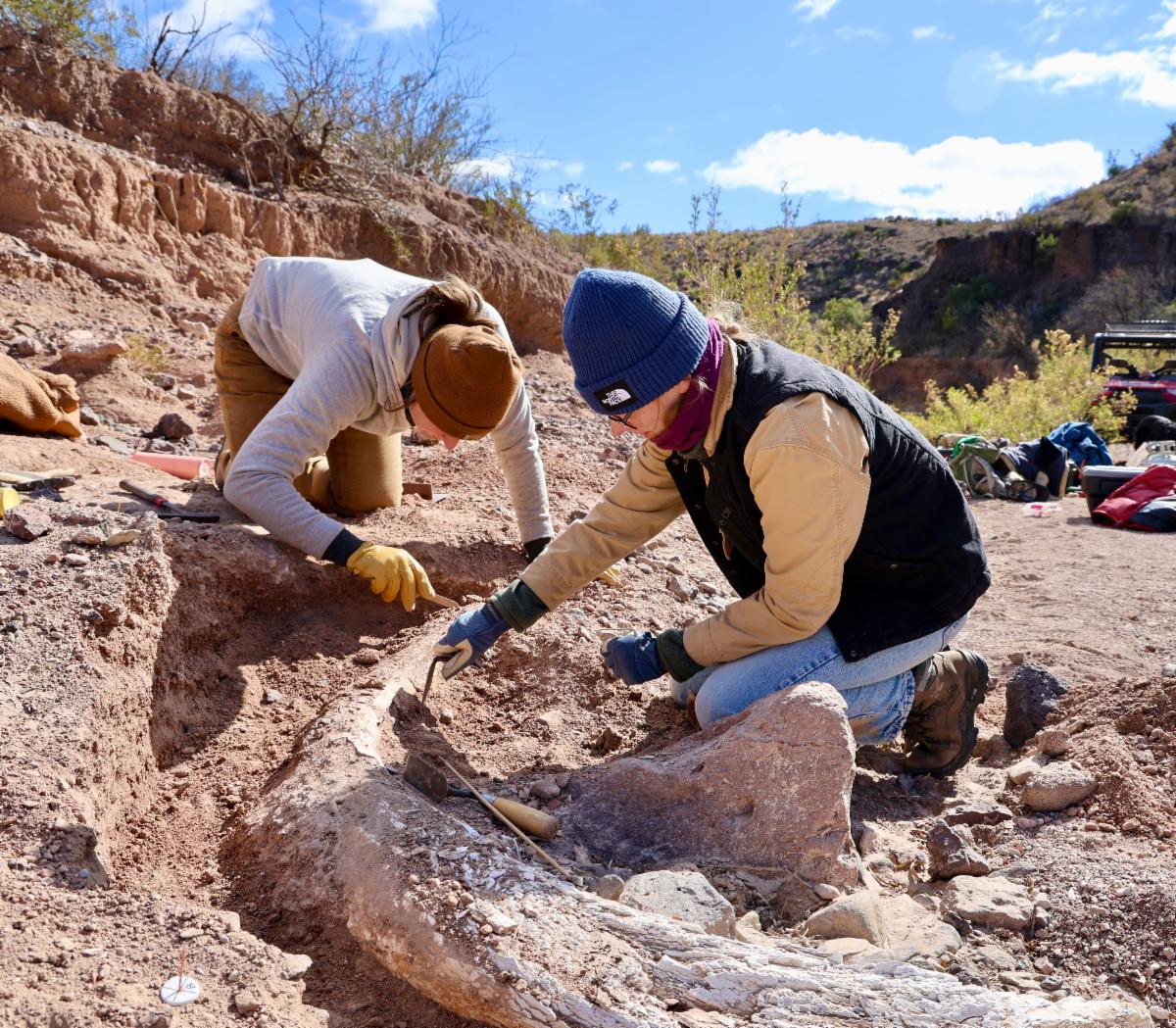
University of Kansas graduate student Haley Bjorklund and CBBS Archaeologist Erika Blecha work carefully to uncover a mammoth tusk recently discovered in West Texas.

Upper Photo: University of Kansas graduate student Haley Bjorklund and CBBS Archaeologist Erika Blecha work carefully to uncover a mammoth tusk recently discovered in West Texas. Credit: Justin Garnett/CBBS.

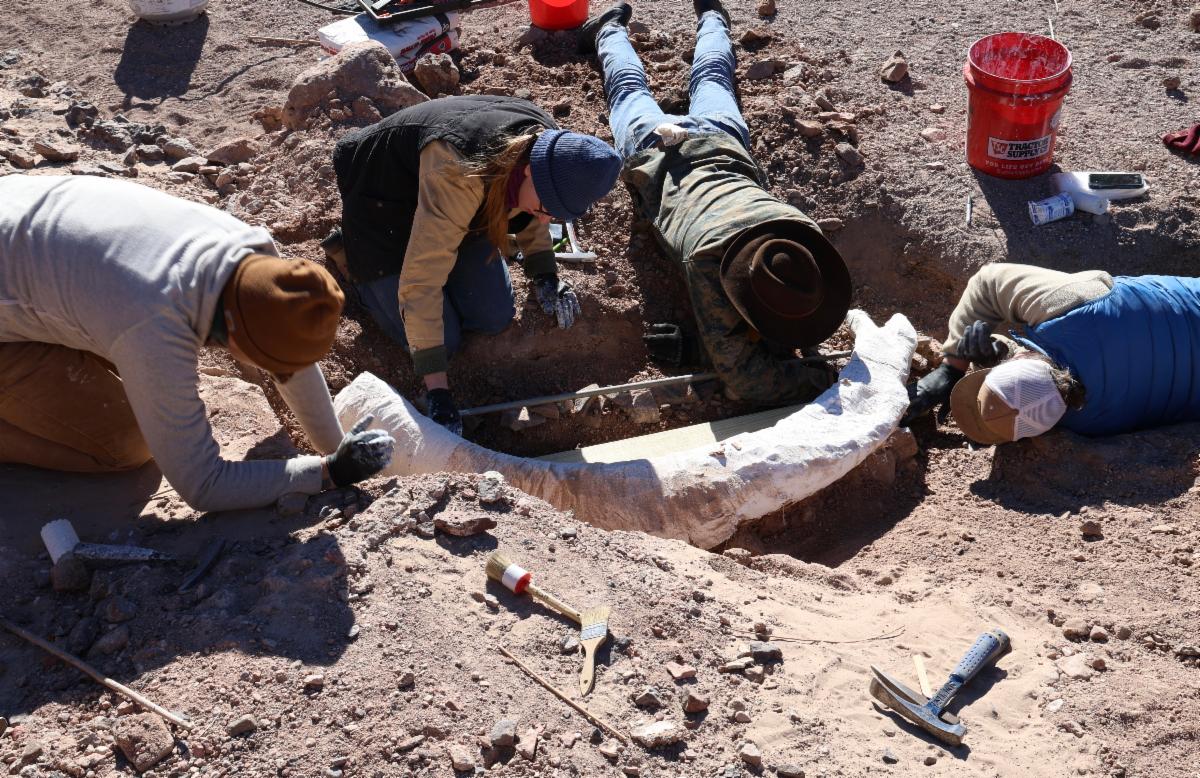
Lower Photo: Team members Erika Blecha, Haley Bjorklund, Justin Garnett and Bryon Schroeder wrap the tusk with strips of plaster-covered burlap that will harden into a cast to protect it during transport. Credit: Devin Pettigrew/CBBS.

Although he was searching for deer, a hunter at the O2 Ranch (a private ranch in Brewster and Presidio counties) found something very different and a little puzzling. 


Could it be a mammoth tusk? In West Texas? 


“I was skeptical when a deer hunter showed me a picture of what he thought was a fossil,” says O2 Ranch Manager Will Juett. “I figured it was likely just an old stump, but imagined how great it would be if he was right.”  


Juett says his great working relationship with the Center for Big Bend Studies (CBBS) at Sul Ross State University in Alpine spurred him to immediately reach out to CBBS Director Dr. Bryon Schroeder and CBBS Archaeologist Erika Blecha. The researchers contacted graduate student Haley Bjorklund from the University of Kansas, a CBBS collaborator specializing in environmental archaeology who is interested in studying ancient animals like the mammoth. All three, plus anthropology professors Dr. Justin Garnett and Dr. Devin Pettigrew, met up at the ranch as soon as possible to explore the discovery further. 


“It paid off big time,” Juett says of their visit. “When they confirmed what they had uncovered, I couldn’t believe it.”  


Schroeder says the researchers quickly verified that it was indeed a mammoth tusk, a very rare find in West Texas. 


“The tusk was located in the drainage area of a creek bed,” Schroeder says. “We realized pretty quickly there was not more to the skeleton, it was just an isolated tusk that had been separated from the rest of the remains.” 


The researchers then spent two days plaster-jacketing the tusk — covering it in strips of plaster-covered burlap for protection — and building a frame to transfer it to Sul Ross State University for further study.  


“A local [who subsequently wrote his PhD dissertation on it] found one in Fort Stockton in the 1960s,” Schroeder says, noting that it’s the only mammoth tusk in the Trans-Pecos that was carbon dated, as that process began in the 1950s. “There was a big range of error back then. Now we can get it down to a narrower range within 500 years.” 


Carbon dating results will be available in the next few months. While researchers study the new find with newer technologies, the discovery sparks our imaginations. 


“Seeing that mammoth tusk just brings the ancient world to life,” Juett says of the find that created a buzz of excitement for everyone involved. “Now, I can’t help but imagine that huge animal wandering around the hills on the O2 Ranch. My next thought is always about the people that faced those huge tusks with only a stone tool in their hand!” 

CBBS Director Assists International Team with Ancient Maize Research

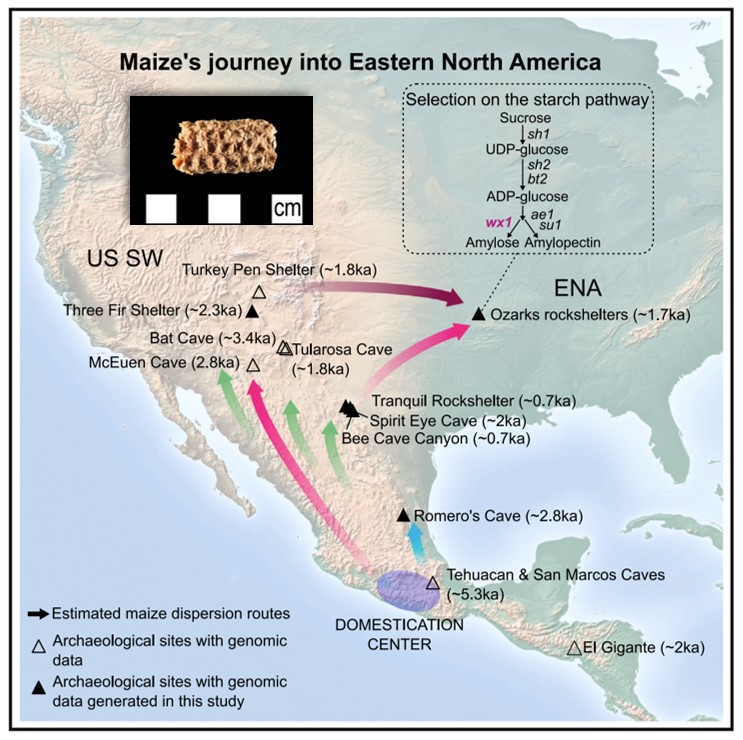
Photos: Graphical Abstract modified from the article (Ramos-Madrigal, et al., 2025).

As Texans continue to choose corn as a major food ingredient of choice — happily consuming street tacos and enchiladas and tortilla chips by the ton — research from a new study finds that corn also holds many answers to the unknown stories of the earliest people of this country. 


What makes corn so remarkable is that it must be cultivated by human hands. It doesn’t grow naturally, so the earliest farmers intentionally planted seeds from the most robust ears, then stayed nearby to tend and harvest the crop. Bits left behind offer a trail of clues that offer tantalizing additional kernels about human movement 1,000 years ago. 


CBBS Director Bryon Schroeder was part of an international team that published that new study in the journal Cell in December 2024, reporting interesting findings about the eastward movement of maize (aka corn) in the United States a thousand years ago. Ancient genomes from the Ozark rockshelters indicated that the crop entered eastern North America from Mexico at least twice, tracing ancestry across the upland Southwestern states and up from southern Texas. 


“The presence of maize in our regions means humans were in contact with groups who had cultivated it,” Schroeder says. “I knew the genetics of maize would bear out that story.” 


Schroeder contacted now-retired Bruce Smith, longtime maize researcher, for recommendations. There he found Dr Nathan Wales, from the University of York’s Department of Archaeology. 


“He was looking for how maize got into the eastern United States and I was looking for how it got into Texas — we helped each other out,” Schroeder says. “I sent him 28 samples and he worked with the best preserved.” 


The researchers discovered that the maize underwent genetic selection as it moved eastward, particularly through a gene known as waxy1. 


“This suggests that farmers 1,000 years ago were not just engaged in planting and harvesting, but in selecting traits that could help in breeding and producing the best quality yield for food, not too dissimilar to farmers today,” a University of York article cites. “Genetic variants in the waxy1 gene affect the stickiness and chewiness of maize, traits that are still valued in some traditional cuisines today.” 


According to the report, ancient maize from West Texas shows a different admixture pattern, carrying ancestry from both the US Southwest and Mexican maize, given the placement of the Bee Cave Canyon (700 years BP), Tranquil Rockshelter (690 years BP) and Spirit Eye Cave (2,000 years BP) genomes between these two groups. 


“We also showed that maize could only be introduced into eastern North America once humans bred local varieties with the genetic tools to cope with the challenging environment of the region, which goes someway to demonstrating the skills and knowledge of farmers 1,000 years ago,” says Dr Jazmín Ramos-Madrigal, Globe Institute at the University of Copenhagen in Denmark. 


Schroeder says this shows that maize is far more ancient in this region than previously imagined. The Trans-Pecos was connected to larger chunks of real estate, but groups adapted this cultivar to local conditions. 


“We will keep dating maize — we just found a new site with maize present — because I think it is older than 2,000 years here,” Schroeder says. “Wales and I have discussed a real possibility that maize entered the US multiple times rather than a single entry, and that alternative entry point is probably up the Rio Grande. So, we need to do more genetic work and dating to better understand the longevity of the cultivar in Texas.” 


Download the Article Here!

Longtime CBBS Supporter Receives Honorary Doctorate from Sul Ross State University

Photos: Sul Ross President Dr. Carlos Hernandez, Honoree Dr. John "Jeff" F. Fort III, CBBS Director Dr. Bryon Schroeder. Credit: Bobby Greeson.

John “Jeff” F. Fort III, a long-time CBBS supporter, received an honorary doctorate degree in Humane Letters from Sul Ross State University in December. 


A resolution underscored Fort’s significant support, generosity and his continued philanthropy. 


“Mr. Fort has been the Center for Big Bend Studies’ most consequential supporter for over two decades. He has graciously opened his properties, provided critical financial resources and actively promoted our programs to the public and local land stewards while remaining an active scholar in anthropology,” the resolution reads. “Mr. Fort’s dedication to the State of Texas and Higher Education has profoundly impacted the lives of West Texas residents and SRSU students. His commitment to the Center and his land — which he affectionately calls ‘an outdoor laboratory’ — has enriched the region by providing unique and invaluable insight into the past inhabitants and environment.” 


Fort, a successful businessman, first came to the Big Bend region in the 1990s and immediately fell in love with its beauty. He purchased his Pinto Canyon Ranch and contacted CBBS when he discovered a significant rock art site while exploring. Later, he allowed the center unrestricted access to thousands of world-class archaeological sites — most of which he found himself. 


Fort helped CBBS develop its charitable status, enabling gifts from the Brown Foundation totaling more than $3.5 million. He has personally contributed approximately $2 million and has facilitated additional support exceeding $5.6 million. 


“Your unwavering dedication to uncovering hidden archaeological sites in the Chihuahuan Desert has not only enriched the field of anthropology but also shed light on how humans have adapted and thrived in such an exacting environment,” wrote SRSU President Carlos Hernandez in his announcement to Fort. “Your contributions to SRSU and the Center for Big Bend Studies are a testament to your passion and commitment to understanding the forgotten chapters of Big Bend history.” 

Schroeder to Keynote SRSU Student Symposium

CBBS Director Dr. Bryon Schroeder will be the keynote speaker at the 8th annual SRSU Student Symposium banquet on April 11 in the Alpine campus’ UC Espino Center. 


The symposium will be held two consecutive days: a virtual event on Thursday, April 10, from noon to 5 p.m. and an in-person event on Friday, April 11, from noon to 6 p.m.  


In addition to Dr. Schroeder’s in-person keynote on Friday, a virtual keynote will be presented Thursday night by 2017 graduate and distinguished alumnus Earnest Jones. 


Undergraduate and graduate students who have produced excellent research OR creative work from any area or discipline during the current academic year were nominated to present by faculty members. Student work can be from the summer/fall 2024 semesters, or spring 2025 work-in-progress.  


A new addition this year is the incorporation of the student presenters from the SRSU McNair-Tafoya event. 

CBBS and Sul Ross Welcome Dr. Justin Garnett as Visiting Anthropology Faculty

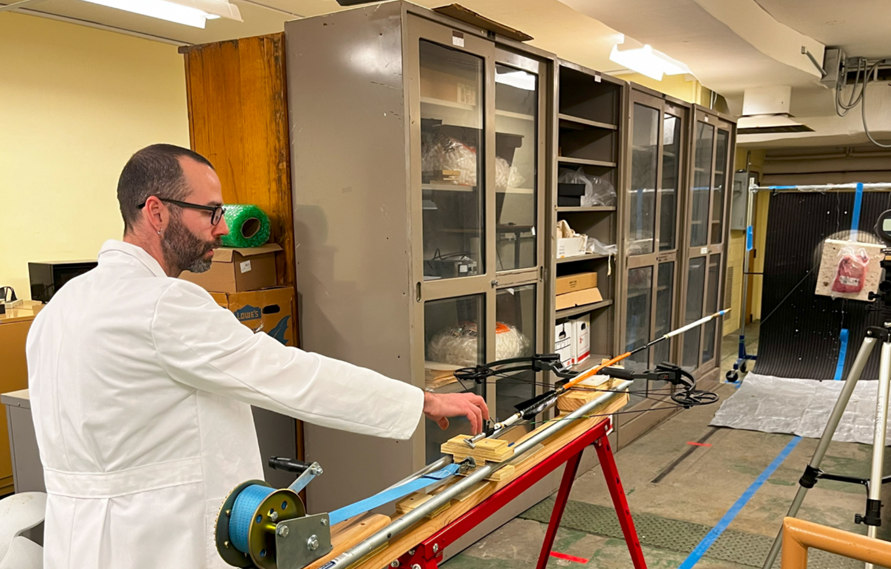
Photos: Dr. Justin Garnett conducting an experiment with a crossbow at the University of Kansas.

CBBS’ Dr. Justin Garnett will serve as a visiting assistant professor in the fall semester, teaching Introduction to Anthropology to Sul Ross students. He’ll teach students the basics of anthropology as well as specialized methods such as photogrammetry, 3D modeling and 3D printing. 


Garnett will build a program for an eventual undergraduate major in anthropology at the university. 


“I'm excited to be a part of CBBS and am looking forward to working and teaching at Sul Ross,” Garnett says. “The small classes provide a great teaching environment, and the location offers opportunities for world-class archaeological research.” 


Garnett pursued his graduate degrees at the University of Kansas, which works in cooperation with CBBS in ongoing excavation at two archaeological sites. Stone and bone fascinate him, particularly how these materials enter and exit the “social world” through the manufacture and discard of tools. His dissertation research examined the functional efficiency of Paleoindian lithic projectile points across a range of resharpening states, and the influence of projectile point mass on the external ballistics of spearthrower darts. 


With a particular interest in the lithic technologies termed “Clovis” and “Folsom,” Garnett ponders and researches the differences between them. 

Hello, and thank you for reading our E-Newsletter! Please share with friends and family who may be interested in the Center for Big Bend Studies' work. If you would like to receive emails like this, SUBSCRIBE HERE.

DONATE
BECOME A MEMBER
Center For Big Bend Studies 432.837.8179 • cbbs@sulross.edu • https://cbbs.sulross.edu/
Ferguson Hall, Suite 114 • SRSU • P.O. Box C-71
Alpine, TX 79832
STAY CONNECTED
Facebook  Instagram  
Contact Us