THE NAIT TIMES
Masjid Financial Management Special
|
|
Financial Management:
Establishing internal controls to prevent fraud
In the Islamic tradition, all assets of an Islamic center are considered an amanah, and staff handling them bear a great responsibility of safeguarding them.
An Islamic center should be built and managed on the foundations of honesty, integrity, loyalty and mutual trust. However, any human can fall prey to the attacks of Shaitan and engage in unethical practices, or apparently harmless mistakes that may damage the center's financial standing.
What are Internal Controls? They are policies and procedures that the organization must have in place to protect against fraud, mistakes or manipulations. Internal controls also help improve efficiency, accuracy and timeliness of financial reporting.
There are TWO TYPES of internal controls:
- Preventive Controls
- Detective Controls
|
|
Preventive controls are processes that help to deter, decrease or stop the chance of errors and fraud "before" they occur. For example, restricted access through passwords, approvals, verifications, reconciliations, policies and procedures.
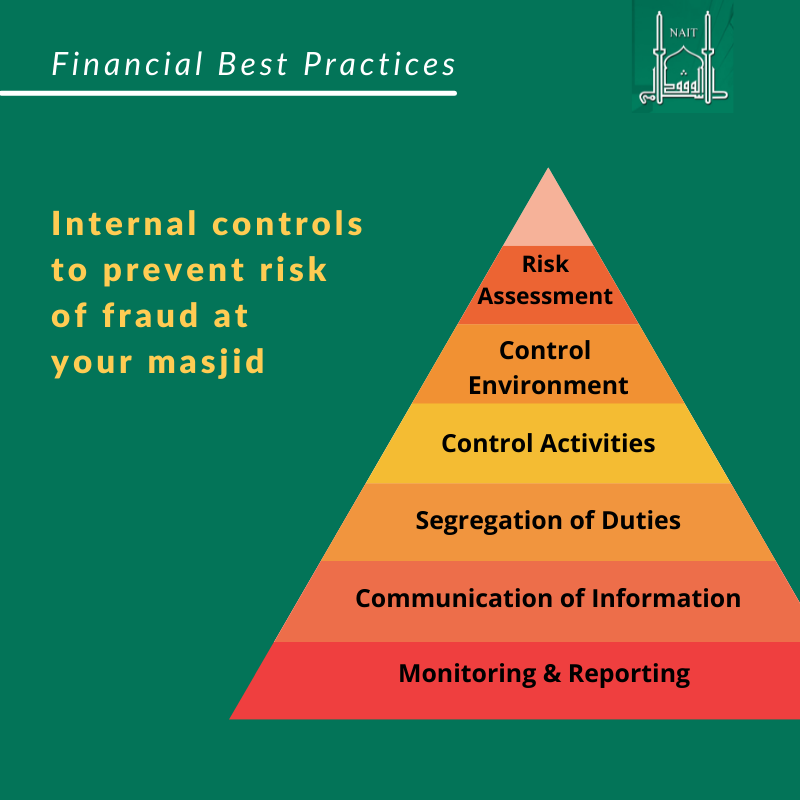
Structure for Preventive Controls:
Risk assessment is the identification and analysis of relevant risks and how they should be managed. For example:
- Conduct monthly meetings to review risks and internal audits
- Perform thorough background and criminal checks before hiring.
Control environment: Sets the tone of an organizational culture that influences the control consciousness of its employees. Control environment factors may include:
- Proper direction and clear policies especially those that deal with financial affairs
- Emphasis on accountability - from top to bottom
- Employee training on (1) how to notice and identify discrepancies or suspicious activity; and (2) how to avoid risky and apparently harmless mistakes themselves that can cause bigger damages.
- Clear policies on how to respond when issues arise, who to inform, what to expect.
- Protect anonymity through policy after suspicious activity is reported so staff doesn't hesitate to report due to insecurity.
Control activities: A range of activities such as purchasing limits, approvals, authorizations, verifications, reconciliations, reviews of operating performance, physical and online safeguards, security of assets, etc. See Best Practices article below for detailed activities.
Segregation of duties: Where responsibilities of financial affairs are divided among different people to reduce the risk of error or inappropriate actions. No one person should have control over all aspects of any financial transaction such as check signing, accounts receivables, record keeping, reconciliation, and custody of assets, etc. See Best Practices Article below.
Communication of information: A broader system defining expectations and policies for flow of communication is key to good internal control systems - especially the steps to follow in the event of suspicious activity or identification of fraud.
Monitoring and reporting: A process to perform ongoing evaluations if the internal controls are properly implemented and are functioning well over time.
- Conduct monthly reviews of performance reports and internal audits.
- Report serious matters to management.
- Report internal control deficiencies or need of corrective measures to the board.
|
|
Detective controls are designed to uncover errors or irregularities that may already have occurred. For example,
- monthly accounts and bank statement reconciliations;
- independent review of activities and balances;
- ongoing monitoring of expenses vs. budget;
- regular manual cash or inventory count in addition to the electronic one; and
- sometimes utilizing detective audits such as surprise or random cash counts also helps to keep employees honest and focused on performing with integrity.
Detective controls are essential because they provide evidence that preventive controls are operating as intended, as well as offer a chance to detect loop holes and irregularities.
|
|
Internal Control Best Practices
You Can Implement at Your Masjid
Each Islamic center is operated uniquely. Listed below are some internal control best practices that you can tailor to the needs and management style of your Islamic center:
Access Controls and Physical Safeguards:
- Maintain locks on doors, cabinets, drawers, or a safe for cash/checks.
- Create a schedule to regularly back up all financial files. Use cloud based systems.
- Restrict access to bank accounts and financial software through passwords and other types of authentication systems to only authorized personnel.
- Change passwords regularly, and do not repeat them. Select strong passwords.
- Do not save access-information on documents or places others may have access to.
- Periodically count all financial assets, cash and check stocks kept in lock on-site, and compare with control records. Manually counting assets is crucial because fraud can occur off the books to bypass financial report audits.
Segregation of Duties:
- Authorization, recording and custody of assets should be divided among employees.
- Person reconciling bank statements or conducting audits shouldn't be an authorized check signer.
- Ensure records are routinely reviewed and reconciled by someone other than preparer or transactor.
- The person opening the mail should be independent of the accounting records.
- Islamic centers that don't have enough employees to separate duties, peer review can serve a similar function to mitigate.
Bank Accounts:
-
Set transactional and purchasing limits, and limits of withdrawal. Dual signature should be required for cash disbursement of amounts over a certain limit. Often banks don't honor two signature system for checks. In this case, best practice is to maintain a cash flow system to track the amount of money spent each month.
- Maintain a restricted account that only certain board members would allow to be monitored.
- The number of bank accounts should be kept to a minimum. It is best to have one account for payroll, one for operating expenses, and you may open a separate account for a large capital project.
- The sequence of all check numbers should be accounted for.
- Examine paid checks for date, name, endorsement with cash disbursements journal.
- Compare details of bank deposits to cash receipts records.
- Follow up on old outstanding checks.
-
Invest any extra cash or savings in NAIT's ICCF instead of keeping them in checking or savings accounts so cash is not easily available to staff taking care of financial affairs. This not only provides safety but also offers growth over cash long term.
Cash Receipts:
- Pre-numbered receipts should be issued to individuals who bring money to the office for fees/donations, etc. Receipt should contain the date, name, amount and purpose of funds, and be signed by the employee/volunteer who received the funds.
- No less than two unrelated individuals should count the donations or cash collections and members of counting teams should be rotated.
Cash Disbursements:
- All cash disbursements should be made by pre-numbered checks with the exception of petty cash.
- Bills should be approved and evidenced in writing.
- Blank checks should NEVER be signed and kept for later use.
- All paid bills must accompany a vendor invoice and marked as paid to avoid double payment.
- Voided checks should be marked VOID and retained.
- All supporting documents should be given to the check signer to review before signing
- the check.
- A check to CASH must be prohibited.
- Individual checks should clearly identify the specific expenditure for the disbursement.
Sources: Investopedia, UCSF Audit and Advisory Services, Washington State Office of Financial Management's guide to internal control and auditing.
|
|
NAIT is proud to supports ISNA for being a national cosponsor of Faiths 4 Climate Justice: a bold, morally powerful grassroots climate action!
We are proud of the American Muslim community, and the worldwide faith community for stepping up with a grassroots campaign for climate justice.
This two-day, global multi-faith action will bring together over 200 high-level interfaith leaders and thousands of people from various religious backgrounds from around the world. Together they will call upon political and financial leadership of the world to meet a series of ambitious climate related demands to combat the problem by 2030.
These demands include the following:
- an end to new fossil fuel projects and tropical deforestation;
- universal access to renewable energy;
- policies creating green jobs and a just transition for impacted workers and communities;
- support for those forced to migrate due to climate impacts; and
- reparations from the countries and industries responsible for the lion’s share of the problem.
Use hashtag #Faith4ClimateJustice
|
|
Up to 15% of the ICCF is used to extend no-interest loans to empower Muslim organizations across America. To learn more, download the latest brochure below. |
|
A great benefit of being a NAIT entrusted Islamic center is the free legal advice to help protect your nonprofit's tax exempt status, or manage property tax exemption. |
|
Hate crimes and shootings are sudden.
Stay Vigilant
Security Tips & Guides
-
Active shooter situation response. Download
Please don't hesitate to reach out to your local police or local Council of Islamic Relations in the event of suspicious activity or needing help. You may also reach our to NAIT at +1 630-789-9191.
|
|
|
Is the content of this email relevant to you?
|
|
|
|
|
Tell us what type of content you would like to receive? May choose more than one answers.
|
|
Non profit/Masjid management/administration
|
|
|
|
|
Communications/Marketing/Social Media
|
|
|
|
|
NAIT services and related news
|
|
|
|
|
Financial - planning, investing, taxes, etc
|
|
|
|
|
Something else. Reply to this email with suggestions.
|
|
|
|
|
|
|
Disclaimer
NAIT or its subsidiaries assume no responsibility or liability for the quality of information, any errors or omissions in the content of external links or information provided or used in this newsletter. The links are provided on an "as is" basis with no guarantees of completeness, accuracy, usefulness or timeliness, and without any warranties of any kind whatsoever expressed or implied. NAIT or its subsidiaries do not warrant that the external links, images, videos, or other content used or downloaded from this newsletter will be uninterrupted, error free, omission free, or free of viruses or other potentially harmful items or data. Therefore, NAIT will not be responsible for any financial, physical, mental or psychological damages caused by it.
Copyright © 2021. All Rights Reserved.
|
|
|
|
|
|
|