Week of February 24, 2025 | Vol. 15, Issue 8 | |
|
Bourne Insights
Key Topics of Conversation this Week
| | |
|
President Trump and Department of Government Efficiency (DOGE) leader Elon Musk have promised to dramatically downsize the federal government/workforce. And, this appears to be now well underway. Over the past week, the Trump administration fired multiple thousands of probationary workers across multiple federal agencies, including the Department of Health and Human Services (HHS), the Department of Veterans’ Affairs (VA), the Centers for Disease Control and Prevention (the CDC), and the National Institutes of Health (NIH). The Trump administration appears to be initially targeting probationary workers because they are easier to fire without violating civil service protections. (These include workers who were recently hired, recently switched to a new role, or facing a disciplinary action.) Already, the HHS estimates to save well over $600 million annually as a result of the layoffs, and this figure will increase over time. These layoffs followed a February 11 executive order by President Trump that requires every federal agency hire “no more than one employee for every four employees that depart.” Also, each federal agency must also develop a “data-driven” plan with a DOGE team lead to ensure a vacancy is not filled if the DOGE team lead deems it unnecessary. Needless-to-say, this has resulted in disgruntled workers speaking to the media and a number of lawsuits. It remains to be seen how this will impact on the functioning of public health programs. Read More | | |
|
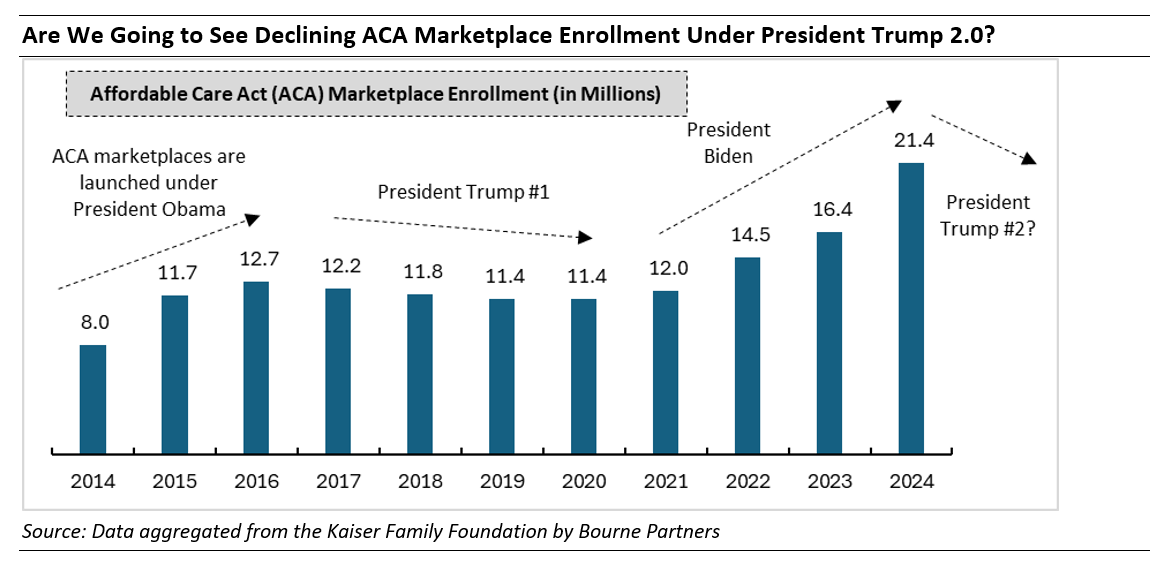
President Trump appears to be following the same playbook with respect to the Affordable Care Act (ACA) exchanges as he did in his first administration. The U.S. Centers for Medicare and Medicaid Services (CMS) announced a significant cut to the budget for consumer navigators for ACA exchanges from $98 million last year to $10 million this year (and annually going forward). This is similar to what Trump did during his first term. These cuts are intended to allow for lower ACA plan premiums (and help reduce budget deficits). Also, the CMS argued that the navigators were inefficient -- only enrolling 92,000 people for the entire 2024 plan year, implying $3,000 per person. At the same time, the U.S. Department of Health and Human Services (HHS) is working on a new proposed rule focused on “program integrity” for the ACA, which could include shortening the enrollment period and letting states determine their own standards for network adequacy. Altogether, these actions, coupled with the pending expiries of ACA plan subsidies (absent Congressional action), could result in a significant reduction in ACA exchange enrollment in the coming years, in our opinion. Read More | | |
|
We are concerned by early signs that the Trump administration may prove to be less friendly to mergers and acquisitions (M&A) and private equity roll-ups than expected. A memo issued by Trump’s new Federal Trade Commission (FTC) Chair, Andrew Ferguson, suggests that the FTC will, in fact, apply the very strict antitrust guidance that was issued in December 2023 by the former President Biden administration. These antitrust guidelines from Biden give regulators more leeway to target vertical and cross-market deals, such as health plans acquiring providers -- as well as private equity “roll-ups” of multiple companies. In our view, this seems oddly out-of-line from the broader vision of the Trump administration to cut government spending and regulation. Ferguson wrote about the importance of retaining stability in the merger review process across different Presidential administrations. However, Ferguson also implied the 2023 merger guidance could change pending a transparent and careful review process. Read More | | |
|
Robert F. Kennedy Jr. (RFK), the new Secretary of Health and Human Services (HHS), is being accused (by some) of reversing course on a pledge not to restrict vaccines. Recall, during his confirmation, Senator Bill Cassidy indicated that RFK promised to make any changes to existing vaccine recommendations and/or change the Centers for Disease Control and Prevention (CDC) statements that clarify vaccines do not cause autism. In his first address to HHS employees, RFK emphasized his commitment to better understand the rise of chronic diseases (e.g., diabetes, obesity, hypertension, and mental illness, etc.) through scientifically rigorous research and that -- importantly -- no topic will be off-limits. This explicitly includes an evaluation of childhood vaccines, selective serotonin reuptake inhibitors (SSRIs), and other mental health medications -- as well as electromagnetic radiation, the herbicide glyphosate, microplastics, and ultra-processed foods. Read More | | |
|
Make America Healthy Again. With the confirmation Robert F. Kennedy Jr (RFK) as Secretary of Health and Human Services, a number of major health plans (and health systems) launched the “Food is Medicine National Network of Excellence.” In our view, this is a first private sector effort to develop collaborative research on how food and nutrition can be used as “medicine” for Americans dealing with diet related conditions, e.g., obesity, hypertension and heart disease. Among other things, this could include the development and study of “voucher plans” for medically-tailored meals and the use nutritional educational programs for Medicaid populations. Poor nutrition is well known to be a major driver of healthcare costs, with some estimating that bad diets cost the U.S. economy $1.1 trillion annually. The founding members of the Network include the Food is Medicine Institute at the Gerald J. and Dorothy R. Friedman School of Nutrition Science and Policy at Tufts University, Kaiser Permanente, Blue Cross and Blue Shield of North Carolina, CVS Health, Devoted Health, Elevance Health, Geisinger and Highmark Health. Read More | |
|
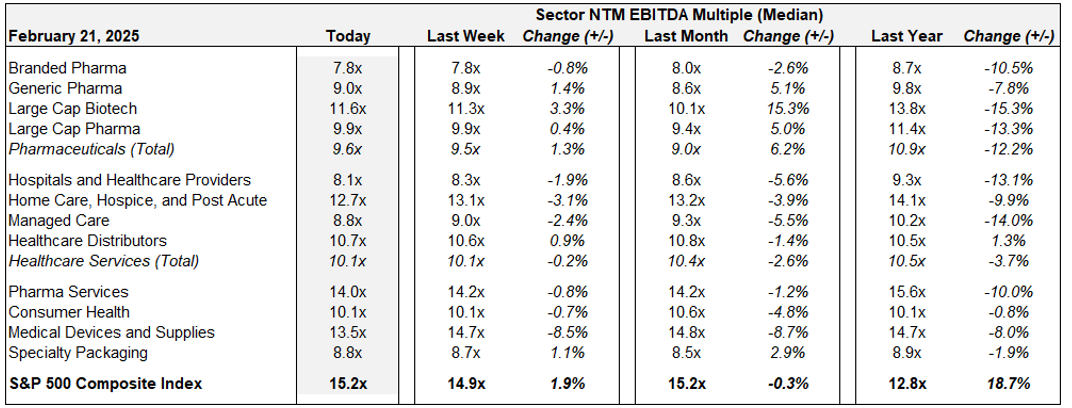
Note: Market values as of the close of business February 21, 2025
Source: S&P Global Intelligence
| |
Active Banking Deal Contacts | |
Select Banking Transactions | | | | |