 |
|
Share this on your favorite social channel or forward to a colleague!
|
|

Technical Report
A Summary of the Benefits and Safety of Glyphosate
by Held, A., J. Hudson, L. Martin and W. Reeves. 2016. Monsanto
Glyphosate (the active ingredient in Roundup® branded herbicides) is a versatile herbicide used by farmers, land managers and gardeners to simply, safely and effectively control unwanted vegetation. Combining glyphosate to control weeds with crops that can withstand glyphosate has transformed agriculture. Glyphosate combined with glyphosate-tolerant crops reduces farm labor while protecting yield from weeds that compete with crops for water, sunlight and nutrients. Glyphosate also has a wide range of uses in orchards, vineyards, recreational settings/parks, homes, and road and railway management, making it an important product for the public.
|
ADDRESSING RECENT NEWS ON GLYPHOSATE
California Court Case
A recent jury verdict in California State Court in the case of Dewayne Johnson has increased the public conversation about the safety of glyphosate-based herbicides. Bayer takes the safety of its agricultural products, medicines and devices, and the well-being of the people who use them, very seriously.
The Johnson verdict in California does not change this extensive science or the conclusions of regulators in the U.S. and around the world. The Company plans to challenge this verdict and is confident that science ultimately will prevail in this case.

Glyphosate and Cheerios
A recent episode of The Dr. Oz Show plus several other media
outlets focused on an already debunked report by a special interest group called the Environmental Working Group (EWG) The EWG's report shows detection of glyphosate in some food items, including oatmeal, breakfast cereals, and snack bars. The levels reported are not even remotely close to any level of concern. The U.S. Environmental Protection Agency (EPA) and other regulatory authorities have strict rules when it comes to pesticide residues.
Additional Reading:

A recent
paper
published in the Proceedings of the National
Academy of Sciences links the use of glyphosate to gut microbe problems in honey bees. No large-scale study has ever found a link between glyphosate and honey bee health issues. This paper does not change that and does not provide any evidence that the purported effects could have a negative impact on bee health under realistic field conditions.
|
POSITIONS & STATEMENTS OF SAFETY OF GLYPHOSATE
- United States Environmental Protection Agency (EPA)
- December 2017, "The draft human health risk assessment concludes that glyphosate is not likely to be carcinogenic to humans."
- March 2017, "RAC concluded that the available scientific evidence did not meet the criteria to classify glyphosate as a carcinogen, as a mutagen or as toxic for reproduction."
- Korean Rural Development Administration (RDA)
- March 2017, "Moreover, it was concluded that animal testing found no carcinogenic association and health risk of glyphosate on farmers was low. ... A large-scale of epidemiological studies on glyphosate similarly found no cancer link."
BACK TO TOP
|
PEER-REVIEWED PUBLICATIONS
By Brookes et al., 2017. GM Crops and Food
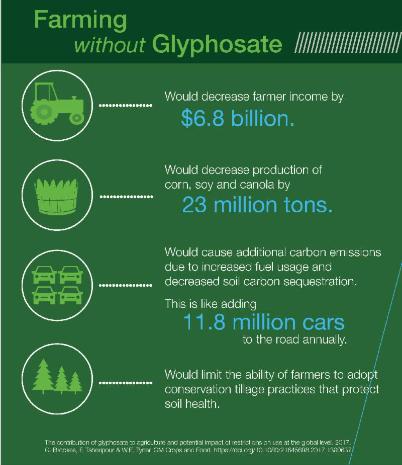
Brookes et al. examined the economic and environmental impacts of eliminating the use of glyphosate (herbicide tolerant GM crops) on farms. Farm income gains were decreased by almost $7 billion while crop production yield was reduced. There was an increase in herbicide use (8.2 million kg of herbicide, 1.7 active ingredient), less carbon sequestered in the soil and more CO2 emitted, negatively impacting the environment. Global welfare impacts and land use is also discussed in this paper.
By Duke and Powles. 2008. Pest Management Science
This is a mini-review of the adoption of glyphosate, how it works and its safety for the environment, humans and animals. They provide information on the environmental benefits of glyphosate/glyphosate-resistant crops, and the importance of weed resistant management practices.
By Gardner et al., 2009. AgBioForum
Authors review the literature to determine reasons farmers adopt GM Crops and how they've increased farm welfare. An estimate of the labor savings when households use GM Crops was studied finding significant savings for soybean crop farmers averaging 14.5%.
By Fernandez-Cornejo et al., 2012. AgBioForum
The case of soybeans. AgBioForum
The authors reviewed the literature to determine the interaction between the decision to use herbicide tolerant (HT) crops and adoption of tillage method as well as the use of HT crops and adoption rate of conservation tillage. A review of the literature for soybeans across 12 states suggests that the use of HT soybeans encourages farmers to adopt conservation tillage and also leads to a decrease in the quality-adjusted herbicide use.
By Kniss et al., 2004. Weed Technology
This study compares conventional and GM Sugar beets cultivars for economic return when glyphosate. The glyphosate resistant sugar beets had a higher economic return compared to conventional varieties as a result of the improved weed control.
By Norsworthy et al., 2012. Weed Science
Programs for herbicide resistant weeds include the use of herbicides, mechanical and cultural methods. It is explained that herbicide resistant weeds are a natural response in farming and should be managed from a multi-year approach (instead of a single year approach). Authors include a list of best management practices for farmers to use.
|
PEER-REVIEWED PUBLICATIONS
By Androtteotti et al., 2017. Journal of National Cancer Institute
Andreotti et al. is an update to a 2005 publication of the Agricultural Health Study (AHS) and is specific to glyphosate. The data was compiled from licensed pesticide applicators from two U.S. states and analyzed for incidence of cancer. This study has looked at 89,000 agricultural workers and spouses over 20 years. The authors conclude there was no association between glyphosate and Non-Hodgkin lymphoma (NHL) or any NHL subtype. Their findings provide further support to the conclusions of regulatory agencies globally that glyphosate does not cause cancer in humans.
By Levine et al., 2007. Cell Biology and Toxicology
This study examined the relationship of the disruption of the mitochondrial membrane and subsequent steriodogenesis using cultured Leydig cells. Secondly, the researchers looked at the effects of direct exposure of glyphosate on similar cell types. Results indicate that the surfactants inhibit the mitochondrial membrane import, process and cholesterol transfer activity. Researchers report the importance of using a sensitive assay to determine in vitro mitochondrial function when determining effects on steriodogenesis.
By Williams et al., 2016. Critical Reviews in Toxicology
In July 2015, Monsanto retained a scientific consultant to convene an expert panel to review the International Agency for Research on Cancer (IARC) monograph on glyphosate. The charge to the experts was to take a thorough look at the data in the monograph, assess the scope of the research included or excluded, and publish their conclusions to allow for external review.
The experts concluded that "the data do not support IARC's conclusion that glyphosate is a 'probable human carcinogen' and, consistent with previous regulatory assessments, further concluded that glyphosate is unlikely to pose a carcinogenic risk to humans."
By McGuire et al., 2016. American Journal of Clinical Nutrition
Researchers evaluated whether glyphosate was detectable in human milk and urine in samples collected from lactating women. Samples were analyzed for glyphosate and AMPA; concentrations of glyphosate in milk and urine were not detectable and therefore not a concern for breastfed infants.
By Thompson et al., 2014. Integrated Environmental Assessment and Management
Honeybee colonies including developing brood honeybees were exposed to worst-case exposure rates of glyphosate residues in pollen and nectar. Then the larvae and pupae were provided sucrose that contained worst-case exposure rates of glyphosate. Results showed no effects on adult mortality, survival, development or mean pupal weight in the glyphosate treatment groups.
By Williams et al., 2000. Journal of Toxicology and Environmental Health
This is a review of the literature on the safety of glyphosate, specifically the effects on the development and reproductive outcomes. They did not find any consistence negative effects from glyphosate exposure nor mechanisms by which glyphosate could cause these issues. Some studies showed toxic effects from the surfactants in the formulation.
By Greim et al., 2015. Critical Reviews in Toxicology
Fourteen separate cancer studies in rats and mice conducted over the last several decades conclude that there is no evidence that glyphosate causes cancer. Data from these long-term studies were reviewed to determine whether there were any patterns to suggest humans exposed to glyphosate would have any concern about developing cancer. Other scientifically relevant information such as expert regulator evaluations, human dietary exposures and epidemiological studies were also discussed. Across more than 30 years of relevant information continues to support opinions from the 1980s, that glyphosate does not cause cancer.
By L.D. Kier et al., 2015. Critical Reviews in Toxicology
This review examined several studies that alleged damage to the DNA in cells collected from people after self-reported exposures to glyphosate-based herbicides. The author concluded that there are no direct risks to human DNA under normal exposure conditions
By Geisy et al., 2000. Reviews of Environmental Contamination and Toxicology
This book chapter provides a review of the literature for safety of glyphosate for non-target organisms, humans and the environment. It provides the published papers and books available as well as the conclusions made by independent global regulatory agencies.
|
 
Claims continue to circulate that blame the use of Roundup® branded herbicides, or glyphosate-based pesticides in general, for various chronic diseases and other ailments. Here are some resources to set the record straight and address common claims about Roundup® and its safety.
By Parves, et al., 2018. Environmental Health.
Parvez et al. performed a correlation analyses to assess the relationships between the presence of glyphosate in the urine with fetal growth indicators (e.g., birth weight, head circumference) and gestational length. The authors find that 90% of pregnant mothers had detectable glyphosate in their urine. The authors report a significant correlation between the length of pregnancy and the level of glyphosate exposure.
Our Perspective:
The authors found no cor
relation with any fetal growth indicators. The only change claimed is in the length of gestation. This claimed change in gestation length is small. It appears to be 2 days difference from pregnancies with no glyphosate present at the time it was measured. This reflects a 0.4 percent change in gestation length. This change in length is small and well within the normal range of variation for gestation lengths. Further, the trace amounts of glyphosate in the urine samples are consistent with exposures that are well below the strict limits EPA established to protect human health.
__________________________________________________________________________________
By Milesi et al., 2018. Archives of Toxicology
Milesi et al. conclude that maternal exposure to environmentally relevant doses of glyphosate-based herbicide impairs female fertility and impacts second-generation offspring.
Our Perspective:
Regulatory authorities and independent experts around the world agree that glyphosate does not cause adverse reproductive effects in adults or birth defects in offspring of these adults exposed to glyphosate, even at very high doses. This conclusion is based on multiple studies in laboratory animals that have been conducted to examine the potential for such effects. These include studies in which laboratory animals, their offspring and the next generation of offspring have been examined for adverse effects
.
___________________________________________________________________________________
By Samsel, A. and S. Seneff. 2016. Journal of Biological Physics and Chemistry
The authors use correlation to make the claim that glyphosate acts as a glycine analogue and can be incorporated into peptides during protein synthesis. They further link this claim with several diseases including asthma, diabetes and several others.
Our Perspective:
Glycine is the simplest form of all of the 20 amino acids used to make proteins. All the other amino acids are also chemically
similar to glycine, but are not used accidentally in place of glycine as our cells make proteins. This would be catastrophic to all forms of life, since correctly made proteins are critical. So our cells have mechanisms in place to ensure a high degree of fidelity to correctly select the right amino acid as proteins are made and our cells equally select against accidentally using other molecules including glyphosate. Therefore, the claim that glyphosate acts as a glycine analogue is not biologically plausible and no evidence is presented to demonstrate this occurs.
__________________________________________________________________________
International Agency for Research on Cancer (IARC)'s Classification of Glyphosate
In March 2015, IARC convened a meeting to evaluate the potential carcinogenic risks to humans from several pesticides, including glyphosate, an active ingredient in many popular herbicides, including Roundup brand herbicides. After that meeting the IARC panel classified glyphosate in Category 2A, a category that also includes red meat.
Our Perspective:
To better understand how IARC arrived at such an inconsistent conclusion from every regulatory body that has reviewed glyphosate, Monsanto retained a scientific consultant to convene an expert panel to review IARC's assessment. The charge to the experts was to take a thorough look at the data in the monograph, assess the scope of the research included or excluded, and publish their conclusions to allow for external review. The experts concluded that "the data do not support IARC's conclusion that glyphosate is a 'probable human carcinogen' and, consistent with previous regulatory assessments, further concluded that glyphosate is unlikely to pose a carcinogenic risk to humans."
Click here
to view the expert panel's peer-reviewed findings.
Click here
for information about the expert panel and its members.
Since IARC classified glyphosate, regulatory authorities in the United States, Europe, Canada, Japan, New Zealand and Australia have publicly reaffirmed that glyphosate does not cause cancer. Most recently, the Environmental Protection Agency (EPA)
reiterated their conclusion
that glyphosate should be classified as "not likely to be carcinogenic to humans." Additionally, in May 2016, the Joint FAO/WHO Meeting on Pesticide Residues (JMPR) again
concluded
that "glyphosate is unlikely to pose a carcinogenic risk to humans from exposure through the diet."
Additional Resources:
_________________________________________________________________________________
Shelton et al., 2014. Environmental Health Perspectives
This study links proximity to pesticide applications with neurodevelopmental disorders including autism spectrum disorder (ASD) and developmental delay. The authors conclude "this study of ASD strengthens the evidence linking neurodevelopmental disorders with gestational pesticide exposures, and particularly, organophosphates."
Our Perspective:
The study incorrectly assumes that proximity equates to exposure and that a single exposure is sufficient to cause harm. Furthermore, exposure was never measured (i.e., no information was obtained on residue levels in the body [blood or urine] or residue levels in the local [home] environment), nor was any attempt made to describe or quantify the relationship between proximity and exposure.
Additional Resources:
_____________________________________________________________________
By Farm Wars
This media article discusses the recent findings from Samsel and Seneff, scientists which collected samples of popular vaccines and tested them for the presence of glyphosate. They conclude that the vaccines contain glyphosate and how they are informing government and international organizations on their findings.
Our Perspective:
A response to the above media article is here:
Monsanto Responds to Flawed Study by Samsel Claiming Glyphosate in Vaccines
.
Goldstein indicates that " Everything that regulatory agencies and credible scientists know about glyphosate tells us this outcome is extremely unlikely" and cautions on potentially scarring parents about vaccinations. He explains that the testing methods listed were for water and not for vaccines. The same method utilized for testing these vaccines was also used previously by same individuals which then they report glyphosate in other matrices like breast milk.
Additional Resources:
____________________________________________________________________________
By Perry et al., 2016. Science Advances
Perry et al. analyze pesticide use data for farmers in the U.S between 1998 and 2011 to determine if pesticide use differs between farms growing GMO varieties and conventional varieties. The authors conclude that widespread adoption of genetically modified crops has decreased the use of insecticides, but increased the use of weed-killing herbicides as weeds become more resistant.
Our Perspective:
Overall pesticide usage has decreased in most instances and continues to decrease.
Klumper and Qaim, 2014
looked at various aspects of biotech/GM crops including pesticide usage and concluded that "a global meta-analysis of 147 studies for the last 20 years reported that on average, GM technology adoption has reduced chemical pesticide use by 37%." Graham Brookes' discusses why herbicide use increases in his paper,
Weed control changes and genetically modified herbicide tolerant crops in the USA 1996-2012
.
For example, while herbicide use may be increasing in some areas where farmers are following best practices to manage emerging weed issues, farmers in other areas with different circumstances may have decreased or maintained their herbicide usage. It is important to remember that herbicide tolerant crops have helped farmers and agriculture mitigate on-farm challenges presentedby pests (e.g., weeds and bugs) and have also helped support agriculture practices - such as conservation tillage practices - which have, in turn, provided direct benefits to the environment.
Perry et al. fail to mention that any weed control method when used alone will result in resistant weeds that are able to resist that method. In fact, resistance to a previous generation of herbicides was one of the drivers of glyphosate-tolerant crop adoption in the 1990s. Weeds can become resistant to whatever mechanism is used repeatedly to kill them - chemical, mechanical or biological, in the absence of using a diversified program which incorporates multiple herbicides and/or methods of weed control.
________________________________________________________________________________
By Zhao et al., 2018. Environmental Pollution
Zhao et al., in Detection of glyphosate residues in companion animal feeds, surveyed 18 commercial companion animal feeds using ELISA. The authors concluded that all analyzed samples contained some level of detectable glyphosate.
Our Perspective:
Global regulatory agencies set very strict levels for exposures, following a 100-fold safety factor that go into establishing an Ac
ceptable Daily Intake (ADI) in humans. The data from this study show that companion animals have exposures less than EPA's reference dose for humans.
However,
because there are canine toxicology studies available, it is not appropriate to use the inter- and intra-species uncertainty factors. Rather, EFSA provides a recommended intake for dogs of 17 g DM/kg BW and is based on a 15-kg dog. Converting to pounds of dry dog food a dog could eat to reach the established chronic no observed effect level in dogs, that number for a 15-kg dog would be: 3,500 kg food/d (7,700 lb food/d; math is below). This is for a worst case glyphosate exposures through the diet at the established chronic no observed adverse effect level for glyphosate in 12-month dog toxicology study.
Calculation:
Going off the highest reported value in the study:
- 2140 ug/kg feed x 0.017 kg feed/kg bw/day = 36.4 ug glyphosate/kg bw/day
To determine the appropriate chronic dog NOAEL from the five 12-month dog studies (250-500 mg/kg body weight/day), we used the highest NOAEL (500 mg/kg bw/day) below the lowest LOAEL (900/1000 mg/kg bw/day in females/males, respectively), to calculate a margin of exposure (MOE).
- MOE = 500 mg/kg bw/day/36.4 ug/kg bw/day = 13,736
- (15 kg X 17 g food/kg BW/d X 13,736) = 3,502,680 g food/d = 3,500 kg food/d
- Converting kilograms to pounds of dog food = 3,500 x 2.2 = 7,700 lb food/d
BACK TO TOP
|

Is There a Link Between Roundup® & Chronic Diseases like Autism, Cancer or
Celiac Disease?
 No. Glyphosate-based herbicides have a 40-year history of safe use and are supported by one of the most extensive worldwide human health, safety and environmental databases ever compiled for a pesticide product. All attempts to establish a connection between glyphosate and chronic diseases have failed to withstand scientific scrutiny. That's because comprehensive safety studies conducted over the last 40 years provide a large amount of data that scientists can use to put new claims into context. No. Glyphosate-based herbicides have a 40-year history of safe use and are supported by one of the most extensive worldwide human health, safety and environmental databases ever compiled for a pesticide product. All attempts to establish a connection between glyphosate and chronic diseases have failed to withstand scientific scrutiny. That's because comprehensive safety studies conducted over the last 40 years provide a large amount of data that scientists can use to put new claims into context.
Additional Resources:
_________________________________________________________________________________
Should I be Concerned About Small Amounts of Glyphosate Being Found In or
On Food?
Precise pesticide applications and strict regulations help ensure our food is safe to eat. The U.S. Food and Drug Administration reports that pesticide residues on food do not pose a safety concern for Americans.
Additional Resources:
__________________________________________________________________________
Has the Monarch Butterfly been Impacted by Glyphosate?
Monarch butterfly populations have declined in recent years. Many scientists studying monarchs think a number of factors are contributing to the decline, including logging, weather and loss of habitat. The declining availability of milkweed plants for butterfly habitat is one contributing factor. We're collaborating with experts from universities, nonprofits and government agencies to help restore lost monarch habitats.
Additional Resources:
_________________________________________________________________________________
Does Glyphosate cause "Superweeds"?
Weed control has always been a challenge for agriculture. Some weeds have developed a resistance to some herbicides. On the farm, the principles of good weed management can limit the emergence of resistance, and that's why multiple mechanism of action are often necessary today.
|

By Monsanto (Bayer)
A website designed specifically for the periodic regulatory review of glyphosate with the European Union.
It was created to present facts and truths from the world's leading independent scientific organizations, sharing what is known about glyphosate, how it works and how regulators ensure its safe use.
By Monsanto (Bayer)
This Monsanto/Bayer website contains a list of ingredients for Monsanto's chemistry products and a link to key scientific publications and data summaries used for regulatory submissions globally.
By Bayer
Bayer's website that contains information on glyphosate as a tool for farmers, safety, environmental benefits and updates by the company on trending topics.
By CropLife International
This website contains resources on varying topics on crop protection including topics on the regulations of crops, their stewardship, pollinators, and how crop protection is being used worldwide.
By EPA
The EPA provides a thorough explanation of the regulatory process for pesticides. They explain how their assessment is based on science and its mission to protect human health and the environment.
By FDA
The FDA provides an annual report on the results of its pesticide residue monitoring program. Glyphosate is one of the pesticides tested. Results showed that there were no residue violations in corn, soybeans, milk and eggs. Details about glyphosate testing can be found here,
Questions and Answers on Glyphosate
.
By National Pesticide Information Center (NPIC)
The NPIC provides fact sheets to summarize the current knowledge for each pesticide ingredient, including mechanism of action, regulation, health effects, and environmental fate:
here's a
general
and a
technical
fact sheet on glyphosate.
By Campaign for Accuracy in Public Health Research & the American Chemistry Council
A website that includes science-based information on IARC; what is the problem, the facts, how IARC confuses the public and more.
|
VIDEOS
Crop Protection: Protecting More than Crops
By Liza Halcomb, Bayer
A Medical Science Outreach Lead, at Bayer talks about how pesticides are one of the most important advances in human health. She discusses how critical crop protection is for plants to protect the food supply and what happens when we ban a crop protection product, like glyphosate, in areas like Sri Lanka.
Give it a Minute Videos
By Bayer
These are 1 minute videos on the topics of pesticides, glyphosate, and superweeds. How does glyphosate and other pesticides work? Are they safe? And how have weeds evolved into weeds resistant to herbicides? These videos provide accurate and concise answers to these questions.
|
|
|
Give it a Minute: Pesticides
|
|
|
|
Give it a Minute: Glyphosate
|
|
|
|
Give it a Minute: Superweeds
|
The Regulatory Process to bring Pesticides to Market
By Bayer
This is a short video which provides perspective on crop protection and its regulations, safety and processes to bring pesticides to market.
By Bayer
This video shows how glyphosate based products for lawn and garden work and their safety for people and pets.
By Brian Scott
This video by a farmer demonstrates the amount and frequency of glyphosate used on their crops as they combat weeds in their fields.
By Nick Saik, Know Ideas Media
This video provides information on some of the common claims about glyphosate like cancer, glyphosate in breakfast cereal while discussing why farmers want to use glyphosate.
PODCASTS & WEBINARS
By Glyphosate Task Force
The speakers address IARC's categorization of glyphosate as a probable human carcinogen in 2015. The scientific arguments and evidence/studies on glyphosate that are used to determine its safety are covered in depth in the series of videos below.
Speaker biographies and PDF Slides for webinars found here
By Jenny Schmidt and host Melissa Joy Dobbins, Sound Bites
Farmer and registered dietician joins Melissa Joy Dobbins, also a registered dietician to have a discussion on pesticides, farming and soil preservation as she is the crop protection applicator on their farm. Dobbins also comments on the recent news driven by the EWG group's claims of glyphosate in cereal.
INFOGRAPHICS
By Bayer
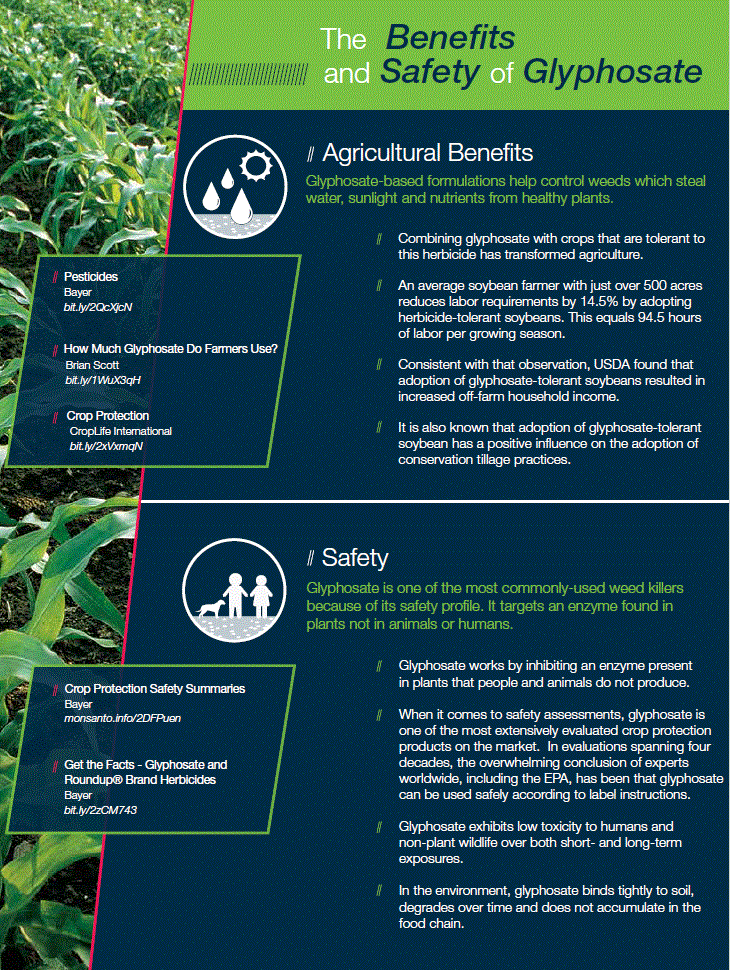
This infographic, based on a Monsanto technical
report
, summarizes the benefits glyphosate brings to farming and non-farming and details the rigorous scientific studies and regulatory scrutiny that affirm the safety of glyphosate.
|
This infographic is based on the Brookes et al., 2017 study: The contribution of glyphosate to agriculture and potential impact of restrictions on use at the global level. It covers how it allows farmers to adopt conservation tillage which leads to: 1) less ploughing/tilling of land, 2) reduced CO2, and 3) improved soil health.
|
GMOAnswers provides answers to commonly-asked questions about the safety of glyphosate for humans, animals, and the environment.
|
|
ARTICLES
By Juan Ferrara, Linked in
A Bayer employee provides his perspective on why a product like glyphosate is worth fighting for someone that has sold the product for 25 years (as a Monsanto employee). He uses the "Four P's" of marketing when explaining why glyphosate is needed for modern agriculture as well as trusted voices to help communicate the need for this tool.
From Iida Ruishalme, Thoughtscapism.com
This author of the blog provides answers to questions received from her readers covering topics on IARC, breastmilk, and other topics relating to safety of glyphosate.
By Genetic Literacy Project, D. Warmflash
Perspective on how dosage impacts chemical residues using glyphosate as an example.
By Andrew Kniss, A Plant Out of Place, Andrew Kniss)
A weed scientist writes about glyphosate and cancer from a pesticide applicator's perspective after a jury recommended Monsanto pay an individual that has been diagnosed non-Hodgkin lymphoma.
By Jake Leguee, A Year in the Life of a Farmer
A Canadian farmer discusses how they use glyphosate on the farm and how it allows this generation of farmers work the land less. He talks about how he feels about the safety of glyphosate as an applicator of it hundreds of hours a year.
By Dave Walton, Genetic Literacy Project
A U.S. farmer provides his perspective on how a banning of glyphosate would change how he farms, with respect to the use of alternative herbicides, no-till sustainable farming, and "superweeds". He addresses some of the myths and memes seen in media about the quantity of glyphosate used on crops.
From Joe Schwarcz, The Montreal Gazette
An article that contains a video which provides an explanation of Roundup, what the IARC classification means. The article highlights some scientists that are causing "fearmonging" and a brief history of glyphosate and provides the relevancy of acceptable daily intake to glyphosate safety.
|
|
|
|
|
|
|