The Institute for Health Equity Research, Evaluation & Policy | |
Recognizing Transgender Day of Remembrance | |
The Mass League's Institute for Health Equity Research, Evaluation, and Policy (IHE) is observing Transgender Day of Remembrance by reporting critical examples of community health center research to improve equity in Transgender health.
Dr. Sari Reisner, an Affiliated Investigator at The Fenway Institute and Director of Transgender Health Research, and faculty at Harvard University, shared his clinical and research expertise with the Institute earlier this month in the following interview.
| |
National Transgender Day of Remembrance (TDoR) is November 20. | TDoR is a day to remember and mourn the lives lost to hate and transphobic violence. | |
An Interview with Dr. Sari Reisner at the Fenway Institute | |
IHE: What drives you to work on transgender health issues?
SR: Transgender, nonbinary, and other gender diverse people – collectively what I refer to here as trans people – experience health inequities across an array of physical and mental health outcomes relative to cisgender (non-transgender) people, including in mortality, poor self-rated general health, chronic condition co-morbidities, HIV and other sexually transmitted infections, suicidality, depression, substance use, and others. Trans people also have suboptimal rates of healthcare engagement and retention in care, such as avoiding needed care when sick or injured, delaying preventive care services. In addition, individual, interpersonal, and structural barriers to receipt of healthcare exist, including care for medical gender affirmation (e.g., hormones, surgery) and for general care that is gender-affirming (e.g., any care that is culturally competent and affirms trans people in who they are).
For trans people occupying multiply marginalized social positions, such as trans people of color, stigma due to being trans is further compounded due to other forms of oppression at the intersectionality of racism, transphobia, and cisgenderism. Social marginalization is also connected with economic exclusion for many trans people, which can be seen in the high rates of unemployment, living at or below poverty, and houselessness, factors which we know are powerful social determinants of health.
What drives me to do this work is a passion for social justice and health equity. By documenting, identifying, and addressing the root causes of these health inequities – stigma and oppression – I believe we can improve the health of trans people. The somewhat bleak portrait of trans population health I have painted is both avoidable and remediable.
On a personal note, I am also member of the trans community. I was able to access gender-affirming care at age 19. It literally saved my life. I conducted my first published research study in the field of trans public health in 2009. We have come a long way since then, but we have a long way to go to address health inequities burdening trans communities.
| |
IHE: Could you tell us about your research?
SR: I am trained as a social and psychiatric epidemiologist and health inequities researcher. My research focuses on identifying and leveraging trans-specific social determinants of health, with a focus on mental health, HIV prevention, and gender-affirming interventions. I use a participatory population perspective to work “with” not “on” communities to increase the reach and relevance of the research I conduct.
Historically, diverse gender identities that are outside of cisgender and heteronormative gender norms have been pathologized by psychiatry and medicine through psychiatric diagnoses. Gender dysphoria is a current psychiatric diagnosis in the DSM-V, which was previously gender identity disorder in the DSM-III. There is a lot of research focusing on the dysphoria and distress trans people experience, and it is important to understand these. But it is equally important to identify positively valanced mental health targets – things that can be enhanced and built upon to lift people up.
We conducted focus groups with trans patients about clinical research priorities and heard that they want us to learn more about what is going right in their lives and the positive aspects about being a trans person. Our study is published online at BMC Public Health. So, we implemented a study about gender euphoria – positive emotions or feelings of joy associated with gender – recently published in Psychiatry Research. We surveyed 2,165 trans patients receiving care at two community health centers (Fenway Health in Boston, MA and Callen-Lorde Community Health Center in New York City, NY). Overall, 30.5% reported gender euphoria and gender euphoria was associated with reduced gender dysphoria, reduced alcohol misuse, and increased resilience. This work was published in the journal Psychiatry Research.
| |
IHE: What services support transgender health at Fenway?
SR: Fenway Health offers gender-affirming and culturally responsive care for trans people. Gender-affirming care refers to healthcare that affirms people in who they are – such as using respectful language, using the correct names and pronouns that people go by, and utilizing patient-centered care principles to “meet patients where they are”. Fenway services include primary care, HIV prevention and treatment, mental healthcare, dental care, vision, and specialty care like dermatology. Gender-affirming care is also sometimes used to refer to care specifically for medical gender affirmation – to medically affirm gender. Fenway offers hormones via primary care, and referrals to other gender-affirming services such as surgery. Not all trans patients want medical gender affirmation.
| |
IHE: How do you hope your research and other actions (clinical, policy, advocacy) lead to better health outcomes for trans people?
SR: Sex and gender are determinants of health and wellbeing for everyone, trans and cisgender alike. We have much to learn from trans medicine and public health about how sex and gender impact health for all people. Trans public health and trans medicine are growing fields of practice, research, policy, and clinical care.
Trans rights are under attack with legislation banning, or seeking to ban, gender-affirming care. Research on how this hostile sociopolitical climate impacts the mental health of trans people will be important. In the USTS, 40% of trans respondents reported a lifetime suicide attempt. Suicide is already a public health crisis for trans communities. The anti-trans legislative environment may have far-reaching and detrimental mental health impacts for trans communities. Healthcare is a fundamental human right. Gender-affirming care – care that is respectful, affirming (correct names, pronouns), and culturally responsive – is lifesaving care.
Evidence-informed interventions for medical education and training are needed to train providers and ensure a competent workforce able to care for trans patients. We also need to train the public health workforce. I offer a course in “The Health of Transgender and Gender Diverse People” at Harvard T.H. Chan School of Public Health for this reason.
I am inspired by the stories of resilience I hear each day from trans people. I am inspired by the many and diverse ways people describe their gender identities and expressions. This reminds me that gender diversity is something to be celebrated, not pathologized.
| For more information on the work of Dr. Sari Reiser and initiatives at Fenway Health, please visit FenwayHealth.org/the-Fenway-Institute. |
|
Gender-affirming Psychiatric Care: book launch
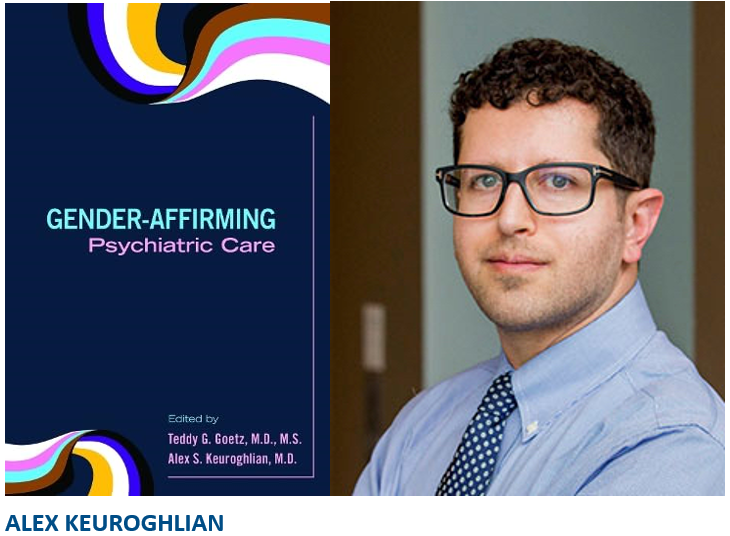
On November 10, Fenway Health announced the release of the American Psychiatric Association's textbook, Gender-affirming Psychiatric Care, written and edited by Fenway Health’s Alex Keuroghlian, Director of the Division of Education and Training at the Fenway Institute, along with Teddy Goetz, Psychiatry Resident at the University of Pennsylvania and features information collected from experts in the field.
Ninety percent of the authors are transgender and gender diverse, with each chapter led by at least one transgender or gender-diverse authors. Many of the authors are Fenway/TFI staff.
Learn more.
|
|
The Institute for Health Equity Research, Evaluation, and Policy | |
The Massachusetts League of Community Health Centers (Mass League) is proud to announce the creation of the Institute for Health Equity Research, Evaluation and Policy, Inc. (IHE), a 501(c)(3) non-profit organization designed to support Emancipatory research driven by community health centers. | |
IHE Executive Director: Cheryl R. Clark, MD, ScD | |
Dr. Clark is Executive Director of the IHE and Senior Vice President at The Mass League of Community Health Centers.
| |
IHE highlights in the media:
"Women leaders from Greater Boston honored at awards luncheon" in The Boston Globe, October 19, 2023
"New institute looks to shake up health equity research" in The Worcester Business Journal, June 23, 2023
The Brigham Bulletin, July 12, 2023
"A Comprehensive Journey Toward Health Equity: Dr. Cheryl Clark At The Helm" in The Seamless Connection: Slice of Health Care Network podcast, September 12, 2023
| |
|
IHE October feature:
Hispanic Heritage Month
Exclusive Interview with Dr. Cristina Huebner Torres, Chief Research and Population Health Officer at Caring Health Center.
"Health center leadership, representation, transparent engagement, and responsiveness to health center mission and needs are core to the effectiveness of health equity initiatives."
- Dr. Huebner Torres
Read the full article online.
| |
Dr. Cristina Huebner Torres, Chief Executive Vice President, Strategy and Research Officer at Caring Health Center, a Federally Qualified Health Center (FQHC) in Springfield, Massachusetts | | | | |