|
Any comments/suggestions please email the editor at editor@redrockrx.com
Edited by Malcolm Fraser MD, CMD
| |
|
Red Rock Pharmacy is monitoring a National IV Fluid Shortage
| |
|
I hope that you all had a wonderful Thanksgiving. Here at Red Rock Pharmacy, we were busy! Hurricane Helene, which hit North Carolina in September, severely damaged the Baxter International facility that produces most of the IV fluids used in the U.S. As a result, Baxter was forced to stop production and is now rationing its IV products. The shortage is expected to last at least until early 2025. We advise our customers to check with us before accepting any new residents who will require IV fluids.
The big news last month was the release on November 18 of the 900-page CMS Surveyor Guidance Revisions, which will take effect on February 25, 2025. To put this into perspective, the 2017 State Operating Manual Megarule was only 550 pages. We are closely reviewing the new guidance revisions to determine their impact on the services we provide to our customers. It is worth noting that shortly after the release, we began hearing rumors (wishful thinking?) that the new administration may put a moratorium on all new federal regulations. We will plan for the worst and hope for the best!
We will continue to keep you updated on both the IV fluids shortage and federal regulations.
On a more positive note, I want to wish you all a very happy holiday season and assure you that here at Red Rock, we will be available for you during the holiday season. May I be among the first to wish you all a Happy New Year for 2025!
Shixian Wang
Director of Operation
Here is a Link to the new CMS Surveyor Guidance Revisions: Click Here
| |
|
Juel joined Red Rock Pharmacy in April of 2021 and currently works as a Certified Pharmacy Technician (CPhT) in the Typing department at the Idaho branch. When Juel moved to Boise and began the job search, Red Rock Pharmacy wasn't initially on the radar. However, the interview process convinced Juel that it was the right choice, leading to a rewarding career at Red Rock.
Juel appreciates that Red Rock Pharmacy combines the resources of a large company with the personal touch of a smaller "Mom and Pop" pharmacy. The swift and responsive communication ensures that any issues or needs are addressed quickly, without cumbersome bureaucratic delays. This environment makes Juel feel heard and valued, even if a solution isn't immediately available.
In the role of a Typing CPhT, Juel enjoys the unique challenges that come with resolving unusual situations that arise daily in the pharmacy. This aspect of the job ensures that no two days are the same, providing a dynamic and engaging work experience. Since joining Red Rock, Juel has developed strong conflict resolution and customer service skills, thanks to the excellent examples set by colleagues.
Motivated by the supportive and collaborative atmosphere, particularly the people nearby, Juel strives to perform at the highest level every day. Outside of work, Juel enjoys cooking, spending time with family and dogs, engaging in various outdoor activities, playing video games, and reading. When asked about a favorite meal, Juel's choice is a medium rare ribeye steak covered in sautéed mushrooms and onions, accompanied by mashed potatoes and an ice-cold Pepsi. Juel describes himself as an open book, always authentic and straightforward with colleagues.
| |
|
Ozempic May Lower Alzheimer's Risk in Patients with
Type 2 Diabetes
According to a recent study, Ozempic may lower the risk of patients with Type 2 diabetes developing Alzheimer’s disease. Researchers at Case Western Reserve University School of Medicine examined three years’ worth of electronic records from almost 1 million people with Type 2 diabetes.
The research group found that people who were prescribed semaglutide — the main ingredient in Ozempic — had a 40 to 70 percent reduced risk of developing Alzheimer’s compared to Type 2 diabetics who took one of seven other types of antidiabetic medications, including insulin.
Semaglutide’s potential risk reduction for Alzheimer’s was observed across gender identities, age, and weight groups, the study notes.
For more details: Click Here
| |
|
Today’s seniors (65+) are eligible for healthcare coverage under Medicare. Within the “Medicare” bucket, there are several options that individuals must navigate to find the best one for them. Straight Medicare involves Part A (hospital insurance), Part B (medical insurance), and Part D (prescription insurance). Part C is Advantage plans and encompasses all the parts listed above in one package, provided by private insurers. If you select an Advantage plan, you no longer have Medicare; you have private insurance.
Some Advantage plans offer vision and dental as part of their package, but there is no standard offering across insurers, and comparison takes careful consideration. It’s extremely difficult to do side-by-side comparisons in any region because Advantage plans have different networks and coverages based on the area you live in. The complexity of the Advantage plans makes navigating the available plans difficult and confusing, and covering the entire topic here would take pages. With that in mind, we’ll cover one aspect of Advantage plans, HMO and PPO plans.
-
HMO (Health Maintenance Organization) - The HMO Advantage plans generally require members to receive care from a specific network of doctors, hospitals, and other healthcare providers. If a member seeks care outside of the HMO network, they may have to pay the full cost of the service. This model allows the HMO to control costs but can restrict flexibility in choosing providers. HMO plans also usually require an in-network primary care provider to refer patients to specialists. Beware that this can lead to additional copay costs before seeing a specialist. However, HMO plans often have lower premiums and reduced out-of-pocket costs compared to other plans at the expense of flexibility.
-
PPO (Preferred Provider Organization) - The PPO plan offers greater flexibility than HMO plans. Enrollees do not need to see their primary care provider for referrals to specialists and can see out-of-network providers, although they may pay higher out-of-pocket costs for doing so. This can be a good option for individuals with more complex medical conditions requiring multiple specialist visits throughout the year. These plans often come with higher premiums and out-of-pocket costs.
Choosing between an HMO and PPO Advantage plan depends on each individual’s healthcare needs and budget. Both types of plans involve a network that individuals will need to research to ensure their providers are in-network. Just remember, signing up for an Advantage plan means you no longer have Medicare but private insurance. As a note of context, straight Medicare does not have a network. Any provider in any part of the country that accepts insurance will accept Medicare. If you ever decide to switch back to straight Medicare from an Advantage plan down the road, you may be restricted or blocked from Medicare Supplement plans due to pre-existing conditions... but that is a topic for next month.
David Rimlinger
Director of Marketing
| |
Adjuvanted flu, shingles vaccines can safely be given together, clinical trial shows | |
|
A recent clinical trial conducted at Duke University, with findings published in JAMA Network Open, demonstrated that the adjuvanted influenza vaccine and the adjuvanted shingles vaccine can be safely administered simultaneously. The study compared the safety and reactions of simultaneous intramuscular vaccination with the quadrivalent inactivated adjuvanted flu vaccine (aIIV4) and the adjuvanted recombinant herpes zoster vaccine (RZV) against the simultaneous administration of the RZV and the quadrivalent high-dose inactivated nonadjuvanted flu vaccine (HD-IIV4).
The trial included 130 community-dwelling adults over the age of 65, with a median age of 71, who were vaccinated and monitored for three months. The results showed no significant difference in side effects between the groups receiving the simultaneous vaccinations and those who did not.
The authors concluded that, from a safety perspective, both the flu and shingles vaccines can be administered simultaneously in an older adult population (i.e., those over 65 years old).
| |
|
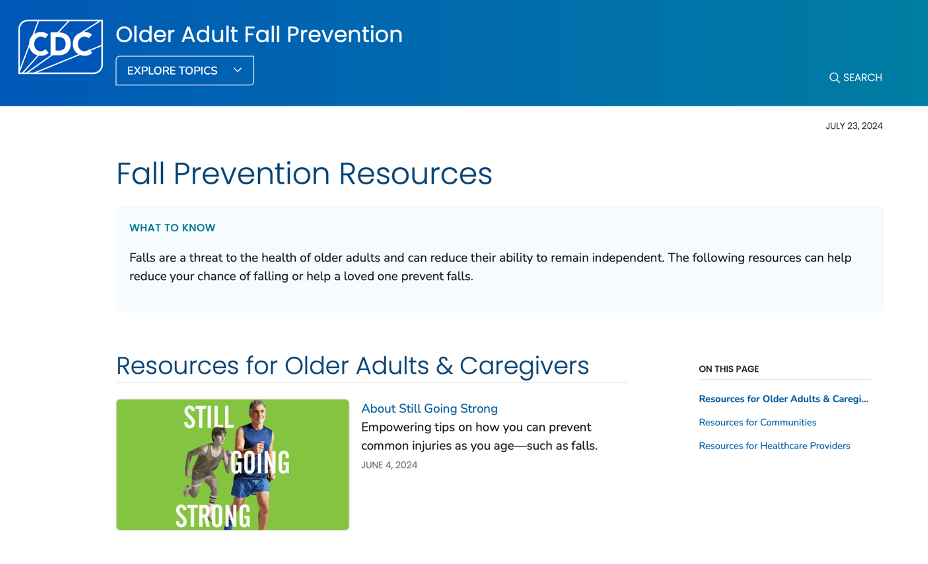
CDC and Fall Prevention.
Did you know that the CDC has a website devoted to Fall reduction in the adult population: Click Here
If you want to proactively keep up to date concerning Fall Prevention and the appropriately named CDC STEADI (Stopping Elderly Accidents, Deaths and Injuries) Initiative, consider subscribing to CDC “Older Adult Falls” emails. Its free and here is a link: Click Here
| |
|
TB is back!
Tuberculosis (TB) has reclaimed its position as the leading infectious disease responsible for the most deaths worldwide, according to a recent announcement from the World Health Organization (WHO). In 2023, TB caused 1.25 million deaths globally, including 161,000 among people with HIV.
COVID-19 had surpassed TB as the world’s leading infectious killer for the previous three years, but its impact has now relatively waned. Although around 25% of the global population has likely been infected with the TB bacteria, only 5% to 10% will experience symptoms and develop the disease.
-KFF Health News 11/1/2024.
| |
|
Hospitalization Rates for RSV in Unvaccinated Adults: Insights from a Six-Year Study
According to a recent report published in JAMA Network Open, about 1 in 20 adults with respiratory syncytial virus (RSV) require hospitalization within 28 days of infection. This equates to 5% of unvaccinated patients who develop RSV being hospitalized within this period. The data, collected from RSV seasons between 2016 and 2022, involved 67,239 people diagnosed with RSV in outpatient settings.
Since the RSV vaccine was not available during this time, all subjects were unvaccinated. The data came from three different databases, showing hospitalization rates of 6.2%, 6%, and 4.5% in each respective database.
For a subgroup of high-risk individuals aged 65 and older with conditions such as asthma, chronic obstructive pulmonary disease (COPD), or congestive heart failure, the hospitalization rates were higher: 7.6%, 8.5%, and 6.5% across the three databases.
For more details: Click Here
| |
If you have any questions, ask your Red Rock Consultant Pharmacist | | | | |