|
Any comments/suggestions please email the editor at editor@redrockrx.com
Edited by Malcolm Fraser MD, CMD
| | | |
Tramadol: Risks, Alternatives, and the Move to Safer Care
| | |
First of all, I hope that you all had a great 4th of July and got time to see family and friends. Here at Red Rock Pharmacy we were busy filling orders. There was an unusually high number of new admissions at facilities that we serve.
One thing that I have been thinking a bit about recently is the use of Tramadol (Ultram) in the population we serve. Tramadol is on the Beers List due to risk of hyponatraemia (low blood sodium) but is still widely used in facilities that we serve.
The dangers of Tramadol are:
1. Cognitive Side Effects
◦ Delirium, confusion, dizziness, especially in frail older adults.
◦ Increased fall risk due to sedation or orthostatic hypotension.
2. Seizure Risk
◦ Tramadol lowers the seizure threshold, especially in those with
predisposing conditions or on medications that increase seizure risk.
3. Serotonin Syndrome
◦ Risk is elevated if combined with SSRIs, SNRIs, or other serotonergic
agents (many older adults are on antidepressants).
4. Renal Impairment
◦ Active metabolites can accumulate in renal insufficiency, which is common
in the elderly.
An increasing number of our facilities are becoming “Tramadol Free.” Acetaminophen is frequently successfully substituted for Tramadol. If you are interested in becoming a Tramadol Free Facility, talk to your Red Rock pharmacist for more information.
Shixian Wang
Director of Operations
| | |
Employee of the Month – July
Meet Melani, one of our dedicated Line Techs, who has been part of the Red Rock Pharmacy team since 2018.
When asked why she joined Red Rock, Melani shared, “I was looking for a career to help me further my experience in the healthcare field.”
Melani says what she loves most about working here is the friendly, kind culture that made her feel welcome and appreciated from day one.
“What I really love about my work here is the variety—there's always something new to learn or a different challenge to tackle, which keeps things interesting. Plus, Red Rock offers so many opportunities to grow and try new things. And honestly, being in healthcare and knowing that what I do genuinely helps people and makes a difference is incredibly rewarding.”
When she’s not at work, you might find Melani enjoying the energy of a music festival, dancing, meeting new people, and trading fun trinkets. She also loves to cook and bake, and says “food is my favorite topic!”
Thank you, Melani, for your dedication, positivity, and commitment to making Red Rock Pharmacy such a great place to work. We’re so glad you’re part of the team!
| | The Hidden Danger: Families Installing Cameras in Care Homes Without Staff Knowledge | | |
As concerns over elder abuse and quality of care in long-term care facilities grow, more families are turning to surveillance by placing cameras in residents' rooms without informing facility staff. While many see it as a way to ensure their loved ones' safety, this practice raises serious legal, ethical, and operational issues for nursing homes and assisted living facilities.
Laws regarding electronic monitoring in congregate care homes vary by state. Some states, like Utah and Illinois, explicitly allow it under specific conditions, such as obtaining consent from the resident and notifying the facility. However, in states with no clear legislation, unauthorized surveillance may violate privacy laws (especially if roommates or staff are recorded without consent), state wiretapping/eavesdropping laws, and HIPAA regulations if protected health information is captured and shared. Facilities could also be held liable if footage reveals care lapses, even if improperly obtained. Checking your specific state laws is the only way to know if your facility is at risk due to having no laws prohibiting camera placement, or if the state has specific legislation covering this topic.
When cameras are installed covertly, staff morale and trust can suffer if they feel spied upon without cause. Additionally, cameras convey a lack of trust and are a tool for litigious family members looking for any reason to sue a facility. Other considerations include resident privacy, which may be compromised in shared rooms. Legal exposure increases if the facility is unaware of recording devices but fails to protect all parties' rights.
To safeguard residents, staff, and the organization, facilities should have a clear and comprehensive electronic monitoring policy that includes:
• A requirement that families request written permission to install cameras.
• Consent procedures for the resident and any roommates.
• Guidelines on placement, signage, and data use (e.g., prohibiting live streaming
or posting online), hours that monitoring is allowed, etc.
• A clause stating that unauthorized surveillance is prohibited and may result in
removal of the device or other action.
• Reference to applicable state laws to clarify what is and isn’t allowed.
By proactively addressing this sensitive issue, facilities can protect residents’ rights, maintain staff integrity, and minimize legal risk without compromising transparency or accountability. Ignoring the potential for technology to enter facility rooms without your knowledge leaves the staff, residents, and company at risk of adverse actions. Act now and ensure you have the necessary policies and procedures in place.
| | |
New Survey criteria effective July 2025
1. CMS Inspection & Star Ratings Updates
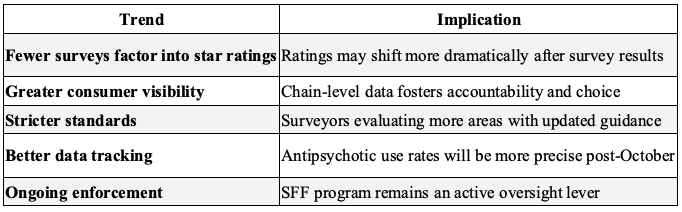
• Survey frequency reduced: As of July 2025, CMS will calculate Health Inspection star ratings using only the two most recent standard surveys, dropping the third—this change reflects ongoing survey backlogs.
• Enhanced transparency: Starting July 30, 2025, Care Compare will begin showing chain-level performance (overall stars, survey, staffing, quality measures) for the first time.
2. Revised Surveyor Guidance (April 2025)
• The new Long-Term Care (LTC) Surveyor Guidance issued in April 2025 updates key domains like psychoactive medication use, infection control, medical director oversight, admission/discharge processes, and more. Surveyors began applying these in late April 2025.
3. Quality Data Integration
• CMS is also enhancing data accuracy by updating the long-stay antipsychotic usage metric, adding Medicare/Medicaid claims and MA encounter data. This aims to prevent undercounting—projections estimate rates will rise from ~14.6% to ~17.0% after October 2025.
4. Spotlight on Struggling Facilities
• The Special Focus Facility (SFF) program continues highlighting persistently deficient homes. The latest SFF candidate list (May 2025) pinpoints facilities with "yo‑yo" compliance (i.e., cyclical but unresolved serious citations).
What this means for Q2 2025 & beyond
| | |
Bottom Line
• Q2 2025 marks a turning point: nursing home oversight is tightening, data is becoming clearer and more transparent, and CMS is focusing scrutiny on systemic issues.
• Facilities should proactively update policies—especially around psychotropic meds, infection control, and discharge processes—and prepare for potential star rating shifts due to the rating change.
| | |
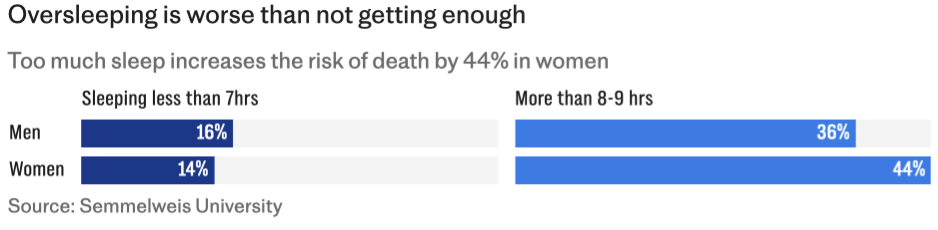
Too much sleep is more dangerous than not getting enough!
The ideal amount of sleep to get per night is between 7 and 8 hours. Less than that increases the risk sudden cardiac death by 16% in men and 14% in women. But regularly sleeping more than 9 hours increases the risk of death by a massive 36% in men and 44% in women according to a new study by Semmelweisss University who analyzed data from over 70 studies covering over 2 million people.
| | |
Older adults in the US are increasingly dying from unintentional falls
Who’s most affected
• Age & sex differences: Highest death rates in the 85+ group — approx. 373 per 100,000 for men and 320 per 100,000 for women .
•. Racial disparities: White, non-Hispanic seniors experience the highest fall-related death rates—roughly 3× higher than Black seniors in the 85+ category.
Regional patterns
• Wisconsin had the highest rate in 2023 (158.4/100k), while Alabama had the lowest (29.5/100k).
•. Cold climates (ice, snow) and state-level differences in reporting may partly explain this.
|
| |
Decline in Number of Geriatrician Physicians Offset by Increasing Number of Geriatric Nurse Practitioners
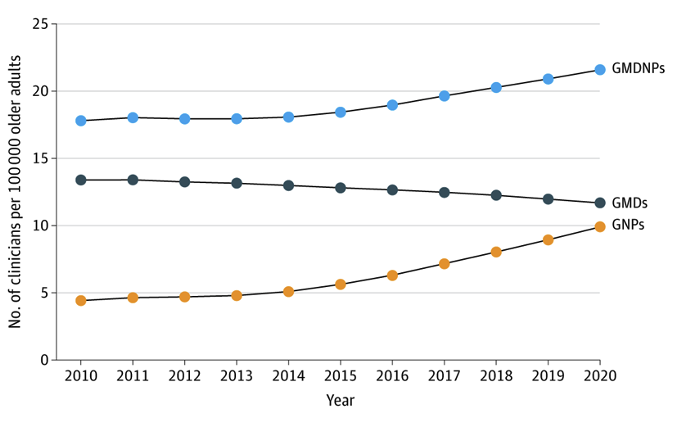
• From 2010 to 2020, the national per capita supply of geriatrician medical doctors (GMDs) decreased by 12.7%, from 13.4 per 100,000 older adults in 2010 to 11.7 per 100,000 older adults in 2020.
• The supply of geriatric nurse practitioners (GNPs) increased by 125%, from 4.4 per 100,000 older adults in 2010 to 9.9 per 100,000 older adults in 2020.
• The combined GMD and GNP workforce increased by 21.3%, from 17.8 per 100,000 older adults in 2010 to 21.6 per 100,000 older adults in 2020.
• There are approximately 7,300 board-certified geriatricians currently practicing in the U.S. This is far below the estimated need of 30,000 by 2030, leaving a gap of over 20,000 specialists.
Supply stagnation: With low entry numbers into geriatrics fellowships (about 70% fill rate in 2022–23) and high retirement rates, supply is expected to hold steady or decline slightly.
Figure 1. Trends in National-Level Densities of Geriatric Physicians (GMDs), Geriatric Nurse Practitioners (GNPs), and Combined GMDs and GNPs (GMDNPs) in the U.S., 2010–2020.
| | If you have any questions, ask your Red Rock Consultant Pharmacist | | | | |