Specializing in Turf Fertilizer
|
|
|
Many of the people we talk to when presenting Reed and Perrine for the first time believe all fertilizer is created equally. In actuality, however, the fertilizer industry is split into two categories, agg grade and turf grade. agg grade fertilizer is blended without any concern for particle size while turf grade fertilizer is, or at least should be, blended with great attention to sizing. Why, you ask?
When spreading fertilizer, different sized particles fly out different distances. For example, a farm grade fertilizer may have very large Urea and comparatively small Potash. When this is put through a spreader, the Urea will fly much farther than the Potash. On a field of crops, this difference is mostly negligible and the plants end up getting approximately the same amount of nutrients. On a lawn that is being fertilized for aesthetics, however, particle separation causes streaking, greening in some strips with no greening in others.
Because approximately 97% of the fertilizer industry is driven by agriculture, our little 3% of turf is not given much of a voice at the table. Producers of fertilizer raw materials would much rather make cheaper, more readily sold agg fertilizer. Because of this fact, not only is turf grade fertilizer more expensive, it is also very hard to find consistently.
Bob Bulkowski, co-owner of Reed and Perrine, always makes finding clean, properly sized, 220 SGN (size guide number) raw material sources his highest priority. He has been doing so for over 30 years and knows all the players in the game so that we can provide the best blended turf fertilizer possible. Unlike many competitors that cut corners, R&P will never sacrifice quality for cost. We know how to exhaust all possibilities to obtain the best sources of raw materials at all times.
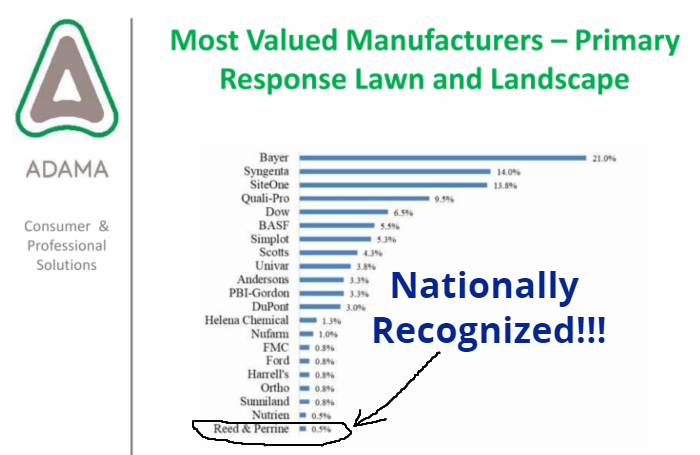
We were very excited to learn last week that in a
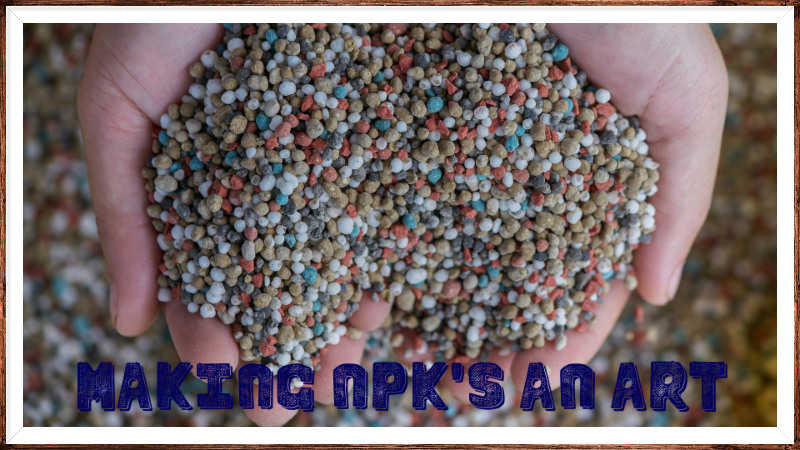
national survey commissioned by our buying group, Primera, and conducted by a well known survey company, Reed and Perrine made the list for most valued manufacturers in the lawn and landscape industry!! For our regional company to be recognized on a national scale among names like "Bayer" and "Syngenta" is a testament to the high quality fertilizer we manufacture. R&P makes NPK's an art! Please call us today to place your orders or to start doing business!
|
|
|
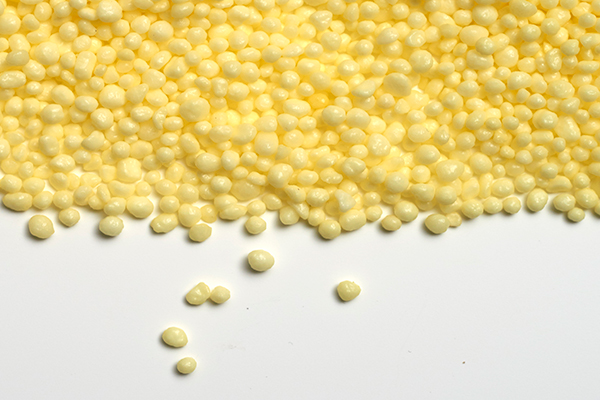
Reed and Perrine has recently started to bring in and blend with a new, exciting slow release nitrogen form called XRT. XRT is produced by Knox Fertilizer Company and has a new, advanced epoxy coating that has a number of advantages when compared to the classic PCSCU (Polymer Coated, Sulfur Coated Urea).
Unlike PCSCU, XRT never has what is called "catastrophic failure" of the coating. In PCSCU, water enters the capsule and pressure builds and builds until the coating ruptures, many times releasing all the nitrogen contained inside at once (catastrophic failure). In other words, if there is a lot of rain, your slow release nitrogen isn't very slow releasing. In contrast, XRT releases through Osmotic Diffusion, a molecular process that never breaks the epoxy coat and only increases as the temperature increases. This creates a more stabilized release and keeps lawns greener for longer. In addition to a more steady slow release, XRT has a longer residual, claiming to last up to 90 days. PCSCU usually only lasts somewhere between 45-60 days.
The best part about XRT? Currently, Kenko is offering XRT for the same price as blends typically containing XCU! We are not sure how long we will be able to extend this offer so please place your orders ASAP! Check out the sell sheets below if you want to learn more about this exciting new slow release nitrogen.
|
|
|
Humates, the Future of Fertilizer?
|
|
|
Increasingly, there are more and more rumblings of government enforced NPK restrictions coming down the pipeline. In NJ and NY, the use of Phosphorus has already become nearly outlawed with legislation prohibiting turf applications unless starting new seed. Out on Long Island, there has been talk of drastically reducing the lbs/acre of Nitrogen allowed per year. Most notable of all the restrictions is in Maryland, where one county has completely outlawed the use of synthetic fertilizer on turf!
They say the only thing guaranteed in life is change and with the way things are going, it looks like change will be coming to the turf fertilizer industry. Whether restrictions will tighten sooner or later is yet to be seen, but either way, it behooves anyone that deals in fertilizer to have a contingency plan.
The most likely solution has already been a tried and true staple in the farming industry for many years and is becoming more popular in the turf industry as well; Humates. Humates are the product of prehistoric organic matter decomposing for thousands of years. They are found deposited most abundantly in the Western United States. Unlike humus, manure and other forms of organic matter, Humates have gone through many years of interaction with soil microbes, making their beneficial Humic acids immediately available to plants.
There are three separate Humic acids that benefit plants in three unique ways. Humic acid chelates nutrients in the soil, greatly increasingly uptake and making applied fertilizer go much further. Ulmic acid increases root growth and development. Finally, Fulvic acid helps in plant metabolism and improves a plant's ability to tolerate stress. In addition to the benefits of each individual acid, Humates also greatly increase water retention in soil, increase soil aeration, feed beneficial soil microbes and provide carbon building blocks for plants.
Although Humates are relatively expensive when compared to synthetic fertilizer, when fertilizing a lawn several times a year, you only need 2-3% Humates by weight to see some great results (around $1.00 more per 50lb bag). You can also consider reducing the NPK count slightly to offset the cost of adding Humates since the fertilizer will go much further.
There are a number of commercially available forms of Humates on the market, but Reed and Perrine always blends with Humic DG from The Andersons. With the addition of their DG technology, we believe this is the best form of Humates for turf out there. Watch the video below to learn more about Humic DG.
If you are interested in adding a product with Humates to your lineup but do not want commit to the minimum 5 pallets required for a custom blend, consider trying a skid of Reed and Perrine's stock
17-0-3 w/SOP, 30%CRN w/XCU, 2.5%Humic DG. Getting your customer base accustomed to Humates now could greatly decrease the headaches NPK restriction could bring later!
|
|
|
R&P is able to produce any fertilizer you can think of with a minimum 5 pallet order, but we already stock a number of excellent products that are ready to ship out as soon as you place an order. Take a look below at some of our most popular stock fertilizers. Please note that bag coverage is based on a rate of 1lb of nitrogen/1,000sqft.
- 17-0-3 w/ SOP, 30%CRN w/XCU and Humic DG. SOP greens up nicely and Humic DG provides a number of benefits including increased nutrient uptake. Covers 8,500sqft.
- 18-0-3 25%CRN w/XCU and Bio Solids. An economical blend with bio solids for a little extra punch. Covers 9,000sqft.
- 20-0-5 15%XCU, 15%UFLEXX, 5%Fe. High iron provides very deep green color without a lot of surge growth. Covers 10,000sqft.
- 24-0-5 40%CRN w/XCU, 3%Fe. Our most popular product. High slow release content for lasting green. Iron for deep green color. Covers 12,500sqft.
|
|
|
|
|
|
|
|