|
|
Dear HERC Family,
We recently returned from an overseas trip to Poland and the Czech Republic, travelling with and co-educating a truly inspirational cohort of 89 student musicians and their chaperones from the Milwaukee Youth Symphony Orchestra as part of their World Tour. You can learn more about this highly impactful experience (and hear some of the student’s beautiful music and reflections) by visiting MYSO’s blog.
When HERC was approached about the upcoming Violins of Hope Residency hosted by MYSO over a year ago, we knew how essential our contributions to this project would become. While learning about the Holocaust was not the only objective of a trip anchored in music and culture, the students needed a broad understanding not only of the genocide itself, but background on the vibrant Jewish culture that once thrived in the cities they would visit, how antisemitism took hold and shapeshifted over the centuries in these regions, and how Jewish resiliency and identity continues today.
In 2025 – one of the peak moments of global antisemitism since the Holocaust – such lessons must always be part of Holocaust education.
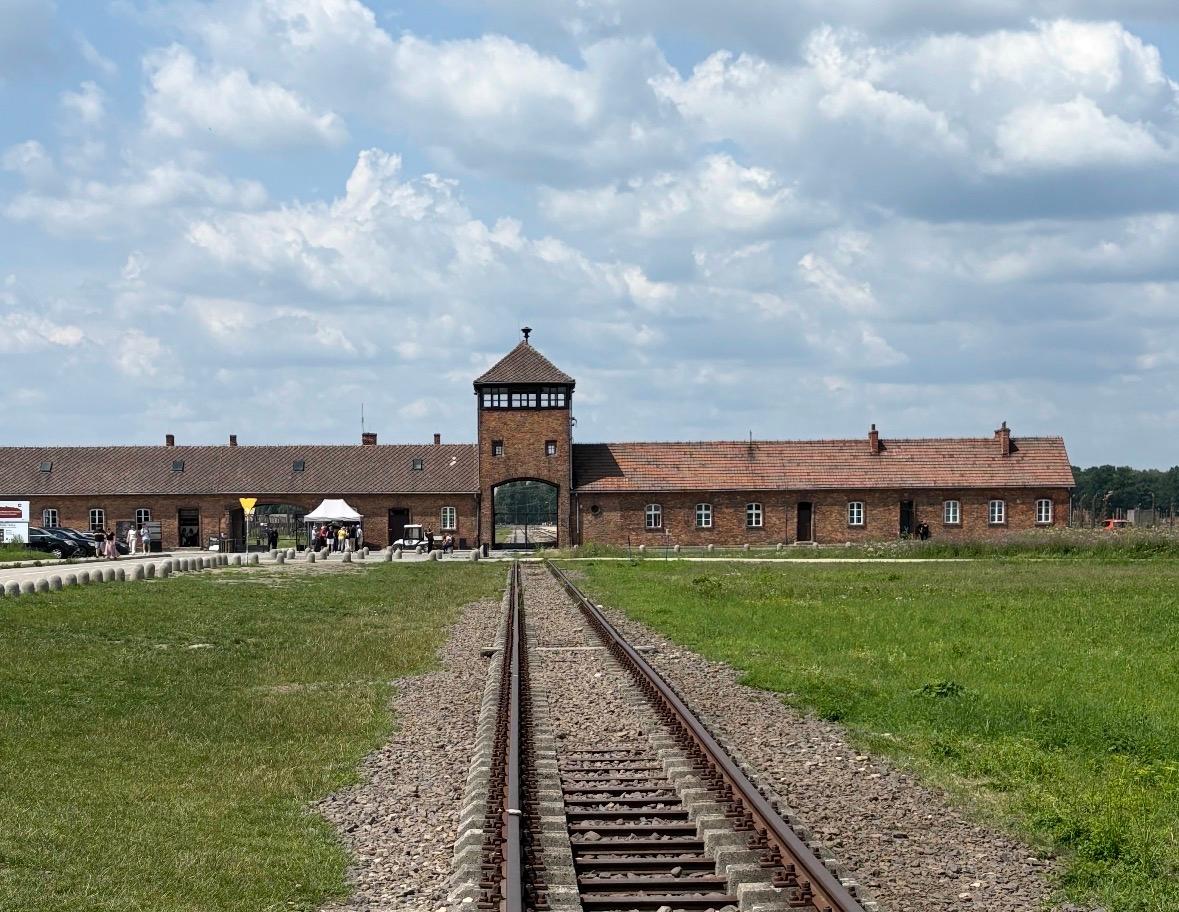
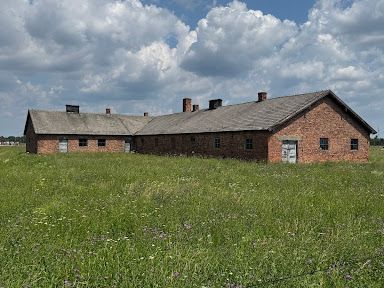
One of the most powerful days of this trip was a tour to Auschwitz-Birkenau, the infamous Nazi death camp. As HERC staff, we wanted to ensure that the students on this trip understood the gravity of the space they were entering and learned of the individual stories of people who stood on those grounds.
|
| |
On the bus ride to the memorial site, we spoke to the students about the history of the town, and how people’s homes weren’t that far from the camp. They saw this firsthand as we approached.
During the tour itself, students were quiet, soaking in the information and their surroundings. When asked questions about resistance, we told the courageous story of the Jewish women and men that led a revolt in 1944, in their attempt to blow up the crematorium.
As we left the site, we held a silent moment in front of the gates for those who had perished, sharing the Jewish memorial tradition of Yizkor.
Studying the Holocaust can be difficult, coming face to face with the facilities where it happened is even more so. These sites remain for a reason, as both a symbol and a tool to educate others on what can happen if antisemitism and hatred goes unchallenged.
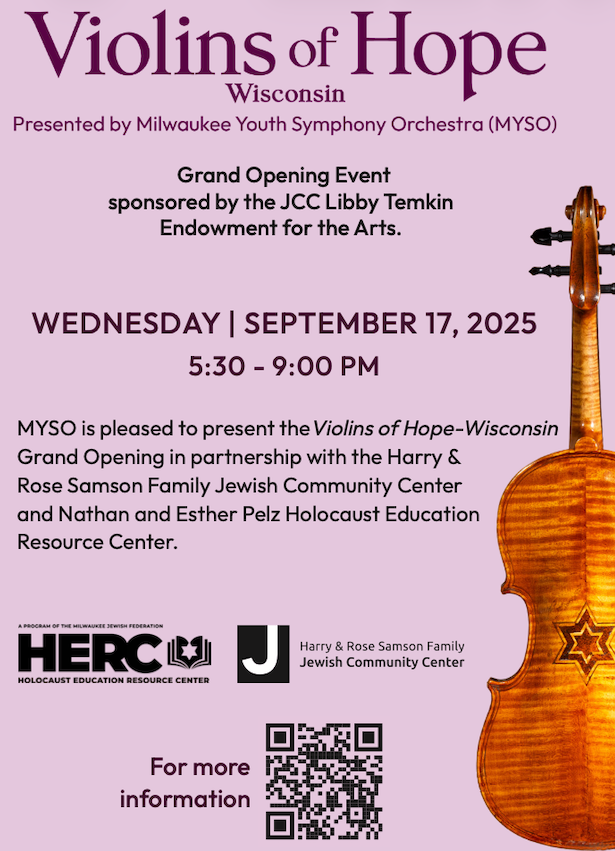
We are grateful to the Milwaukee Youth Symphony Orchestra for inviting HERC to participate in this experience. We look forward to sharing further reflections from this trip with you over the coming months as programming around Violins of Hope – including a cutting-edge exhibition hosted by our colleagues at Jewish Museum Milwaukee with educational support from HERC.
| | |
Samantha Abramson
Executive Director
| | |
Sam Goldberg
Education Director
| | 2025 Poland and the Czech Republic Tour Blog | MYSO | |
|
by Lucy Hamann
Photo: Lucy Hamann
(This blog by student Lucy Hamann was originally published by MYSO as part of their 2025 POLAND AND THE CZECH REPUBLIC TOUR BLOG)
After I stepped into Auschwitz, it felt as though this era of history had been paused, not erased, and not forgotten, but suspended. Frozen in time while the rest of the world moves forward. Driving into the camp, I noticed life continuing outside its gates. People were gardening in their yards, dogs napped on patios, and neighbors walked to work, only five minutes away from the entrance to Auschwitz-Birkenau. I couldn’t imagine waking up every day so close to a place marked by such destruction and trying to go about life as normal. The guilt would eat me alive.
Outside the camp, the world moves on. Inside, time stands still. The buildings are preserved, but they did not just feel intact; they felt active, alive. I could almost sense movement. Hear footsteps. Feel the presence of people who once lived, suffered, and died there. The energy was overwhelming. I expected to cry. I expected to feel lightheaded or overtaken with emotion. Instead, I just felt numb. It was too much to process all at once. Millions murdered, families torn apart, and identities erased. The weight of what happened there pressed down on me like something physical. And even now, writing this a day later, I’m only beginning to process what I witnessed.
| | | | More student reflections can be found here. | | |
We are excited to welcome our new board leadership and new and returning board members as an important milestone in continuing our vital mission of Holocaust education.
Under this invigorated leadership, we look forward to expanding our statewide reach, strengthening our educational programs, and continuing to honor the memory of Holocaust victims and survivors while ensuring their stories remain shared for generations to come.
| | |
Incoming Board Chair
Joe Peltz
A longtime HERC supporter and previous vice board chair, Joe (along with his wife Miriam) are the grandchildren of Holocaust survivors (Joseph and Rebecca Peltz, Bill and Franka Neufeld). Joe is a fierce advocate for our work. He is a commercial litigation attorney and a partner with Beck, Chaet, Bamberger & Polsky, S.C. He is a graduate of Marquette University Law School (J.D., 2007) and Colgate University (B.A., 2003). Joe and Miriam have three children - Mia, Chloe, and Miles.
| | |
Incoming Vice Chair
Ronna Bromberg Pachefsky
Ronna had a traditional Jewish upbringing, attending Jewish day school in Pittsburgh through eighth grade, then continuing on to the School for Advanced Jewish Studies during her time in high school. She graduated with a BA from the University of Pittsburgh. After college, Ronna worked in a number of production roles at WQED (a PBS affiliate) in Boston. After moving to the Milwaukee area, Ronna served as the Membership Coordinator at the Betty Brinn Children’s Museum and currently co-owns and operates Plaster Gallery LLC. Ronna currently volunteers as the co-chair of the Milwaukee Jewish Film Festival, and as a member of the Board of Directors of the JCC, Hillel Milwaukee, and HERC.
| | |
Immediate Past Chair
Richard Rocamora
We want to express our heartfelt gratitude to Richard Rocamora for his outstanding leadership and service to our organization and community. His vision, thoughtful guidance, and unwavering commitment have been instrumental in driving our success and helping us navigate both opportunities and challenges during his tenure. Prior to becoming chair from 2023-2025, Rick also served for many years as HERC's Treasurer, ensuring that our board and staff had the fiscal knowledge and resources to implement our mission.
Thank you Rick!
| | 2025-2026 HERC Board of Directors | | |
Joe Peltz - Chair
Ronna Bromberg-Pachefsky - Vice Chair
Nancy Kennedy Barnett
Betty Chrustowski *
Dave Fantle
Bev Greenberg *
Leo Kleiner
Mary Jo Layden
Jaime Levine
Mark Miller *
Ted Neitzke IV
Dr. Monica Olague
Neal Pease
Bruce Peckerman
Arleen Peltz *
Ellen Pelz
Harry Pelz *
Jason Pelz – Treasurer
Todd Richheimer
Rick Rocamora **
Leigh Tabak
Barbara Tenin
Bruce Varick
Liza Wiemer
Eva Zaret
*Past Chair
**Immediate Past Chair
| |
Outgoing Board Members
Thank you to outgoing board members, Kari Altman, Sue Dabaco, William Deck, Becky Komisar, and Rabbi Ron Shapiro for their dedicated service to our organization.
Incoming Board Members
HERC is honored to welcome Leo Kleiner, Todd Richheimer, and Barbara Tenin to our board.
| | Upcoming Programs Spotlight | | |
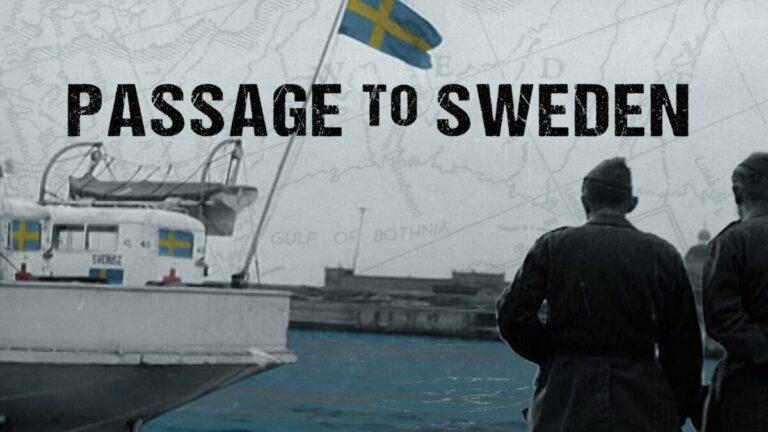
Film Screening: Passage to Sweden
Tuesday, August 5
7pm-8:30pm
Set against the backdrop of World War II, the film, Passage to Sweden, focuses on the lesser-known events in Scandinavia and Budapest, revealing how ordinary people and entire nations took extraordinary risks to save thousands of Jewish lives.
Following the screening, join us for a conversation with filmmaker Suzannah Warlick, who served as the film’s director, producer, and editor.
Free/Pre-registration required.
Co-organized in partnership with the Jewish Museum Milwaukee and the Sam & Helen Stahl Center for Jewish Studies (University of Wisconsin-Milwaukee).
|
| |
Critical Thinking, Moral Imagination, and the Courage to Rescue: A Dialogue
Thursday, September 4
7pm-8:15pm
Drawing from histories of individuals and communities who chose to rescue Jews during the Holocaust, Dr. Amy H. Shapiro will explore the difficult decisions made by those who risk their lives to help others. She will share insights into what drives people to act with compassion in the face of danger and discuss the broader implications for moral decision-making today.
This program has been co-organized in partnership with the Jewish Museum Milwaukee.
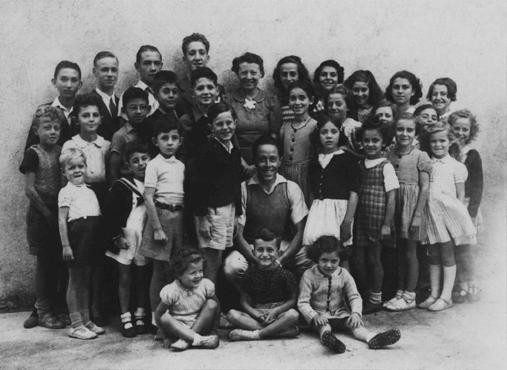
Image: A group of children who were rescued during the Holocaust, having found shelter in the town of Le Chambon-sur-Lignon, France. Le Chambon-sur-Lignon, France, August 1942.
Courtesy of United States Holocaust Memorial Museum.
|
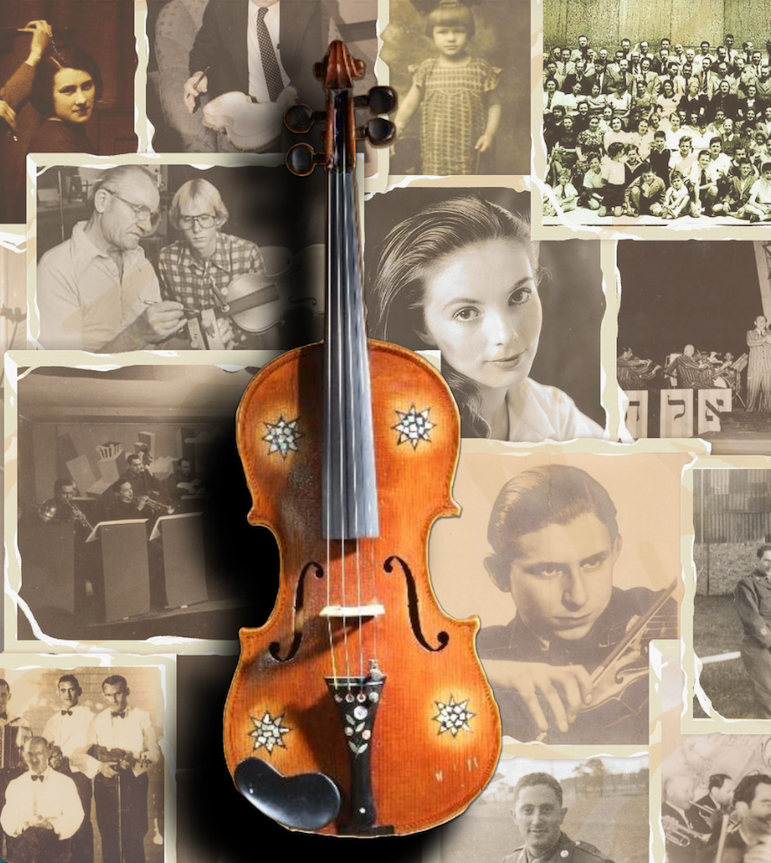
| Join us for the grand opening of Violins of Hope - Wisconsin, a five-month residency, featuring instruments played by Jewish musicians and others during the Holocaust. | | | |
|
The generosity of our community fuels our work and allows us to make a difference. | | | | |