In 2019, I began a project exploring the Nicene Creed using various spiritual disciplines, seeking ways to connect its recitation more deeply to the spiritual lives of contemporary Christians. One series of reflections was based on a study during Lent looking for connections between the text of the Creed to the liturgies and prayers of Lent. I invite you to join me in reflecting how our “we believe” of the creed connects to our annual Lenten journey.
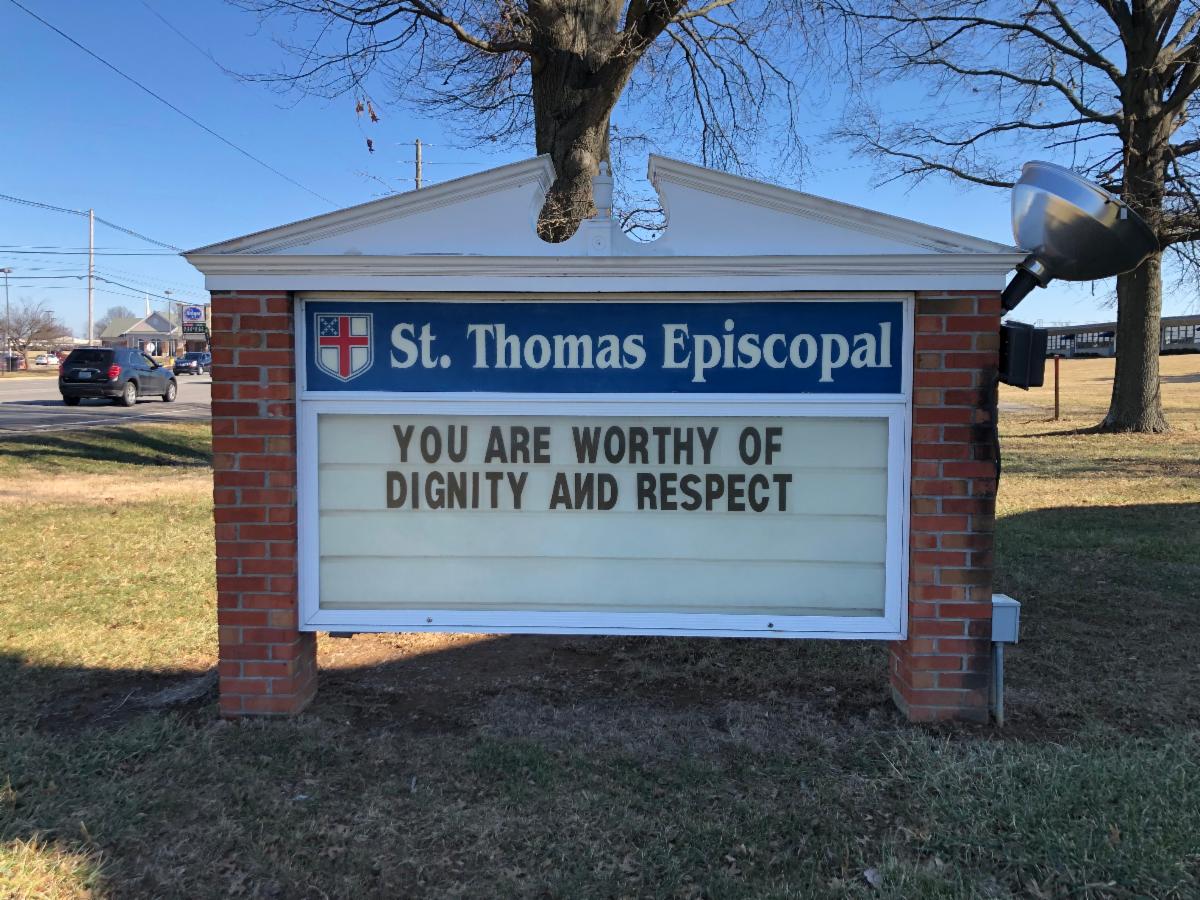
Photo: St. Thomas, Louisville, February 2019
“You are my Son, the Beloved, with you I am well-pleased.” We heard this striking proclamation yesterday in Mark’s gospel as Jesus comes up out of the water of his baptism in the Jordan River. We are witnesses to the bat qol* announcing very plainly and directly how much Jesus is loved. There are various scriptural references (e.g. Ps. 2, Isa. 42) in the statement and it can be deeply exegeted for its theological implications. Those are important. But what is powerful for me about the line is that it’s just such a lovely and generous affirmation. How wonderful that as the reader, as people clinging to the story of God, we get to overhear the divine voice in this way. It is a hint that we too may find ourselves as beloved.
The Nicene authors put a lot of words into trying to describe exactly who this Son, the Beloved, is. Luke Timothy Johnson reminds us in his volume on the Creed that the early Christians first experienced Jesus’ humanity, and then were able to more fully appreciate his divinity after the resurrection. They then began articulating who Jesus was in the most basic Christian creed: Jesus is Lord. The Nicene fathers start at the same place, declaring, “We believe in one Lord, Jesus Christ. Who the Lord is was their central question. Like those early Christians, the writers know that the experience of the Lord is personal. Jesus gives God a historical identity: Jesus of Nazareth, son of Mary, the carpenter. Jesus, Yeshua: “the Lord saves”; the name of Moses’ successor. Jesus Christ, the title: Christ, messiah, the anointed. Jesus, the Christ—called “Son of God” by Gabriel at the annunciation, by the voice of God at his baptism, by unclean spirits, Jewish authorities, and Roman soldiers*—is the Jesus who came up from the waters of baptism to the announcement “You are my Son, the Beloved.”
The Christians who worked out the words of the Nicene Creed were following both a natural impulse to write a unifying statement of basic belief and answering a threat to Jesus’ divinity. It was a complicated, detailed argument, finally hinging on one iota (homoousios = same substance; homo*i*ousios = similar substance) that insisted on the truth that Jesus was eternally begotten of the same stuff as God the Father, not made, not subservient, present at creation. During my study of the Creed, one common reflection from people I talked with was that the Creed’s Jesus is too impersonal, spending so much textual real estate on homoousia and not enough on what that meant in the real world. James Cone raises this point, arguing that the Creed’s christology is too limited by the specific argument of its day. He suggests that if the Nicene authors had been Black slaves in America, for example, they “would have asked a different set of questions.” (Cone, p. 13) “What are we to make of a tradition that investigated the meaning of Jesus’ relation to God and the divine and human natures in his person, but failed to relate these christological issues to liberation of the slave and the poor in the society?” (Cone, p. 103) Rowan Williams also tries to expand the homoousia discussion into something that addresses the questions of modern daily life, emphasizing that the “of one being”-ness of Jesus as described in the Creed, assures us that what we know of God through the life and ministry of Jesus is who God always is. “God is thus and not otherwise.” He recounts that Michael Ramsey was known to say it this way: “God is Christlike and in God there is no unChristlikeness.” (Williams, p. 70)
Lent is a time when we try to re-orient, or turn, ourselves closer to God. We are looking for moments to practice Christlikeness, to turn from our habits of thinking or acting in unChristlikeness. We are called to examine whether we have listened to the important, hard questions of our neighbors, which might be different from our own. Our hope, our faith, our liberation, is in Jesus, the Light from Light, the true God, the Lord, and who has brought us to our own baptism in the water, and marks us as his own, his beloved, forever.
Who is Jesus for you? What words do you use to describe your relationship to God?
Is there something in your life that makes you feel like you have competing Lords?
What question do you have that doesn’t seem to be answered by the Creed?
What does it feel like to be “beloved?”
Who in your life might like to hear how beloved they are to you?
Peace,
Canon Amy+
Works cited:
The Creed: What Christians Believe and Why it Matters, Luke Timothy Johnson
Tokens of Trust: An Introduction to Christian Belief, Rowan Williams
Hope and Suffering, Desmond Tutu
God of the Oppressed, James Cone, 2012 edition
- “bat qol” is the rabbinic phrase describing a voice from heaven, translated as “daughter of the voice.” Insights in this paragraph are paraphrased from The Jewish Annotated New Testament, Oxford University Press, 1st edition
The Rev. Amy Real Coultas is Canon to the Ordinary in the Diocese of Kentucky. Her project Light from Light: Encountering the Nicene Creed in the Third Millennium was funded by the Louisville Institute.