Robert Hiett
Executive Director
| | Creating Regional Solutions Since 1971 | |
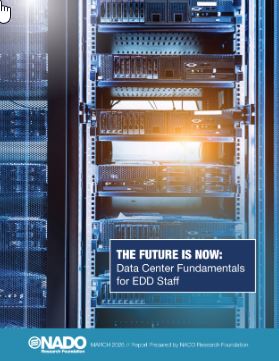
The Future is Now: Data Center Fundamentals for EDD Staff
As counties, towns, and cities across the country explore how to manage new demand for data centers, Economic Development Districts (EDDs) can serve as important partners in the decision‑making process. This report provides EDD staff with an overview of data center basics, the variety of local and regional impacts to consider, and the roles EDDs are increasingly playing as communities respond to data center development. In general, these roles revolve around advising local communities, convening regional conversations and planning efforts, offering zoning and land use guidance, providing grant‑writing expertise, and supporting workforce and training initiatives.
| | |
FOR IMMEDIATE RELEASE
Bipartisan Legislation Introduced to Expand Access to Federal Data for AI Innovation
Washington, D.C. — U.S. Senators Ted Budd (R-N.C.) and Andy Kim (D-N.J.) have introduced the Artificial Intelligence Ready Data Act, bipartisan legislation designed to modernize access to federal government data and support the development of advanced American artificial intelligence (AI) systems.
The legislation aims to improve the accessibility, quality, and usability of federal datasets, enabling researchers, developers, and businesses to better leverage government data for AI applications. With the federal government maintaining one of the largest and most comprehensive collections of data in the world, the bill seeks to unlock these resources to drive innovation, economic growth, and job creation across key sectors.
Under the bill, the National Institute of Standards and Technology (NIST) would solicit input from industry and the public on how to enhance federal data for AI use. Based on this feedback, NIST would develop standards and guidelines to ensure data is structured, reliable, and interoperable. The White House Office of Science and Technology Policy (OSTP) would then direct federal agencies to implement these standards.
The legislation also includes provisions to support the National Oceanic and Atmospheric Administration (NOAA) in integrating AI and machine learning into weather forecasting and modeling, further strengthening the nation’s technological capabilities.
The Artificial Intelligence Ready Data Act has received support from leading organizations including Google, Siemens, Snorkel AI, and the North Carolina Chamber, reflecting broad industry recognition of the importance of high-quality, accessible data in advancing AI.
By modernizing federal data infrastructure and promoting responsible data use, the legislation aims to ensure the United States remains at the forefront of global AI innovation while maintaining transparency and public trust.
| | |
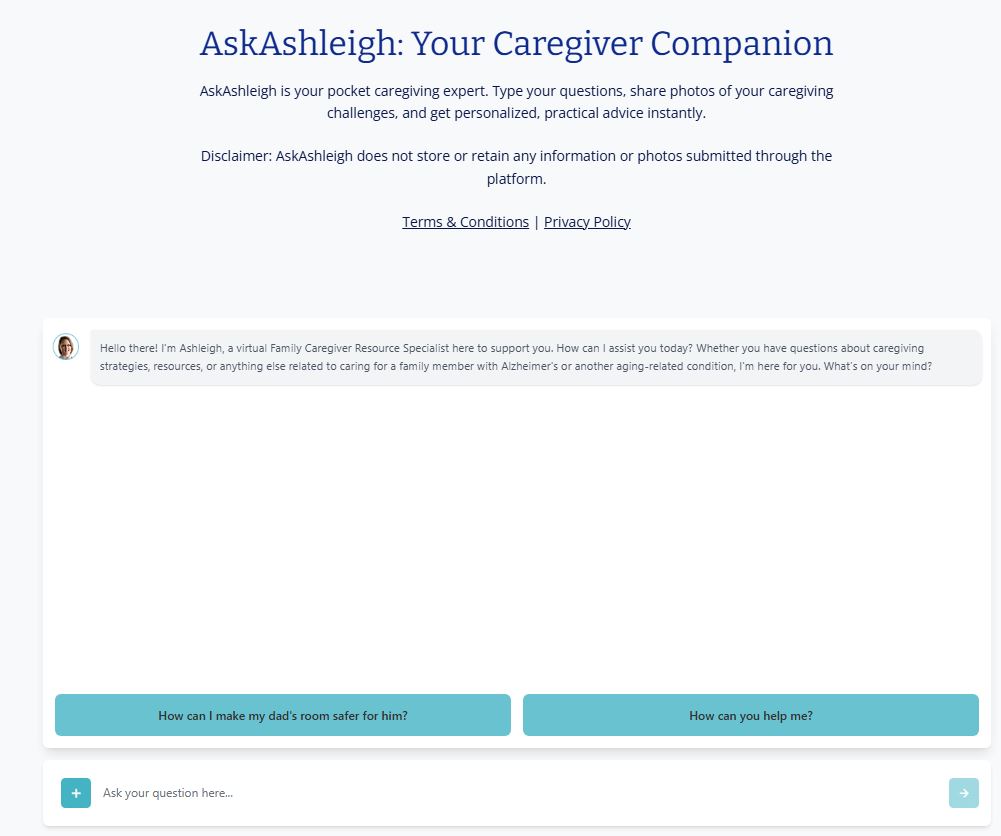
AskAshleigh is the first virtual caregiver integrated into an Area Agency on Aging in the nation. AskAshleigh provides immediate, personalized support with deep local knowledge, accessible at any hour of the day or night. Imagine having the expertise of Family Caregiver Resource Specialists right at your fingertips, helping you navigate caregiving challenges with real, actionable advice.
Caregiving is often an unexpected journey, filled with late nights, endless questions, and emotional challenges. For many families, especially those caring for loved ones with dementia, the journey can feel overwhelming and isolating.
This isn't just technology; it's a promise that no caregiver has to navigate this journey alone. For residents of Edgecombe, Halifax, Nash, Northampton, and Wilson counties, AskAshleigh is ready to provide the support you need.
Learn more: https://ucpcog.org/askashleigh/
| | Funding Opportunites and Resources | | |
Each year, the Golden LEAF Foundation invites organizations from counties from a different Prosperity Zone to participate in our $11 million Community-Based Grants Initiative (CBGI). The process is competitive, but organizations from all counties within the Prosperity Zone will have an opportunity to apply.
The CBGI is designed to identify projects with the potential to have a significant impact. It is a focused process with grants targeted toward investments in the building blocks of economic growth. Funds are limited to projects that address job creation and economic investment, agriculture, and workforce preparedness.
Available Funds Eligible Entities Process Regional Projects
A total of $11 million is available to support projects in the region. Awards are limited to no more than three projects in any county and may total no more than $1.5 million in any county. Not all proposals will be funded and there is no assurance that there will be a funded project in every county. Funds may also be awarded for regional projects (see information below), which will not count toward the limit of projects in a county, but regional projects are funded through the overall $11 million program budget.
Counties from the North Central Prosperity Zone are invited to participate in our Community-Based Grants Initiative (CBGI). The counties in the North Central Prosperity Zone are Chatham, Durham, Edgecombe, Franklin, Granville, Harnett, Johnston, Lee, Nash, Orange, Person, Vance, Wake, Warren, and Wilson.
| | |
USDA and EDA Update Resources in Joint Guide to Boost Economic Development in Rural Communities
The Stronger Together: Federal funding and planning opportunities designed to promote sustainable economic development in rural America guide has been updated to provide a handy summary of EDA and USDA Rural Development programs that can be used to support common rural development strategies
| | |
Digital Skills Training Available to Local Government Personnel
Computer Skills Training Available to Local Government Personnel
Get free training and a free laptop! A free self-paced training offered through UCPCOG includes internet basics, email, Microsoft Word, Excel, social media, career searching, tele-health and more.
Upon successful completion of the 17-module Northstar training, trainees receive a certification of digital skills, and a free laptop from the Kramden Institute.
UCPCOG is pleased to extend this training program to all member governments.
Everyone is eligible:
- Employees of local governments
- Local elected officials
- Local appointed board members
UCPCOG will help set each trainee up in Northstar and provide assistance as needed.
Northstar is a self-paced, virtual training portal. The online modules can be done at work or home. Each module may take about an hour to complete, depending on the self-paced timing.
The trainings are a good refresher or first course in computer skills. They give staff and officials the training necessary to use computers and online resources safely and efficiently.
Contact Betsy Kane (BKane@ucpcog.org) for more information on how to get started.
The Digital Economies Project, funded by NC Department of Information Technology, is a collaboration between UCPCOG and the three local community colleges (+ CADA & AMEXCAN) to train community members on digital skills using the Northstar Digital Literacy platform.
| |
Trump Administration Announces Latest Action to Address Diesel Exhaust Fluid (DEF) System Complaints, Saves American Farmers and Truckers Over $13 Billion Annually
WASHINGTON – Today, at the White House Great American Agriculture Celebration, President Trump announced another decisive action U.S. Environmental Protection Agency (EPA) Administrator Lee Zeldin has taken to address nationwide concerns from farmers, truckers, motor coach operators, and other diesel equipment operators regarding Diesel Exhaust Fluid (DEF) system failures by removing the DEF sensor requirement for all diesel equipment. EPA understands that sudden speed losses and shutdowns caused by DEF system failures that compromise safety and productivity are unacceptable and problematic. While EPA continues to pursue all legal avenues to address Americans’ complaints, today the agency is implementing another part of Administrator Zeldin’s plan to help keep American operators from losing days in the field or on the road because of faulty DEF systems. EPA’s new guidance, which removes DEF sensors, will provide immediate relief and save billions of dollars in repairs and lost productivity. According to the U.S. Small Business Administration (SBA), this guidance will save farmers $4.4 billion a year and this action will provide $13.79 billion a year of savings to Americans.
| | |
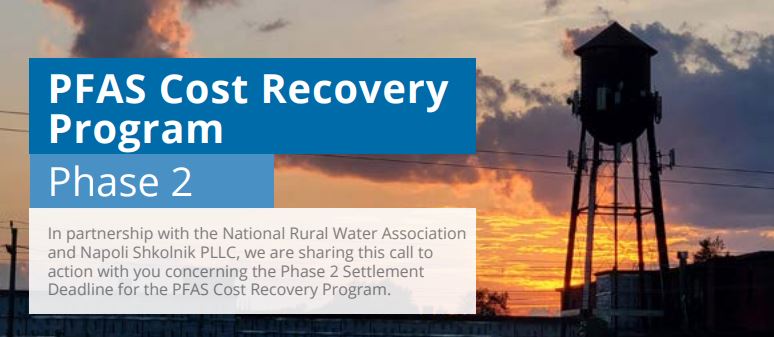
PFAS Cost Recovery Program: Phase 2 Is Open
Deadline to register: July 12, 2026
In partnership with the National Rural Water Association (NRWA) and Napoli Shkolnik PLLC, we are sharing this important update: Phase 2 of the PFAS Cost Recovery Program is now open. This program provides public water systems with access to unrestricted settlement funds to help offset costs associated with PFAS contamination.
Why Act Now?
- $15.4 Billion Settlement Available for PFAS detections and contamination.
- No cost to register – your utility pays nothing unless funds are recovered.
- Phase 1 has ended; Phase 2 covers systems that tested after June 22, 2023.
- Deadline to register: July 12, 2026.
Who Is Eligible?
Any public water system that has detected ANY PFAS chemical at any level is eligible. This includes all 29 PFAS compounds listed in the UCMR5 monitoring rule.
How Much Will My Utility Receive?
Awards are based on:
- Level of PFAS detection
- Compound detected
- Maximum daily flows
- Funds are unrestricted—your utility decides how to use them. No approvals or reporting requirements.
Read more…
| | |
Have you received a Closeout Notice from Treasury?
“Closeout Notices” are being emailed by the US Treasury to some local governments for ARPA SLFRF Funds. The email notice lets you know you have the option to close out your ARPA funds. If you are ready to close out:
- First, log in to your Treasury portal using your existing ID and login credentials.
- Then follow the straightforward steps to complete your close out certification. It does not take long.
- Keep a copy of your work for your ARPA records.
The only local governments receiving these notices will be those that indicated in their last year’s (April 2025) Treasury Report that they have fully expended their ARPA funds and are ready to close out.
According to the email from Treasury: “Treasury encourages your community to utilize the resources below to successfully close out the SLFRF award as soon as possible. Recipients who initiate the award closeout in the portal are no longer required to submit Project & Expenditure (P&E) Reports. Note: Recipients who do not initiate program closeout are required to continue to submit required reports”
If you have received a Closeout Notice, and would like assistance with logging in to the Treasury portal and/or closing out your funds, feel free to reach out to Betsy Kane at bkane@ucpcog.org .
| | |
Visit the Carolinas Development Assistance and Siting Hub!
NCCETC leads the Carolinas Development Assistance and Siting Hub (DASH) project as part of a U.S. DOE-funded program designed to support large-scale renewable energy development. The new hub will launch this week, featuring an ordinance database, numerous resources, upcoming events, and an extensive FAQ section. Be sure to check the website later this week to access the new features!
Visit the Website ➔
| |
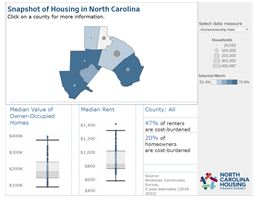
A Look at Housing in North Carolina
From NC’s Housing Finance Agency, the NC Housing Snapshot is an interactive map that provides the latest housing-related data by county.
· How many residents are cost burdened
· Age of each county’s housing stock
· Population change and
· Other information that is vital to understanding the need for affordable housing across the state.
| | |
Whether you're planning for compliance, pursuing sustainability goals, or seeking long-term cost savings, Government Fleet's Guide to Fleet Electrification offers practical, step-by-step guidance tailored to public sector operations.
This comprehensive resource covers:
- Cost-benefit analysis and TCO for government applications
- Infrastructure planning for municipal and agency fleets
- Accessing federal, state, and manufacturer incentives
- EV suitability assessments and operational readiness
- Charging strategies and long-term planning
Public fleets face unique challenges—from regulatory pressures to complex vehicle use cases. This guide is built to help you make informed, strategic decisions that balance policy, budget, and performance.
| | |
Announcing the
NC Resilient Communities
Planning Guide!
We are pleased to announce the publication of NCORR’s newest resource:
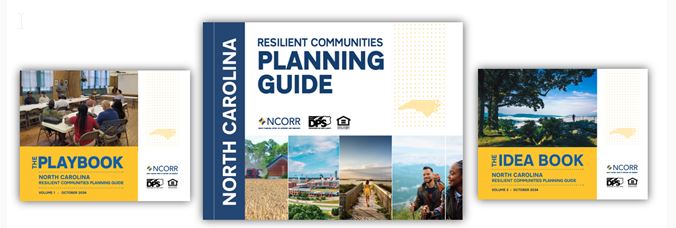
The NC Resilient Communities Planning Guide!
The Guide is a collection of resources tailored to help North Carolina communities develop a resilience plan or integrate resilience into existing planning documents, such as a comprehensive plan or strategic plan. Because each community’s needs are unique, the Guide doesn’t offer a fixed approach. Instead, it provides users with a set of considerations, options to up- or down-scale its approaches and examples of other communities’ actions.
The Guide consists of two volumes: the Playbook and the Idea Book.
The Playbook takes users through the stages of resilience planning, from preparation through plan implementation. Each section of the Playbook includes checklists and questions for consideration, to allow the user to customize their planning process to their organization’s specific needs. While the target audience is local governments, the content will also help community organizations or regional groups craft resilience strategies.
The Idea Book provides insight into strategies that advance resilience across 14 categories. These categories include environmental topics, like Stormwater Management and Flooding; social topics like Communication and Education; and economic topics like Business and Local Economy. For each topic, we explain its connection to resilience, demonstrate strategies for increasing resilience in this area and offer an in-depth case study of a community’s resilience project.
| | |
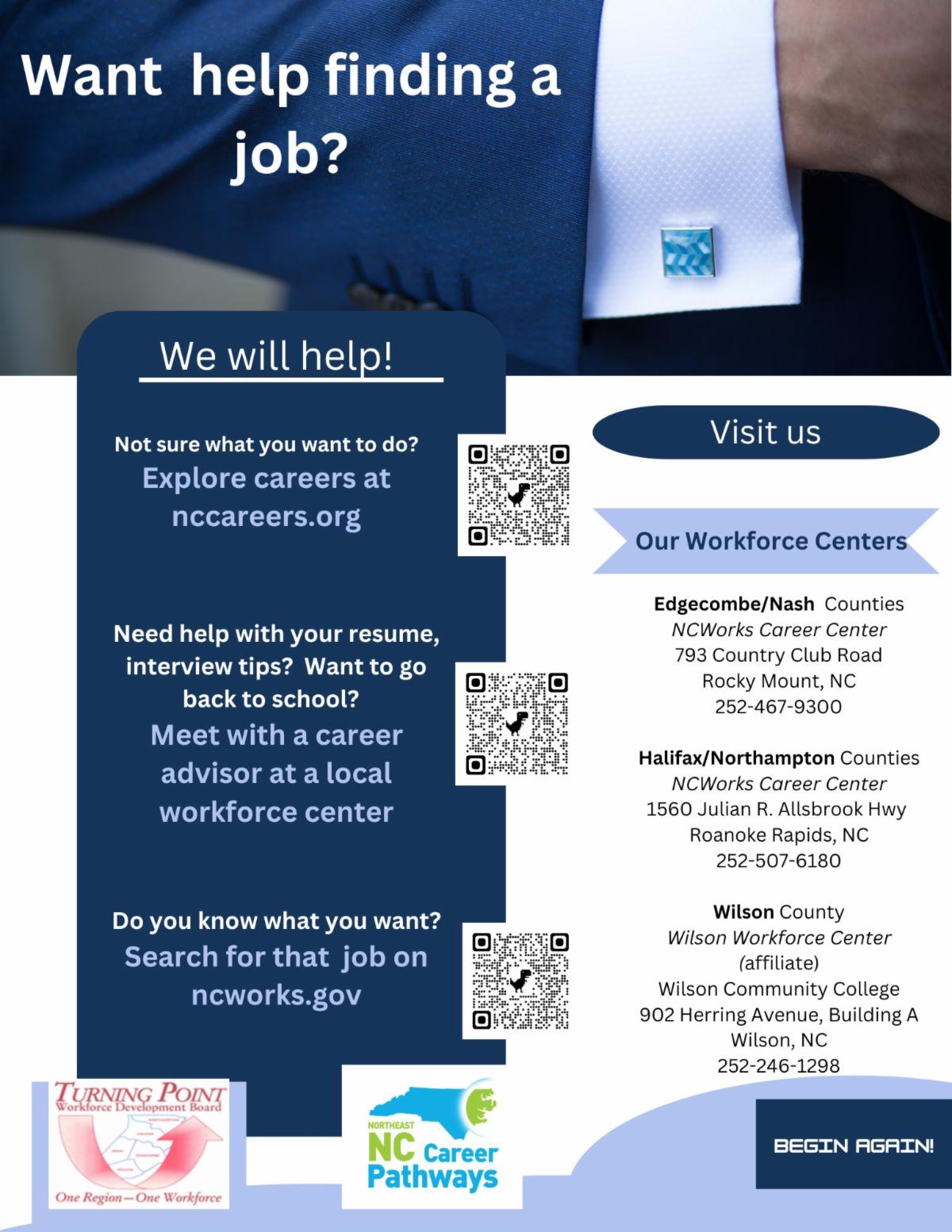
NC Works Career Centers assists both JOB SEEKERS AND EMPLOYERS; Feel free to reach out to the Centers in the Turning Point Region and let a team member know how they can assist! Occasionally, the NC Works Centers (Rocky Mount and Roanoke Rapids share information about events and services), however, feel free to also follow the State's general NC Works page for general information that is statewide, regarding what basic job seeker and employer services are available and what Career Centers basically offer daily; some services are set on a different schedule such as resume writing courses and other partner-offered services throughout the week, however in an effort to assist customers, this information can be shared, just call or visit! The Wilson Workforce Center, powered by Turning Point Local Area is also a resource, located at Wilson Community College campus.
NC Works Career Centers:
NCWorks Career Center, Rocky Mount
NCWorks Career Center, Roanoke Rapids
| | |
Get off the List (GOTL) Initiative Success Story
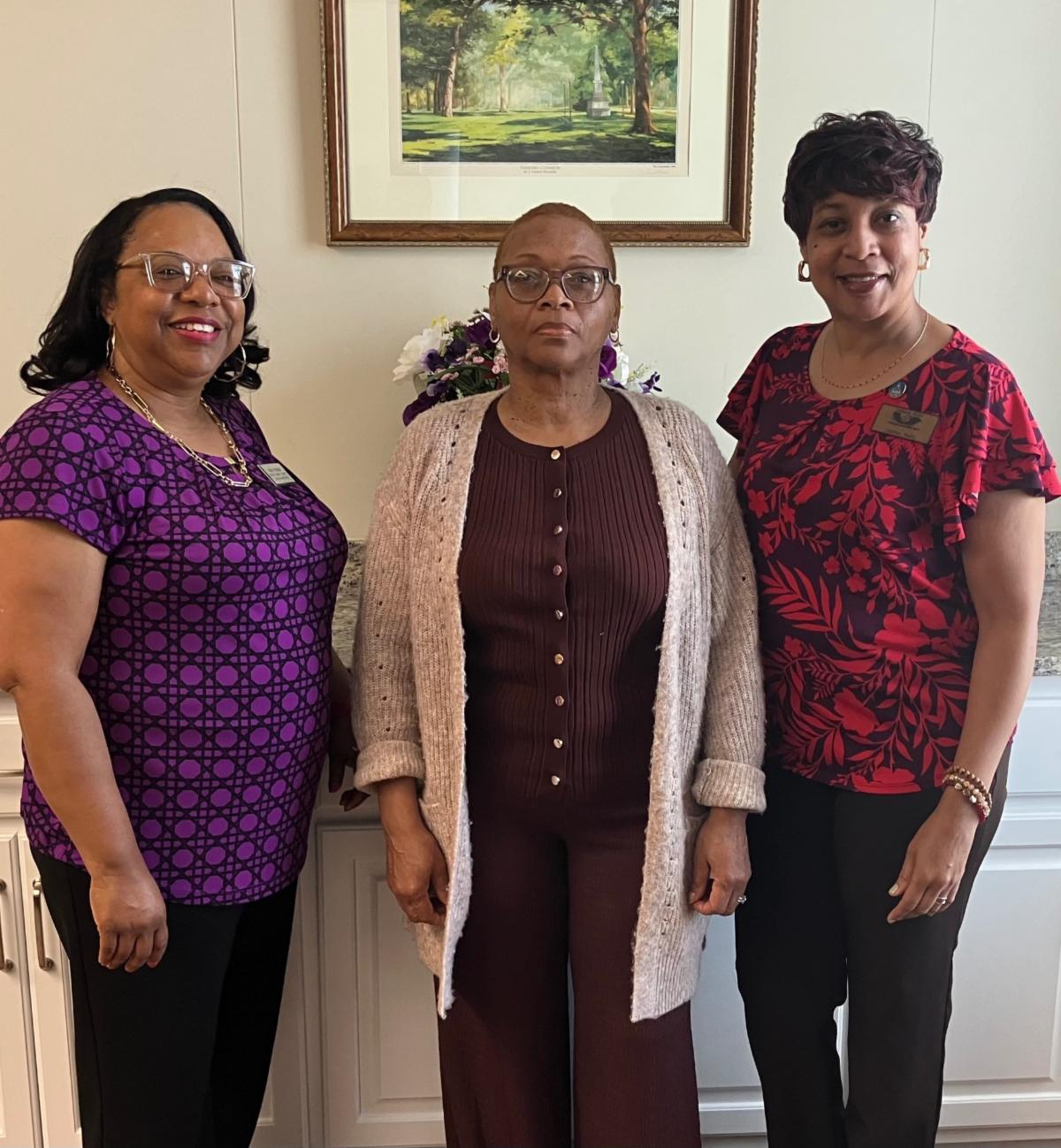
And our GOTL Initiative is showing the success of a client that received a scholarship for support !! Why?? To finish her studies at ECC started a few years ago! And thanks to the successful grant award of Turning Point WDB and our wonderful partner of Edgecombe County, work with their Career Navigator, Tracy Puddy introduced this ambitious lady to us. Ms Sandra, who we met in 2025, attended a workforce readiness session with our Engagement Coordinator, met employers and other agencies for resources as needed, all coordinated by our Board staff and the County’s Navigator. After we chatted with ECC, confirmed what courses were missing towards completion of business studies, we provided support! To come back later working towards her goal after some obstacles, it took spirit! We are working to get her off the list, skilled up and ready for her next step. Well done this quarter Ms Sandra! Our Business Services Manager and the Edgecombe County Navigator say thank you for the opportunity to chat and snap a pic during our follow up! Stay tuned more to come- as we follow her journey.Thank you Ms Sandra for allowing us to share your success!
| |
New Mobile Crisis Dispatch Program to Improve Response for People Experiencing a Mental Health Crisis
PRESS RELEASE — The North Carolina Department of Health and Human Services today announced a new pilot program to improve Mobile Crisis Teams’ response when someone experiencing a mental health crisis calls for help. The $1.5 million investment to Trillium Health Resources establishes a real-time dispatch process that streamlines response to individuals in crisis wherever they are.
The North Carolina Department of Health and Human Services today announced a new pilot program to improve Mobile Crisis Teams’ response when someone experiencing a mental health crisis calls for help. The $1.5 million investment to Trillium Health Resources establishes a real-time dispatch process that streamlines response to individuals in crisis wherever they are.
Mobile Crisis Dispatch (MC Dispatch) is now operating in 10 counties in eastern North Carolina. The initiative is directly in line with Governor Josh Stein’s Executive Order 33 that calls on NCDHHS to strengthen the mental health crisis system. MC Dispatch will get people directly into mental health care with a mobile response team, freeing up law enforcement resources.
"This initiative will connect people in crisis to the care they need by making sure they receive the appropriate level of response more quickly and efficiently," said NC Health and Human Services Secretary Dev Sangvai. "Streamlining this process will help achieve our goal of creating a stronger coordinated system of care."
"During a mental health crisis, seconds can make a difference," said Kelly Crosbie, MSW, LCSW, Director, NCDHHS Division of Mental Health, Developmental Disabilities and Substance Use Disorders. "This new platform will help mobile crisis teams respond quicker. These highly trained counselors can come to a location of the caller’s choosing and will ensure they get the help they need."
MC Dispatch is managed by REAL Crisis Intervention, Inc., North Carolina’s 988 service provider. When someone calls the 988 Suicide and Crisis Lifeline experiencing a mental health crisis that requires Mobile Crisis response within the pilot region, MC Dispatch will either send a mobile crisis team or connect the caller with a provider and other local resources. MC Dispatch is partnering with mobile crisis teams from Integrated Family Services and Easterseals PORT Health in the pilot counties.
The MC Dispatch platform will track key performance metrics to assess response efficiency and service accessibility including:
- Response times and adherence to service-level agreements (SLAs)
- Client demographics and payer information
- Request resolution outcomes
- Travel distances for responses
- Disposition outcomes and follow-up actions provided
The ten counties involved in the first phase are: Duplin, Edgecombe, Greene, Halifax, Lenoir, Nash, Sampson, Warren, Wayne and Wilson counties. The pilot is expected to be operational in 27 eastern North Carolina counties by the end of April with the ultimate goal of expanding it statewide. MC Dispatch is one part of NCDHHS efforts to support a coordinated system of mental health care that makes services easy to access when and where they are needed.
This investment is part of the NC General Assembly’s historic $835 million investment in mental health in 2023, with funds targeted for expanding and improving mental health care in North Carolina.
| | |
Join a short virtual session we’re hosting on April 16 at 2:00 PM ET, focused on something many of you are seeing every day:
More older adults are struggling with loneliness, depression, and anxiety — but most still don’t access care.
This session is designed for professionals working with older adults across community-based organizations, aging services, and care networks.
We’ll be sharing:
- What we’re seeing across Medicare populations today
- Where older adults tend to fall through the cracks
- Practical ways organizations are helping increase access to behavioral health
- How this support can improve engagement, wellbeing, and overall outcomes
This is a no-cost session, and meant to be practical, not theoretical.
You can join here:
https://luma.com/ut96lt8x?tk=pxuw89
If helpful, you can also visit our website where we share more about how we support older adults, along with resources you can use with your community:
www.totallife.com
| | |
Now Recruiting: NC Senior Tar Heel Legislature Alternate – Edgecombe County
Do you have a passion for advocacy and improving the lives of older adults? We are seeking an Alternate Representative for Edgecombe County to serve on the NC Senior Tar Heel Legislature (NCSTHL).
NCSTHL is made up of volunteers age 60+ who raise awareness of issues affecting older adults and encourage the NC General Assembly to address gaps and shortages in supportive services. Who better to speak on behalf of older adults than older adults themselves?
NCSTHL meets 3 times a year: March, June, and October
Interested or want more information?
Contact Ty Whitaker, AAA Liaison to NCSTHL
252-234-5963
twhitaker@ucpcog.org
Your experience matters. Your voice matters. Help shape a better future for older adults in North Carolina.
| |
Healthy Aging Highlights
Staying active is an important part of healthy aging! To help those interested in learning more about exercise, NIA created an Exercise and Older Adults Toolkit to share reliable health information, research news, infographics, publications, and videos that highlight the benefits of physical activity. The materials are designed for older adults, caregivers, and health care providers.
Explore and share the toolkit to help encourage safe, enjoyable exercise at any age
| |
Upcoming School of Government Courses
Leading with Respect for Local Elected Officials
April 22, 2026 | Chapel Hill
9:00am-4:00pm | Course Cost: $225
Building and sustaining mutual respect is a hallmark of an influential leader and a fundamental tool to help you serve and support your community. How can elected officials feel and convey genuine respect for their fellow board members, staff, and citizens – especially in the face of contentious public issues or profound ideological differences? Do you have to agree with someone’s viewpoint in order to show them respect? Is respectful disagreement possible? How do we get there?
This practical workshop will help elected officials learn to navigate the rich terrain of differing opinions to build productive relationships with others on their boards and in their communities.
What You'll Learn:
- Explore the meaning and layers of respect
- Recognize the power that derives from conveying genuine respect for others
- Practice communicating respect across differences
- Strengthen unique strategies for exacting respectful treatment from others
Click here to see the course page and register
| | |
Performance Management in Purchasing and Contracting
May 12, 2026 | Online
1:00pm-5:00pm | Course cost: $325
This course focuses on converting performance information into decisions that enhance organizational outcomes. We will review performance management topics including goal setting, measurement, analysis, decision-making, and best practices. This course offers purchasing and contracting professionals the tools to use performance metrics to make evidence-based decisions in their organizations. We will employ accessible step-by-step techniques to demystify the performance management process for public managers and present flexible, pragmatic methods to implement these systems.
What You’ll Learn:
· Gain an understanding of performance management in purchasing and contracting
· Analyze performance data
· Connect performance information with organizational strategy
· Use performance data for organizational learning and improvement
· Mitigate the unintended consequences of performance management
· Apply best practices in designing and implementing performance management systems
Click here to see the course page and register
Public Executive Leadership Academy (PELA)
July 12-17 and August 2-7 2026
Chapel Hill
Course Cost: $5,400 (includes hotel, parking and most meals)
Applications open until May 15, 2026
In an intensive two-week residential program, participants will learn more about themselves as leaders and gain skills to lead and manage change in their communities. Participants choose a “real world” project for leading regional, community, or organizational change and develop a plan, in consultation with their learning teams, for carrying it out. This project will integrate and apply the leadership knowledge and skills acquired during PELA.
Who Should Attend: Municipal and county managers, their assistants, and key department heads.
This course requires a minimum of seven years of supervisory experience in a local government-at least five years of which must be as a municipal or county manager (CAO), assistant/deputy manager, or department director.
What You'll Learn:
· Gain skills in facilitation, media relations, and emotional resiliency
· Understand their leadership approach and how it affects their interaction with stakeholders, staff, and elected officials
· Create a personal leadership development plan that will incorporate feedback from faculty, peers, and a leadership self-assessment
This course is sponsored by NC City and County Management Association.
| | |
April and May 2026
1:00pm - 4:30pm | Course cost: $115
*See the course page for group registration rates
In April and May, we will be in regional locations across the state to lead half-day workshops on legislative zoning decisions. These workshops will focus on the roles and responsibilities of land use planning, as well as the procedures and considerations for legislative zoning decisions like rezonings and zoning text amendments.
Who Should Attend: Members of planning boards and elected boards, as well as the staff who serve them.
AICP credit available.
Affordable Housing Seminar: Tools, Strategies, and Case Studies for Local Government Leadership
May 7, 2026 | Marion
10:00am - 5:00pm | Course Cost: $270
Open to professionals and elected officials
This interactive in-person seminar is designed for those who are setting strategic direction around affordable housing. The seminar will focus on local government support and public-private partnerships for workforce residential housing.
What You'll Learn:
- Strategic approaches to affordable housing
- Affordable housing tools and financing mechanisms
- How to assess local housing needs
- Case studies and exercises
- Immediate next steps
This course has been approved for 5.5 Certification Maintenance (CM) credits through the American Institute of Certified Planners (AICP).
June 9, 2026 | Online
9:00am-4:00pm | Course Cost: $275
This course is a primer on evaluating proposed and existing programs for local governments and discerning their efficacy and viability within a community.
Throughout the one-day workshop we will refer to your own situation and you will be asked to apply the ideas to the program, policy or process you have, or are in the process of evaluating in your own organization. The goal of the workshop is to let you start with an idea and leave with a jump start on your final report.
This course fulfills the evaluation requirement for the CLGBO Certification and NCLGBA Certification and continuing education.
July 27-30, 2026 | Chapel Hill
Course cost: $715
The course is a comprehensive educational experience that integrates theoretical and practical perspectives and provides participants with the foundation needed to organize, plan, and implement economic development programs. Expert instructors will cover trends, strategies, and the core tools of the trade.
Who Should Attend: Economic development professionals employed by public, nonprofit, and private organizations. It is appropriate for individuals new to the field and also more experienced professionals seeking to update their knowledge and skills.
What You'll Learn:
- Trends in economic development
- Ethical dilemmas
- Strategic planning
- Workforce development
- Business attraction and site selection
- Business retention and expansion
- Entrepreneurship
- Development finance
- Real estate development
- Community development
- Managing EDOs
The course is accredited by the International Economic Development Council (IEDC) and counts toward the CEcD certification.
| |
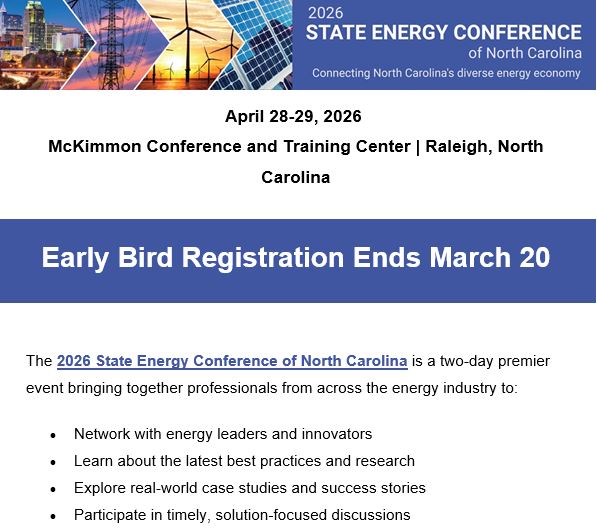
Keynote Topics Announced
Meeting NC Clean Energy Goals in an Era of Load Growth
The most recent forecasts predict that demand for electricity in North Carolina will grow anywhere from 16% to 60%. How the state responds to this wide range of possibilities will directly impact whether we meet statutory carbon neutrality goals by 2050. In this panel, we will hear from regulators and lawmakers about how they are approaching the task of meeting NC electricity demand with an eye toward reducing emissions.
The Squeaky Clean Energy Podcast: Containing Rising Electricity Costs while Maintaining Reliability
Over the past few years, electricity ratepayers across the country have seen a departure from the trends that defined much of the 2000s and 2010s - stagnant load growth and minimal cost increases. In North Carolina alone, electricity costs have risen on average by more than 23% over the past five years. This relatively recent trend does not appear to be slowing based on current proceedings in front of the NC Utilities Commission. Join us for this keynote plenary panel as we talk about the reasons for rising electricity rates, the tactics utilities are taking to maintain reliability and affordability, and the policy solutions under consideration across the country.
Building North Carolina’s Energy Future: How We Do Big Stuff
As questions of load growth, reliability, affordability, and business development come to the forefront in North Carolina and around the country, we will hear from the experts who build big things. This panel will feature business leaders to discuss how utilities and developers are building new energy infrastructure to meet the challenges of a changing grid.
| |
121 W. Nash St. Wilson, NC 27893
252-234-5952
| | | | | |