|
Dear Friends and Neighbors,
Let's begin today with some good news.
Following the devastating wildfires of 2020, Oregon and the Federal government passed legislation that said compensation received after a natural disaster would not be taxed.
That’s no small matter. Imagine, horribly, that you lost your home and received a million-dollar court award from the people judged to have caused the fire. You would then normally pay 40% to your lawyers. And then, because you are suddenly in the highest tax bracket of your life, you would owe 30% to the Federal government. That would leave you with about $300,000 to replace your home and rebuild your life.
While the Oregon law was permanent, the Federal law presumed all 2020 legal cases would be resolved in five years. And so it expired at the beginning of 2026.
People seeking compensation for wildfire losses in 2020 largely fell into two categories. Some sought negotiated settlements which often produced fewer dollars but did so more quickly. Others joined together into class-action lawsuits that promised larger awards but took much longer.
In 2023, a jury determined that PacifiCorp caused a substantial amount of damage related to fires in the Santiam Canyon, as well as fires near Chiloquin, Lincoln County and Eagle Point. PacifiCorp, the parent company of Pacific Power, was directed to pay more than $2.2 billion in damages to about 2,000 people. However, earlier this year, the Oregon Court of Appeals reversed the jury’s verdict based on a procedural flaw, upending six years of litigation and potentially jeopardizing wildfire survivors’ payments. That decision has now been appealed to the Oregon Supreme Court. They could overturn it, leaving the judgements intact, or sustain it, which means wildfire survivors would start the legal process again from the start.
Either way, those thousands of families have received nothing so far, and if they do, Federal taxes will again apply.
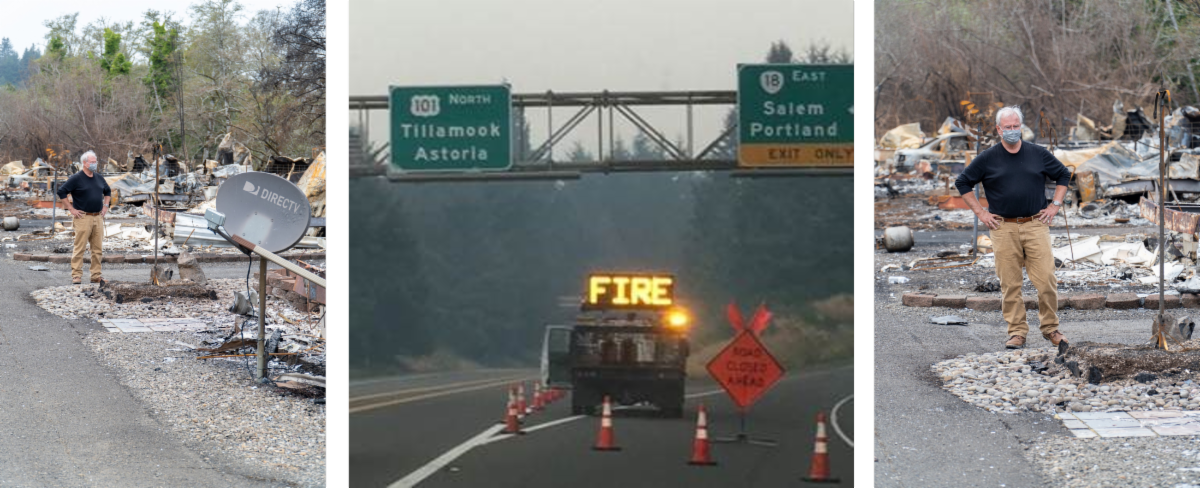
| | Before the area was reopened, I was able to visit the Echo Mountain fire zone along the Salem River Highway. | |
So now the good news.
In the final hours of work before members of Congress went on recess for five weeks, a bill backed by Oregon’s U.S. Sen. Ron Wyden to relieve natural disaster survivors from paying federal income taxes on their recovery settlements and lawyers fees passed against unexpected odds.
It allows disaster survivors to more easily deduct from their federal income taxes the cost of any uninsured or uncovered property losses and makes disaster settlement payments non-taxable, including any portion of awards that cover lawyers’ fees, living expenses, lost wages, or compensation for injury, death, or emotional distress.
In 2024, the Oregon Legislature unanimously passed Senate Bill 1520 ending state income taxation on settlements and lawyer fees for wildfire victims. I was a sponsor of that bill which was championed by survivors of the 2020 Labor Day Fires, some of which were found to be caused by Pacific Power electrical lines.
As the anniversary of the Labor Day fires approaches, you can drive through northern Lincoln County and still see the devastation—and the recovery. People are returning and rebuilding. Life goes on. But the dead trees and burn scars remain. And even on my own street where a third of the homes were lost and a third more were unlivable for years, a quarter of the lots destroyed are still vacant. For each home and each family, there is a story.
Fortunately, as of today, that story will not include a huge tax burden.
| | |
I’d like to spend the balance of this newsletter with information about developments and choices we face maintaining and improving our critical roads, highways and bridges. I’ve also included an important opportunity for you to add your own thoughts and priorities.
As co-chair of the budget committee that funds the Oregon Department of Transportation (ODOT), I’m working with a small group of Democrats and Republicans to prepare for the coming legislative session. As I have often explained, city, county, and state roads are primarily funded with gasoline taxes. And as people drive less, use more fuel-efficient vehicles, buy more electric vehicles, or use other transportation modes, those tax revenues have declined.
| | |
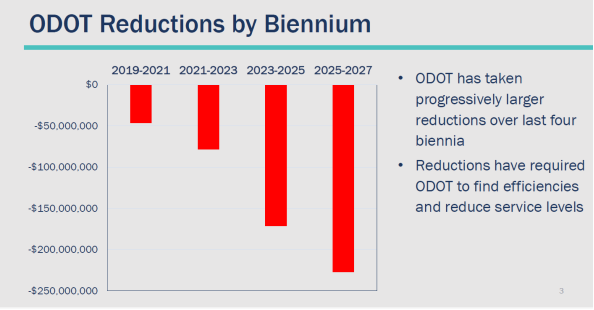
A recent meeting of the Oregon Transportation Commission reported that for the next two-year budget cycle, 2027-2029, ODOT is looking at a $200 million budget gap. That’s $200 million more on top of the more than $250 million cut made in the last long legislative session in 2025 that included Connect Oregon (ports and freight), Safe Routes to School (sidewalks and crossings), deferred repairs to seismically vulnerable bridges, and roughly $80 million achieved by leaving agency positions vacant.
Options before the Commission as they prepare new budget recommendations are to make additional cuts, redirect funding within ODOT’s budget, or seek new revenue.
Oregonians have made clear that they don’t want gas taxes increased. The legislative proposal for a six-cent increase was an unpopular short-term fix. I say “short-term” because gas taxes will continue to decline. Other options now being considered include increased registration fees and charging you for miles driven. (Tolling is no longer being considered.)
Most people writing me argue we should continue to trim the budget.
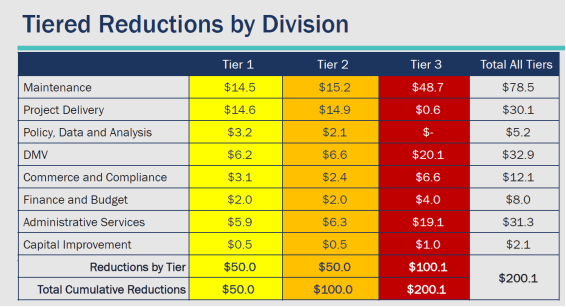
Budget reductions are often difficult. Generally we begin by looking at cuts that are tolerable (Tier 1), then difficult (Tier 2), and finally those with significant impacts on service and safety (Tier 3).
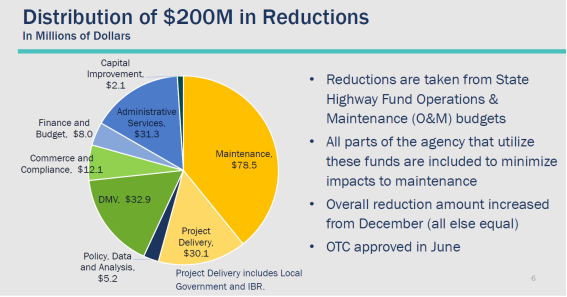
Here is what $200 million might look like:
| You can review the initial budget presentation to the Transportation Commission here. | | |
The proposed ODOT budget goes from the agency, to the Transportation Commission, to the Governor’s budget department, to the Legislative Fiscal office, and then to my committee before it is approved by the full Ways and Means Committee and legislative assembly. During the six-month long session, we might spend two weeks in committee reviewing performance and proposals together with a public hearing.
Normally we do not review budgets during the one-month short session in even-numbered years. There is a good reason we don’t normally budget in short sessions. Here’s one example.
We make budget decisions based on forecasts prepared by the state economists. They estimate how much money we have and we cannot spend more.
This year, however, we were required to “rebalance” the budget which is legislative language for “make more cuts,” because the gas tax increase was expected to fail during the May election. With only four weeks’ time, we were required to make hard decisions quickly.
So in February, we began the process of filling a $288 million gap in ODOT funding. We cut positions, delayed repairs, and cancelled projects. But at the same time, the legislature was not aware that there were signs that more money was being received in one account than the forecast had projected. That account received monies intended primarily to repair aging and unsafe bridges.
In mid-February, ODOT informed the non-partisan Legislative Fiscal Office that nearly $56 million might be available to offset anticipated budget cuts. The fiscal office didn't pass that information on to the legislature, because it had not been officially documented. The Transportation Commissions March 12 meeting came less than a week after the session wrapped up. At that meeting, the Commission formally approved updating ODOT's Bridge/Seismic and Preservation/Culvert funds to reflect the addition of the $56 million.
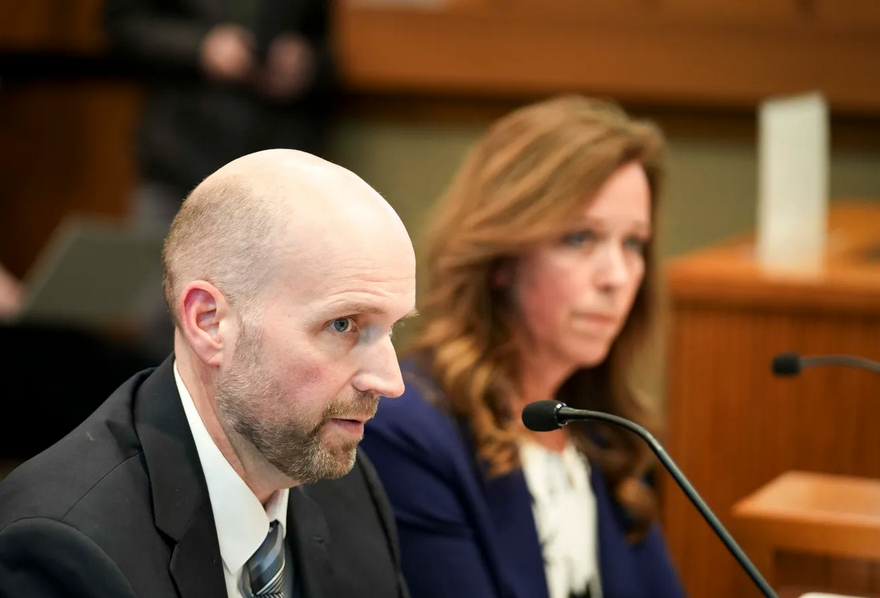
| | ODOT finance and budget administrator Daniel Porter speaks to legislators about the agency budget in February. Statesman Journal photo. | | |
If the information had come sooner or the session lasted longer, results would have been different. That money could have accounted for about 20% of the $288 million gap lawmakers ultimately patched by swapping funds around ODOT programs and holding positions open. Proper process was followed and the timing was absolutely imperfect. I told the Statesman Journal that covered this story, "By the time we found out that more revenue had come in than the forecast had predicted, we had adjourned and gone home."
Legislators could have moved the $56 million anywhere in ODOT's budget. We may still do so, as additional funding redirections are on the table as we search for solutions to the agency's anticipated $200 million need for the next budget cycle. Filling that budget gap could mean cutting 548 positions without more redirections or additional revenue.
At the same time, knowing about the money, I might have argued that we leave it in the original account. We can’t keep delaying repairs to unsafe bridges up and down the coast. That’s more important to me than bike paths and public transit in our larger cities. We don’t ride their busses. But they sure drive on our coastal roads…
| | |
Let’s now talk about two highway projects that are underway and could affect you.
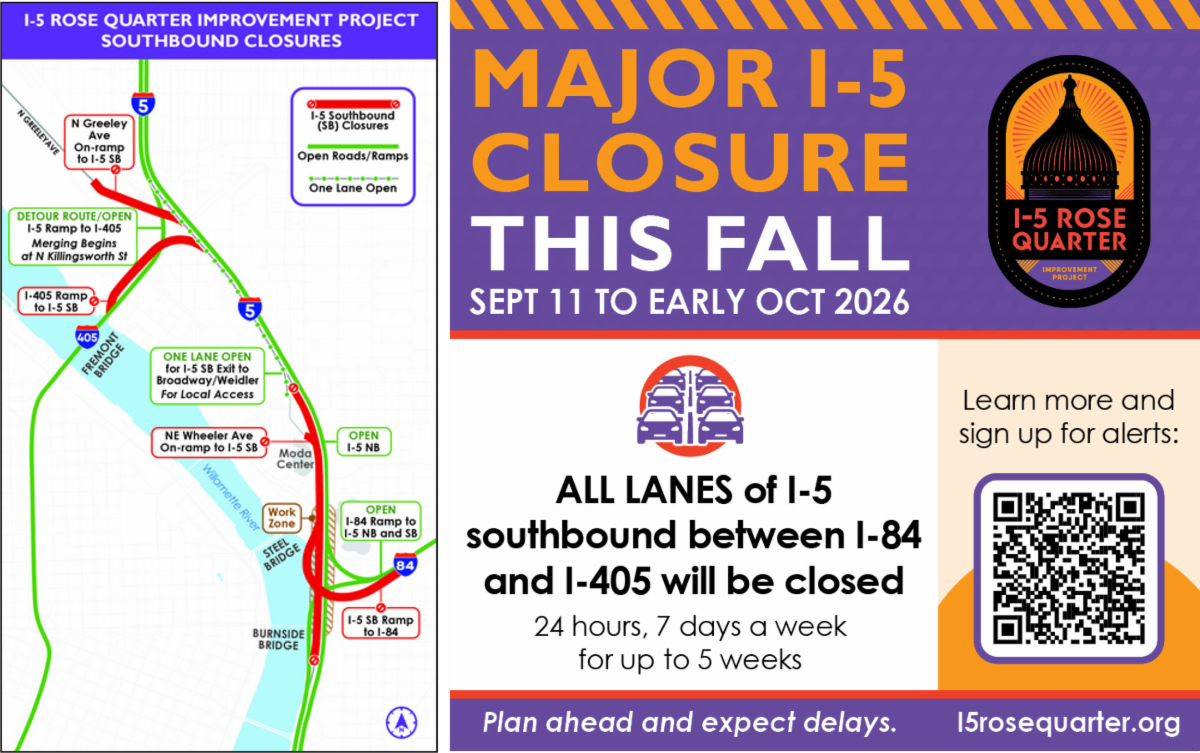
Planning to visit Portland next month? Starting September 11, all southbound lanes of Interstate 5 in Portland’s Rose Quarter will be closed for up to five weeks. The Oregon Department of Transportation is using this time to conduct critical repairs on a 2-mile section of the highway.
| | |
ODOT is encouraging long-distance travelers to take Interstate 205 through the region. Local traffic will be diverted to southbound I-405. During this closure, ODOT predicts travel times on I-5 near the construction site will take up to three times longer than normal.
The one-month closure is part of the state’s multiphase Rose Quarter Improvement Project, which aims to improve an area of the highway that has the highest crash rate of any urban interstate in Oregon and is the state’s No. 1 bottleneck.
ODOT says the total project has received about $480 million in funding so far. That includes money from state, federal and local agencies, grants, taxes and more. Construction for September’s closure will cost $75 million. The total cost of the overall project is currently estimated at up to $2.08 billion.
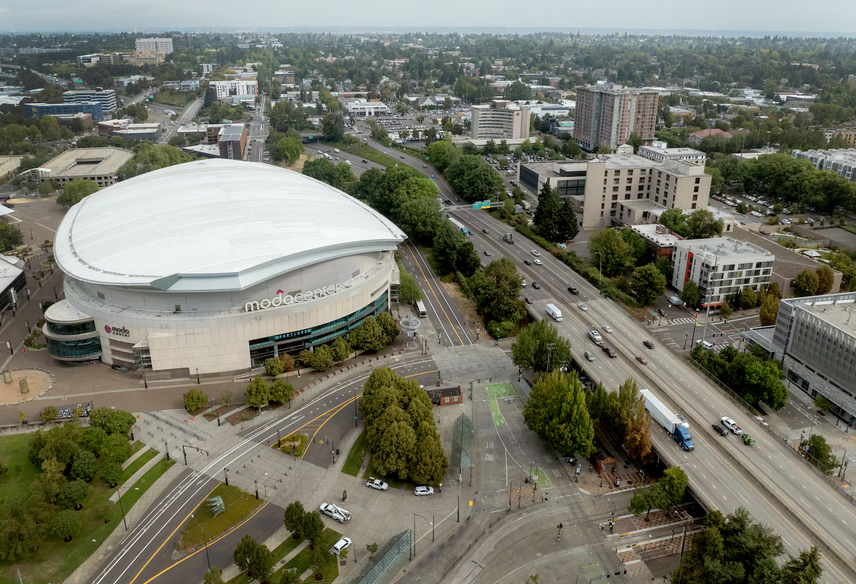
| | Aerial views of the area surrounding the Moda Center. Brooke Herbert / OPB | | |
A bit closer to home, I have an update on Highway 229.
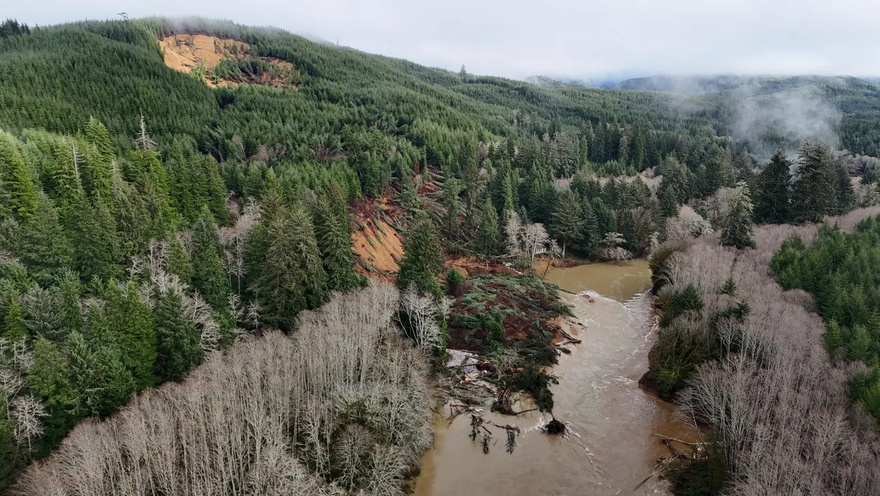
A massive landslide on December 12, 2025, destroyed multiple homes and a 1,000-foot section of the Siletz Highway at milepost 14 between Kernville and Siletz. The highway remains completely closed to through traffic with no local detour. As many as 400 vehicles a day used the highway prior to the December 12 landslide, according to state traffic data. Drivers who once needed only about 20 minutes to travel from U.S. Highway 101 through Kernville south to Siletz must now take a detour that more than triples that time.
The Oregon Department of Transportation is moving into the next phase of reconstructing the Highway and has been surveying the site to understand what is below the surface.
The new survey began in July and will finish this month, ODOT said. It will be followed by geotechnical drilling to install monitoring equipment so ODOT can see how the slide is moving while it plans a new highway. Most of the drilling will occur outside the highway right-of-way with permission from property owners.
The work is necessary for engineers to design a safe repair of the highway, ODOT said. The work will help them understand how deep the landslide extends, map the soil and rock layers, monitor ongoing ground movement and measure groundwater levels. Part of the ongoing work involves efforts by state highway engineers to explore what it might take to build a temporary road near the existing highway. Any temporary road is expected to be no larger than two lanes and wide enough only for cars, school buses and garbage trucks.
There is no estimated schedule for reopening the highway or opening a temporary access road, ODOT said. This is due to continued wet soil and unstable slopes within the landslide. A cost for the repair has not yet been determined, ODOT said. Some repairs are expected to qualify for reimbursement through the Federal Highway Administration's Emergency Relief Program.
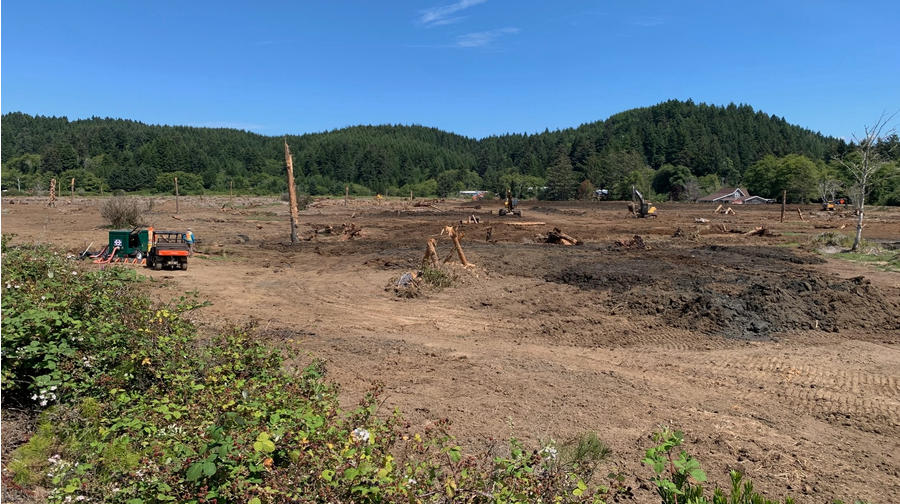
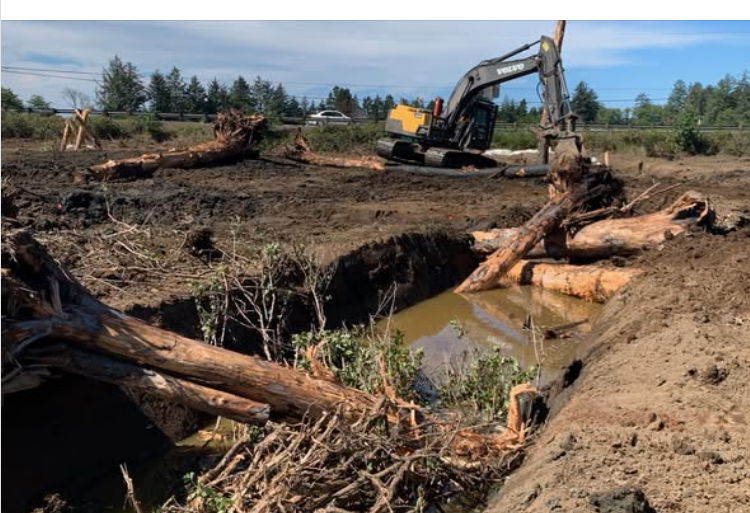
| | Aerial photos show the massive landslide on Highway 229 that slid into the Siletz River. ODOT photo. | I’ve also been receiving a number if inquiries about work occurring next to Highway 101 south of Lincoln City. I’ve read online that that crews have been clearing land to build a Costco. Please, don’t believe everything you see on the internet… | | Rumors abounded during the 45-day excavation of the tidal habitat restoration project along U.S. Highway 101 just south of Lincoln City that a new Costco was going to be built on the site. (Garret Jaros/Lincoln Chronicle) | | |
The recently completed construction phase that scalped a slice of land between the highway and South Drift Creek Road is actually part of a $1.5 million project to restore natural tidal wetland habitat on 37 acres of the 578-acre Siletz Bay National Wildlife Refuge. The primary goal of the project is to assist coho and chinook salmon recovery and bolster habitat for other native fish, birds and wildlife.
The project is spearheaded by the MidCoast Watersheds Council and the U.S. Fish and Wildlife Service, which say that beyond aiding fish and wildlife, the project delivers vital “ecosystem services” by establishing nature-based solutions to environmental challenges.
The revived wetlands will act as a natural buffer against shoreline erosion and flooding, absorb excess runoff, trap sediment, filter pollutants and store carbon. The restoration is also designed to withstand longer-term shifts in the environment.
Read more details and plans for the next phase in the Lincoln Chronicle.
| | |
Now an opportunity for you to comment.
Oregon’s transportation system includes everything from the edge of your driveway through city streets, county roads, sidewalks, bike lanes, intersections, state highways and interstates. It also includes the public buses and trains. Oregon’s transportation agencies at the city, county and state level are struggling to fund the maintenance, operation and improvement of our state’s transportation system.
Cars are using less gas to get around due to better fuel efficiency, resulting in lower gas tax revenue. Inflation means everything costs more these days. Transit agencies in cities big and small are struggling to grow ridership and facing rising operating costs, and many are being forced to cut service.
As the agencies, workgroups and legislators developing recommendations on how to maintain and improve the transportation system more efficiently, how Oregon should prioritize its transportation dollars, and what the most fair, affordable ways are to fund all of it, we would like to hear from you about what you think Oregon's transportation priorities should be.
- What should Oregon’s transportation priorities be?
- How should limited transportation dollars be spent?
- What reductions would impact you most?
These are not easy choices. For example, here is the first question: Facing limited budgets, state and local transportation departments need to prioritize their spending. Please rank the outcomes below to reflect your priorities.
- Preserve Key Assets: Bridges and roads are regularly repaired and replaced to ensure long-term performance of Oregon’s transportation system and avoid higher repair or replacement cost later.
- Maintain the System: Roads, highways and bridges are maintained well with crews fixing potholes, clearing debris, and plowing snow quickly.
- Reliable Public Transit: Public transit remains available and reliable for people who use it.
- Improve Safety: People can get where they need to go safely.
- Easier to Bike and Walk: Safe and comfortable options are available for people to walk and bike.
- Better Traffic Flow: Highways, roads and bridges are improved through construction projects to improve traffic flow.
Take the survey here.
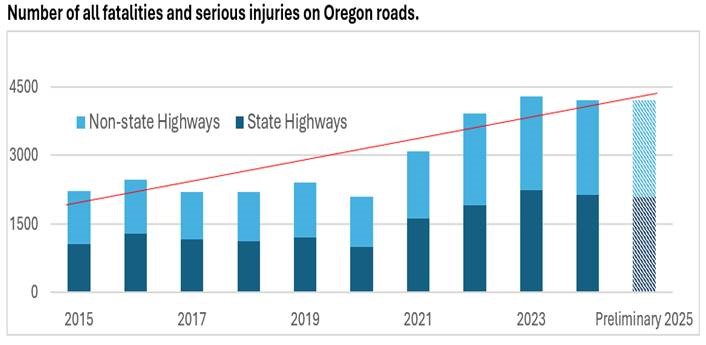
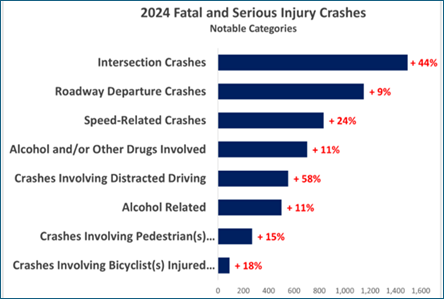
All of these investments affect road safety. And sadly, traffic fatalities continue to increase in Oregon.
| | |
It is looking like a slow week. I’ll be having lunch with the Chair of the Rebuilding Transportation Vision Workgroup and receiving a Legislative Wildfire Update.
Tuesday is committed to the Lincoln County Natural Resource Tour. This excursion is hosted by the Partnership for Lincoln Lands and Waters and is designed to educate Lincoln County citizens & decision makers about the local natural resource sector.
Later in the week, I’ll be the auctioneer for the Siletz Bay Music Festival gala. We hope to catch several performances of this remarkable festival this year.
Please enjoy the waning days of summer, and as you drive our large and diverse district, give some thoughts to our roads. I do every day.
| | |
Representative David Gomberg
House District 10
| | | | |