The Reliant Review
2nd Quarter 2021
|
|
|
Welcome to the Reliant Review, our quarterly newsletter. We hope this will provide insight into our philosophy and thought process when it comes to managing investments. Our goal is to provide concise, yet comprehensive commentary on the state of the financial markets, some of the moves we have made within the portfolios, and a few wealth management considerations for the near future. |
|
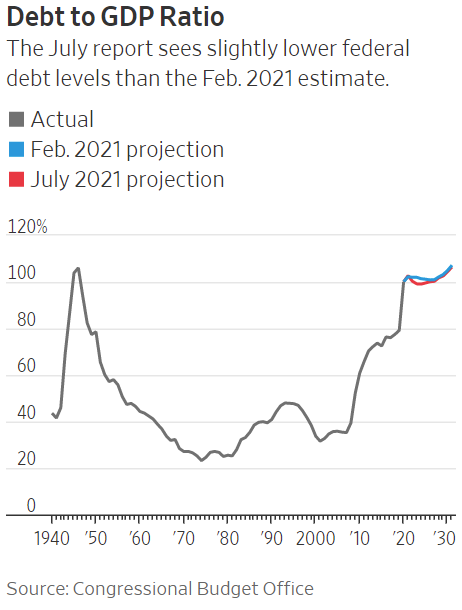
Inflation has dominated market headlines recently due to prices rising at their fastest rate in more than a decade. The number of companies mentioning the word inflation in their quarterly earnings calls also stands at a ten year high. Surely you too have felt at least some effects of widespread supply chain issues and more expensive fill-ups at the gas station. The Federal Reserve has argued that the inflation we are seeing right now is transitory—short lived and not a long-term fundamental shift—though it is hard to not at least be somewhat skeptical given the growth in the money supply since the start of 2020 and an elevated level of government spending to GDP not seen since the years following WW2.
Potentially contributing to inflation is the record number of job openings throughout the country. Roughly 9 million positions remain unfilled as the unemployment rate hovers around 6%. While normally disinflationary, the mismatch between employees and employers is leading to widespread wage increases. We believe there are several factors affecting the high number of job openings—lack of childcare, lingering health concerns, unemployment benefit payments—though all point directly to the fact that our economic recovery is not complete. So, the Federal Reserve will be in no rush to tighten their monetary stance of the last fifteen months.
|
|
Policies in Washington continually effect the financial markets, and we are actively following the ongoing negotiations surrounding infrastructure and social spending. It is important to note that while the direct results of spending at the federal level are likely to not be felt until 2022, almost all state and local governments are flush with cash after the previous pandemic recovery stimulus bills. Your portfolios are well positioned to take advantage of the more immediate infrastructure spending done by municipal and state governments. Hopefully, that includes finalizing the repairs to the I-40 bridge! |
|
Earnings have been better than optimistic estimates from the beginning of the year, and consumer sentiment in the 2nd quarter rose to its highest level since the outbreak of the pandemic. Despite the challenges in filling positions, many businesses have seen productivity improve with fewer workers. We will be paying close attention to the economy’s ability to continue output per hour gains, hopefully allowing profits and wages to rise together limiting longer-term inflationary pressures. |
|
Taking a Look at Some Stocks |
|
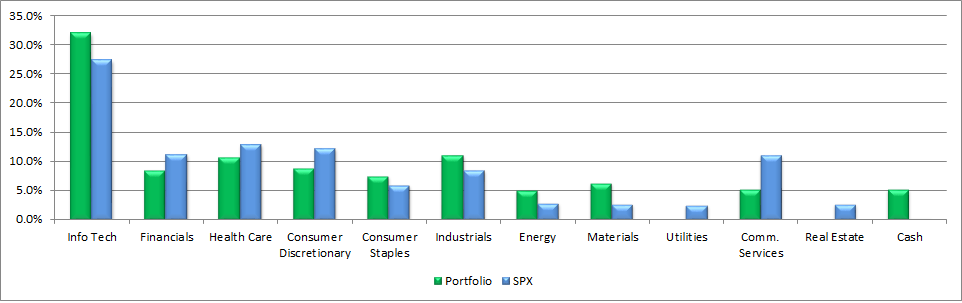
Reliant Strategic Sector Weightings vs S&P 500 Sector Weightings |
|
We added ConocoPhillips, one of the world’s leading oil and gas producers, to the portfolio mid-quarter. Aside from adding dividend yield, ConocoPhillips bolsters the portfolio’s exposure to the energy sector at a strategic moment in the reopening of our economy. Demand for gas should remain elevated throughout the summer months as travel and shipping return to pre-COVID levels, thus positively impacting ConocoPhllips’ earnings and share price.
Recently, we added Palo Alto Networks, a computer network security company. Remote working has brought a new level of emphasis on cybersecurity from corporations around the world, and you have no doubt seen the news stories highlighting an increased number of cyber-attacks on businesses, governments, and health care facilities. Palo Alto is uniquely positioned to serve customers both large and small, and we expect their earnings growth rates to remain positively impacted for some time by the amount of capital being allocated to enhanced network security.
We did reduce exposure to more defensive sectors this past quarter, selling Walmart and NextEra Energy. Walmart was many people’s only regular trip during the pandemic, and their business model allowed them to grow even when our economy was partially shut down. So, while we do believe Walmart will continue to grow their earnings over the next few quarters, the 2020 results will prove to be a tough comparison, and we feel the return on the stock may lag some other options that are better suited for this point in the recovery. NextEra, while not a traditional utility stock, is still categorized as a utility stock nonetheless. Historically, utility stocks have underperformed in rising interest rate environments, and even though the Federal Reserve is unlikely to raise rates until 2022 or 2023 at the earliest, we felt the static price action among the utility sector was enough for us to reallocate capital from the NextEra investment to another idea poised for outperformance.
|
|
What are rates telling us? |
|
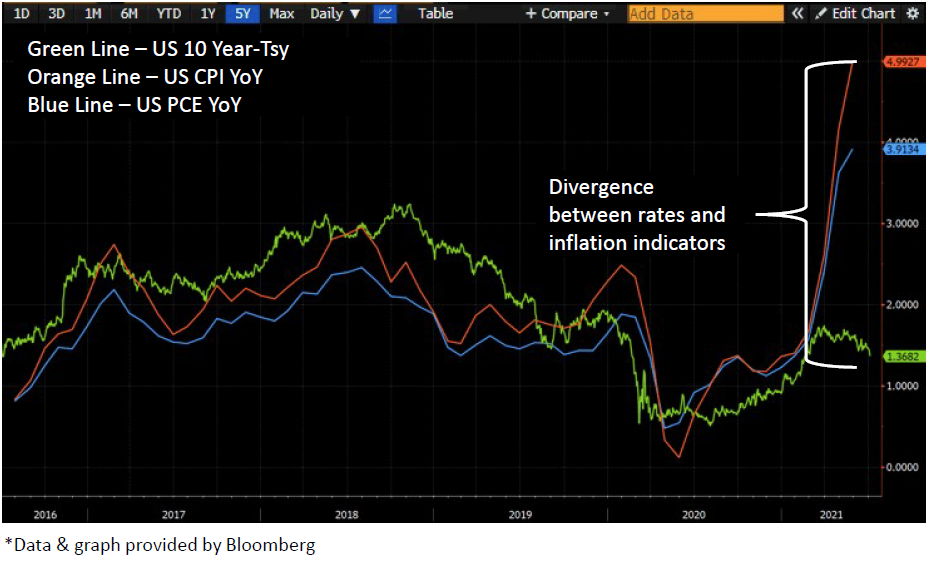
Towards the end of the first quarter, we saw a steep rise in mid and longer maturity US Treasury bond yields, largely framed around fear of excessive inflation. Many market prognosticators believed the rise in yields would continue, especially with strong economic data releases and continued benefits from reopening domestically. Despite this backdrop, during the second quarter, US 10-year Treasury bond yields fell into a tighter range, volatility dropped, and rates trended lower throughout the quarter. As you can see in the graph on the left, longer term interest rates and inflation have been highly correlated to each other over the past 5 years, but lately a disparity has developed between the personal consumption expenditure (PCE), the consumer price index (CPI), and the 10-year US Treasury.
While there are many theories regarding why Treasury bonds have not reacted more to the current rise in inflation, a plausible scenario could be the bond market’s general belief that this inflation spike is indeed transitory and the Federal Reserve’s ability to keep long-term interest rates under control is very much still intact. It is our belief that for true long-term inflation to take root, there is still ground to make up regarding unemployment and taking slack out of the economy.
We will be looking for further clues regarding the recent inflation spike and determining if it is truly temporary. Hiring is indeed expanding throughout the economy, but there is still a meaningful gap between the levels of employment now versus those seen before the pandemic. The Federal Reserve’s new policy framework of allowing higher inflation is clearly being put to the test, and the timing of the tapering asset purchases and hiking the Fed Funds rate will have major implications for both equity and bond markets for the duration of the year.
|
|
The annual gift tax exclusion amount for 2021 is $15,000. As you may be aware, this annual exclusion means you can give anyone else, such as a relative or friend, up to $15,000 in assets this year, free of federal gift taxes. Payments made directly to a school for tuition or a health care provider for medical expenses on behalf of a another are not subject to the gift tax nor does it count toward your lifetime exemption.
Mortgage rates have risen slightly, but remain near historic lows. If you are interested in refinancing but feel as if you missed your opportunity last year, you may be surprised by what rate you could still lock in at a bank or refinancing institution. We have plenty of tools at our disposal to help you determine if refinancing makes sense for your current situation, so don't hesitate to reach out if you have any questions.
Monthly child tax credit payments are scheduled to begin in mid to late July. For 2021, the maximum credit is $3,600 for children younger than age 6 and $3,000 for those between 6 and 17 (there is no limit on the number of children who can receive the credit per family). Recipients do have the option to receive the full amount of the credit on their 2021 tax return, but they must notify the government of their choice. Otherwise, h alf of the credit will be distributed as an advance on 2021 taxes in six monthly installments. For households getting the full benefit, those payments will be $300 per month for children under the age of 6 and $250 for those between the ages of 6 and 17.
|
|
|
|
As always, please do not hesitate to contact us with any questions, ideas, or concerns. We are happy to meet with you in person or via video conference. |
|
|
1715 Aaron Brenner Drive Suite 504 | Memphis, TN 38120 | 901-843-0600
|
|
|
|
|
|
|
|