|
Below you will find news updates and upcoming deadlines. If you are interested, click on the link for more information.
*For questions contact Alicia McCarthy at 360.942.7370 or alicia@wastatedairy.com.*
| |
|
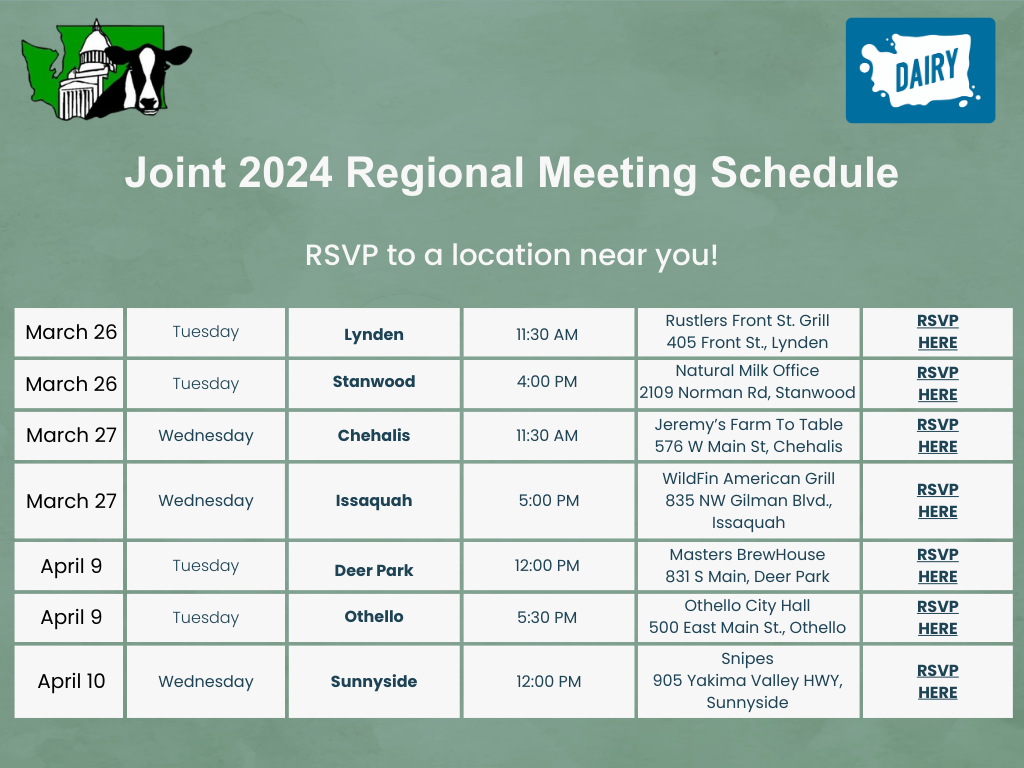
Regional Kitchen Meetings Start Next Week!!
Please join the Washington State Dairy Federation and the Dairy Farmers of Washington (Products Commission) for joint regional meetings this March and April.
The meetings will include updates on the legislative session, efforts to create dairy farmer income through existing and new programs, strategic planning, and stabilizing funding for our advocacy on behalf of dairy families.
Dairy Farmers of Washington will cover highlights and results from their 2023 efforts focused on advancing dairy through reputation, sustainability, innovation, and exports to ultimately build trust and drive sales. We will also jointly share updates on the Washington Sustainable Dairy Collaborative’s efforts to support farmers with resources, funding, implementation, and research to drive progress on industry environmental stewardship goals.
| |
RSVP online at wastatedairy.com.
*If you would like to attend at multiple locations, please RSVP to each one separately.
| |
|
Emergency Loans Available to 22 Washington Counties After Secretarial Disaster Designation
Secretary Vilsack declared 22 counties in Washington State as primary and contiguous disaster areas due to excessive heat that occurred between March 15, 2023 and July 31, 2023. A Secretarial disaster designation allows farmers and ranchers in primary and contiguous disaster counties to be considered for emergency loans through the Farm Service Agency (FSA), provided all other eligibility requirements are met. Farmers in eligible counties have until November 14, 2024 to apply.
The primary disaster counties are Adams, Benton, Chelan, Douglas, Franklin, Grant, Kittitas, Klickitat, Okanogan, Walla Walla, and Yakima. The contiguous counties also eligible for emergency loans are Columbia, Ferry, King, Lewis, Lincoln, Pierce, Skagit, Skamania, Snohomish, Whatcom, and Whitman.
| |
 | |
Enroll Now for Dairy Margin Coverage
Producers are able to enroll for 2024 Dairy Margin Coverage (DMC), an important safety net program offered through the U.S. Department of Agriculture (USDA) that provides producers with price support to help offset milk and feed price differences. This year’s DMC signup are open and end April 29, 2024. For those who sign up for 2024 DMC coverage, payments may begin as soon as March 4, 2024, for any payments that triggered in January 2024.
2024 DMC Coverage and Premium Fees
FSA has revised DMC regulations to extend coverage for calendar year 2024, which is retroactive to Jan. 1, 2024, and to provide an adjustment to the production history for dairy operations with less than 5 million pounds of production. In previous years, smaller dairy operations could establish a supplemental production history and receive Supplemental Dairy Margin Coverage. For 2024, dairy producers can establish one adjusted base production history through DMC for each participating dairy operation to better reflect the operation’s current production.
DMC offers different levels of coverage, even an option that is free to producers, minus a $100 administrative fee. The administrative fee is waived for dairy producers who are considered limited resource, beginning, socially disadvantaged or a military veteran. To determine the appropriate level of DMC coverage for a specific dairy operation, producers can use the online dairy decision tool.
DMC Payments
DMC payments are calculated using updated feed and premium hay costs, making the program more reflective of actual dairy producer expenses. These updated feed calculations use 100% premium alfalfa hay.
| |
|
USDA Announces Conservation Reserve Program General Signup for 2024
The U.S. Department of Agriculture (USDA) announced that agricultural producers and private landowners can begin signing up for the general Conservation Reserve Program (CRP) starting March 4 and running through March 29, 2024. This conservation opportunity gives producers tools to conserve wildlife habitat while achieving other conservation benefits, including sequestering carbon and improving water quality and soil health.
As one of the largest private lands conservation programs in the United States, CRP offers a range of conservation options to farmers, ranchers, and landowners. It has been an especially strong opportunity for farmers with less productive or marginal cropland, helping them re-establish valuable land cover to help improve water quality, prevent soil erosion, and support wildlife habitat.
Producers and landowners enrolled about 926,000 acres in General CRP in 2023, bringing the total of enrolled acres in General CRP to 7.78 million. This, combined with all other acres in CRP through other enrollment opportunities, such as Grassland and Continuous CRP, bring the current total of enrolled acres to 24.8 million.
| |
|
WSDA LOCAL FOOD SYSTEM INFRASTRUCTURE GRANTS NOW OPEN
The purpose of the Local Food System Infrastructure Grant program is to support local food supply chains and market access for farms, ranches, food processors, and food distributors. The intention is to fund projects that expand and strengthen collaboration across linkages in the regional food supply chain. This includes planning, equipment, and facilities that support on-farm post-harvest handling, aggregation, processing, manufacturing, storing, distribution, and sale of Washington grown, caught, and raised foods.
Investments that strengthen linkages along the regional food supply chain create new economic opportunities for farmers, ranchers, and food businesses. Expanding local market access with improvements in the regional food supply chain allows small and mid-sized farms, ranches, and food businesses to retain more of the value chain dollar. Ultimately, this grant program benefits Washington consumers by enhancing the resiliency of the local food supply.
Allowable Costs
Grant expenses must directly support the grant purpose to improve local food supply chains and market access for farms, ranches, food processors, or food distributors. This includes planning, equipment, and facilities that support on-farm post-harvest handling, aggregation, processing, manufacturing, storing, distribution, and sale of locally and regionally produced food products.
- Facility improvements must comply with all applicable license and permit requirements by the state, county, or other local jurisdiction.
- No self-dealing in contracting or purchasing of goods and services is allowed.
- Applicants who rent their facilities must ensure approval for the project from the facility owner.
| |
|
Whatcom Family Farmers
On March 27, 2024, Whatcom Family Farmers will host an informational event where water rights consultants from Aspect Consulting, Associated Earth Sciences, and RH2 Engineering, will discuss steps you can take to prepare for the upcoming WRIA 1 adjudication (water rights lawsuit).
| |
|
Farmer Stress Assistance and Wellness Event
April 5th, 2024
9 am to 4 pm
351 NW St. North, Chehalis, WA
Join Washington State University Extension for a day of learning and reflecting on how to reduce and manage stressors on your farm with a focus on physical, emotional, mental, and financial health. Farming can be extremely stressful. Agriculture is known to be a dangerous occupation full of potential stressors like weather, changing economic markets, and machinery breakdowns. When those start to compound many farmers experience excessive stress, making it hard to move forward to positive solutions. Due in part to the stressors faced in farming, agricultural workers have rates of suicide much higher than the average rate. Farmers need support now more than ever.
During this free, one day workshop, we will explore how farmers can care for themselves to sustain their tenure in agriculture. You will walk away with practical knowledge and resources to help manage the stressors of agriculture. While we understand that some of these topics may be challenging to address in our agricultural community, it is necessary to be proactive in community health and wellbeing.
| |
|
Boost Your Farm's Sustainability with SFF Grants
The Washington State Conservation Commission introduces the Sustainable Farms and Fields (SFF) grant program, generously funded by the Climate Investment Account with $30 million for the 2023-25 biennium.
-Funding Opportunities-
| |
|
Option 1:
Alternative Manure Management
- Purpose: Reduce GHG emissions from manure management.
- Eligible Projects: Solid separation, manure collection changes, enhanced pasture.
-
Application Period: February 20 - April 5, 2024.
- Funding: Up to $200,000/project (larger requests considered case-by-case).
| |  |
|
Option 2:
Research and Demonstration
- Goal: Increase adoption of climate-smart livestock management and improve practice impact accounting.
- Eligible Projects: Practices reducing enteric methane emissions and improving manure management.
-
Application Period: February 20 - March 29, 2024.
-
Funding: Up to $200,000/project (larger requests considered case-by-case).
| |
|
Stay tuned for the soon-to-launch Dairy Anaerobic Digesters initiative, aimed at helping farms turn manure into renewable biogas. Detailed information will be shared shortly.
Questions? Reach out to:
| |
|
Rural Energy For America Program
The program provides guaranteed loan financing and grant funding to agricultural producers and rural small businesses for renewable energy systems or to make energy efficiency improvements. Agricultural producers may also apply for new energy efficient equipment and new system loans for agricultural production and processing.
How may the funds be used?
Funds may be used for the purchase and installation of renewable energy systems, such as:
- Biomass (for example: biodiesel and ethanol, anaerobic digesters, and solid fuels).
- Geothermal for electric generation or direct use.
- Hydropower below 30 megawatts.
- Hydrogen.
- Small and large wind generation.
- Small and large solar generation.
- Ocean (tidal, current, thermal) generation.
Funds may also be used for the purchase, installation and construction of energy efficiency improvements, such as:
- High efficiency heating, ventilation and air conditioning systems (HVAC).
- Insulation.
- Lighting.
- Cooling or refrigeration units.
- Doors and windows.
- Electric, solar or gravity pumps for sprinkler pivots.
- Switching from a diesel to electric irrigation motor.
- Replacement of energy-inefficient equipment.
Energy Efficiency Improvement applications must contain an Energy Audit, or Energy Assessment (depending on Total Project Costs) that complies with Appendix A to RD Instructions 4280-B
Agricultural producers may also use guaranteed loan funds to install energy efficient equipment and systems for agricultural production or processing.
| |
|
Value Added Producer Grant
The Value-Added Producer Grant (VAPG) program helps agricultural producers enter value-added activities to generate new products, create and expand marketing opportunities, and increase producer income.
You may receive priority if you are:
- Beginning farmer or rancher.
- Socially-disadvantaged farmer or rancher.
- Small or medium-sized farm.
- Ranch structured as a family farm.
- Farmer or rancher cooperative.
- Proposing a mid-tier value chain.
Who may apply for this program?
Independent producers (includes harvesters and steering committees), agricultural producer groups, farmer- or rancher-cooperatives, and majority-controlled producer-based business ventures, as defined in the program regulation, are eligible to apply for this program.
How may funds be used?
Grant and matching funds can be used for planning activities or for working capital expenses related to producing and marketing a value-added agricultural product. Examples of planning activities include conducting feasibility studies and developing business plans for processing and marketing the proposed value-added product. Examples of working capital expenses include:
- Processing costs.
- Marketing and advertising expenses.
- Some inventory and salary expenses.
| |
|
Purina Animal Nutrition Scholarship
Land O’Lakes, Inc. has established a scholarship program for students who plan to continue their education in college or vocational school programs.
The program is administered by Scholarship America®, the nation’s largest designer and manager of scholarships and other education support programs for corporations, foundations, associations, and individuals. Eligibility for individual programs is determined at the sole discretion of the sponsor and eligible applications are reviewed by Scholarship America’s evaluation team.
Applicants to the Purina Animal Nutrition Scholarship must:
- Be high school seniors, graduates, or current college undergraduates residing and studying in the United States (U.S.).
- Plan to enroll in full-time undergraduate study at an accredited two- or four-year college,
- university or vocational-technical school for the entire upcoming academic year.
- Have experience showing or caring for large/small livestock animals, equine, or poultry (not
- house pets).
| |
|
Dairy Margin Coverage Program
Dairy producers are able to enroll for 2024 Dairy Margin Coverage (DMC), an important safety net program offered through the U.S. Department of Agriculture (USDA) that provides producers with price support to help offset milk and feed price differences. For those who sign up for 2024 DMC coverage, payments may begin as soon as March 4, 2024, for any payments that triggered in January 2024.
USDA’s Farm Service Agency (FSA) has revised the regulations for DMC to allow eligible dairy operations to make a one-time adjustment to established production history. This adjustment will be accomplished by combining previously established supplemental production history with DMC production history for those dairy operations that participated in Supplemental Dairy Margin Coverage during a prior coverage year. DMC has also been authorized through calendar year 2024. Congress passed a 2018 Farm Bill extension requiring these regulatory changes to the program.
| |
|
2024 Dairy Scholarships
The Dairy Farmers of Washington are happy to announce that the Washington Dairy community scholarships are officially open for applications!
Dairy Farmers of Washington is committed to empowering the next generation of dairy leaders and industry professionals to achieve their educational goals and strengthen the Washington dairy industry.
The winning scholarship recipients will be leaders amidst their peers and committed to strengthening the Washington dairy community. The winning recipient for each scholarship will receive $5,000. Two runners-up for each scholarship will each receive $1,500.
To learn more about the scholarship criteria and application process, please visit our website. The deadline for submissions is May 1, 2024, so make sure to submit your application before then.
| | |
|
For additional resources, visit the Washington State Dairy Federation website and click on "Resources". This is a password protected page so you will need to enter the password before you're able to view the list of resources. Please do not share this password with anyone outside the dairy community.
Password: Farm Resources
|
| | | | |