 |
Iron & Steel Preservation
|
|

.
|
"You never stop learning" is an old adage that would seem to apply to a younger generation who are daily exposed to new experiences, building a reservoir of knowledge to survive the next day, certainly not one of an older generation. Recently, I indicated to a project manager for corporate training at Lansing Community College that I knew something about rigging from my many years working in the steel fabrication industry. As a result, hired to teach a series of rigging classes, I found myself on a daily search for information to add to my rigging skills. I developed and taught several classes for corporate training, amassing more and more knowledge and materials on rigging. While I enjoyed the opportunity to expand my skills in a field I've worked in for years and to experience the excitement of learning something new, the process consumed a large amount of time and energy, with the result that much of my ISP Newsletter writing was put on the back burner. With the completion of my teaching schedule at LCC, I'm back to writing about an area I'm passionate about: metal preservation, especially historic metal truss bridges and the hot riveting process.
Vern Mesler
Iron & Steel Preservation Coordinator
Lansing Community College
|
Rust -- a quick search on the internet and you will find multiple sites that describe in technical language the various ways rust can form on an iron or steel structure. One such description is for pack rust:
"(I)f water is allowed to flow over overlapping joints, capillary action can draw the water into the joint and cause "rust-pack" to form (FHWA, 1989)." When iron and steel are exposed to wind, rain, ice, snow, or highly corrosive elements, rust will eventually appear. In dark hidden wet corners of a metal structure the oxidation of iron begins, and eventually spreads across the surface of what was a finely fabricated metal truss bridge. Without maintenance, the bridge soon appears ready to scrap. Setting alongside the Battle Creek garage of the Calhoun County Road Commission some years ago was the stored 20 Mile Road Bridge, its trusses a prime example of what happens when rust is allowed to breed and spread. Large heavy dark brown slabs of layered rust clung to much of the steel structural members. On the ground piles of rust lay beneath the trusses. It seemed at first an impossible restoration. I approached Mr. Dennis Randolph (then Managing Director of the Calhoun County Road Commission) with a suggestion to restore just one truss of the 20 Mile Road Bridge and display it in the park. His response was immediate: "You successfully restored one bridge, let's restore the second bridge." With that commitment, the 20 Mile Road Bridge was loaded on a semi flatbed trailer and shipped to the Calhoun County Road Commission's facility in Marshall where a fabrication shop was already set up for restoration work. The Marshall facility would be the site not only for restoration of the 20 Mile Road Bridge but also for the next three historic riveted truss bridges destined for the Historic Bridge Park.
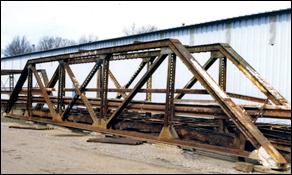
20 Mile Road Bridge 1997
|
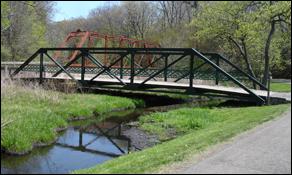
20 Mile Road Bridge 2007
|
|
|
20 Mile Road Bridge History
|
Believed to have been fabricated around 1906, the 20 Mile Road Bridge spanned the St Joseph River in Calhoun County and remained in service until its closure in 1992. There is little written documentation about this bridge, no county records on when the bridge was purchased or erected, no maintenance schedule, and no historic photographs.* There were some significant historical features of the bridge that made it eligible for the National Register of Historic Places, most of these features determined from reading the physical parts of the bridge. It is made of steel, the only one of the five historic bridges in the Calhoun County Historic Bridge Park fabricated with steel, the other four made of wrought iron.** Once the original members were shotblasted clean for painting, the embossed Illinois mill marks could be plainly seen, a clear indication that these members were milled at the Illinois Steel Company. More than likely, the trusses themselves were fabricated at another location. Another historic feature of the bridge is its all-riveted construction. The trusses were fabricated without bolted or pinned connections, unlike most bridges of this size that typically were fabricated in shop-riveted sections, shipped to the bridge construction site, and assembled there with pinned and bolted connections. Shop-riveted sections of the 20 Mile Road Bridge trusses would have been shipped by rail on flatcars to the erection site. The trusses, 64 feet in length overall, were probably fabricated in shorter sections. There was some indication during the restoration of the bridge that hand field-riveting was done at vertical and diagonal connections. Documents for the historic evaluation of the 20 Mile Road Bridge show no distinction between the different rivet methods: shop-riveting, field-riveting, hand field-riveting, all of which would have been done with different tools.
The romantic vision of a hot rivet pulled from a bed of black burning coals, grasped by iron tongs, thrown up several floors, expertly caught in a catcher's can, seized by a shorter set of iron tongs, slipped in a drilled hole of several plates, hammered round and solid with a pneumatic field rivet hammer, is often imagined as the way most riveting got done. However, that scenario actually represents only a small percentage of the driven rivets in a riveted structure. Riveted structures were fabricated with thousands of shop-driven rivets, and the primary methods used heavy pneumatic powered equipment.
The Historic Architectural Engineering Record (HAER) for the 20 Mile Road Bridge reports that "
Flat steel bars are welded to the four angles to create a lattice pattern." In fact, no welding, either forged or electric arc, was made on any of the bridge members (except for later repairs). It would be decades before electric arc welding was in widespread commercial use. In the historic record, welding is sometimes confused with riveting.
In the historic evaluation of the 20 Mile Road Bridge, two other features were listed as historically significant: the concrete abutments and the concrete jack arch deck. Neither of these features was replicated on the restored bridge.
Restoration work began with the dismantling of the trusses. The tools used in this process were the same as those used in steel fabrication, both historic and contemporary. It was during the restoration of the 20 Mile Road Bridge that many of the metal restoration skills used later for the next three bridges were developed: the electric arc welding process adapted for the replication of bridge members, the hot rivet process for reassembling the bridge trusses, and the development of a process for removing pack rust. Future ISP Newsletters will continue to tell the story of the restoration of the 20 Mile Road Bridge, as well as the third bridge restored for the Historic Bridge Park, the Gale Road Bridge.
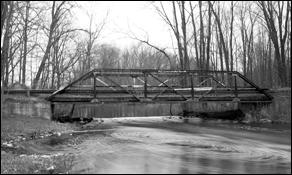
20 Mile Road Bridge at its original site. HAER
|
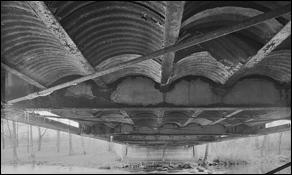
Concrete jack arch deck. HAER
|
|
|
Calhoun County Historic Bridge Park
|
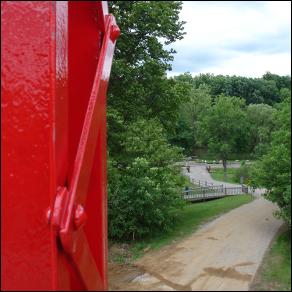
The Historic Bridge Park viewed from the restored Charlotte Highway Bridge toward the Kalamazoo River.
|
For a unique Michigan summer adventure, visit the Calhoun County Historic Bridge Park and stroll across five restored riveted metal truss bridges from Michigan's transportation past. Restored to their original fabricated design for Michigan's early road system, they are a history book not written in words but in the metal fabricated by the hand of a craftsman.
Group tours can be arranged for those who want to learn more about the history of the five historic bridges, the wrought iron and steel they were fabricated with, and the manufacturing processes used to fabricate and erect the bridges.
One bridge in the park, the Gale Road Bridge, has become known as the "Wedding Bridge." Reservations can be made for weddings and other special events. For more information about park reservations, contact
Calhoun County Parks and Recreation.
Entering "historic bridge park" in Google Maps will give you directions to this exceptional park.
|
|
|
Crystal Bridges Museum & Rosie the Riveter
|
|
For another family summer trip, visit the Crystal Bridges Museum of American Art in Bentonville, Arkansas. This outstanding museum in a scenic wooded area of nature trails is welcoming for all people, from young families through older generations. While no historic bridges are featured at the museum, there are works by famous artists whose art portrays the rural, city, and industrial settings of the USA. The December ISP Newsletter featured the Crystal Bridges Museum. Read about Norman Rockwell's painting of Rosie the Riveter displayed at Crystal Bridges and about Lansing Community College's own Rosie the Riveter.
|
|
Program Fund
Please consider contributing to the Iron and Steel Preservation Program Fund. This fund was established to support projects, research, conferences and scholarships related to the repair, rehabilitation, and restoration of metals. The Lansing Community College Foundation is a nonprofit 501(c)(3) corporation.
Donate Here
|
|
|
|
Past Iron & Steel Preservation Newsletters
|
|
|
|
Sponsor
|
Want to become a sponsor?
|
|
Lansing Community College
5708 Cornerstone Drive
PO Box 40010
, MC 4100W
Lansing, MI 48917
|
|
|
|
|
Copyright © 2016. All Rights Reserved.
|
|
|
|