|
|  | |
Retail Beat
updates for retailers + key business partners
November 16, 2026
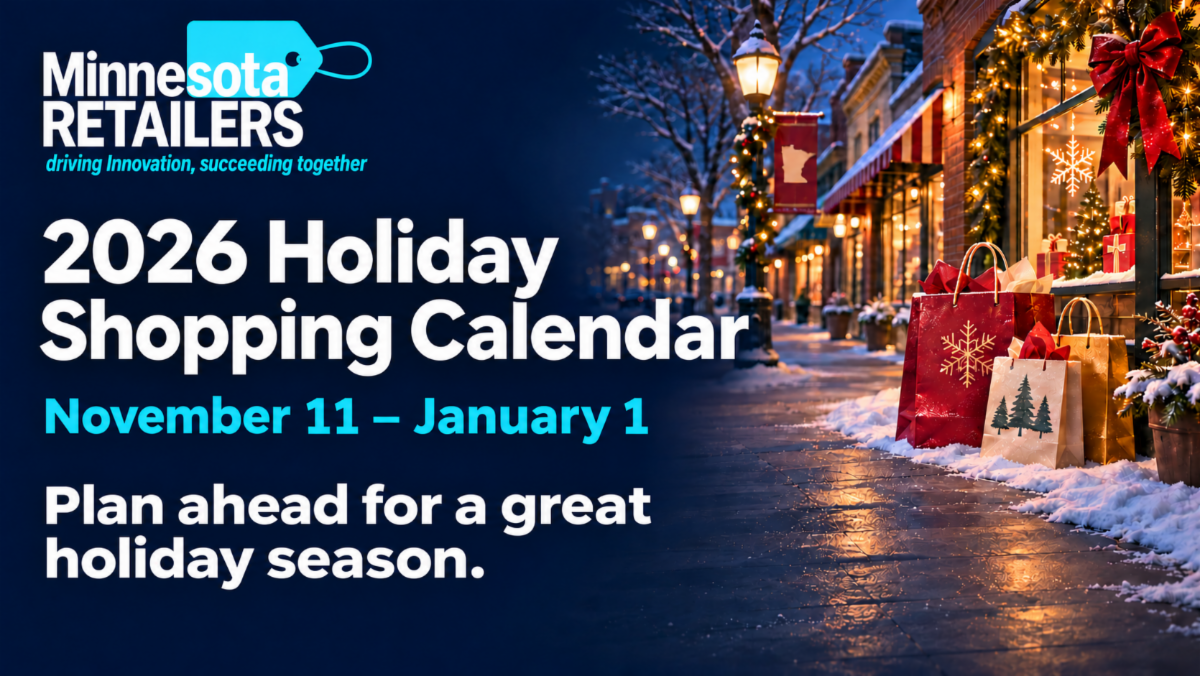
| | Get ready for a great holiday shopping season! Minnesota Retailers has assembled a calendar of key shopping dates, from Black Friday and Small Business Saturday to Sustainable Sunday, Cyber Monday and beyond, to help retailers plan promotions, connect with customers and make the most of the season. | | | Holiday Shopping Calendar for Minnesota Retailers | | |
Minnesota Retailers has assembled key shopping dates from Veterans Day through New Year's to help retailers plan for the holiday season. Use the calendar to decide when to add checkout or pickup coverage, stock up on popular gifts, launch promotions and set shipping deadlines.
Before publishing your holiday hours, check what’s happening in your community, too! A downtown market or tree lighting can bring shoppers to your door outside your usual busy hours.
Thanksgiving weekend brings Black Friday, Small Business Saturday, Sustainable Sunday and Cyber Monday. When you build your December schedule, give Dec. 12, Dec. 19 and Dec. 26 a close look. Sensormatic projects those will be the three busiest days for store visits after Black Friday, with Super Saturday on Dec. 19 leading that group.
November 2026
- Wednesday, Nov. 11 | Veterans Day. USPS observes the federal holiday. Check carrier pickup schedules before setting delivery expectations for customers. We hope this was a great holiday for veterans!
- Thursday, Nov. 19 | Give to the Max Day. Minnesota’s statewide giving day supports nonprofits and schools. Retailers can spotlight a local organization they already work with, share its GiveMN fundraiser or offer to match customer donations up to a set amount.
- Thursday, Nov. 12 | Dayton’s Holiday Market opens. The downtown Minneapolis market features more than 100 local makers and vendors and runs through Dec. 24.
- Thursday, Nov. 26 | Thanksgiving. Post your holiday hours early and let customers know when online orders will be ready for pickup or shipment.
- Friday, Nov. 27 | Black Friday. For what’s projected to be the season’s busiest day for store visits, make featured deals easy to find and plan for extra traffic at checkout and pickup.
- Saturday, Nov. 28 | Small Business Saturday. Give shoppers a reason to explore their local shopping district. Team up with neighboring stores or your local chamber to spread the word about what’s happening nearby.
- Sunday, Nov. 29 | Sustainable Sunday. Minnesota Retailers' shopping day to celebrate the savings and environmental benefits of buying pre-owned, refurbished and recycled products at your favorite stores. Retailers can join in by showcasing secondhand finds, refurbished products and gifts made with recycled materials.
- Monday, Nov. 30 | Cyber Monday. Make online offers, shipping costs and pickup options easy to find before customers check out.
December 2026
- Tuesday, Dec. 1 | GivingTuesday. If you’re partnering with a local nonprofit, tell customers how they can participate and where their contributions go.
- Friday, Dec. 4 at sundown through Saturday, Dec. 12 | Hanukkah. Have gifts and celebration merchandise ready ahead of the first evening.
- Saturday, Dec. 12 | Second Saturday in December. Sensormatic projects this will be the season’s third-busiest day for U.S. store visits. Check staffing, inventory and pickup
capacity.
- Thursday, Dec. 17 through Saturday, Dec. 19 | USPS holiday shipping dates. For expected delivery before Dec. 25 within the contiguous U.S., USPS recommends sending by Dec. 17 for Ground Advantage and First-Class Mail, Dec. 18 for Priority Mail and Dec. 19 for Priority Mail Express. Set customer order deadlines early enough to allow for packing and carrier pickup.
- Saturday, Dec. 19 | Super Saturday. The last Saturday before Christmas is projected to be the season’s second-busiest day for U.S. store visits. Put in-stock gifts, gift cards and same-day pickup options front and center.
- Wednesday, Dec. 23 through Friday, Dec. 25 | Final Christmas rush. Dec. 23 is projected to be a top-five day for U.S. store visits. Share your Christmas Eve and Christmas Day hours and the last times customers can place and collect pickup orders.
- Saturday, Dec. 26 | Day-after-Christmas shopping. With a busy Saturday projected, plan for returns, exchanges, gift card redemptions and clearance shoppers. Kwanzaa also begins Dec. 26 and runs through Friday, Jan. 1.
New Year’s
- Thursday, Dec. 31 and Friday, Jan. 1 | New Year’s Eve and New Year’s Day. Confirm holiday hours and make return and exchange deadlines easy to find.
As a reminder, before the rush, put your holiday hours, shipping and pickup cutoffs, and return deadlines in one place. Share the same information online and in-store so shoppers and staff know what to expect.
Cheers to a great holiday season!
| | Minnesota Retailers Seeks Clear Rules and Lower Compliance Costs for Packaging EPR Program | |
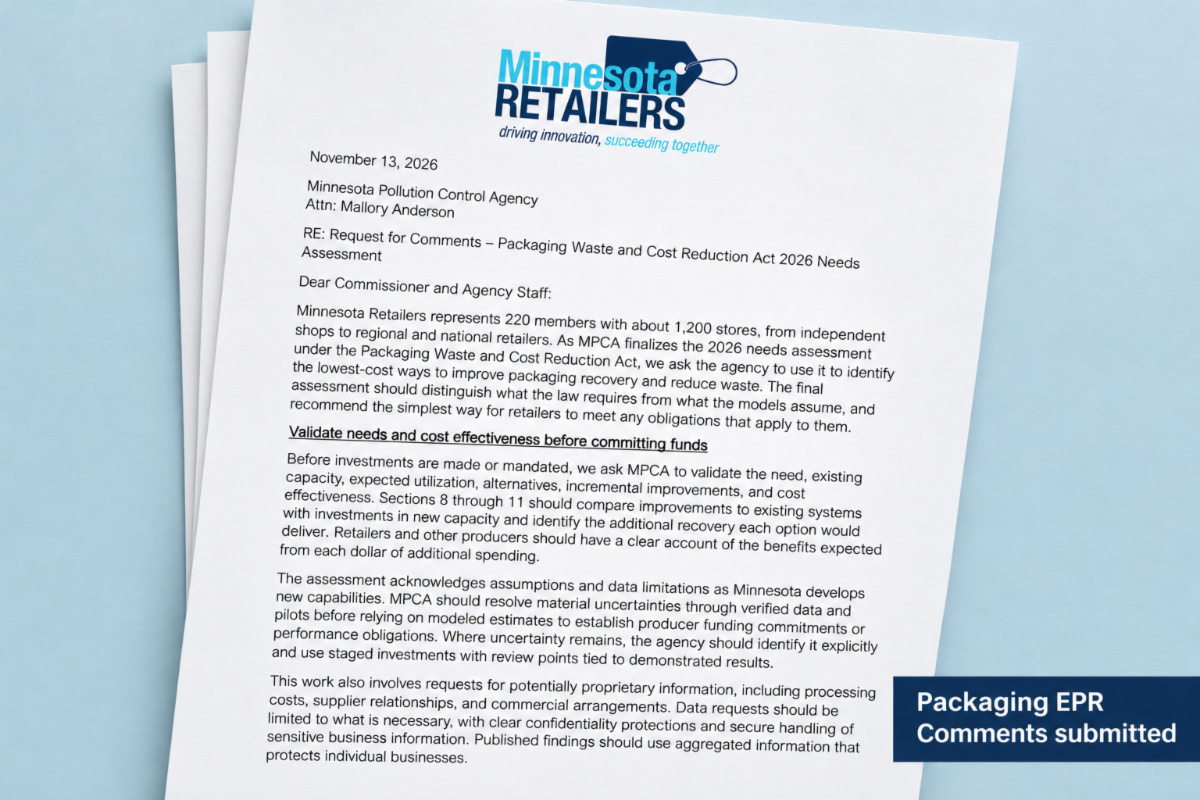
Minnesota Retailers submitted comments this past Friday to the Minnesota Pollution Control Agency on its draft 2026 Packaging Needs Assessment, urging practical implementation that improves packaging recovery while minimizing retailer costs and paperwork.
Our comments call for clear guidance on who is responsible for packaging, particularly for store-brand products and packaging filled in stores. We also requested simple reporting through Circular Action Alliance, consistent requirements across states, and the ability to rely on supplier information to avoid duplicate filings and fees.
Other priorities include keeping store collection voluntary, covering participating retailers’ additional costs, and building on existing commercial recycling and reuse networks. We asked MPCA to validate costs, capacity, and consumer participation before committing producer funds, protect confidential business information, and demonstrate viable reuse economics before expanding programs.
Throughout the comments, we emphasized realistic timelines that allow retailers and suppliers to test packaging alternatives, use existing inventory, and maintain food safety and product quality.
Read our full comments here.
| DoorDash–Instacart Combination Could Expand Delivery Opportunities for Retailers | | |
The proposed acquisition of Instacart by DoorDash is drawing attention from retailers across the country as businesses look for new ways to meet growing consumer expectations for convenience, delivery and digital shopping.
The proposed combination would bring together DoorDash's extensive delivery network with Instacart's grocery ordering, fulfillment and retail technology. The companies say the merger could provide retailers with additional tools to reach customers, improve delivery services and compete in an increasingly digital marketplace.
In a recent article published by The Packer, retail industry leaders shared their perspectives on the proposed transaction and the opportunities it could create for retailers and consumers.
Bruce Nustad, president of Minnesota Retailers, offered the following comments:
"We've heard positive feedback from retailers about how DoorDash and Instacart help them reach customers and meet growing expectations for convenience. Today's customer expects last-mile delivery to be part of the shopping experience, whether they're buying from a neighborhood store or a national retailer. DoorDash's acquisition of Instacart would seem to build on those strengths and should enable even better service for retailers and their customers. We support opportunities like this to improve delivery, help retailers grow and make it easier for consumers to shop the stores they value."
The proposed merger reflects the growing importance of last-mile delivery as part of the retail experience. For many retailers, partnerships with third-party delivery platforms provide access to technology, logistics and customer connections that would be difficult or costly to develop independently.
The transaction remains subject to regulatory and shareholder approvals.
Read the November 13 article in The Packer.
| | Minnesota Sales Tax Collections Dip Below Forecast in October | |
Minnesota's general sales tax collections came in below expectations in October, even as overall state revenues exceeded projections, according to the latest monthly revenue review from Minnesota Management and Budget (MMB).
The state collected $753 million in general sales tax revenue, approximately $5 million (0.7%) below the $758 million forecast. Individual income tax collections also fell short of expectations by $29 million.
Despite those shortfalls, Minnesota's total general fund revenues reached $2.694 billion in October, exceeding projections by $78 million, or 3%. Stronger-than-expected corporate franchise tax collections and other revenues more than offset the declines.
For retailers, sales tax collections are an important economic indicator because they provide a window into taxable consumer spending. October's modest shortfall is worth watching as Minnesota retailers enter the critical holiday shopping season, particularly amid concerns about household budgets, consumer confidence and discretionary spending.
The October results also contrast with stronger sales tax collections earlier in the fiscal year. MMB cautions that monthly revenue fluctuations can reflect the timing of payments, processing and refunds rather than underlying economic trends.y
Overall, Minnesota's fiscal year 2027 revenues remain $1.011 billion, or 9.8%, above forecast through October. The state's next comprehensive budget forecast, expected in December, will provide an important outlook for policymakers preparing for the 2027 legislative session.
Read MMB's November 10 Monthly Revenue Review.
| Hennepin County Launches Shop-Local Rewards Program on Small Business Saturday | |
Hennepin County is giving shoppers another reason to support local businesses this holiday season with the launch of a new countywide rewards program on Small Business Saturday, November 28.
Through a partnership with Open Rewards, customers can earn up to 5% back in rewards when shopping or dining at eligible independent businesses throughout Hennepin County. Rewards earned at one participating business can be redeemed at another, encouraging consumers to continue spending their dollars locally.
The program is designed to make participation simple for businesses. There is no cost to participate, no requirement to offer discounts or special promotions, and no additional technology or employee training needed. Most eligible independent retailers, restaurants and personal service businesses will automatically be included in the program's directory.
For local retailers, the program offers an opportunity to attract new customers, encourage repeat visits and increase visibility during the important holiday shopping season. It also creates an incentive for consumers to explore businesses throughout their communities.
Customers can participate by downloading the free Open Rewards app, finding eligible businesses and earning rewards on qualifying purchases beginning November 28.
Business owners are encouraged to check whether their store is included in the Open Rewards directory. Eligible businesses that are not listed can register to participate.
The launch coincides with Small Business Saturday, a nationwide celebration of independent businesses and the important role they play in local economies.
Thanks to the Uptown Association for sharing information about this new program and helping spread the word to local businesses.
Learn more about Hennepin County's Open Rewards program.
| | Minnesota Hemp Retailers Face Growing Uncertainty as Federal Deadline Approaches | |
Minnesota retailers selling hemp-derived THC products are facing growing uncertainty as a December 11 federal deadline approaches, with some businesses already changing their operations, reducing inventory or reconsidering their involvement in the market.
According to a recent FOX 9 report, Minnesota businesses are navigating questions about product availability, banking, insurance and payment processing as federal restrictions on hemp-derived THC products approach.
Minnesota's hemp-derived THC market generated an estimated $180 million in retail sales in 2025, making the potential disruption significant for retailers, manufacturers and distributors.
Although Minnesota has established a state regulatory framework for these products, changes at the federal level creates conflicts and uncertainty for businesses operating legally under state law. Some businesses are already experiencing challenges with financial services, while others are evaluating whether to continue selling these products.
The situation also raises questions for Minnesota policymakers heading into the 2027 legislative session. Retailers that have invested in compliance with Minnesota's licensing and regulatory requirements may need clarity about how state and federal rules will interact.
With the December 11 deadline approaching, retailers should remain in communication with suppliers, payment processors and regulators while monitoring developments that could affect their ability to continue selling these products.
Read the November 11 FOX 9 report.
| Minnesota Cigarette Sales Tax Increasing January 1 | |
Minnesota retailers selling cigarettes should prepare for an increase in the state's cigarette sales tax beginning January 1, 2027.
According to the Minnesota Department of Revenue, the cigarette sales tax will increase from 84 cents to 87.7 cents per pack of 20 cigarettes. When combined with the state's cigarette excise tax, the total state tax on a pack of 20 cigarettes will reach $3.917 for settlement brands.
The cigarette sales tax is adjusted annually under existing Minnesota law, meaning the upcoming change is not the result of newly enacted legislation.
While the increase amounts to approximately 3.7 cents per pack, retailers and wholesalers should account for the adjustment as they prepare pricing systems and business operations for the new year.
Retailers should review applicable pricing information, confirm that suppliers and point-of-sale systems reflect the updated rates, and communicate with employees responsible for tobacco sales.
The adjustment also comes as several Minnesota communities continue considering or implementing additional tobacco regulations, including minimum pricing requirements, restrictions on promotions and limitations on certain tobacco products.
For retailers operating in multiple communities, the combination of state tax changes and differing local ordinances can add complexity to tobacco sales and compliance.
Minnesota Retailers encourages businesses selling tobacco products to review the updated rates and prepare for the January 1 effective date.
Review the Minnesota Department of Revenue's 2027 cigarette tax rates.
| Holiday Pop-Ups Bring New Energy to Minnesota's Retail and Hospitality Scene | |
The holiday season is bringing more than traditional decorations and shopping promotions to Minnesota businesses. Seasonal pop-ups and themed experiences are creating new reasons for consumers to visit local establishments, offering a reminder that memorable experiences can be just as important as merchandise in attracting customers.
Across the Twin Cities and surrounding communities, restaurants, bars and hospitality businesses are transforming their spaces into holiday destinations featuring elaborate decorations, seasonal products and limited-time experiences.
According to a recent FOX 9 report, businesses in Minneapolis, St. Paul, Waconia and other communities are expanding their holiday offerings. Lola's Lakehouse in Waconia opened its seasonal experience two weeks earlier than usual, reflecting growing interest in holiday-themed destinations.
While many of these examples come from the hospitality industry, the concept has clear applications for retailers.
Holiday pop-ups, special merchandise collections, in-store demonstrations, visits with Santa and community events can give shoppers additional reasons to visit physical stores. Limited-time experiences can also create excitement, encourage repeat visits and introduce businesses to new customers. A unique holiday atmosphere, personalized service and connections to the local community can create value that extends beyond price.
Seasonal events can also benefit neighboring businesses. When shoppers visit a downtown district or shopping center for a special experience, nearby retailers and restaurants have additional opportunities to capture customer traffic.
As Minnesota retailers enter the busiest shopping period of the year, the growing popularity of holiday pop-ups reinforces an important lesson: retail is about more than transactions. It's also about creating experiences, building relationships and giving customers a reason to come back.
Read the November 6 FOX 9 report.
| Retail Sales Grow for 13th Straight Month as Holiday Shopping Season Begins | | |
U.S. retail sales continued their upward trend in October, marking the 13th consecutive month of growth, according to the latest CNBC/NRF Retail Monitor released November 11 by the National Retail Federation (NRF).
Total retail sales, excluding automobile dealers and gasoline stations, reached $561.7 billion in October, an increase of 0.15% from September and 3.57% compared with October 2025. Core retail sales, which also exclude restaurants, totaled $454.2 billion, up 0.26% for the month and 3.36% year over year.
The results suggest consumers remain willing to spend despite continued pressure on household budgets, with promotions and seasonal shopping helping drive activity.
“Retail sales edged higher in October as a strong Halloween season and early winter holiday promotions pulled demand forward,” said NRF President and CEO Matthew Shay.
Shay noted that households are carefully managing their budgets and timing purchases around sales and special offers to make their dollars go further. Retailers, meanwhile, are responding with promotions and value pricing to help keep everyday essentials and holiday gifts affordable.
Electronics and appliances led the way, with sales increasing 9.3% compared with October 2025. Nearly every retail category posted year-over-year gains, with two exceptions: furniture and home furnishings declined 2.62%, while sporting goods fell 0.44%.
For the first 10 months of 2026, total retail sales increased 5.75% compared with the same period last year, while core retail sales grew 5.63%.
The October results provide an encouraging signal heading into the busiest shopping weeks of the year. However, they also reinforce the importance of value, discounts and promotional events as consumers balance holiday purchases with higher everyday expenses.
Read the November 11 CNBC/NRF Retail Monitor report.
| | | | |