|
|  |
|
Retail Beat
updates for retailers + key business partners
January 22, 2024
| |
Minnesota's 2024 legislative session kicks off February 12. This week we welcome Grace Greene to the team for the session! | |
|
Minnesota Retailers gears up for the 2024 legislative session with new addition | |
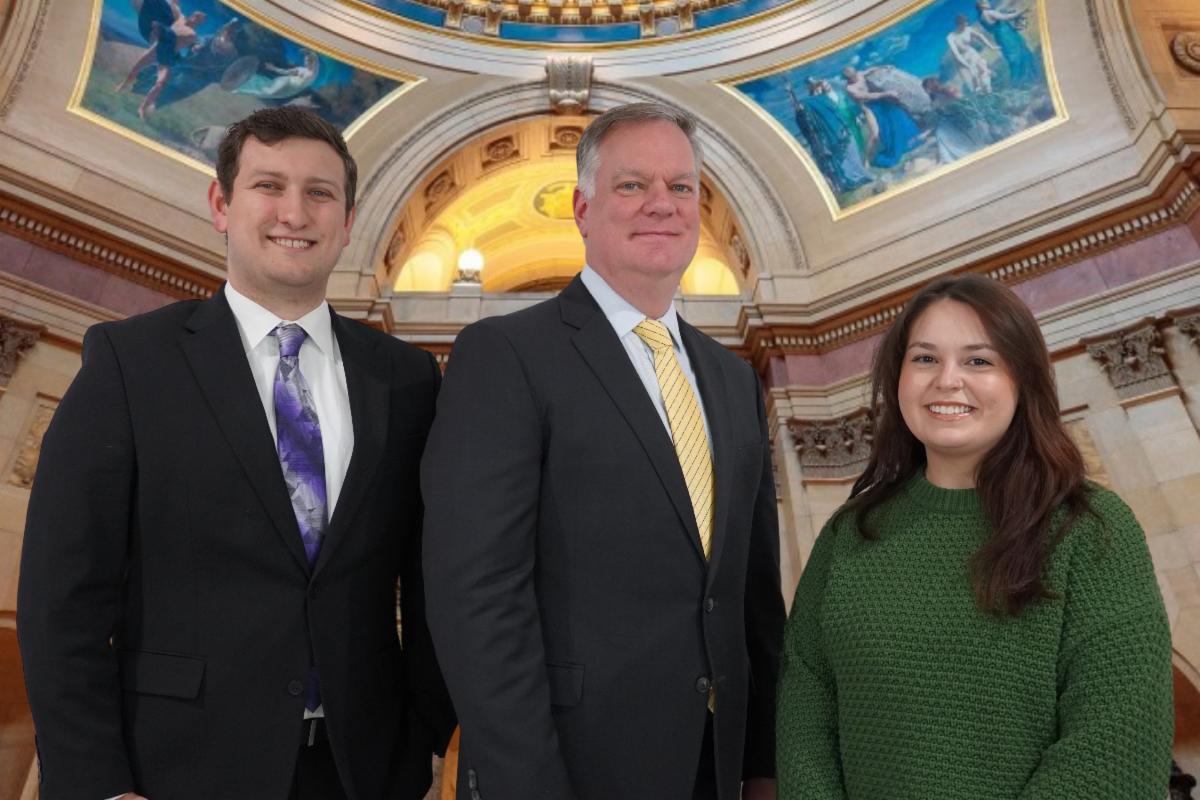
As the 2024 Minnesota legislative session kicks off on February 12, Minnesota Retailers is ready to represent retailers and their key business partners. Joining forces with current staff members Will Hagen and Bruce Nustad is Grace Greene, who brings a unique perspective and experience to the team.
Grace Greene, a graduate of the University of Minnesota with a master's degree in public policy, is set to be an important part of the team this upcoming legislative session. With a strong academic background and practical experience, Grace is well-equipped to navigate the complex landscape of Minnesota public policy.
Prior to joining Minnesota Retailers, Grace served as a government relations student worker at Land O'Lakes, gaining invaluable insights into the intricacies of government relations and policy advocacy. Her experience at Land O'Lakes, coupled with her academic achievements, positions Grace as a valuable asset in addressing the diverse challenges and opportunities facing the retail sector.
"We are thrilled to welcome Grace to the Minnesota Retailers team for the 2024 legislative session. Her background in public policy, with a focus on agriculture, aligns seamlessly with our commitment to representing the interests of retailers and their key business partners," said Minnesota Retailers President Bruce Nustad.
Minnesota Retailers remains dedicated to championing the concerns of the retail community, and with Grace on board, the organization is poised to have a solid impact during the legislative session. As the voice of retailers, Minnesota Retailers continues to advocate for policies that foster a thriving business environment and address the evolving needs of the industry.
Our most important asset in our work is you! Thank you for your support and your perspective. We depend on your experience as you work with your employees to serve your customers.
The 2024 legislative session holds the promise of change, and Minnesota Retailers, alongside its dynamic team, and with the leadership of our Board of Directors, looks forward to representing the interests of retailers and fostering collaboration with key stakeholders.
Together, Will, Grace and Bruce are ready to navigate the intricacies of legislative processes, ensuring that the retail sector's concerns are at the forefront of policy discussions in Minnesota.
Please join us in welcoming Grace, who can be reached at grace@mnretail.org, or tel. (651) 227-6631.
| |
How many e-gadgets per household? | |
|
From Shop Association!, January 12, 2024
The answer: 17, per research released at the CES 2024 trade fair by Parks Associates. That’s up from eight as recently as 2015.
The international market research and consulting firm’s latest Consumer Electronics Dashboard also noted that for the first time, smartphone ownership surpassed TV ownership, with 90 percent of households reporting ownership of a smartphone compared to 88 percent with a TV.
“Smartphones are ubiquitous now, and connected consumer electronics such as wireless earbuds, tablets, and smart TVs are commonplace,” said Sarah Lee, Research Analyst, Parks Associates. “Today, these devices are essential for entertainment purposes and daily personal communications, which can include school, work and family. This necessity drives continued purchases, as every year CE companies roll out innovative and advanced models that drive the consumer desire to upgrade.”
The research also showed consumer spending demonstrated what Parks described as “remarkable resilience” in 2023. After a brief pause early in the year, shoppers’ enthusiasm for consumer electronics products rebounded at the end of the year. Purchase intentions for popular entertainment devices such as gaming consoles, streaming media players and VR headsets increased compared to 2022 and now resemble 2021 levels, which was the height of the pandemic.
“Economic conditions and fear of a recession previously stalled purchases of CE categories,” Lee said. “But higher intentions to purchase are likely a reflection of prolonged delayed gratification, the end-of-year holiday season, enticing retail promotions and hope for continued economic improvement in 2024.”
READ MORE
| |
Indicators giving Minnesota businesses reasons for reserved optimism | |
From MinnPost, Andrew Tellijohn, January 18, 2024
When mortgage interest rates started to rise in mid-2022 for the first time in years, it slowed what had been a hot housing market for EDCO Enterprises.
The company manufactures siding, roofing and aluminum soffits, trim and gutter products. The fall in demand was noticeable.
But as interest rates peaked and then began falling a bit toward late 2023, the market – maybe not yet so much in Minnesota, but in areas served by the siding, roofing and aluminum exterior product manufacturer – definitely started rebounding, said John Lewis, president and CEO of EDCO Enterprises.
“Our take is they’re (interest rates) likely to continue to ease a bit,” he said. “Maybe not to the good old days of 2.5% mortgages, but a kind of stabilizing and moderating that is healthy for our business.”
Lewis said EDCO expects 2024 to be good. Maybe not the best of times, but definitely not the worst of times either.
“For our business, stability and moderating interest rates are pretty helpful,” Lewis said.
Uncertainty, but no panic
Lewis may be slightly more optimistic than some in the manufacturing industry. Enterprise Minnesota, which supports the state’s manufacturing industry, does an annual state of the industry survey and in 2023 manufacturers expressed significant concerns about many issues, including new legislation around paid sick and safe time, paid leave and cannabis in the workplace and indicated that such rules make Minnesota a less attractive place to do business.
READ MORE
| |
Minnesota labor commissioner expects busy 2024 following labor-law changes | |
From the Minneapolis/St. Paul Business Journal, Keith Schubert, January 18, 2024
The Minnesota Department of Labor and Industry has seen an increase in inquiries about workplace violations over the past year, a trend Commissioner Nicole Blissenbach expects to continue following a 2023 legislative session that saw a number of changes to labor laws.
While the labor department handles thousands of inquiries annually from workers, employers and others about various wage-and-hour concerns, it's seen more workers and employers reaching out about complying with the 2014 Women's Economic Security Act, which was toughened last year.
The department said in a recent report that it has seen the number of calls it received regarding parenting leave and nursing employees’ rights nearly doubled in the past year from 180 to 327. That figure accounted for nearly two thirds of all WESA intakes the department received in the past year.
WESA was originally passed in 2014 and updated in 2021 and 2023. The law is a combination of 14 provisions designed to address gender equity.
The provisions of the law that DLI is tasked with enforcing involve:
- Wage disclosure protection
- Nursing mothers, lactating employees, and pregnancy accommodations
- Pregnancy and parenting leave
- Sick leave benefits and care for relatives
The Legislature passed statutes last year that added additional requirements for nearly all of the workplace protections listed above. Those actions bolstered protections for nursing mothers and pregnant employees, prohibited employers from banning employees from discussing wages and expanded Minnesota's Parental Leave Act. All of those changes mean more work for the labor department's enforcement division.
READ MORE
| |
Take the Fed business survey now! | |
Businesses today face a multitude of challenges. To help understand these challenges, the Federal Reserve Bank of Minneapolis is partnering with chambers of commerce, economic development associations, and other organizations on a survey of businesses across Ninth District states (MN, MT, ND, SD, WI, UP/MI).
Please take this 7-minute survey to help the Minneapolis Fed and our local partners understand the impact that the economy is having on your business. Results are shared with our partners (who sent you this survey) and they can share results with you once the survey is closed. Results are also shared with the general public.
All responses are anonymous. To maintain anonymity, please do not include any self-identifying information in any comments. If you get this survey from multiple sources, please respond to the survey only once.
The survey is also available in the following languages:
The Minneapolis Fed and Minnesota Retailers greatly appreciates your time and valuable insight.
| |
Holiday sales hit new record — so do full-year sales | |
From Chain Store Age, Marianne Wilson, January 17, 2024
Core retail sales during the 2023 holiday season totaled a record $964.4 billion. Despite inflation and high interest rates, consumers ramped up their spending in December, helping to end the holiday season and full year on an upbeat note.
Core retail sales during the 2023 holiday season grew 3.8% over 2022 to a record $964.4 billion, according to U.S. Census Bureau data. The results easily met the National Retail Federation’s forecast that holiday sales would increase between 3% and 4% over 2022 to between $957.3 billion and $966.6 billion. Sales for the full year grew 3.6% over 2022 to a record $5.13 trillion.
The 2023 holiday sales results top the previous record of $929.5 billion spent during the 2022 holiday season. Despite a slower growth rate compared with the past three years, when trillions of dollars of stimulus led to unprecedented rates of retail spending during the pandemic, 2023’s holiday spending was consistent with the average annual holiday increase of 3.6% from 2010 to 2019.
The holiday total, which is not adjusted for inflation, includes online and other non-store sales, which were up 8.2% at $276.8 billion.
“Consumer spending was remarkably resilient throughout 2023 and finished the year with a solid pace for the holiday season,” said NRF chief economist Jack Kleinhenz. “Although inflation has been the biggest concern for households, the price of goods eased notably and was helped by a healthy labor market, underscoring a successful holiday season for retailers.”
READ MORE
| |
Strong US retail sales underscore economy's momentum heading into 2024 | |
From Reuters, Lucia Mutikani, January 17, 2024
U.S. retail sales rose more than expected in December, boosted by an increase in motor vehicle and online purchases, keeping the economy on solid ground heading into the new year.
The upbeat report from the Commerce Department on Wednesday, which prompted economists to upgrade their economic growth estimates for the fourth quarter, cast further doubt on financial market expectations that the Federal Reserve would start cutting interest rates in March.
It followed news earlier this month of strong employment and wage gains in December as well as a pickup in consumer prices. Fed Governor Christopher Waller on Tuesday described the economy as "doing well," which he said was giving the U.S. central bank "the flexibility to move carefully and methodically" on monetary policy.
"The economy is still flying high enough and economists can take down those recession forecasts this year," said Christopher Rupkey, chief economist at FWDBONDS in New York. "For Fed officials, the economy is not too hot and not too cold, but it is just right perhaps for a few interest rate cuts in 2024."
Retail sales rose 0.6% last month after an unrevised 0.3% gain in November, the Commerce Department's Census Bureau said. Economists polled by Reuters had forecast retail sales would gain 0.4%. Retail sales are mostly goods and are not adjusted for inflation. Sales increased 5.6% on a year-on-year basis in December.
Sales were likely partially boosted by difficulties adjusting the data for seasonal fluctuations following distortions during the COVID-19 pandemic. In the last couple of years, consumers started their holiday shopping early to avoid empty shelves.
"We recommend averaging the December and January retail sales data, or averaging over the November to February period, to get a more reliable read on the state of the consumer," said Aditya Bhave, senior U.S. economist at Bank of America Securities in New York.
Nonetheless, households have maintained a healthy pace of spending, thanks to the labor market's resilience. Retailers also have offered discounts to lure holiday shoppers.
READ MORE
| |
House Research: Budget forecasts, surpluses, and deficits | |
The Minnesota House of Representatives Research Office recently produced a short overview that answers basic questions about state budget forecasts, surpluses, and deficits.
The piece answers these common budget-related questions:
- When are budget forecasts prepared?
- How are the forecasts used?
- What if a forecast predicts a general fund deficit?
- What if the forecast predicts a general fund surplus?
- Has the treatment of budget surpluses changed recently?
Click here read the research publication.
READ MORE
| |
Connect with Minnesota Retailers! | | | | |