|
RETIREMENT SECURITY MATTERS
A forum for retirement savings innovation, together.
Vol 103 | June 18, 2026
| | |
Greetings! Greetings! welcome to Retirement Security Matters—where we talk about retirement readiness innovation across public and private spaces. | |
Summer is in full swing here—we’re keeping it light for you while keeping you in the loop. Grab your orange marmalade slushy and take a load off. You’ve earned a moment for yourself. 🥤
IN THIS EDITION
-
Getting In Is Just the Beginning—Jack VanDerhei thinks about federal solutions and the Saver’s Match
- State Auto IRAs: The Score / The Action
- Retirement Security, Social Security and … Babies
-
HOT SAUCE! Hand-Picked Cool Stuff, and we got you some
-
PIX 📸 OF THE WEEK
| | View as Webpage Comments or content suggestions? We welcome both. Have something about your program or work you’d like to share? We are all ears. | Getting In Is Just the Beginning | | Jack VanDerhei of Morningstar's Center for Retirement and Policy Studies on the Saver's Match, federal auto-enrollment, and the design choices that could make—or break — a federal retirement savings program. | | |
Jack VanDerhei has made a career interrogating data to understand the effectiveness, opportunities, and pitfalls of our modern retirement savings system. At Morningstar, Jack and co-author Spencer Look developed a new simulation of a hypothetical federal retirement account for the roughly 32 million workers without any employer plan or state Auto IRA coverage. It offers an interesting analysis of federal auto-enrollment. And the numbers have something important to say about what's coming next with Trump IRA and other potential federal solutions.
We sat down with Jack for an extended conversation. Here's how it started—and the key ideas that followed.
Jack - what did the simulation tell you about a federal retirement savings proposal—including a $1,000 matching contribution—and what workers could gain?
Jack VanDerhei: Before we get to the findings, let me set the stage for what we actually modeled, because this is not the Trump proposal specifically. Honestly, the details of that are still being worked out. What we did was build a generic federal retirement savings framework—a Roth account—and then ran a series of scenarios, adding bells and whistles one at a time to see what moves the needle.
The modeled account covers workers without an employer-sponsored defined contribution plan or a state auto-IRA. We tested both voluntary and automatic enrollment. We modeled three contribution defaults: a straight 3%, a straight 6%, and a 3% that auto-escalates to 6% at 1% per year. And we used the Saver's Match as the matching vehicle, then tested two enhancements: locking match funds until age 62, and expanding the eligible population by modifying income requirements while doubling the match to roughly $2,000.
Critically, all the messy real-world behavior is baked in—opt-outs, withdrawals, cash-outs, job changes, leakage. We are not producing a best-case scenario. We look at retirement wealth at age 65 and also model the first 10 years, because that's the standard federal budget scoring window.
So, what's the headline finding?
JV: The big takeaway—and I can't stress this enough—is that access matters enormously. We've known this for decades, but the numbers here make it concrete. A federal auto-enrollment approach could bring in about 32 million currently uncovered workers. Over 10 years, depending on the design choices, we're looking at anywhere from $635 billion to $983 billion in additional retirement wealth. That's real money. But here's the thing: the match alone is not going to be enough. You have to make sure people stay in the program long enough for it to make a difference.
What does the match actually do on its own?
JV: The match works. There's no getting around that. But it's best when you pair it with strong program design. If you have auto-enrollment at a 3% default, you get about a 28% increase in retirement wealth at age 65 for the affected population. Jump the default to 6%, and that goes up to 49%—a significant difference. If you also protect the match funds until age 62, the 28 goes to 35 and the 49 goes to 56. Locking it up helps, but not as much as getting people in at the right level in the first place.
Here’s a shortcut, and you’ll want the rest of the story—read the full piece here!
Key ideas from our conversation:
- On automatic features as a force multiplier: Auto-enrollment at a 6% default rate produces average wealth gains of 49%—nearly four times the impact of opt-in approaches.
- On duration: Workers who stay in the plan for at least 10 years see wealth increase by 67% or more. Those who participate for fewer than nine years see only a 16% increase. Portability and re-enrollment matter.
- On Saver's Match enhancements: Restricting access to match funds until age 62, combined with doubling the match rate for lower-income earners, can increase retirement wealth by up to 77%.
- On what state programs have shown us: The real-world friction built into the simulation—opt-outs, cash-outs, job changes, leakage—comes directly from what CalSavers, OregonSaves, and Illinois Secure Choice have shown us. The state laboratory can inform federal design.
| | "Getting in is nice. Getting in and staying in
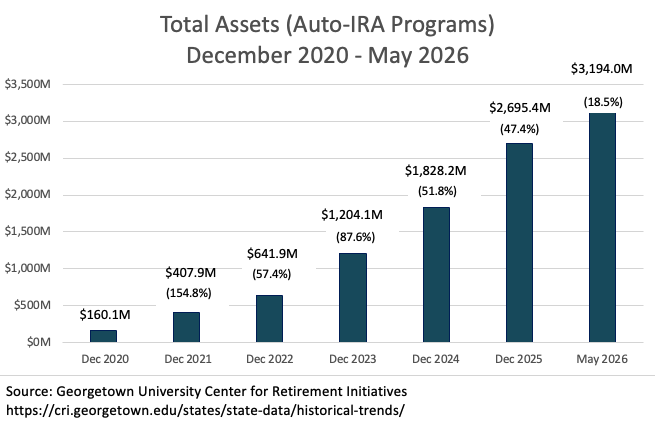
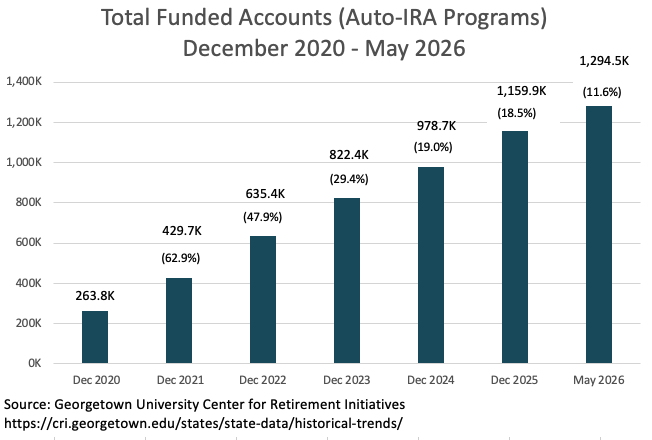
matters a whole lot more." | | State Auto IRAs: The Score | | The latest data, courtesy of Angela Antonelli and the Georgetown Center for Retirement Initiatives. A big thank you to Angela and the CRI team for their ongoing tracking and data sharing. SPECIAL NOTE – these results now include New York Secure Choice! (Well done, New Yorkers ❤️). You can find and follow New York’s progress on the CRI site here. | |
- $3 billion+ in total assets — and growing. It took the states 6 years to reach $1B, 18 months to $2B, and 11 months to $3B.
- 1.23 million funded saver accounts as of May 2026 — up 71,000 from year-end 2025, up 20% from a year ago.
- We count 23 programs launched or able to launch: 22 states + Philadelphia (enacted May 19, 2026)
- 17 programs are fully open to all eligible employers and workers. Auto IRA states: CA, CO, CT, DE, IL, ME, MD, MN, NJ, NV, NY, OR, RI, VT, VA. Plus MA (MEP) and WA (Marketplace).
-
CalSavers remains the largest program by a wide margin — $1.6B+ in assets, 629,000 accounts, 281,000 participating employers.
- Two 2026 threshold reductions: New Jersey (25 → 1 employee, enacted January 12) and Virginia (25 → 5 employees, effective July 1, 2026).
-
New York Secure Choice final registration deadline: July 15, 2026 (employers with 10–14 employees). Watch this space, and theirs, for progress.
- *and* Woot Woot 📣– Philadelphia’s PhillySaves! Newest on the Auto IRA board. This is cool: Philadelphia Voters Overwhelmingly Approve the Creation of the Phillysaves Program During The May 19 Pennsylvania Primary. board approved by voters May 19, 2026. Contributions begin July 1, 2027. When launched, Philly’s will be the first city-based program. We’ve heard some cool terms lately. Geofencing, anyone? Well as you know we prefer not to fence; perhaps a success in Philadelphia will serve as a beacon statewide.
| | Retirement Security, Social Security and ... Babies | | |
We don’t think you’re going to read this one anywhere else this week.
Recent travels have taken us to some of the countries, where – like ours – populations are aging and population replacement rates are falling.
On the island of Crete, someone sitting beside us said that the population swells by 90% during tourist season. Exaggeration? It didn’t feel like it. And that’s a good and a bad thing. Cretan businesses crowd the busy harbor of Chania while visitor money spills in to shops and restaurants. Small family farms operate produce and honey stands, and create experiences just for you. And if you take a boat to a nearby swimming beach, the crew will urge you to buy local products at every opportunity. Because they are dependent on you. By some measures more than half of Crete’s GDP comes from tourism.
In Tokyo, Kyoto and Osaka you will experience big, beautiful, well-organized cities with lots of local and national industry and … tourists. Everyone we know has been or is going to Japan this year. Despite this 😂, tourism contributes an important but much lower 1.2% to Japan’s GDP. Population aging is instead a much bigger factor in local economies, leading to some of the same impacts you see in Greece, Italy and elsewhere. Big cities are booming. Outlying areas—many of them—are experiencing dramatic depopulation. We ran across this sad-spiring short doco piece—Why Does Japan Have 9,000,000 Abandoned Homes? –- worth a watch.
Both countries are concerned and focused on population size, and on stemming or slowing its decline. In Japan, national strategic planning includes approaches and incentives around both immigration and birthrate. Greece is taking a different tack – strengthening borders, holding immigration down, and also investing heavily in birth and family support. In the words of Immigration minister Thanos Plevris (jump to minute 25), “Greeks are not being born. We are missing Greeks.”
Since we traveled to Greece to see Greeks and Greek culture, this caught our ear.
We’ll step carefully here because of a belief that a robust, percolating society includes both those that are born here and those that are not. But the concept of supporting parents and families in ways that work for them makes sense to us.
So, what does this have to do with the US?
We won’t go deep on this, but the Social Security Administration’s 2026 Report highlighting the 2032 Trust Fund reserve depletion is garnering plenty of headline space. As it should. We are confident that—at the last possible minute—our legislators will take action on an optimal set of changes that will adjust funding and benefits to new sustainable levels. (Here’s one view)
At the heart of it though, we soon won’t have enough workers to support the current level of committed benefits. And—not a sole factor, but closely related and a contributing factor—is our birth rate.
So, should it be easier to have and raise a family in the US?
Kathryn Anne Edwards is one of the economists who thinks it should be. You’ll find many clips of her perspectives on paid family leave, child care tax credits and more online.
Ours today in RSM is going to be an incomplete commentary because we are just starting to think about it. But the link between families and workforce is strong, and the link between workforce and Social Security is very strong. And the link between Social Security and retirement security? Critical.
Are we stretching these links too far? Let’s all think about it.
And on that note, we asked our friend Claude/Claudia for some input. We liked what it found and we share it for your reading pleasure.
Retirement security matters! / Lisa
| | |
Hand-picked cool stuff. Light but not fluffy.
5. Our friend Catherine Harvey asks – how could the Saver’s Match go viral? It’s an excellent question and about to be very timely. #leanin
4. It’s a hot hot policy summer. The Georgetown Center for Retirement Initiatives hosted its Annual Policy Forum this month. You’ll see speakers and highlights on LinkedIn – and watch this space for a recap soon.
3. We love wealth-building savings. And we loved this announcement focusing on foster kids and their Trump Accounts. Yes. Yes. Yes. More please.
OK here’s the fluffy stuff.
2. An Indian perspective – we appreciated two views in each of these books. Coming along at a deliberate pace is The Reading List by Sara Nisha Adams (2021) – was it designed as a teen read? We don’t know but we liked it. Following quickly on its heels was A Suitable Boy by Vikram Seth (2021) – and we’re linking to this version because … hey, cool narration and sound effects.
And, our #1 summer read for those sunny Japanese days is Convenience Store Woman by Sayaka Murata (2016). Did we read it while browsing in and out of Japan’s unique and delightful convenience stores? Yes we did. 🎎
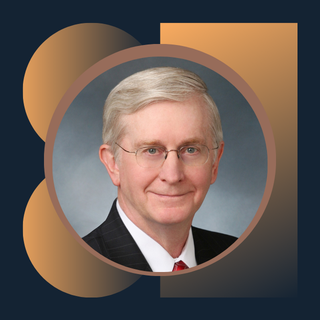
| Pix of the Week! Let's have a little fun. | | We love to share day-in-the-life photos of our guest experts. When we asked Jack VanDerhei about his, he said, if I gave you one all you would see would be clouds. Data clouds. So that got us thinking and we had a little fun with our local AI. Jack, we hope you approve. | | In our last edition we shared some knitting—ocean series style, beachside. We’re happy to share that knitting project #1 is done ✅. Woohoo! Here’s a peek at the finished piece. If You Knit, You Know what’s going on here … | | We would be remiss if we didn’t thank our two on-site office assistants for their support in the production of RSM Ju. Soooooo Helpfullllll. #Harry and #Anna | | |
That’s it for this edition. ❤ Hug your people and change the world.
| | |
Massena Associates provides process, policy, and implementation consulting on retirement savings programs and products.
Our clientele includes public entities, policy organizations, and private sector providers. Our specialty – efficient, targeted results. We are an active speaker on retirement security topics, including state-facilitated programs, MEPs and more.
If you’d like to explore working together, we welcome the conversation. Connect with us here, and at 339-236-0684.
| | |
Looking for a great retirement savings innovation resource? The Center for Retirement Research at Boston College develops and hosts terrific content and proprietary research related to states, financial security, social security, and more.
The Defined Contribution Institutional Investment Association (DCIIA) is dedicated to enhancing the retirement security of America’s workers. To do this, DCIIA fosters a dialogue among the leaders of the defined contribution community who are passionate about improving defined contribution outcomes. DCIIA's site provides a range of public and member-specific resources.
The Georgetown Center for Retirement Initiatives, Led by Angela Antonelli, GCRI provides excellent information on state-based and other retirement security innovation and policy.
Pew’s Retirement Savings Project studies the challenges and opportunities for increasing retirement savings and is another great resource - check out the work of John Scott and his terrific team.
If you want a great source of broad-based, consumer-focused retirement news, Jeffrey H. Snyder’s The Morning Pulse is your ticket. You can subscribe here.
| | | | |