RETIREMENT SECURITY MATTERS

A forum for retirement innovation information sharing

focused on states, supporters, and service providers.

Vol 76 | April 6, 2023


Greetings!  Lisa, welcome to Retirement Security Matters – where we talk about retirement readiness innovation by states, supporters, and service providers. 

Friends – It's our favorite time of year - April is Retirement Security Month! Grab your coffee and join us to sharpen your insights and information. Here's a sampling of what's going on locally, and in a few other parts of the world:  


  • Jasper Forum's John Mitchem and Jorik Van Zanden: cultural differences impact retirement thinking in the Eurozone, Australia, and the US
  • Frrresshhhh state metrics - closing in on $750 million
  • Key updates from California, Colorado, Massachusetts, Minnesota and North Carolina ... and we're saving some goodies for the next edition
  • Are Millennials getting a Watered Down Deal ?
  • Hot Sauce and Cool Stuff
  • … and Pix of the week! 

Comments or content suggestions? We welcome both. Have something about your program you’d like to share? We are all ears.

 
Your Logo 2.jpg

RSM wants your support! Be seen.

Click to grab this space for your brand.


Culture Matters: Retirement Thinking US, Australia and Eurozone-style

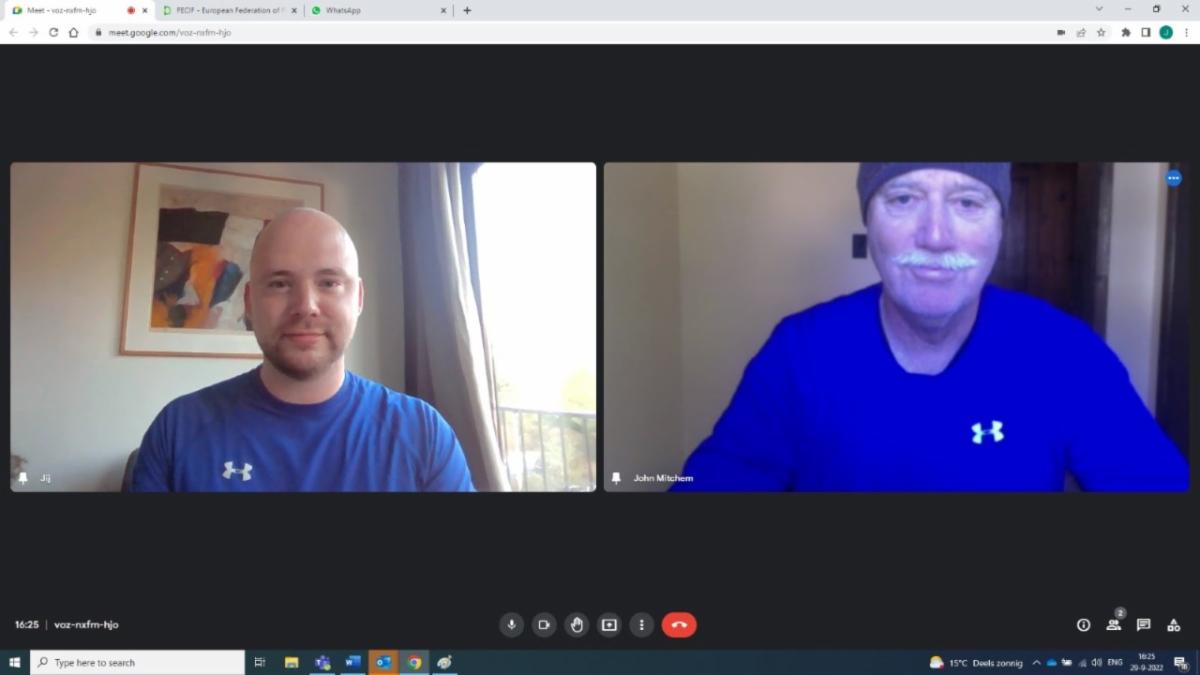
John Mitchem, Vice President & Executive Director, Financial Security Program (left) and Jorik Van Zanden, Director & Project Director, Retirement Savings Initiative, Financial Security Program (right)

Today we are here with John Mitchem and Jorik Van Zanden. We're going to talk about one thing only: what are the cultural differences around retirement thinking in the Eurozone, Australia, and the US. With a dollop of what that means for retirement outcomes.


Let’s jump in! This is an excerpt. The full piece can be found here.


Kicking us off with the Eurozone. What the heck is going on in France right now and why?


Jorik: Yes, in France the retirement age has always been a sensitive issue, and considered a right for many. In the midst of democratic changes and changing economic realities, Macron has reignited the plan to increase the retirement age and reform the retirement system. You might remember this was in part the reason for the Gilets Jaunes (Yellow Vests or Jackets) protests taking Paris to ashes a few years back.


This reform is necessary, and I think everyone knows it’s necessary, because approximately 15% of France’s GDP goes toward state pensions. That, in combination with an aging society and the burden of healthcare, is absolutely unaffordable. But that does not mean it’s easy to change. Many French people regard their pension as a right. Any interference is seen as a hefty impairment of their accrued rights.


John, you were in France during the Yellowjacket protests.


John: Yes, I was there. Culture influences how you feel about retirement, and the retirement funding experience you have informs the culture.


It’s about much more than what year you retire. In continental Europe, pensions are considered a right. The pension age situation in Paris today is very symbolic and emblematic of how the French feel about themselves, their role in France, and the role of France in the world. It's big.


How bad is it to work an extra two years?


Jorik: It may not appear to be much of a loss, two years from age 62 to 64. But that's also highly dependent on what kind of economy you have. We had a similar shift in the Netherlands going from age 65 to 67. But that's very easy for a country which is also the market leader in part time work, and extremely service oriented. So in France, those two years in combination with very high unemployment among the elderly is a different thing.


Many of these issues go back to just before Second World War, where, for example, Germany chose the Bismarckian model, which basically aims to protect against relative poverty. It assumes that the more you earn during your lifetime influences on how much you need after retirement.


Other countries like Netherlands and the UK chose the Beveridge model, which focus on absolute poverty protection.


Crises make great political tools. Gentlemen, let's hop over to Australia and talk about their model.


John: Australia is a country with pensions funding at 150% of GDP and a universal, mandatory participation, funded defined contribution retirement system. Every worker in Australia has a superannuation account, which is in contrast to the US where only 55% of people have a 401(k) type of account, and in Europe where no one has a similar retirement account.


Jorik: What's really unique about the Australian system is that there is a real spirit of engagement and positive feeling about retirement prospects. People own these assets, and there's an interesting conversation about the future of super. The conversation is creative and focused on using these assets during people's lives for housing, healthcare, education, infrastructure, and energy transition.


Do you think we can ever have these sort sof characteristics in the US?


John: It's possible. We're getting there with the rise of Auto IRA programs, parallel to the 401(k). In a generation, we could extend workplace savings coverage from 55% to maybe 75%.


My head explodes because we want it faster! [keep reading HERE]


For those who aren’t (yet) involved, what is the Jasper Forum?


John: Jasper Forum is a discussion group of practitioners, academics, policymakers and friends from all over the world. We just do defined contributions. The construction of these systems and how these tools can work, and the lessons we can learn from the variations we see between these systems around the world.


Very valuable, very important efforts. I do think there's a lot to be learned. Thank you John Mitchem and Jorik Van Zanden both for taking time to share your expertise today. We appreciate it!


Want more? You can connect directly by email: John Mitchem and Jorik Van Zanden. You can learn more about Jasper Forum on Twitter: @jasperforum


John Mitchem, Principal of JM3 Projects, has worked in journalism, public policy and the financial industry. After two decades with the United Nations and the State Street Corporation, he founded JM3 Projects to provide strategy development and thought leadership projects for financial firms, consultancies, trade associations and NGOs. John collaborated with Bob Reynolds and the team from Great West/Empower/Putnam on the book “From Here to Security: How Workplace Savings Can Keep America’s Promise” (McGraw-Hill Professional).


Jorik van Zanden, is a consultant at AF Advisors in Rotterdam and researcher at Utrecht University. Jorik worked at the European Parliament as a legislative aid to Sophie in ’t Veld where he worked on the Pan-European Pension Product legislation. After his time in Brussels, he moved to Fidelity International as a pension and public policy specialist and was involved in setting up FILs pan-European pension solution. In addition to working on his PhD he has consulted with many large financial firms and central banks, mainly on legislative and business development issues. Jorik has published on a variety of pension and retirement issues.


In 2022, John Mitchem and Jorik van Zanden launched Jasper Forum – a discussion group and think tank focused on the development of defined contribution savings systems worldwide.

 
*Fresh!* State Auto IRA Program Metrics

What’s up! March figures are rolling in.


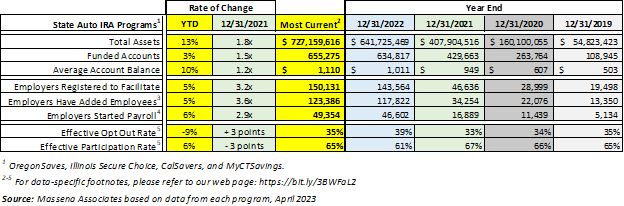
Saver assets are still up 13% year-to-date and 1.8x since December 2021 to $727 million. Average account balances remain just over $1,000. Longer term balances are higher.


The four programs shown here now aggregate to over 655,000 funded accounts. For comparison, funded accounts are up 1.5x since December 2021, up about 2.5x since December 2020 and up about 6x since December 2019 – and up in 2023.


Over 150,000 employers are now registered to facilitate a state Auto IRA. Of that number, more than 49,000 have begun forwarding payroll contributions for savers. 

 
State Facilitated Retirement Programs - Fresh Highlights
I M P L E M E N T I N G

California (workforce 19.2 million) – The CalSavers Retirement Savings Board has issued proposed rules a notification of proposed rulemaking action of regulation amendments to conform with the changes made to statue though passage of Senate Bill 1126 - changing the CalSaver Program eligibility o employers include business with as few as one employee. The written comment period will close May 8, 2023. You may review the initial statement of reasoning and text of regulations amendments on the Program website here.

Colorado (workforce 3.2 million) – The Colorado SecureSavings Program Board met on March 28, 2023. The agenda included an update from Executive Director Hunter Railey and team on program updates followed by an enrollment overview. Also included on the agenda was a presentation on investment updates by Segal Marco Advisors. At the meeting, the Board approved the 2023 Colorado SecureSavings Program annual report, now available online here. 


The report provides a concise overview of key milestones such as the procurement of program administration and investment services, development of program rules, and outreach/marketing strategy, as well as approval of a multisate partnership governance framework, successful testing of the current platform and launch of the Program in January 2023. 

Massachusetts (workforce 1.6 million) – The Massachusetts CORE Plan Statutory Committee met on March 14, 2023. As a refresher, this program is a multiple employer plan targeted specifically to non-profits with 20 employees or fewer. The agenda included a Q4 2022 CORE investment review from Aon Investments, and a broader program update from Empower Retirement that included social media marketing and outreach strategy development.

A C T I V E - Selected Updates


Minnesota (workforce 3.1 million) - In support of the recently introduced Secure Choice Retirement Program Act, the Pew Charitable Trusts explores the legislation in this great op-ed.


North Carolina (workforce 5.1 million) has introduced HB 496, the North Carolina Work and Save Program Act. The legislation describes a voluntary IRA program and provides administrative duties and powers to the State Treasurer regarding such program. "An estimated 1.7 million North Carolina working families, including employees, independent contractors, and the self-employed, have no access to an employer-sponsored retirement plan or program or any other easy way to save at work," the bill states. For more information see related coverage by Plansponsor and Pension & Investments (subscription may be needed to view this piece).


C O M I N G  U P


  • Maryland (workforce 3.2 million) – The next meeting of the Maryland$aves Board is scheduled for May 1, 2023.


  • Oregon (workforce 2.2 million) – The next meeting of the OregonSaves Board is tentatively scheduled for May 16, 2023.


  • Virginia (workforce 4.3 million) – The next meeting is tentatively scheduled for May 24, 2022.


The Watered Down Deal

Joel Metlen brings us an unvarnished Millennial perspective this week. *Must Read*


When I was thinking about what to write this today, I asked ChatGPT for some ideas, because if nothing else, it’s entertaining to see what it comes up with. The AI’s first suggestion was a blog post about, “The importance of starting early: Tips for millennials to save for retirement.”


I rolled my eyes immediately and not just because I’ve seen a million of those types of posts over the years. I believe I count as an “elder millennial,” and at 42 years old, I don’t think recommendations like “save early” are helpful at this point, mid-career. But putting aside the fact that ChatGPT incorrectly assumes “Millennial” is a synonym for young people, I also am not a big fan of overly simplistic advice like “save early.”

More Here

More to come! /  Joel


Columnist and Senior Associate Joel Metlen is based in Oregon. Joel is a pioneer of the state facilitated retirement savings space, woven into a career of public service and innovation. At OregonSaves, Joel’s responsibilities ranged from marketing and employer engagement to operations and data analysis. You’ll see his insights from that experience, and more, here.

Hot Sauce! Cool Stuff

Coming Up: All of these gatherings will include a focus on the retirement savings ecosystem, innovation by long-term and new contributors, and are worth your time. Note, some of these organizations fund their work through membership and membership may be required to participate; again, worth a look:


We’ve got a bit of a global focus today so we thought you’d like this new research piece by Noel Asiones citing Sita Slavov and others: On Second Wind: Understanding How Academics from the Philippines Adjust to Retirement. We know you’ll read it, but here are a few quick highlights with parallels in the US. #meaty!. We are both quoting and paraphrasing.


  • retirement prep programs should consider a range of factors that affect the transition from work to retirement, and support advance planning by individuals and their employers; a good process helps ease the transition at work and empowers new retirees to get a second wind for their “third chapter”
  • retirement intentions vary - and retirement is a psychological process of identity transition and search for meaning - it’s a recursive process of intentions, actions, and outcomes
  • members of married and partnered couples don’t think about retirement identically, even in the same household


In our ears. The Autobiography of Calvin Coolidge, whose wife loved baseball almost as much as we do and was probably a Red ⚾ Sox fan cuz she was from New England. One biographer says of Coolidge that (we paraphrase) he was a perfect man for the age because he was good at doing nothing. But there’s much more to Coolidge than that. He brings a very clear philosophy to the role and is committed to fiscal soundness – an approach we could all benefit from. We’re listening to this on Audible and #werecommend. It’s short, and good.


And here’s your cheeky tiktok for today. Supercheeky.


Finally, just for fun: Astonish yourself with this absolutely gobsmacking image of the Sun. The combined data from over 90,000 individual images was jointly processed to reveal the layers of intricate details within the solar chromosphere.


That was gobsmacking - how about some PIX!

It’s a new world. Our friends John and Jorik have been working hard on Jasper for years – communicating daily – and they have yet to meet in person. #itsavirtuallife


They do, however, have some great pix to share. They call this one, That weird day we were wearing the same shirt …

You can check out any time you like, but you can never leave. 🎵


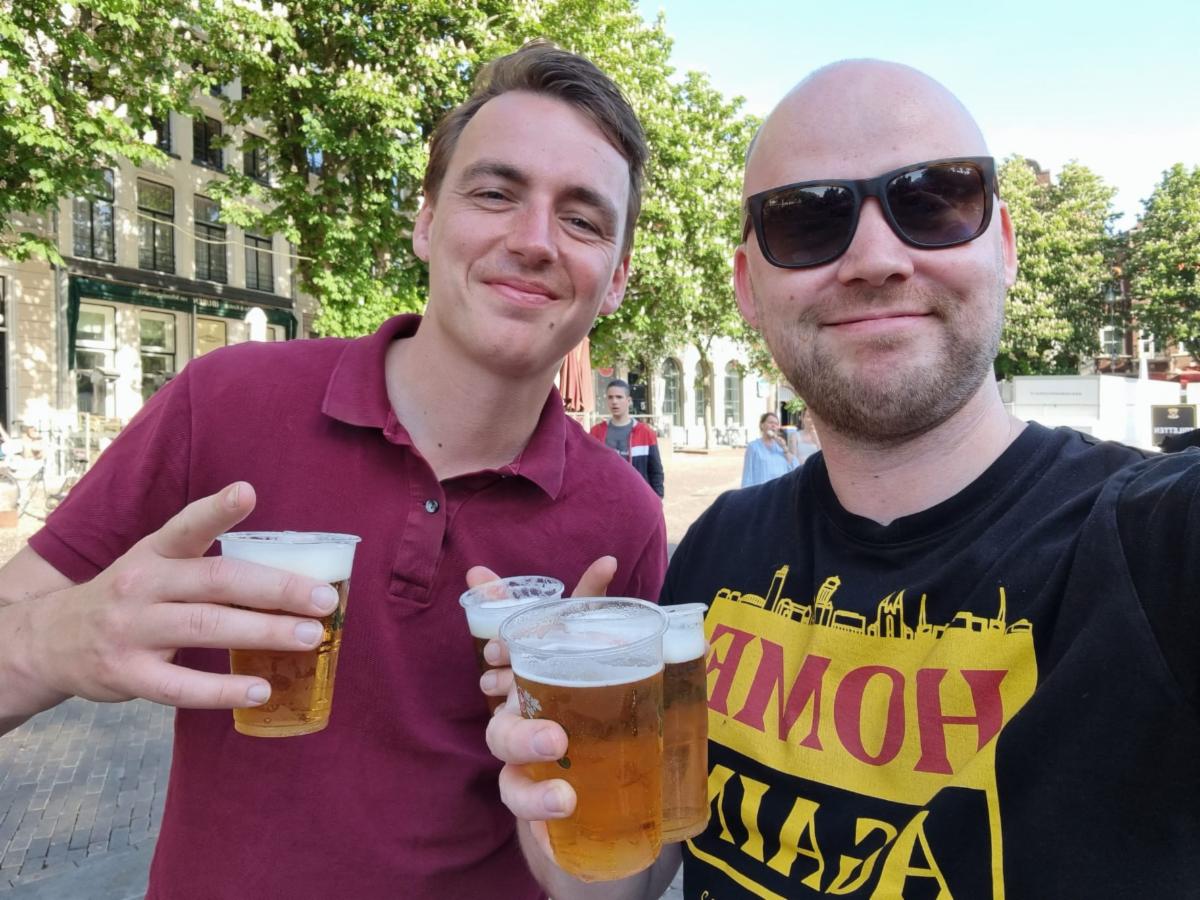
Jorik is seen on the left enjoying a cold beer at the bar, and on the right celebrating their soccer team, the Go Ahead Eagles. ⚽

and … is it my imagination or are we having a late spring? Snapped just days ago on Mount Hood. We gotta work on our selfie skillz.

That’s it for this edition. ❤️ Hug your people and change the world.


If you like this piece, please stick with us. We’ll be back in about two weeks. If you don’t like it, please unsubscribe below. Comments for us? Please let us know. Want your own subscription? Request one here. All information shared is from public sources or used with express permission.

Massena Associates provides process, policy, and implementation consulting on retirement savings programs and products.

Our clientele includes public entities, policy organizations, and private sector providers. Our specialty – efficient, targeted results. We are an active speaker on retirement security topics, including state-facilitated programs, MEPs and more.

If you’d like to explore working together, we welcome the conversation. Connect with us here, and at 339-236-0684.
RESOURCES you can use:

Looking for a great retirement savings innovation resource? Led by Dr. Alicia Munnell, the Center for Retirement Research at Boston College develops and hosts terrific content and proprietary research related to states, financial security, social security, and more.


The Defined Contribution Institutional Investment Association (DCIIA) is dedicated to enhancing the retirement security of America’s workers. To do this, DCIIA fosters a dialogue among the leaders of the defined contribution community who are passionate about improving defined contribution outcomes. DCIIA's site provides a range of public and member-specific resources.


The Georgetown Center for Retirement Initiatives, Exec Angela Antonelli, provides excellent information on state-based and other retirement security innovation and policy.


Pew’s Retirement Savings Project studies the challenges and opportunities for increasing retirement savings and is another great resource - check out the work of John Scott and his terrific team.


If you want a great source of broad-based, consumer-focused retirement news, Jeffrey H. Snyder’s The Morning Pulse is your ticket. You can subscribe here.

 
Subscribe
Linkedin  Twitter