|
RETIREMENT SECURITY MATTERS
A forum for retirement innovation information sharing
focused on states, supporters, and service providers.
Vol 71 | January 26, 2023
| | |
Greetings! Lisa, welcome to Retirement Security Matters – where we talk about retirement readiness innovation by the public sector, private sector, and policy organizations. | |
Happy Late January, friends! Is it just us or is the year already speeding by? There's a lot going on in the world of retirement savings innovations. Warm yourself up with a steaming cup of something (did you know Jan. 31 marks National Hot Chocolate Day?) and read on:
-
Treasurer Michael Frerichs on Illinois Secure Choice at Five – Wow!
-
Key updates from California, Connecticut, and Maine
-
Our first Correction (certainly not our first mistake though)
-
A hot take on SECURE 2.0 - key features of the Saver’s Match
-
Hot Sauce and Cool Stuff – Always an audience favorite!
-
Swearings-in and more in Pix of the week
| Comments or content suggestions? We welcome both. Have something about your program you’d like to share? We are all ears. | |
|
RSM wants your support! Be seen.
Click to grab this space for your brand.
| |
Illinois Secure Choice at Five: $100 Million and 100,000 Savers | | |
|
|
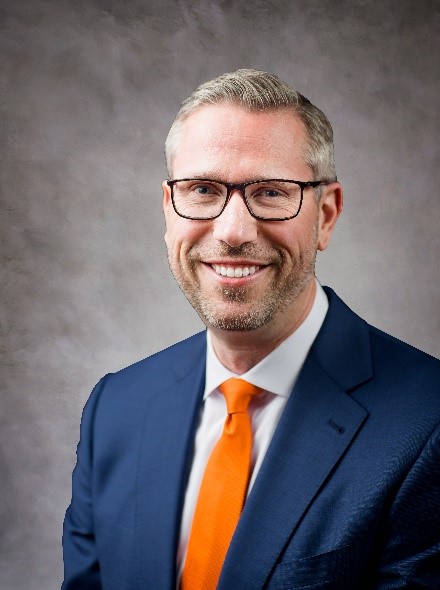
This week we have the pleasure of chatting with Michael Frerichs, Illinois State Treasurer. Frerichs (pronounced FREH-ricks) was an active proponent of the Illinois savings program before it passed the State Legislature in 2014.
As Treasurer he’s had a chance to see it through from earliest days to a coverage reach of nearly 2 million workers.
This is our summary. Join our full conversation here.
| |
|
Michael Frerichs
Illinois State Treasurer
| |
Illinois Secure Choice is five years old! Let’s talk about what this means and what’s coming next.
It feels great. We're really excited because as of early January we have more than 116,000 saver accounts, savers are adding a total of $3 million to their accounts every month, they’ve saved about $100 million so far, and we have more than 9,300 registered employers covering every county in the state (Illinois is home to 102 counties). As someone who grew up in a small town in downstate Illinois, I'm very excited to see that we're covering everywhere in the state.
What do you know about the savers so far?
We have savers working in many different industries that traditionally didn't offer workplace retirement savings options. This is exactly why we set up Illinois Secure Choice — to help give greater opportunities to those who have been denied them in the past.
Employers are part of this process, forwarding employees’ savings to the program – what are they saying?
Some employers worried about a state mandate and about costs. But now, after they've been up and running for a bit, almost all of them are saying it’s far easier than expected. Many say that they always wanted to offer a retirement savings option to their employees, but it was either too expensive or there was too much risk involved with it.
You are expanding the program as of late 2022. Tell us more.
Several legislators limited the program to employers with 25 or more employees. Based on positive feedback from employers and their employees regarding the ease of the program, we decided to make it available to a larger group of employees.
In 2021, we went back to the General Assembly to lower the threshold down to five employees or more. We're very excited that by the end of 2023, all employers in the state of Illinois with five or more employees should be eligible for Illinois Secure Choice.
What lessons learned would you share with states that are thinking about Auto IRAs today?
For those decision-makers looking at a state auto IRA program, the objections that many people brought up in the early days haven't been borne out.
Keep reading HERE
It's been very meaningful to extend to thousands of people an opportunity that many thought was out of reach because of what has and hasn't been done historically.
Treasurer Michael Frerichs, thank you for sharing your experience and Cheers both for your boldness, and for five years of savings into Illinois Secure Choice.
Treasurer Frerichs was born and raised in the small farming community of Gifford, Illinois. He graduated from Yale University and spent two years in Taiwan teaching English and learning to speak Chinese. Returning to Champaign County, he launched a technology business, was elected to the Champaign County Board and elected Champaign County Auditor and served as a volunteer firefighter. First elected State Treasurer in 2014, Frerichs was sworn in for the third time in January 2023. He runs an office that manages over $52 billion, with oversight for multiple state savings programs.
| |
*Fresh!* State Auto IRA Program Metrics | |
|
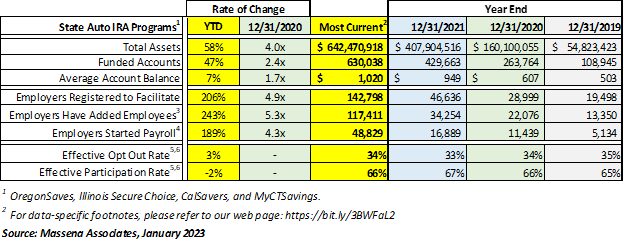
What’s up! December figures are rolling in and we are seeing an upswing in new savers and retirement savings growth. Here’s what you need to know:
Saver assets are up 58% in 2022 thus far, and 4x since December 2020, to $642 million. Average account balances are up slightly to just over $1,000. (Longer term balances are higher, but not reflected in this data).
The four programs shown here now aggregate to over 630,000 funded accounts. For comparison, funded accounts are up 47% in 2022 so far, up 2.4x since December 2020 and up about 5.8x since December 2019.
Over 142,000 employers are now registered to facilitate a state Auto IRA. Of that number, more than 48,000 have begun forwarding payroll contributions for savers.
| |
State Facilitated Retirement Programs - Fresh Highlights | |
|
California (workforce 19.2 million) – CalSavers 2022 Year in Review is out! During the course of the year, saver assets more than doubled to $373 million; the number of Californians actively saving grew by 82% to 396,000; registered employers grew fivefold to nearly 116,000. Compliance deadline for the largest group of employers and the implementation of penalties for non-compliant employers for earlier waves appear to be the essential elements of growth in 2022.
In 2022 the Board successfully advocated for legislation to expand the CalSavers mandate to employers with one or more employees, and to simplify compliance for previously mandated employers (taking effect in January 2023).
In 2023 the program has stated its focus will be on driving compliance, supporting savers, and enhancing technology and user experience. The program expects to advocate for optimal treatment of CalSavers IRA participants in the coming years relative to new provisions of SECURE 2.0, which included an enhanced federal matching credit coming in 2027. For an interesting take on CalSavers and the federal plan startup tax credit, check out the National Association of Plan Advisors (NAPA)'s recent post here.
| |
Connecticut (workforce 1.9 million) – The Connecticut Retirement Security Program Advisory Board met on January 20, 2023. Key items on the agenda included the swearing in of new board members, the Chairman’s report, and program updates. The latter included a brief overview of regulations, update on program progress, marketing and outreach update and RFPs. The MyCTSavings is growing, but not yet publishing public results data.
| |
|
Maine (workforce 674,000) – The Maine Retirement Savings Board met on January 18, 2023. Key items on the agenda included the nomination and election of Board Officers – Chairs and Vice Chair. A summary report from Executive Director Beth Bordowitz included an update on the series of requests for proposals, procurement policy, current publicity and outreach efforts, as well as upcoming legislation that will modify the date and configuration of the start of the program (one start date, no waves). The goal is to have the program up and running by April 2024. For local coverage about the program’s implementation come spring of 2024 see News Center Maine.
Also at the meeting, the Board workshopped on its mission statement. More to come! Here’s a good place to stay informed.
| |
|
C O M I N G U P
Join where you’d like, and count on us to follow these meetings for you:
-
Oregon (workforce 2.2 million) – The next meeting of the OregonSaves Board is scheduled tentatively for February 7, 2023.
-
California (workforce 19.2 million) –The next meeting of the CalSavers Board is scheduled for February 27, 2023.
| |
Stopping to Clarify Sometimes you just have to print a correction. | |
|
We’d like to start by saying Thank you to our friend Craig “Eagle-eye” Silverstein at Paychex for noticing this item and bringing it to our attention. Thank you, Craig! We send another thank you to Michael Kreps of Groom Law for his quick clarification to RSM.
How Automatic Enrollment works under SECURE 2.0. Beginning January 1, 2025, all new plans are required to use Automatic Enrollment*. Our correction is that this is true for new plans as of the date of enactment of SECURE – December 29, 2022. Automatic enrollment is not required until January of 2025, but if you start a plan after the enactment of SECURE 2.0, your plan will be required to use automatic enrollment not later than January 1, 2025. Plans established prior to December 29, 2022, are considered “grandfathered” and may use, but are not required to use, this feature.
The piece below is a hot take on the Saver’s Match. We invite you all to read closely and make sure we are getting it right!
*Except for the exceptions: a) plans of small businesses less than 3 years old, or with 10 or fewer employees b) SIMPLE plans c) Governmental and Church plans d) and plans established before December 29, 2022.
| |
Someday, Over the Rainbow: a Hot Take on SECURE 2.0 and the Saver’s Match | |
This is Part 2 in a series covering key elements of SECURE 2.0, as memorialized into law as part of the 2023 Appropriations Act (Division T) on December 29, 2022. We were still crying over our canceled flights, but it gave us plenty of time to read the Act.
In Division T alone we counted more than 40 new retirement-related provisions. We focused first on Automatic Enrollment, because it’s so impactful and we love it. This week we’ll hit the key features of the Saver’s Match – what qualifies, who gets the money, when, and where.
Saver’s Match: a few notes.
First, the name. Today we have what is called a Retirement Savings Contributions Credit (Saver’s Credit). The new provision under SECURE 2.0 is instead called a Saver’s Match.
The existing Saver’s Credit is essentially a tax credit claimed at the time of filing using Form 8880. If you claim qualifying contributions, you essentially get a credit against taxes you would otherwise owe; your tax liability goes down.
There are a lot of reasons why this credit has been discredited, if you will. Most importantly, it doesn’t do a good job of getting real financial support into the hands of the low-income saver at which it is aimed. You have to owe taxes. You have to file taxes. The funds are a sort of “invisible benefit” occurring once a year for the savings “pain” the low-income family has experienced throughout the year. And the savings aren’t refundable, so they don’t go into an account where they would naturally be retained.
We like the new refundable credit, and its Match concept, better.
Two more notes. The new Saver’s Match provision is not effective until tax years starting January 1, 2027. Meaning no actual matching funds will be flowing to savers until 2028, five years from now. The good news is that gives the Treasury and the financial services infrastructure community plenty of time to figure out how to send and receive matching funds. The bad news is that five years is a long time.
But assuming all goes to plan, here’s what we know.
| |
|
What it means in real life.
The new Savings Match makes the intended credit available to a much larger swath of working Americans, including those in families whose incomes are low enough that they are not required to file taxes. It also refunds the credit directly into retirement savings accounts.
Are there concerns with the credit? Absolutely, yes. We can think of a few:
- Five years seems like an eternity in legislative time;
- How will matching funds work in real life?;
- Treasury needs to devise ways to correctly identify eligible taxpayers and send their credits to the correct accounts; and then there is the human element related to early withdrawal of matching funds.
In whole, however, this looks like a significant improvement to support for low-income savers who are able to contribute as much as $2,000 to their retirement accounts each year.
Watch this space for more details on how this provision comes to life.
Retirement security matters! / Lisa
| |
This piece was written by Lisa Massena and the views expressed are her own. You can get your own copy of the Secure 2.0 Act as included in the 2023 Appropriations Bill here.
| |
|
Adding to our "Must-read" Newsletters list for 2023 is Allison Schrager’s Known Unknowns publication. On her recent post Notes form the inner sanctum – a pension geek goes to Davos, Allison shares thoughts from the World Economic Forum, from the most talked about issue: labor, to optimism that we will have a soft landing, or a mild recession, as inflation falls. Plus, two other big topics: AI and Inequality. Don’t miss Allison’s insights on these global elite conversations.
Conference Season Swings Again.
-
March 8, 2023 DCIIA – the Defined Contribution Investment Industry Association – will host their 2023 Innovation Forum in Charlotte. A round of excellent speakers will cover new thinking and services across multiple topics. (membership may be required)
-
We are all invited to Aspen FSP Financial Resilience Summit Virtual Kickoff on February 1, 2022. Hear from Ida Rademacher, and key leaders like Elizabeth Kelly, Special Assistant to the President, White House National Economic Council and Franz Paasche, SVP, Chief Corporate Affairs Officer, PayPal, and more, on reimagining a modernized benefits system where workplace and safety net benefits effectively support financial resilience for all. Learn more and register here.
-
If you will be at NAST LegCon in DC next month, we hope to see you there. Please save a spot for us in line when it’s time to peek into famous “Room 214” at the Watergate Hotel. We also expect we will see you the next day during the open discussion on state-facilitated retirement programs. Join the conversation #NAST2023. Learn more and register here.
If you care about employee tenure you might care about EBRI’s recent issue brief about the trends in employee tenure of American workers from 1983 – 2022. Using U.S. Census Bureau data from the Current Population Survey (CPS), this research study examines the amount of time an individual has been with his or her current employer. While some believe current American workers change jobs more frequently than was the case for past generations, the data on employee tenure show that career jobs never actually existed for most workers and continue not to exist for most workers.
But there is more, check out more insights from EBRI research:
-
Concern About Financial Well-Being Increased With Inflation. Drawing from the results of the 2022 Workplace Wellness Survey, findings suggest that since 2021, households have grown more concerned about financial well-being, with increased concerns about debt and less preparedness for unexpected financial events, among other concerns. Learn more here.
-
Workplace Retirement Plans by the Numbers. Research finds there were 142.3 million total participants in private retirement plans in 2020, representing $11.9 trillion. In 2022, 52% of private-industry workers participated in a retirement plan. EBRI's Retirement Security Research Center, breaks down worker participation and account activities in these various plans. Learn more here.
-
Webinar Alert! Wellness in the Workplace: Findings From the EBRI/Greenwald 2022 Workplace Wellness Survey. Learn more and register here.
Consider joining Endeavor Retirement upcoming webinar on January 31 at 11 am PST. John Faustino, Blaine Aikin and Bonnie Treichel will review the most impactful provisions of SECURE 2.0 from the perspective of the retirement plan advisor and consultant. While this webinar will not cover every provision of SECURE 2.0, it will focus specifically on practical considerations for advisors and their plan sponsor clients, and you will receive a brandable copy of SECURE 2.0: Complete Guide for Plan Sponsors. Learn more and register click here.
What We’re Listening. Well … Josh Cohen’s terrific podcast The Accidental Plan Sponsor and season 2 episode 5 is a NO MISS. Josh and guest co-host, Michael Kreps, discuss the genesis of auto-IRAs with two individuals from different political backgrounds who came together to conceive and promote the proposal and implementation efforts .. you guessed it! Our dear friends David John and Mark Iwry.
What We’re Reading. We are wrapping up The Bully Pulpit, Doris Kearns Goodwin. From this read William Howard “Will” Taft seems admirable for generally taking the higher road in life and in his relationships. In this read we watch Taft and Roosevelt pursue innovations like the 8-hour working day, and limitations on corporate monopolies, rampant at the time. Roosevelt’s Progressive Party – developed as a platform to enable him to run against Taft in the 1912 elections – ended up splitting the Republican vote. Democrat Woodrow Wilson won the Presidency.
Wilson ran on a planks that don’t sound that different from theirs, including a focus on labor. Wilson’s biography starts out with a list of terrific accomplishments. Until we hear that he was a proponent of segregation laws. Roosevelt himself invited only white southerners to join his Progressive Party. If we are learning anything on this tour of the presidents, it’s that there is a lot of nuance around our leadership over time.
Audio Visual. You can’t help but be charmed by Ruby from Appalachia. At minute 4:40 she talks about savings, briefly. Love it.
And your weekly dose of Three Not-So-Bad Things on Aging and Longevity with a recap on Jennifer Coolidge her first Golden Globe and Jamie Lee Curtis excitement for Michelle Yeoh. “Perhaps these wins will send a message loud and clear: your Golden Years are golden for a reason”.
| |
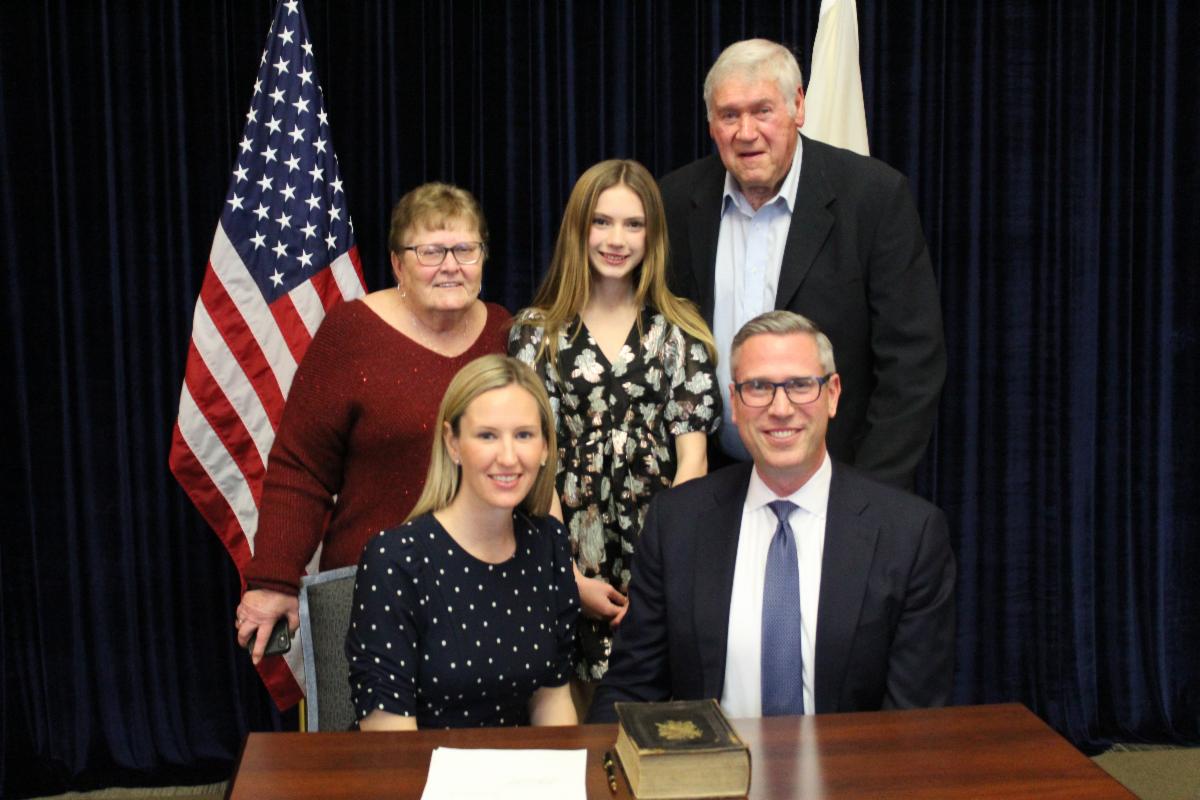
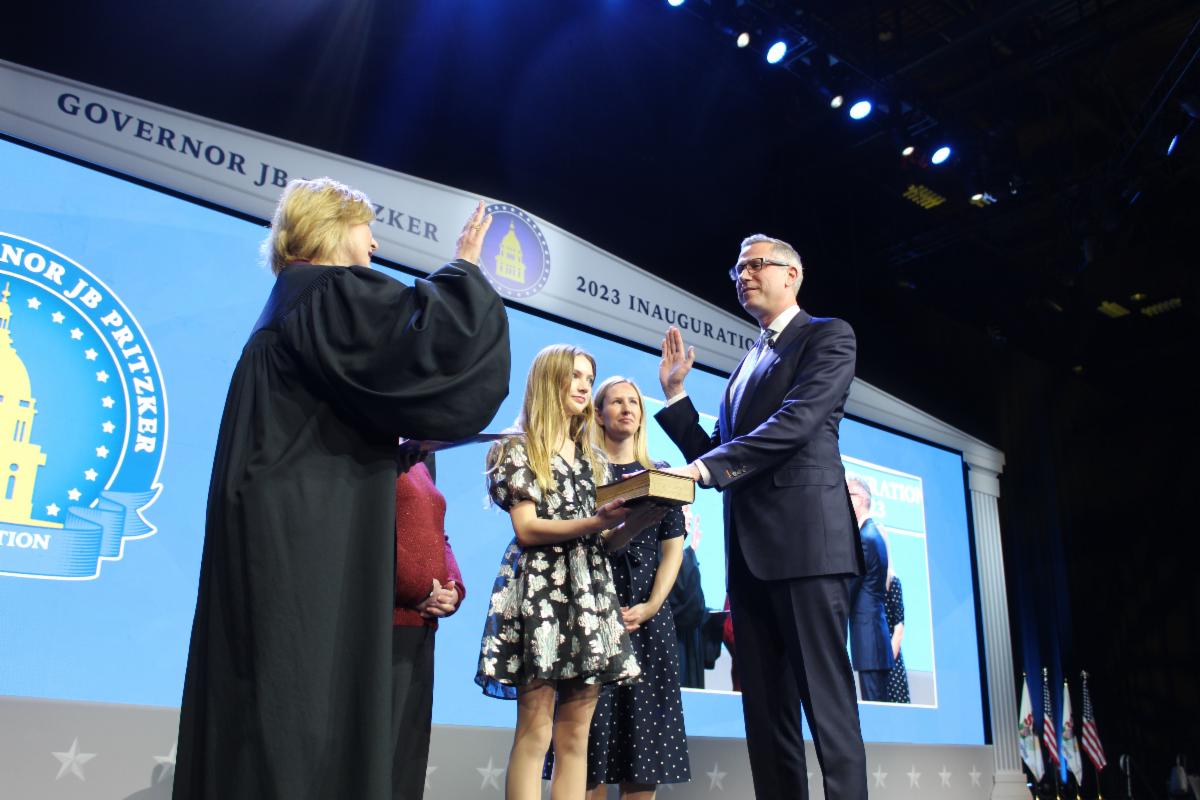
January 9, 2023, We like the family approach. Thank you to Treasurer Michael Frerichs for sharing a personal perspective on swearing-in, including his (proud) parents, his daughter Ella, and his wife Erica. | |
If you weren’t in Illinois this month, perhaps you were in DC. If you were and we had a chance to connect, it was delightful to see you. We enjoyed our coffees and our dry January mocktails, and the glass of wine you had. This is a very #busy city. | |
After that we needed some time on the other end of the spectrum. We look a little bleary, don’t we. Yep-yep-yep, you’ve got to get up early ☀️ if you want to ski with the crowds in January. | |
|
That’s it for this edition. ❤️ Hug your people and change the world.
If you like this piece, please stick with us. We’ll be back in about two weeks. If you don’t like it, please unsubscribe below. Comments for us? Please let us know. Want your own subscription? Request one here. All information shared is from public sources or used with express permission.
| |
Massena Associates provides process, policy, and implementation consulting on retirement savings programs and products.
Our clientele includes public entities, policy organizations, and private sector providers. Our specialty – efficient, targeted results. We are an active speaker on retirement security topics, including state-facilitated programs, MEPs and more.
If you’d like to explore working together, we welcome the conversation. Connect with us here, and at 339-236-0684.
| |
|
Looking for a great retirement savings innovation resource? Led by Dr. Alicia Munnell, the Center for Retirement Research at Boston College develops and hosts terrific content and proprietary research related to states, financial security, social security, and more.
The Defined Contribution Institutional Investment Association (DCIIA) is dedicated to enhancing the retirement security of America’s workers. To do this, DCIIA fosters a dialogue among the leaders of the defined contribution community who are passionate about improving defined contribution outcomes. DCIIA's site provides a range of public and member-specific resources.
The Georgetown Center for Retirement Initiatives, Exec Angela Antonelli, provides excellent information on state-based and other retirement security innovation and policy.
Pew’s Retirement Savings Project studies the challenges and opportunities for increasing retirement savings and is another great resource - check out the work of John Scott and his terrific team.
If you want a great source of broad-based, consumer-focused retirement news, Jeffrey H. Snyder’s The Morning Pulse is your ticket. You can subscribe here.
| | | | |