|
RETIREMENT SECURITY MATTERS
A forum for retirement savings innovation, together.
Vol 106 | September 17, 2026
| | |
Greetings! Greetings! welcome to Retirement Security Matters—where we talk about retirement readiness innovation by fresh thinkers, states and feds, service providers and policymakers. | |
We’re riding a wave of fall feeling and innovation momentum from here to January. Grab your Thermos and get on board 🌊 … the Retirement Security Surfboard, of course. In this edition:
-
Andrew Remo of ACLI on Making it Pay—a fresh perspective
- We’ve got State Auto IRAs -- By the Numbers
- Surfin’ USA – what’s new with the States .. and at the Federal level
- Hot Sauce 🔥 Cool Stuff
- And just for you … Pix of the Week!
Here we go.
| | View as Webpage Comments or content suggestions? We welcome both. Have something about your program or work you’d like to share? We are all ears. | Making It Pay - with Andy Remo | | |
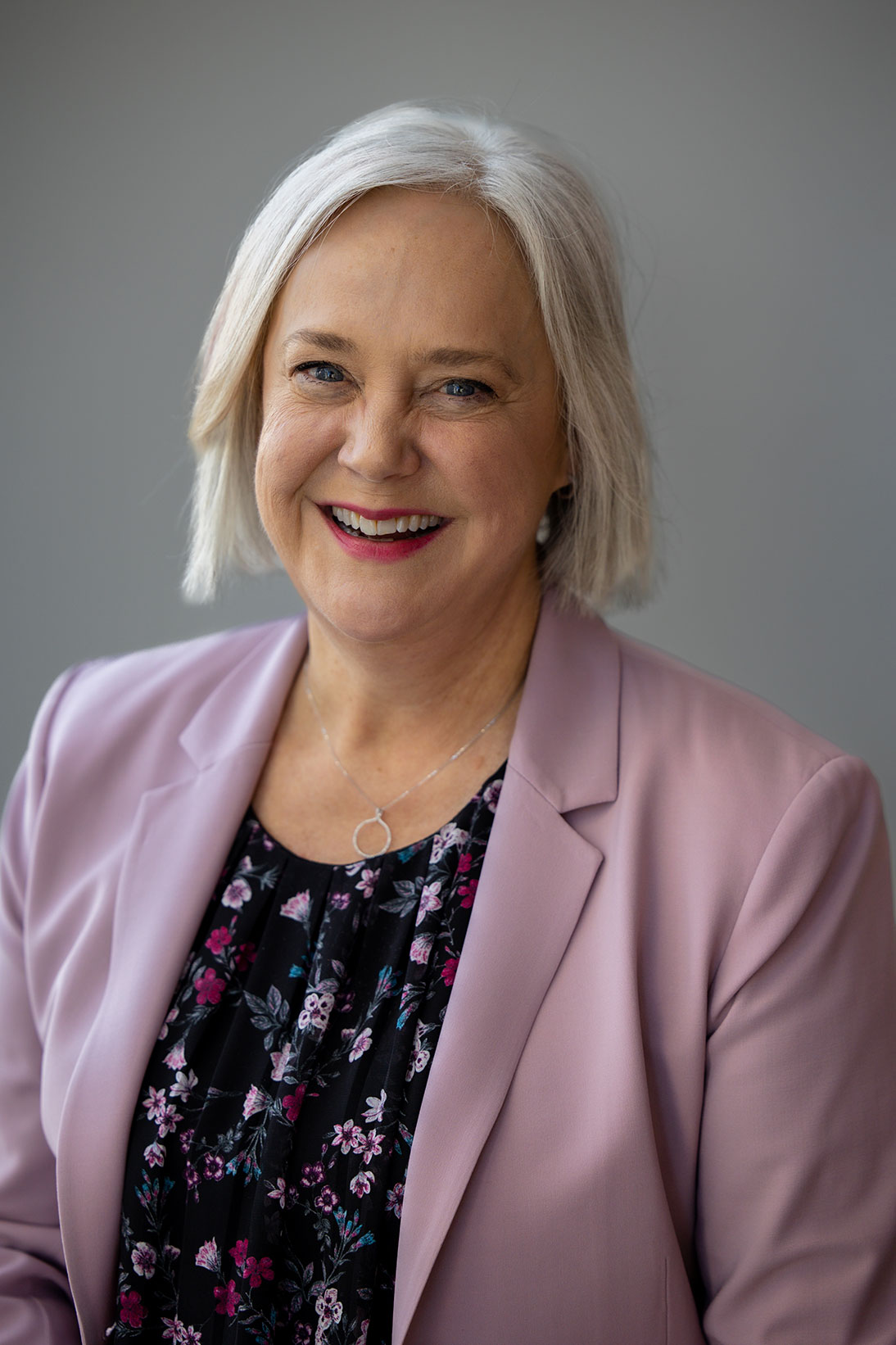
Andrew Remo knows how things get done in Washington. As Vice President, Retirement Security at the American Council of Life Insurers (ACLI), he is one of the leading voices pushing for policies that help Americans turn their savings into income they cannot outlive. Before joining ACLI in 2023, he spent more than a decade at the American Retirement Association (ARA), where he helped shape landmark legislation—including SECURE 1.0 (2019) and SECURE 2.0 (2022). Earlier in his career, he served as a Legislative Aide to U.S. Senator Benjamin Cardin. He holds degrees in Political Science from American University and an MBA and M.A. in Government from Johns Hopkins University.
Lifetime income? Don’t run from the room screaming. We ourselves struggle with this one. We needed a fresh perspective, and what better way to get one than a chat with our friend Andy? We give you some highlights below, you can catch our full convo here.
Andy, we've got that fall feeling. What's happening in your neck of the woods this month?
We're just coming back from the August recess. It's been a slower time in the retirement space. However, I've been told—and we'll see what happensat Rep. Richie Neal is going to introduce his blueprint for SECURE 3.0 as soon as perhaps this work period. (Is that so!)
We all like retirement income—especially when it comes with some certainty. In-plan annuities are one way to get this, but only a few plans are offering them. Why?
The good news is we've seen a lot of developments this decade that I think are really propelling the availability of in-plan annuities. Big asset managers are teaming up with insurance providers to offer guaranteed lifetime income solutions inside target-date funds. (Who? Find out here)
We have a need, we have growing product, and demographics are pushing us in this direction. Is there more we can do? Tell us about the work ACLI is doing.
There's definitely more to be done. ACLI has four legislative proposals aimed at embedding lifetime income tools into the defined contribution plan system.
(Get the deets)
Dream big. What does your ideal retirement security world look like?
I think we're heading toward a system where everybody is covered—either through work or through an account created at birth. Both the current administration's focus on universal coverage and the interest in creating savings accounts for every child are steps in that direction. If you don't use a Trump Account for other purposes, you can roll it into an IRA after 18 years, and that becomes your personal retirement savings vehicle that compounds over a long horizon.
What's encouraging is that both parties are genuinely intrigued by universal savings.
Reader - you’ll want to join the rest of our convo here.
On that note—thank you, Andy Remo, for sharing the view from your seat! We appreciate your perspective and insights. Like to connect with Andy and talk further? You can connect on LinkedIn or reach Andy by email here. You can follow Andy’s work here.
| | By the Numbers: State Auto IRAs Today | | |
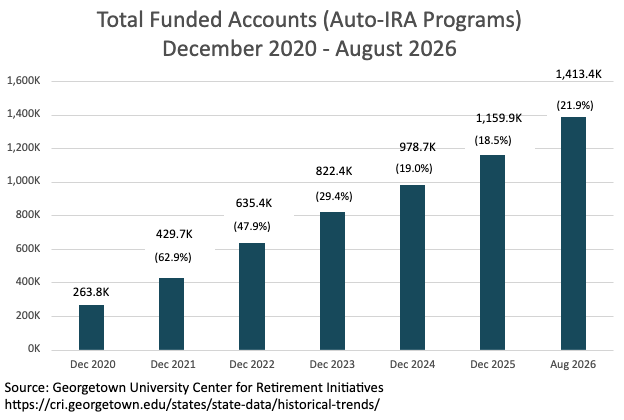
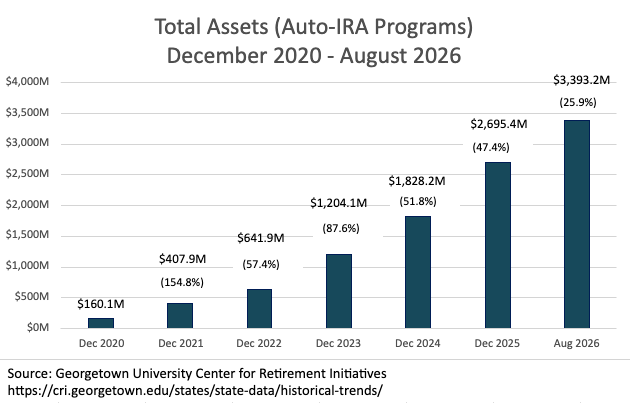
Highlights: State Auto IRA programs now hold more than 1.4 million funded accounts, and nearly $3.4 billion in assets. Let’s not forget—folks are contributing at about 5% a paycheck, and about 60 bucks each time. It’s a meaningful thing to build your own retirement balance at do-able levels, over time.
Total Funded Accounts
As of August 31, 2026, 1,413,400 workers have funded Auto IRA accounts—up over 21 percent from 1,159,900 at year-end 2025. That’s more than 253,000 new funded accounts added in the first eight months of this year. Since December 2020 when we were at about 263,800 funded accounts, the total has grown more than 5x.
| | |
Total Assets
State Auto IRA programs now hold a combined $3,393 million—almost $3.4 billion—in total assets. That’s a nearly 26 percent increase from $2,695 million at year-end 2025. Since December 2020, when programs collectively held $160.1 million, total assets have grown more than twenty-one-fold. TBH, a 5x increase in account volume and a 21x increase in assets surprises us. In a good way.
Back to the charts: year-over-year growth has been consistent and strong—ranging from about 22 percent in the most recent period to over 154 percent in 2021.
| | |
It’s hard not to notice: assets continue to grow faster than accounts. Year-to-date through August 2026, accounts are up over 21 percent; assets are up nearly 26 percent. This gap has held across every period we've tracked. The pattern suggests that workers who are already enrolled are building meaningful balances over time. The average funded account balance has grown from roughly $607 in December 2020 to approximately $2,402 as of August 2026 — ❤️— nearly a four-fold increase. Auto IRA accounts are not just growing in number. They are growing in size.
A special thank you to Angela Antonelli and the Georgetown Center for Retirement Initiatives for this data. You’ll find more detailed metrics and information on their site, here.
| | Surfin' USA—State of the States | | |
Generated with the help of our friend Claude.ai
States are making waves, of course. Cruising out for the big picture, here are a few we find relevant to both local and national conversations.
Achieving scale.
1 - At nearly $2 billion in assets and over 662,000 funded accounts, the CalSavers program has steadily lowered its costs to participants. In May of this year the program dropped its fixed account fee to $14 a year from $17. Asset-based fees also declined. Paper fees did increase, with the intent of reducing program paper costs and encouraging online engagement. (See here, scroll). These fee changes follow reductions achieved in 2025 and 2023.
2 – Multistate partnerships. Colorado’s Partnership for a Dignified Retirement, joined this year by Minnesota, now includes Colorado plus five partner states. Connecticut’s Multistate Alliance for Retirement Security now includes CT and two partner states—most recently Hawaii, alongside Rhode Island’s RISavers. Washington State could join the ranks—this August they’ve issued both a provider services RFP and a partner program RFI with an evaluation of best approach for the state to follow. Why it matters: coming together helps states shorten time to market for their new programs and provides scale benefits across partner states.
Covering more workers.
Aided by their success with initial covered employees and employers, states are lowering their thresholds and making automated retirement savings available to more workers. Oregon and California have dropped their definition of a covered employer to one employee (from five). Vermont went from five to two. Illinois and Virginia dropped theirs from 25 to five. New Jersey brought theirs down from 25 to 10+ employees.
More states (and a city) are in.
New York, as we have said, is the largest state with an active rollout in 2026. Publicly available metrics are limited, but as of its June 12 meeting, the program is showing solid early gains. Minnesota, launched in January, is currently rolling out to its Wave 2 employers (those with 50+ employees) and actively working to enroll its in-home care workers in 2027—a coverage trend we see elsewhere among the states. Hawaii is also targeting a 2026 launch. Washington State and Philadelphia are aiming for launches in mid 2027.
Model experimentation continues.
States continue to test other concepts besides Auto IRA.
Utah’s legislature has directed its state treasurer’s office to establish a retirement plan exchange by January 2027 that includes both plans and IRA accounts. This looks a little like a mashup between TrumpIRA, the Washington State Small Business Retirement Marketplace, the proposed-but-paused New Mexico Retirement Savings Plan Marketplace, and other proposals over time. This extends Utah’s experimentation in the space and follows its Small Employer Retirement Program’s 2018 tax credit. More to follow.
Missouri is working on a state-facilitated MEP (Multiple Employer Plan) for employers in the state who do not otherwise offer a plan—it is voluntary.
In the spring of this year Mississippi passed a bill to establish a state auto IRA program that would be voluntary for employers. You could argue that the current legislation is a placeholder—it’s implementation timeline isn’t until 2028.
| | Surfin' USA—the State of Everyone Else | |
Let’s start with Federal developments. Here are three we expect you are following closely, with some links to give you shortcuts to direct reads.
The Feds are hard at work.
1. TrumpIRA.gov — Executive Order 14403 (April 30, 2026)
President Trump signed Executive Order 14403 on April 30, 2026, directing the Secretary of the Treasury to establish TrumpIRA.gov by January 1, 2027. The order was published in the Federal Register on May 5, 2026. Per the White House.
TrumpIRA.gov will be an informational platform listing private-sector IRA provider products and offering comparative information. Products meeting standards for quality and cost will be highlighted on the platform; all products listed, whether highlighted or not, will accept the federal Saver’s Match. The platform’s primary purpose is helping workers without employer-sponsored plans and who are not otherwise covered—independent contractors, self-employed workers, small business employees—access and compare IRA options and learn about the Saver's Match.
The EO does not preempt state Auto IRA mandates. It is additive — workers subject to state Auto IRA requirements are still covered by those mandates, and TrumpIRA.gov does not provide employers or workers an off-ramp from state programs.
2. Saver's Match — Notice 2026-48 (August 7, 2026)
On August 7, 2026, Treasury and the IRS released Notice 2026-48, a 41-page guidance document announcing intent to propose regulations for the federal Saver's Match program. This is the most significant retirement savings implementation guidance of 2026. Comments are due October 5, 2026.
Key parameters of the Saver's Match:
- Replaces the Saver's Credit beginning with the 2027 tax year.
- Federal matching contribution: 50% of up to $2,000 in qualified retirement contributions = max $1,000/year for individuals; $2,000 for married couples.
- Income limits (2027): Single filers with MAGI ≤ $20,500 qualify for the full match; phases out completely at $35,500. Joint filers: full match ≤ $41,000; phases out at $71,000.
- The match goes directly INTO a retirement account—it is not a tax credit at filing time.
- First match payments expected in 2028 (based on 2027 contributions filed).
- The match can be deposited into traditional IRAs, 401(k)s, 403(b)s, and governmental 457(b)—but NOT into Roth IRAs—unless it is received in the form of a rollover
NOTE: The conduit IRA/Roth conversion path is a potential approach to allow Saver’s Match funds into State Auto IRA accounts—where many eligible savers will be found.
SIDEBAR: Charitable contributions to (Auto) IRAs: Notice 2026-48 asked for comments on whether philanthropic/charitable organizations could contribute to IRAs on behalf of eligible workers—a novel concept that could allow foundations and nonprofits to seed accounts for low-income workers. Verrrrrry interesting.
3. Trump Accounts (Section 530A) — Available July 4, 2026
Created by the One Big Beautiful Bill Act (signed July 4, 2025) and codified as IRC Section 530A, Trump Accounts became available for contributions on July 4, 2026. They are tax-deferred accounts for children under 18—functioning like a traditional IRA (not Roth). Children born between 2025 and 2028 receive a one-time $1,000 government seed contribution. Employers and others can contribute to these accounts and an increasing number are committing to do just that.
We’re touching on this lightly. We like these early wealth-building accounts that graduate to Traditional IRA status—our words, not those of the IRS—and benefit from multiple contribution sources before working-age contributions ever occur.
Others are hard at work too. Policymakers, researchers and advocates have a wealth of new and proposed tools to opine on, promote and evaluate right now. Watch this space for more.
| |
We’re thinking about risk today—three curations for your consideration:
1 – Risk management in an age of humans + technology: no one wants to save for retirement only to have those assets swept away in a tech-driven fraud. As suggested by Senators Warren and Wyden and reported by Emily Boyle at PlanSponsor—it may be time for stronger controls on firm-to-firm asset transfers. Especially since our data gets leaked early and often these days.
2 – “Averages hide the people at risk”—from the new WTW 2026 Defined Contribution Survey. Top line findings we like to see: “Plan design is being retooled for impact”. An acknowledgement that “Support stops before the finish line”—the transition into retirement. And interestingly, “Employers also see AI as part of the answer, in certain areas”—plan analytics, yes. Other uses, maybe/not. Data privacy and security are a big concern. Read the full report here.
3 - Risk management through a different lens. Our friends at Nest's Centre for Inclusive Money ask whether investing alongside saving, in small increments, enables more LMI families to enter the investments world. Check out their refreshed research, above. The US is conducting this experiment in different ways, including the new 530A/Trump Accounts. #globallearning
And we must bring you one palate cleanser involving 🐋whales.
3 – Is there a Sperm Whale phonetic alphabet? Sound on, and YouTube alert if you’re in the office with the volume on high. We find this fascinating.
| FINALLY ... we bring you Pix of the Week! | | A day in the life of our friend Andy Remo is never dull. Eloise heads out to her first day of 4th grade, with Maren's support. Both get to enjoy the local school's newly refurbished playground -- and a brush with celebrity royalty at the Mall of America -- it's Patrick Star. Holding down the fort at home, helpful kitties Bay and Bee brush up on the finer points of MEPs and PEPs. Good kitties!❤️ What beautiful girls and great cat-panions. Thank you for sharing, Andy. | | Fall has arrived at the little cabin in the woods. Coming soon to the forest near you: Earlier nights. Fires—the good kind. Tiny harvests. Dogs in raincoats. #Enjoy. | | That’s it for this edition. ❤ Hug your people and change the world. | | |
Massena Associates provides process, policy, and implementation consulting on retirement savings programs and products.
Our clientele includes public entities, policy organizations, and private sector providers. Our specialty – efficient, targeted results. We are an active speaker on retirement security topics, including state-facilitated programs, MEPs and more.
If you’d like to explore working together, we welcome the conversation. Connect with us here, and at 339-236-0684.
| | |
Looking for a great retirement savings innovation resource? The Center for Retirement Research at Boston College develops and hosts terrific content and proprietary research related to states, financial security, social security, and more.
The Defined Contribution Institutional Investment Association (DCIIA) is dedicated to enhancing the retirement security of America’s workers. To do this, DCIIA fosters a dialogue among the leaders of the defined contribution community who are passionate about improving defined contribution outcomes. DCIIA's site provides a range of public and member-specific resources.
The Georgetown Center for Retirement Initiatives, Led by Angela Antonelli, GCRI provides excellent information on state-based and other retirement security innovation and policy.
Pew’s Retirement Savings Project studies the challenges and opportunities for increasing retirement savings and is another great resource - check out the work of John Scott and his terrific team.
If you want a great source of broad-based, consumer-focused retirement news, Jeffrey H. Snyder’s The Morning Pulse is your ticket. You can subscribe here.
| | | | |